
Finding the right synonyms for since can be surprisingly tricky because since has more than one meaning. It can describe time, as in “I have lived here since 2020,” or cause/reason, as in “Since it was raining, we stayed home.” The best replacement depends on which meaning you intend.
For time-related sentences, alternatives such as from, from the time, ever since, and starting from may work. For cause-and-effect writing, options such as because, as, given that, considering that, and due to the fact that can be useful. Some alternatives are nearly interchangeable, while others change the sentence structure, tone, or meaning. This guide explains the differences so you can choose the most natural expression for emails, essays, business writing, conversation, and everyday English.
Quick Answer
The best synonyms for since depend on its meaning. For reasons, use because, as, given that, or considering that. For time, use from, ever since, from the time, or starting from. Some alternatives are more formal or require a different sentence structure.
Quick List: Synonyms for Since
Closest Alternatives for Reason
- Because
- As
- Given that
- Considering that
- Seeing that
- Inasmuch as
- On the grounds that
- Due to the fact that
- Owing to the fact that
- In view of the fact that
Time-Related Synonyms to Since
- From
- Ever since
- From the time
- From the moment
- Starting from
- Beginning in
- Since the time
- From then on
- Thereafter
- Subsequently
Neutral and Contextual Synonyms to Since
- Because of
- Due to
- Owing to
- As a result of
- Following
- After
- Once
- Given
- Considering
- With
Not all of these expressions can replace since word-for-word. Some introduce a clause, while others must be followed by a noun or noun phrase.
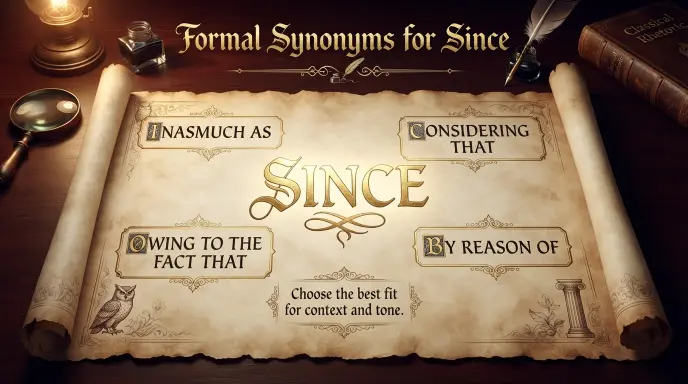
Formal Synonyms to Since
Because
Meaning: Because introduces a reason or cause.
Explanation: When since means “because,” because is usually its clearest replacement. It makes the causal relationship more direct and is often preferable when the reason is important.
Example: “Because the road was closed, we took another route.”
Best Use: Academic writing, professional communication, explanations, and everyday English.
Worst Use: It is not a replacement when since refers to a point in time.
Tone: Neutral and direct.
Given That
Meaning: Given that means “considering the fact that.”
Explanation: It presents an existing fact as the reason for a decision or conclusion. It often sounds slightly more deliberate than since.
Example: “Given that the deadline has changed, we should revise the schedule.”
Best Use: Business writing, reports, formal discussions, and analytical writing.
Worst Use: Casual conversation can sometimes sound unnecessarily formal with this phrase.
Tone: Professional and reasoned.
As
Meaning: As can mean “because” when introducing a reason.
Explanation: It is a concise alternative to causal since. However, as has several meanings, so context should make the intended meaning clear.
Example: “As the store was closed, we returned the following morning.”
Best Use: Formal and neutral writing.
Worst Use: Avoid it if the sentence could be confusing because as might be interpreted as referring to time or manner.
Tone: Neutral to formal.
Considering That
Meaning: Considering that means “taking this fact into account.”
Explanation: It introduces a circumstance that helps explain a conclusion or decision.
Example: “Considering that demand has increased, the company may need additional staff.”
Best Use: Reports, discussions, recommendations, and persuasive writing.
Worst Use: Short everyday sentences may sound heavier than necessary.
Tone: Thoughtful and moderately formal.
Inasmuch As
Meaning: Inasmuch as means “because” or “to the extent that.”
Explanation: This is a formal expression and is much less common in ordinary conversation. It can introduce a reason but may sound old-fashioned in some contexts.
Example: “Inasmuch as the agreement has expired, the parties must negotiate new terms.”
Best Use: Highly formal prose and some legal or institutional writing.
Worst Use: Casual emails, conversations, and simple explanations.
Tone: Very formal.
Seeing That
Meaning: Seeing that means “because” or “given the fact that.”
Explanation: It introduces an obvious or relevant reason. It is grammatical but often more conversational than given that.
Example: “Seeing that everyone had arrived, we started the meeting.”
Best Use: Conversation, informal writing, and narrative prose.
Worst Use: Highly formal academic or legal writing.
Tone: Conversational.
On the Grounds That
Meaning: This phrase means “for the reason that.”
Explanation: It emphasizes the stated reason as the basis for a decision, claim, or action.
Example: “The request was rejected on the grounds that it did not meet the requirements.”
Best Use: Formal reports, policy discussions, administrative writing, and legal-style language.
Worst Use: Simple everyday sentences where because would be clearer.
Tone: Formal and authoritative.
Due to the Fact That
Meaning: This means “because.”
Explanation: It explicitly identifies a fact as the cause of something. However, it is often unnecessarily wordy when because would communicate the same idea.
Example: “The event was postponed due to the fact that severe weather was expected.”
Best Use: Situations where a noun-based construction fits the surrounding sentence.
Worst Use: Short, clear writing. “Because severe weather was expected” is usually better.
Tone: Formal but potentially bureaucratic.
Owing to the Fact That
Meaning: This means “because of the fact that.”
Explanation: It expresses cause and is similar to due to the fact that. It is formal and relatively wordy.
Example: “Owing to the fact that several employees were absent, the meeting was rescheduled.”
Best Use: Formal reports and explanatory writing.
Worst Use: Conversational English and concise business writing.
Tone: Formal.
In View of the Fact That
Meaning: This means “considering that” or “because.”
Explanation: It emphasizes a fact that affects a decision or conclusion.
Example: “In view of the fact that the budget was reduced, the project will be scaled back.”
Best Use: Formal reports, official statements, and policy writing.
Worst Use: Casual communication.
Tone: Formal and official.
Semi-Formal and Neutral Synonyms to Since
Because of
Meaning: Because of gives the reason for something.
Explanation: Unlike because, it is normally followed by a noun, pronoun, or noun phrase rather than a complete clause.
Example: “The match was canceled because of heavy rain.”
Best Use: Everyday and professional writing.
Worst Use: Do not follow it directly with a full clause such as “because of it was raining.”
Tone: Neutral.
Due to
Meaning: Due to indicates a cause.
Explanation: It is commonly followed by a noun phrase. In careful formal writing, make sure the sentence clearly connects due to with the thing it explains.
Example: “The delay was due to a technical problem.”
Best Use: Business notices, reports, announcements, and formal writing.
Worst Use: Do not automatically substitute it for every occurrence of since.
Tone: Neutral to formal.
Owing To
Meaning: Owing to means “because of.”
Explanation: It identifies a cause and usually comes before a noun phrase.
Example: “Owing to heavy traffic, the delivery arrived late.”
Best Use: Notices, formal correspondence, and written explanations.
Worst Use: Casual conversation may sound slightly stiff.
Tone: Formal-neutral.
Given
Meaning: Given can mean “considering” or “taking into account.”
Explanation: It can introduce a circumstance without using the full phrase given that.
Example: “Given the circumstances, we decided to postpone the launch.”
Best Use: Professional writing, analysis, and decision-making.
Worst Use: It cannot replace temporal since in sentences such as “I have worked here since 2020.”
Tone: Neutral to professional.
Considering
Meaning: Considering means “taking something into account.”
Explanation: It works well when a circumstance provides context for a decision.
Example: “Considering the limited budget, the proposal is quite ambitious.”
Best Use: Recommendations, evaluations, workplace communication, and conversation.
Worst Use: Avoid using it when you need to identify a precise time.
Tone: Neutral.
From
Meaning: From can identify the starting point of a period.
Explanation: In time expressions, it may replace since when the sentence is reorganized.
Example: “She has worked there from 2020 onward.”
Best Use: Timelines, schedules, historical descriptions, and date ranges.
Worst Use: “From” alone does not always reproduce the grammatical meaning of since.
Tone: Neutral.
Ever Since
Meaning: Ever since means continuously from a particular past point until now or another stated time.
Explanation: It adds emphasis to continued duration.
Example: “We have been friends ever since college.”
Best Use: Personal writing, storytelling, conversation, and emotional contexts.
Worst Use: It may be unnecessary when simple since already expresses the idea clearly.
Tone: Neutral and expressive.
From the Time
Meaning: From the time identifies a starting point connected to an event or period.
Explanation: It can make the beginning of a period more explicit.
Example: “From the time she joined the team, her performance improved.”
Best Use: Narratives, explanations, and detailed descriptions.
Worst Use: It can sound wordy in simple sentences.
Tone: Neutral.
From the Moment
Meaning: From the moment means starting at a particular instant or event.
Explanation: It is more specific and vivid than since when the starting point is an important moment.
Example: “From the moment the doors opened, customers began entering.”
Best Use: Stories, event descriptions, and narrative writing.
Worst Use: Avoid it if there is no meaningful specific moment.
Tone: Neutral and descriptive.
Starting From
Meaning: Starting from identifies the beginning of a period, sequence, or process.
Explanation: It works particularly well with dates, numbers, locations, and stages.
Example: “Starting from Monday, the office will open at 8 a.m.”
Best Use: Instructions, schedules, announcements, and planning.
Worst Use: It does not normally replace since in present-perfect constructions.
Tone: Neutral and practical.
After
Meaning: After identifies something that happens later than another event.
Explanation: It may be useful when temporal since establishes a sequence rather than emphasizing continuing duration.
Example: “After graduating, she moved to Chicago.”
Best Use: Narratives and chronological descriptions.
Worst Use: It changes the relationship between events and cannot always replace since.
Tone: Neutral.
Informal and Casual Synonyms to Since
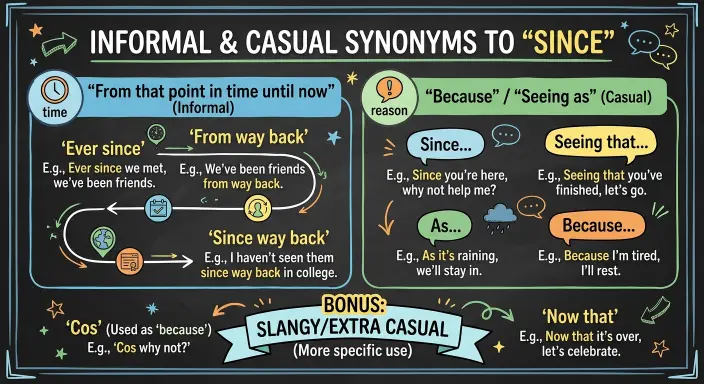
Ever Since
This is one of the most natural conversational alternatives when you want to emphasize continued time.
Example: “I’ve loved that band ever since I heard their first album.”
Natural when: Talking about relationships, memories, habits, or experiences.
Avoid when: Writing a very concise technical statement where the emphasis is unnecessary.
Tone: Friendly and expressive.
From Then On
Meaning: It means continuously from that point forward.
Example: “He apologized, and from then on, they worked together peacefully.”
Natural when: Telling a story or describing how circumstances changed.
Avoid when: You need a precise replacement for since in a present-perfect sentence.
Tone: Conversational and narrative.
Ever After
Meaning: It means from a particular point onward, usually indefinitely.
Example: “They stayed close ever after.”
Natural when: Storytelling and literary writing.
Avoid when: Writing ordinary business or academic prose.
Tone: Literary.
From That Point On
Meaning: It means beginning at a specified point and continuing afterward.
Example: “From that point on, we used a different system.”
Natural when: Explaining a change or sequence of events.
Avoid when: A simple since would be shorter and clearer.
Tone: Neutral-conversational.
Seeing As
Meaning: In informal speech, seeing as can introduce a reason.
Example: “Seeing as you’re already here, we can start.”
Natural when: Casual conversation.
Avoid when: Formal academic, legal, or professional writing.
Tone: Informal.
True Synonyms vs. Contextual Synonyms to Since
Not every expression in a synonym list has exactly the same grammatical function as since. This distinction matters especially because since can express either time or cause.
| Type | What It Means | Can It Replace the Original? |
|---|---|---|
| True synonym | Nearly the same meaning and grammatical role | Often, depending on context |
| Near synonym | Similar meaning but with a slight difference | Sometimes |
| Contextual alternative | Works only in a particular situation | Yes, after restructuring |
| Broader expression | Covers a wider idea | Sometimes, but precision may change |
| Narrower expression | Expresses a more specific relationship | Only in suitable contexts |
For example, because is a strong alternative when since means “because,” but it cannot replace since in “I have lived here since 2019.”
Likewise, ever since is closely related to temporal since, but it adds emphasis to the continuing period. Due to can express cause, but it normally works with a noun phrase rather than a complete clause.
The key question is not simply “What word means since?” Instead, ask: Is since expressing time or reason?
Business Writing
In business writing, clarity usually matters more than finding a sophisticated synonym.
For causal since, the safest choices are:
- Because
- Given that
- Considering that
- As
- Due to
- Owing to
Examples:
- “Because sales declined, we revised the forecast.”
- “Given that the deadline has moved, we will update the schedule.”
- “Due to a system error, some orders were delayed.”
- “Considering the available budget, the proposal is reasonable.”
Because is often the best choice when the reason needs to be unmistakable.
Corporate Communication
Corporate reports and internal announcements often benefit from precise cause-and-effect language.
Instead of:
“Since the supplier changed its delivery schedule, production will be delayed.”
You could write:
“Because the supplier changed its delivery schedule, production will be delayed.”
Or:
“Given the supplier’s revised delivery schedule, production will be delayed.”
The second version is useful when the sentence focuses on a business circumstance rather than simply explaining a cause.
For dates and timelines, however, keep since when it is the clearest choice:
“The policy has been in effect since January.”
There is little benefit in replacing it.
Academic Writing
Academic writing often favors because, given that, considering that, as, and other precise causal expressions.
Examples:
- “Because the sample size was limited, the findings should be interpreted cautiously.”
- “Given that the data were incomplete, the researchers excluded the final observation.”
- “As the two studies used different methods, their findings are difficult to compare.”
Avoid replacing every since with an elaborate phrase. Academic writing should be formal, but it should also be economical.
A sentence such as:
“In view of the fact that the sample was small…”
is usually heavier than:
“Because the sample was small…”
Customer Service
Customer service writing should be polite, direct, and easy to understand.
Good choices include:
- Because
- Due to
- As
- Given that
- Because of
Examples:
“Because your order was placed after the cutoff time, it will ship tomorrow.”
“Due to a shipping delay, your package may arrive later than expected.”
“Given that the item is currently out of stock, we can offer a replacement.”
Avoid expressions such as inasmuch as or in view of the fact that unless there is a very specific reason to use highly formal language.
Legal Writing
Legal writing requires special care because similar-looking phrases may not have identical legal effects. Since, because, due to, following, and after can establish different relationships between events.
For example:
“The agreement has remained effective since January.”
refers to a continuing period beginning in January.
By contrast:
“Following the amendment, the agreement was revised.”
describes an event that occurred after another event.
Do not substitute a casual synonym simply to vary vocabulary in a legal document. Where legal rights, obligations, deadlines, or conditions are involved, preserving the intended meaning is more important than stylistic variation.
Email Communication
For professional emails, because, given that, due to, and as are usually safer choices than highly formal substitutes.
Examples:
- “Because the meeting has been moved, I’m available at 3 p.m.”
- “Given that the report is due tomorrow, could you review the final section today?”
- “Due to a scheduling conflict, I’ll need to reschedule our call.”
- “As the files are still being reviewed, I’ll send the final version later today.”
If since clearly expresses time, there is often no reason to replace it:
“I’ve attached the updated figures since our last meeting.”
Here, since is concise and natural.
Email Examples
Client Communication
Subject: Revised Delivery Schedule
Hello Maria,
Because the supplier has changed its shipping schedule, your order will arrive approximately two days later than originally expected.
I’m sorry for the inconvenience. I’ll send the tracking information as soon as the shipment leaves our warehouse.
Best,
Daniel
Project Update
Subject: Project Timeline Update
Hi Team,
Given that the testing phase is taking longer than expected, we’re moving the final review to next Wednesday.
This gives us enough time to address the remaining issues without rushing the final checks.
Thanks,
Alex
Request
Subject: Request for Updated Figures
Hi James,
Considering that the budget review is scheduled for Friday, could you send me the latest expense figures by Thursday afternoon?
That will give me enough time to prepare the report.
Thanks,
Nina
Customer Service
Subject: Update on Your Order
Hello Mr. Patel,
Due to a temporary warehouse delay, your order has not yet shipped.
We expect it to leave our facility tomorrow and will send tracking information once it is available.
Thank you for your patience.
Best regards,
Customer Support
Academic Communication
Subject: Assignment Submission Question
Dear Professor Lee,
Because I have a scheduled university event on the original submission date, I would like to ask whether I may submit the assignment one day earlier.
I understand if the standard deadline needs to remain unchanged.
Sincerely,
Jordan
Internal Workplace Email
Subject: Friday Meeting
Hi everyone,
As several team members will be traveling on Friday, we’ll hold the weekly meeting on Thursday instead.
Please add your updates to the shared document before noon.
Thanks,
Maya
Short Dialogue Examples
Workplace
Person A: Why are we changing the schedule?
Person B: Because the supplier moved the delivery date.
Person A: That makes sense. Let’s update the team.
Classroom
Person A: Why did the professor extend the deadline?
Person B: Since several students had technical problems, she gave us another day.
Customer Service
Person A: Why hasn’t my package shipped?
Person B: Due to a warehouse delay, it hasn’t left yet. We’re expecting it to ship tomorrow.
Casual Conversation
Person A: How long have you known Sam?
Person B: I’ve known him ever since college.
Professional Discussion
Person A: Should we approve the proposal?
Person B: Given that it fits the current budget, I think we should consider it.
How to Replace “Since” in a Sentence
Example 1
Original: Since the weather was bad, the game was canceled.
Alternative: Because the weather was bad, the game was canceled.
Why it works: Both express cause. Because makes the reason more direct.
Example 2
Original: Since the office was closed, I worked from home.
Alternative: As the office was closed, I worked from home.
Why it works: As can introduce a reason, although because would be stronger if the reason needs emphasis.
Example 3
Original: Since demand has increased, we need more staff.
Alternative: Given that demand has increased, we need more staff.
Why it works: Given that presents the increase in demand as a fact supporting the decision.
Example 4
Original: I have worked here since 2020.
Alternative: I have worked here from 2020 onward.
Why it works: The alternative preserves the starting-point idea but changes the structure. Since 2020 is more natural.
Example 5
Original: Since Monday, the office has been closed.
Alternative: Starting Monday, the office has been closed.
Why it works: This can work in some contexts, but the meaning may shift toward identifying the beginning rather than emphasizing duration. Since Monday is usually more natural.
Example 6
Original: Since the roads were blocked, we stayed home.
Alternative: Because the roads were blocked, we stayed home.
Why it works: The causal meaning is unchanged, and because is very clear.
Example 7
Original: She has felt better since the treatment began.
Alternative: She has felt better from the time the treatment began.
Why it works: The alternative emphasizes the starting point but is considerably more wordy.
Example 8
Original: Since the meeting ended, no one has contacted me.
Alternative: Ever since the meeting ended, no one has contacted me.
Why it works: Ever since emphasizes that the situation has continued from that point until now.
Example 9
Original: Since the company changed its policy, customers have received clearer instructions.
Alternative: Following the policy change, customers have received clearer instructions.
Why it works: Following changes the grammatical structure and emphasizes sequence rather than directly introducing a causal clause.
Example 10
Original: Since you already finished the work, you can leave.
Alternative: Given that you already finished the work, you can leave.
Why it works: Given that sounds more deliberate and professional, while the original is perfectly natural in conversation.
Comparison Table
| Phrase | Tone | Meaning / Scope | Best Use | Example |
|---|---|---|---|---|
| Since | Neutral | Time or reason | General writing | Since it rained, we stayed inside. |
| Because | Neutral | Direct reason | Almost any causal context | Because it rained, we stayed inside. |
| As | Neutral-formal | Reason | Formal and concise writing | As it rained, we stayed inside. |
| Given that | Professional | Reason based on a fact | Business and analysis | Given that it rained, we stayed inside. |
| Considering that | Neutral-formal | Reason/context | Evaluation | Considering that it rained, we left early. |
| Because of | Neutral | Cause + noun phrase | Everyday and professional writing | We left because of the rain. |
| Due to | Formal-neutral | Cause + noun phrase | Reports and notices | The delay was due to rain. |
| Owing to | Formal | Cause + noun phrase | Formal writing | Owing to rain, the event was delayed. |
| Ever since | Neutral | Continuing time | Personal and narrative writing | I’ve known her ever since college. |
| From | Neutral | Starting point | Dates and timelines | From 2020 onward, sales increased. |
| From the moment | Descriptive | Specific starting moment | Narrative writing | From the moment he arrived, he helped. |
| Starting from | Neutral | Beginning point | Schedules and instructions | Starting from Monday, hours will change. |
| Following | Formal-neutral | After an event | Reports and business writing | Following the change, sales improved. |
| After | Neutral | Later than an event | Chronological writing | After graduation, she moved. |
Which Synonyms to Since Should You Choose?
For Formal Writing
Choose given that, considering that, as, owing to, or on the grounds that when they accurately express the intended relationship.
Don’t choose a complicated phrase simply because it sounds formal. Because is completely acceptable in serious writing.
For Business Communication
Use because, given that, due to, or considering that.
For example:
“Given that the deadline has changed, we need to revise the schedule.”
This sounds professional without becoming stiff.
For Academic Writing
Because, as, given that, and considering that are generally useful.
Use the shortest expression that accurately communicates the reasoning.
For Legal Writing
Preserve the original legal meaning rather than searching for a stylistic substitute. Temporal and causal expressions should not be exchanged casually.
For Professional Email
Because is usually the clearest causal alternative. Due to works well before a noun phrase, while given that is useful when explaining a decision.
For Everyday Conversation
Use because, as, ever since, or simply since.
There is rarely a reason to say inasmuch as in a normal conversation.
For Casual Messages
Keep it simple:
“Because I’m tired, I’m staying home.”
Or:
“I’ve known her ever since high school.”
Natural wording is more valuable than forced vocabulary variety.
Grammar and Usage Guide for “Since”
Since as a Conjunction of Reason
When since means “because,” it introduces a dependent clause.
“Since the store was closed, we went home.”
The same sentence can usually use because:
“Because the store was closed, we went home.”
Since as a Preposition of Time
Since can be followed by a point in time or a noun phrase.
“I have lived here since 2018.”
“She has been busy since Monday.”
It can also be followed by a clause:
“I haven’t seen him since he moved.”
Since With Perfect Tenses
Since commonly appears with the present perfect or present perfect continuous when an action or state began in the past and continues to the present.
“I have worked here since 2021.”
“She has been studying since early morning.”
Since + Starting Point
Use since for a starting point, not normally a duration.
Correct:
“I have lived here since 2019.”
Correct:
“I have lived here for seven years.”
Incorrect:
“I have lived here since seven years.”
Since + Past Event
A clause after temporal since normally refers to a past event:
“I haven’t spoken to her since she moved away.”
Punctuation
If a since clause comes first, a comma commonly separates it from the main clause:
“Since the train was late, we took a taxi.”
When the clause comes second, a comma is usually unnecessary:
“We took a taxi since the train was late.”
However, when since means “because,” some writers prefer because when punctuation or sentence structure could make the meaning unclear.
Since Can Be Ambiguous
Consider:
“Since John left, Maria has been managing the office.”
This clearly means time.
But:
“Since John was unavailable, Maria managed the office.”
Here, since means because.
When the intended meaning could be misunderstood, use because for reason and ever since/from the time for time.
Common Mistakes to Avoid
1. Treating Every Alternative as an Exact Synonym
Because, ever since, due to, and after do not have identical grammatical functions.
Better: Identify whether since expresses time or reason first.
2. Using “Because of” Before a Full Clause
Incorrect:
“Because of the meeting was canceled, we left.”
Better:
“Because the meeting was canceled, we left.”
Or:
“Because of the cancellation, we left.”
3. Using “Due to” Everywhere
Due to cannot simply replace every occurrence of since. It normally works with a noun phrase.
“The delay was due to traffic.”
For a clause, use:
“The delay occurred because traffic was heavy.”
4. Confusing Time With Cause
“Since 2020, I have worked here.”
Here, since refers to time.
“Since the office was closed, I worked from home.”
Here, it refers to cause.
Replacing both with the same phrase can produce an incorrect sentence.
5. Making Simple Writing Too Formal
“In view of the fact that the road was closed…”
may be grammatically correct, but:
“Because the road was closed…”
is clearer.
6. Using Casual Expressions in Formal Writing
Phrases such as seeing as can sound natural in conversation but may be unsuitable for academic or official writing.
7. Changing the Meaning With “After”
After indicates sequence. It does not necessarily indicate cause.
“After the meeting, we went home.”
This does not mean the meeting caused us to go home.
8. Misusing “For” and “Since”
For generally expresses duration:
“I have lived here for five years.”
Since expresses the starting point:
“I have lived here since 2021.”
9. Replacing a Perfectly Good “Since”
Not every occurrence needs a synonym. Sometimes since is the shortest and clearest option.
“I have known her since childhood.”
There is little reason to replace it with a longer expression.
When Not to Use “Since”
When the Causal Meaning Is Ambiguous
If readers could interpret since as either time or reason, use because.
Instead of:
“Since the manager arrived, we started the meeting.”
write:
“Because the manager arrived, we started the meeting.”
if arrival is the intended reason.
When a Noun-Based Construction Is Better
If the sentence already focuses on a noun, because of, due to, or owing to may fit better.
“The flight was delayed because of heavy snow.”
When a Clear Temporal Expression Is Needed
For a precise starting point, since may actually be better than a longer alternative.
“The policy has been active since January.”
When Formality Becomes Excessive
Avoid replacing a simple since with an expression such as inasmuch as merely to sound sophisticated.
When the Audience Needs Plain English
Customer notices, instructions, and public-facing messages usually benefit from familiar words such as because and after.
When “Since” Is the Most Precise Choice
If the sentence clearly communicates a starting point or duration, keeping since is often the best editorial decision.
“She has worked at the company since 2017.”
That sentence is already concise and natural.
Advanced Writer Tips
Tone Control
For a neutral tone, use since, because, as, or because of.
For a professional tone, consider given that, considering that, or due to, when the grammar fits.
For a highly formal tone, expressions such as on the grounds that may work, but they should be used sparingly.
Professional Email Etiquette
Don’t replace ordinary words just to make an email sound more sophisticated. A clear sentence such as:
“Because the deadline changed, we need to update the document.”
is usually better than a complicated formal construction.
Politeness
The alternative you choose can affect how a sentence feels.
Compare:
“Since you missed the deadline, we cannot accept the form.”
with:
“Because the deadline has passed, we’re unable to accept the form.”
The second version focuses more on the situation than on directly assigning responsibility to the reader.
Context Alignment
Match the phrase to the audience.
- School assignment: because, as, given that
- Business email: because, given that, due to
- Customer message: because, due to
- Casual conversation: because, since, ever since
- Formal report: given that, owing to, considering that
Precision
First determine the relationship between the ideas.
Is the second idea a reason, a starting point, or simply an event that happened afterward?
Once you answer that question, the correct alternative becomes much easier to identify.
Readability
Prefer a short phrase when it communicates the same meaning.
“Because the test was delayed…”
is usually better than:
“Due to the fact that the test was delayed…”
Good writing is not about using the longest synonym. It is about using the most accurate one.
Related Questions About Synonyms for Since
What is another way to say “since” when giving a reason?
Because is usually the best alternative when since means “because.” Other choices include as, given that, considering that, and seeing that. The best option depends on formality and whether you want the reason to be strongly emphasized.
What is a professional synonyms to “since”?
For a professional context, given that, because, considering that, or due to can work. The choice depends on grammar. Use due to before a noun phrase and given that before a clause.
What is a formal synonyms to “since”?
Formal alternatives include given that, considering that, inasmuch as, on the grounds that, and in view of the fact that when since means “because.” For time, expressions such as from the time may work after restructuring.
Can “because” replace “since”?
Yes, when since means “because.” For example, “Since the road was closed, we turned around” can become “Because the road was closed, we turned around.” However, because cannot replace temporal since in “I have lived here since 2020.”
Is “since” formal or informal?
Since is a neutral, standard English word. It is appropriate in casual conversation, business writing, academic work, and most formal contexts. You do not normally need a more sophisticated alternative simply because the writing is formal.
Can “due to” replace “since”?
Only in some causal sentences. Due to generally introduces a noun phrase, while since can introduce a complete clause. For example, “Since the storm caused delays” can become “Due to the storm,” but the sentence must be restructured.
What is the difference between “since” and “because”?
When they express reason, both can introduce a cause, but because usually makes the causal relationship more explicit. Since can also express time, while because cannot. Use because when there is any risk that a time meaning could be misunderstood.
FAQs
What is the closest synonyms for “since”?
There is no single closest synonym for every use because since has two major meanings. Because is closest when it means “for the reason that,” while ever since or from the time is closer when it refers to a starting point in time.
Can “as” replace “since”?
Yes, when since means “because.” For example, “Since the store was closed, we left” can become “As the store was closed, we left.” However, as has several meanings, so because may be clearer.
Is “since” appropriate in academic writing?
Yes. Since is perfectly acceptable in academic writing when its meaning is clear. There is no need to replace it simply to sound more formal. Use because when you want to make a causal relationship especially clear.
What can I use instead of “since” in a formal email?
For a causal meaning, because, given that, considering that, and due to are useful choices. For time, keep since when it clearly identifies a starting point. Replacing it unnecessarily can make an email less natural.
Is “because of” the same as “since”?
They can express a similar cause, but their grammar differs. Since can introduce a clause: “Since it rained, we stayed home.” Because of is normally followed by a noun phrase: “We stayed home because of the rain.”
What is the difference between “since” and “ever since”?
Both can refer to a starting point in time. Ever since adds emphasis to continuity from that point. Compare “I have known her since college” with “I have known her ever since college.” The second sounds slightly more emphatic or expressive.
Should I avoid “since” in professional writing?
No. Since is standard and professional. Avoid it only when its meaning may be ambiguous or when another expression communicates the intended relationship more clearly. In many sentences, keeping since is the strongest choice.
Key Takeaways
- Since has two major meanings: a starting point in time and a reason or cause.
- Use because when you want the causal meaning to be especially clear.
- Use given that, considering that, or as for professional or moderately formal causal writing.
- Use ever since, from the time, or starting from only when the context genuinely concerns time.
- Don’t replace since automatically; the original word is often the clearest and most concise option.
Conclusion
The best synonyms for since depend on what since is doing in the sentence. When it introduces a reason, because is usually the clearest replacement, while as, given that, considering that, and due to offer useful alternatives in different grammatical structures and levels of formality. When since refers to time, expressions such as ever since, from the time, from the moment, and starting from can work, although they may change the sentence structure or add emphasis.
The most important rule is simple: don’t choose a synonym just because it looks more sophisticated. First identify whether you mean time, cause, sequence, or continuing duration. Then choose the shortest expression that preserves your meaning and fits your audience. In many cases, since itself remains the best choice. Good vocabulary isn’t about replacing familiar words—it is about selecting the word that communicates the exact idea naturally.
