
If you’re looking for synonyms for especially, the best choice depends on what you mean. Especially can emphasize one person or thing, show that something is more important than others, or point to an unusually strong quality. Common alternatives include particularly, notably, chiefly, mainly, specifically, and in particular, but they aren’t always interchangeable.
Choosing the right alternative can make your writing clearer and more natural. A word such as particularly works well in professional and academic writing, while above all adds strong emphasis. Specifically is useful when you mean “exactly” or “in detail,” not simply “more than others.” This guide explains 36+ synonyms for especially, including formal, neutral, casual, and context-specific choices, with examples to help you select the most accurate expression.
Quick Answer: What Are the Best Synonyms for Especially?
The closest synonyms for especially are particularly and in particular. Depending on context, you can also use notably, chiefly, mainly, principally, above all, most of all, specifically, or exceptionally. Some alternatives change the meaning slightly, so choose based on whether you want emphasis, priority, specificity, or unusually high degree.
Quick List: 36+ Synonyms for Especially
Here are useful alternatives, grouped by meaning and tone:
Closest and Neutral Synonyms for Especially
- Particularly
- In particular
- Notably
- Mainly
- Chiefly
- Principally
- Above all
- Most of all
- More than anything
- Primarily
- Predominantly
Formal Synonyms for Especially
- Predominantly
- Principally
- Chiefly
- Notably
- In particular
- Of particular importance
- Of special importance
- To a notable degree
- To an exceptional degree
- Particularly noteworthy
Contextual Synonyms for Especially
- Specifically
- Exceptionally
- Remarkably
- Significantly
- Unusually
- Distinctly
- Predominantly
- For the most part
- First and foremost
- Above all else
Conversational Synonyms for Especially
- More than anything
- Most of all
- Above all
- In particular
- More so
- Really
- Of all things
- By far
Not every expression above is a perfect synonym. Some emphasize importance, some indicate specificity, and others suggest an unusually high degree.
Formal Synonyms for Especially
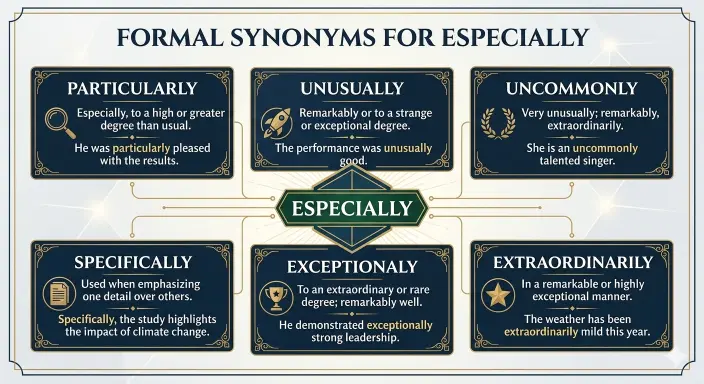
Formal writing often benefits from precise alternatives rather than simply replacing especially with a longer phrase. The following options work well in academic, business, analytical, and professional contexts.
Particularly
Meaning: To a greater degree than usual or compared with other things.
Explanation: Particularly is the closest formal and neutral substitute for especially. In many sentences, the two words can be exchanged without changing the meaning.
Example: The policy is particularly useful for small businesses.
Best Use: Academic writing, reports, professional emails, and general formal prose.
Worst Use: Very casual speech can sound slightly more polished than necessary if every sentence uses it.
Tone: Formal, neutral, and natural.
Notably
Meaning: In a way that deserves attention or stands out.
Explanation: Notably is useful when you want to draw attention to an important or remarkable example. It does not always mean exactly the same thing as especially.
Example: Several departments improved their results, most notably the sales team.
Best Use: Reports, research, analysis, journalism, and professional writing.
Worst Use: Avoid it when the subject isn’t actually noteworthy.
Tone: Formal and analytical.
Chiefly
Meaning: Mainly or principally.
Explanation: Chiefly focuses on the main reason, purpose, or part of something. It is a good alternative when especially means “mainly.”
Example: The program was created chiefly to support first-generation students.
Best Use: Formal explanations, essays, reports, and historical writing.
Worst Use: It can sound old-fashioned in casual conversation.
Tone: Formal and slightly traditional.
Principally
Meaning: Mainly; more than anything else.
Explanation: Principally identifies the primary reason or element. It is more about priority than simple emphasis.
Example: The meeting was principally concerned with budget planning.
Best Use: Business reports, academic writing, and formal explanations.
Worst Use: Don’t use it if you merely want to highlight an interesting detail.
Tone: Formal and precise.
Predominantly
Meaning: Mostly or to the greatest extent.
Explanation: This word describes something that makes up the largest or strongest part of a group, situation, or trend. It is not a universal substitute for especially.
Example: The survey included a predominantly younger audience.
Best Use: Research, statistics, reports, and analytical writing.
Worst Use: It sounds excessive when you simply want to emphasize one item.
Tone: Formal and analytical.
Of Particular Importance
Meaning: Especially important or worthy of attention.
Explanation: This phrase directly communicates that something deserves more attention than other things.
Example: Data privacy is of particular importance to the organization.
Best Use: Policies, reports, academic writing, and formal communication.
Worst Use: Everyday conversation, where it may sound unnecessarily formal.
Tone: Formal and deliberate.
Of Special Importance
Meaning: Having unusual or additional importance.
Explanation: This phrase works when especially emphasizes significance rather than degree.
Example: Accessibility is of special importance when designing public websites.
Best Use: Formal documents, guidelines, policies, and institutional writing.
Worst Use: Avoid it if the item is not actually more important than others.
Tone: Formal and serious.
To a Notable Degree
Meaning: To an extent that is worth noticing.
Explanation: This phrase emphasizes a measurable or noticeable level rather than simply selecting one item for attention.
Example: Customer satisfaction improved to a notable degree after the redesign.
Best Use: Reports and analytical writing.
Worst Use: It can make simple statements unnecessarily complicated.
Tone: Formal.
To an Exceptional Degree
Meaning: To an unusually high level.
Explanation: This expression is appropriate when especially means “unusually” or “very strongly.”
Example: The candidate demonstrated leadership skills to an exceptional degree.
Best Use: Evaluations, formal assessments, and professional writing.
Worst Use: Don’t use it for ordinary levels of ability.
Tone: Formal and emphatic.
Particularly Noteworthy
Meaning: Especially worthy of attention.
Explanation: Particularly noteworthy is not a direct replacement for every use of especially. It works when the purpose is to identify something remarkable.
Example: The report contains several findings, with the final result being particularly noteworthy.
Best Use: Academic papers, reports, reviews, and professional analysis.
Worst Use: Casual messages or simple factual statements.
Tone: Formal and evaluative.
Semi-Formal and Neutral Synonyms for Especially
These synonyms for especially are flexible enough for everyday writing, workplace communication, websites, school assignments, and general professional English.
In Particular
Meaning: Specifically one person, thing, or example.
Explanation: In particular is one of the strongest alternatives to especially when you’re highlighting a specific item.
Example: I enjoyed the museum, the photography section in particular.
Best Use: Essays, emails, conversation, and general writing.
Worst Use: It can become repetitive if used several times in the same paragraph.
Tone: Neutral and clear.
Mainly
Meaning: Mostly; for the most part.
Explanation: Mainly works when especially means “primarily” rather than simply “particularly.”
Example: The workshop is mainly designed for new employees.
Best Use: Everyday writing, workplace communication, and explanations.
Worst Use: Avoid it if you want to emphasize an unusually strong quality.
Tone: Neutral.
Primarily
Meaning: Mainly or chiefly.
Explanation: Primarily identifies the main purpose, cause, or focus.
Example: The website was primarily created for students.
Best Use: Professional writing, school assignments, reports, and presentations.
Worst Use: It may sound too formal for a very casual message.
Tone: Neutral to formal.
Above All
Meaning: More importantly than anything else.
Explanation: Above all adds a strong sense of priority. It is different from especially when no ranking of importance is intended.
Example: Above all, we need to protect customer information.
Best Use: Advice, speeches, persuasive writing, and personal statements.
Worst Use: Avoid it when several points are equally important.
Tone: Strong and emphatic.
Most of All
Meaning: More than everything else.
Explanation: This phrase highlights the strongest preference, feeling, or priority.
Example: I miss the quiet mornings most of all.
Best Use: Personal writing, conversation, and expressive communication.
Worst Use: It may sound too emotional for technical or highly formal documents.
Tone: Natural and expressive.
More Than Anything
Meaning: To a greater extent than other things.
Explanation: This phrase often expresses a strong preference, desire, or feeling.
Example: She wanted to help more than anything.
Best Use: Personal communication, storytelling, and conversation.
Worst Use: Formal reports may benefit from a more precise phrase.
Tone: Conversational and emphatic.
Specifically
Meaning: In an exact or clearly identified way.
Explanation: Specifically is sometimes used in place of especially, but the meanings are not identical. Specifically narrows attention to an exact item; especially emphasizes one item more than others.
Example: The new rule applies specifically to temporary employees.
Best Use: Instructions, policies, explanations, and precise communication.
Worst Use: Don’t use it merely to mean “particularly.”
Tone: Neutral and precise.
Remarkably
Meaning: In an unusually noticeable or impressive way.
Explanation: Remarkably works when the emphasis involves something surprising, impressive, or unusual.
Example: The small team performed remarkably well under pressure.
Best Use: Reviews, descriptions, articles, and general writing.
Worst Use: It is misleading if nothing is unusual or impressive.
Tone: Neutral and expressive.
Exceptionally
Meaning: To an unusually high or extreme degree.
Explanation: This word is stronger than ordinary especially. It suggests that something is far above normal.
Example: The restaurant is exceptionally busy on weekends.
Best Use: Reviews, evaluations, descriptions, and professional assessments.
Worst Use: Don’t use it as a routine replacement for every occurrence of especially.
Tone: Strong and polished.
Significantly
Meaning: To an important or noticeable degree.
Explanation: Significantly emphasizes importance or measurable difference. It is useful when the change or difference matters.
Example: The new process is significantly faster than the previous one.
Best Use: Reports, research, business writing, and analytical content.
Worst Use: Avoid it when you have no meaningful difference to describe.
Tone: Neutral to formal.
Informal and Casual Synonyms for Especially
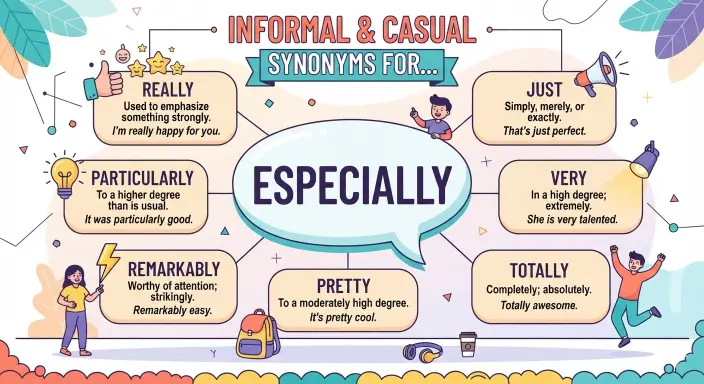
English has fewer true slang substitutes for especially. Most casual alternatives are phrases that change the emphasis slightly.
Most of All
Example: I like the beach most of all.
When it sounds natural: Friendly conversation and personal messages.
When to avoid it: Highly technical or formal writing.
Tone: Casual and warm.
More Than Anything
Example: I want to see my family more than anything.
When it sounds natural: Personal conversations, texts, and emotional writing.
When to avoid it: Formal reports where exact meaning matters.
Tone: Casual and expressive.
Above All
Example: Above all, just be honest with me.
When it sounds natural: Advice and strong personal statements.
When to avoid it: Routine workplace statements where no strong priority exists.
Tone: Direct and emphatic.
More So
Example: The second option is more so because it’s easier to maintain.
When it sounds natural: Informal speech, although the construction often needs careful sentence design.
When to avoid it: Formal writing when particularly or especially would be clearer.
Tone: Conversational.
By Far
Example: This is by far my favorite option.
When it sounds natural: Casual speech and reviews.
When to avoid it: Don’t use it if you aren’t making a strong comparison.
Tone: Informal and emphatic.
True Synonyms vs. Contextual Alternatives for Especially
The word especially has several related meanings. That is why a long synonym list can be misleading. A phrase may work perfectly in one sentence and sound wrong in another.
| Type | What It Means | Can It Replace the Original? |
|---|---|---|
| True synonym | Nearly the same meaning and grammatical role | Usually |
| Near synonym | Similar meaning with a small difference | Sometimes |
| Contextual alternative | Works only in a particular situation | Only in that context |
| Broader expression | Covers a wider idea | Sometimes, with meaning change |
| Narrower expression | Adds a more specific meaning | Only when that detail is intended |
For example, particularly is usually a close synonym:
The course is especially useful for beginners.
The course is particularly useful for beginners.
But specifically changes the idea:
The course is designed specifically for beginners.
Here, specifically means the course was intentionally designed for that group. It doesn’t simply mean that beginners find it especially useful.
Likewise, above all adds priority:
She values honesty especially.
Above all, she values honesty.
The second version suggests that honesty ranks above other values.
Industry-Specific Usage of Especially
Business Writing
Business writing often benefits from particularly, primarily, mainly, and notably.
Example:
“Customer retention is particularly important during the first year.”
For business reports, use notably when highlighting a significant result and primarily when explaining the main purpose.
Corporate Communication
Internal announcements and company policies should favor clear, direct alternatives.
Example:
“Employees should pay particular attention to the updated security procedures.”
Here, particular sounds professional without becoming unnecessarily formal.
Another option is:
“Managers are primarily responsible for communicating the change to their teams.”
Academic Writing
Academic writing frequently uses particularly, notably, primarily, and in particular.
Example:
“This pattern is particularly visible among younger participants.”
Use specifically when narrowing the subject to an exact group, method, or condition.
Example:
“The study examines specifically how sleep affects short-term memory.”
However, the sentence may need restructuring depending on what specifically modifies.
Customer Service
Customer service language should remain polite and easy to understand.
Example:
“We’re especially sorry for the delay.”
Or:
“We’re particularly concerned about the issue you experienced.”
The second version sounds more professional, while the first can feel warmer and more direct.
Legal Writing
Legal writing requires extra care because similar words can have different scopes. Especially, particularly, specifically, primarily, and mainly should not be swapped automatically.
For example:
This rule applies particularly to contractors.
does not necessarily have the same force as:
This rule applies specifically to contractors.
The second statement identifies contractors as the exact intended group. In legal documents, the safest wording depends on the intended scope and the governing document or jurisdiction. Do not substitute a synonym merely to avoid repetition if doing so could change the meaning.
Email Communication
Professional emails usually work well with particularly, in particular, notably, and specifically.
Client email:
“We’re particularly pleased with the progress so far.”
Project update:
“The testing phase has been particularly successful.”
Request:
“Please pay particular attention to the figures on page three.”
Follow-up:
“I’d like to clarify one point in particular.”
Email Examples Using Synonyms for Especially
Client Communication
Subject: Project Progress Update
Hi Maria,
We’re particularly pleased with the progress made this week. The design phase is now complete, and the development team has started testing the main features.
I’ll send another update once the first round of testing is finished.
Best,
James
Project Update
Subject: Testing Results
Hi Team,
The latest tests produced several positive results, most notably in page-load speed. We’ll continue testing the remaining features before the final review.
Thanks,
Alex
Professional Request
Subject: Please Review the Updated Report
Hi Daniel,
Could you please review the figures in Section 3, in particular the revised cost estimates?
I’d appreciate your feedback before Friday’s meeting.
Best,
Nina
Customer Service
Subject: Follow-Up on Your Support Request
Hi Robert,
We’re particularly sorry that your replacement order has taken longer than expected.
We’ve confirmed the shipping issue and have arranged a new delivery. You should receive an updated tracking notice shortly.
Regards,
Customer Support
Academic Communication
Subject: Question About the Assignment
Dear Professor Lee,
I’m reviewing the assignment instructions and would like to clarify one point in particular. Should the final section include sources from outside the assigned readings?
Thank you for your guidance.
Best,
Emily
Internal Workplace Email
Subject: Updated Security Procedure
Hi Everyone,
Please pay particular attention to the new password requirements in Section 2 of the policy. The changes take effect next Monday.
Thanks,
Sam
Short Dialogue Examples Using Synonyms for Especially
Workplace
Person A: Which part of the report needs another review?
Person B: The sales figures, in particular. A few numbers don’t match the source data.
Classroom
Person A: Which part of the lesson did you find most useful?
Person B: The examples, particularly the ones about persuasive writing.
Customer Service
Person A: Is there anything I should check before returning the product?
Person B: Yes. Please check the packaging, particularly the label on the back.
Casual Conversation
Person A: What do you like most about the city?
Person B: The food, most of all. There are so many good places to eat.
Professional Discussion
Person A: Which result stood out to you?
Person B: The final result, notably because it was much higher than expected.
How to Replace “Especially” in a Sentence
Example 1
Original:
I especially enjoyed the final chapter.
Alternative:
I particularly enjoyed the final chapter.
Why it works:
Particularly is a close substitute and keeps the original meaning.
Example 2
Original:
This problem affects students, especially first-year students.
Alternative:
This problem affects students, particularly first-year students.
Why it works:
Particularly highlights the subgroup without changing the sentence structure.
Example 3
Original:
I liked the presentation, especially the final section.
Alternative:
I liked the presentation, the final section in particular.
Why it works:
In particular clearly identifies the specific part being emphasized.
Example 4
Original:
The program was especially created to support new employees.
Alternative:
The program was specifically created to support new employees.
Why it works:
This changes the emphasis slightly. Specifically suggests deliberate design for that group.
Example 5
Original:
The company is especially focused on customer retention.
Alternative:
The company is primarily focused on customer retention.
Why it works:
Primarily means customer retention is the main focus. It does not simply mean that the company considers it important.
Example 6
Original:
The final result was especially impressive.
Alternative:
The final result was remarkably impressive.
Why it works:
Remarkably adds the idea that the result was unusually impressive.
Example 7
Original:
She especially values honesty.
Alternative:
Above all, she values honesty.
Why it works:
The alternative is stronger. It suggests honesty is her highest priority.
Example 8
Original:
The new system is especially useful for large teams.
Alternative:
The new system is particularly useful for large teams.
Why it works:
The replacement preserves both the meaning and professional tone.
Example 9
Original:
The region is especially dependent on tourism.
Alternative:
The region is predominantly dependent on tourism.
Why it works:
This is only appropriate if tourism represents the dominant source of dependence. It is more specific than especially.
Example 10
Original:
We were especially concerned about the delay.
Alternative:
We were particularly concerned about the delay.
Why it works:
The meaning remains nearly identical, while the alternative fits naturally in professional communication.
Comparison Table: Synonyms for Especially
| Phrase | Tone | Meaning / Scope | Best Use | Example |
|---|---|---|---|---|
| Particularly | Neutral/Formal | More than usual or others | General writing | Particularly useful |
| In particular | Neutral | One specific item | Essays, speech | This point in particular |
| Notably | Formal | Worthy of attention | Reports | Notably successful |
| Mainly | Neutral | Mostly | General writing | Mainly for students |
| Chiefly | Formal | Primarily | Essays, reports | Chiefly responsible |
| Principally | Formal | Mainly | Business, academic | Principally concerned |
| Primarily | Neutral/Formal | Main purpose or focus | Professional writing | Primarily designed for |
| Predominantly | Formal | Greatest proportion | Research, analysis | Predominantly urban |
| Specifically | Neutral | Exactly or deliberately | Instructions | Specifically designed for |
| Above all | Emphatic | Highest priority | Advice, speeches | Above all, be honest |
| Most of all | Casual/Neutral | More than everything else | Personal writing | I miss it most of all |
| More than anything | Casual | Strong preference | Conversation | I want this more than anything |
| Remarkably | Expressive | Unusually noticeable | Descriptions | Remarkably effective |
| Exceptionally | Strong/Formal | Unusually high | Evaluation | Exceptionally talented |
| Significantly | Formal | Meaningfully or noticeably | Analysis | Significantly higher |
| Of particular importance | Formal | Especially important | Reports, policies | Of particular importance |
Which Synonyms for Especially Should You Choose?
The easiest way to choose is to ask what you actually want to emphasize.
- For formal writing: Use particularly, notably, chiefly, or principally.
- For business communication: Choose particularly, in particular, or primarily.
- For academic writing: Particularly, notably, primarily, and in particular are strong choices.
- For legal writing: Prefer precise wording based on the intended scope. Don’t replace especially automatically.
- For professional emails: Particularly and in particular usually sound natural.
- For everyday conversation: particularly, especially, and most of all are comfortable choices.
- For casual messages: most of all, more than anything, and above all can work well.
- For exact identification: Use specifically.
- For unusual intensity: Use exceptionally or remarkably.
- For the main reason or focus: Use primarily, mainly, or chiefly.
Grammar and Usage Guide for Especially
Especially as an Adverb
Especially is primarily an adverb. It can modify an adjective, verb, or another adverb.
Examples:
- This book is especially useful.
- I especially liked the introduction.
- She runs especially quickly in short races.
The most natural replacement depends on what especially modifies.
Especially vs. Specially
These two words are often confused.
Especially usually means particularly or to an unusual degree.
I especially liked the opening scene.
Specially often means for a particular purpose.
The equipment was specially designed for children.
A useful shortcut is:
- Especially = particularly
- Specially = for a specific purpose
Especially at the Beginning of a Sentence
Especially can introduce emphasis.
Especially during winter, the roads can become dangerous.
This construction is natural when the writer wants to highlight a condition or time.
Especially Before an Adjective
The common structure is:
especially + adjective
Examples:
- especially difficult
- especially useful
- especially important
- especially effective
You can often replace especially with particularly:
particularly difficult
particularly useful
Especially and Commas
When especially introduces a nonessential example or aside, punctuation may be appropriate.
I enjoy outdoor activities, especially hiking and cycling.
But punctuation depends on the sentence structure. Don’t add commas simply because especially appears.
Especially vs. Specifically
This distinction matters:
The course is especially helpful for beginners.
Beginners find it more helpful than some other groups might.
The course was specifically designed for beginners.
Beginners were the intended target of the design.
The two sentences are related, but they do not communicate exactly the same thing.
Especially vs. Particularly
In many contexts, these are interchangeable.
This feature is especially useful.
This feature is particularly useful.
Both sound natural. Particularly can sometimes feel slightly more formal, but the difference is usually small.
Common Mistakes to Avoid With Synonyms for Especially
1. Treating Every Alternative as Exact
Especially, particularly, and in particular are close, but specifically can change the meaning.
2. Using “Predominantly” for Simple Emphasis
Predominantly means mostly or to the greatest proportion. It should not replace especially simply because it sounds formal.
3. Using “Above All” Without Priority
Above all suggests that something is more important than other things. Don’t use it when you only want mild emphasis.
4. Confusing “Especially” and “Specially”
Especially means particularly. Specially often means for a specific purpose.
5. Overusing Formal Vocabulary
Replacing every especially with principally or predominantly can make ordinary writing stiff.
6. Using “Notably” Without Something Noteworthy
Notably tells readers that something deserves attention. Make sure the context supports that emphasis.
7. Using “Exceptionally” as a Weak Substitute
Exceptionally suggests an unusually high degree. It is stronger than ordinary especially.
8. Ignoring Grammar
Some alternatives require different sentence structures.
especially for students
can become:
particularly useful for students
but not every synonym will fit the original position.
9. Changing the Intended Meaning
If especially means “more than other examples,” don’t replace it with a word that means “mainly” unless that is actually your intended message.
When Not to Use “Especially”
There are situations where replacing especially improves precision, but there are also many cases where the original word is the best choice.
1.When a More Precise Word Is Needed
Use specifically when you mean an exact target or purpose.
The rule applies specifically to contractors.
2.When You Mean “Mainly”
Use primarily, mainly, or chiefly when something is the main reason or focus.
The service is primarily intended for small businesses.
3.When You Mean “Unusually”
Use exceptionally or remarkably when something is notably above normal.
The response was exceptionally fast.
4.When You Need Strong Priority
Use above all when one factor ranks above the others.
Above all, the team needs clear communication.
5.When the Original Is Clearer
Don’t replace especially just to avoid repetition. If the sentence is already precise and natural, especially may be the strongest option.
This advice is especially useful for beginners.
There is no need to force a more complicated alternative.
Advanced Writer Tips for Using Synonyms for Especially
Tone Control
Use particularly for polished but natural prose. Move toward notably, principally, or predominantly when the context is analytical or formal.
For conversational writing, most of all or more than anything can sound warmer.
Professional Email Etiquette
Avoid replacing simple words with unnecessarily complicated expressions.
Instead of:
The issue is of exceptional importance to our organization.
try:
The issue is particularly important to our team.
The second version is easier to read and still professional.
Politeness
Word choice can subtly affect how a message sounds.
Please pay particular attention to Section 3.
is professional and direct.
You must pay particular attention to Section 3.
is much stronger and may sound commanding.
The synonym itself isn’t always responsible for politeness; the surrounding sentence matters too.
Context Alignment
Consider the purpose before choosing a replacement.
If you’re highlighting one example, use in particular.
If you’re identifying the main focus, use primarily.
If you’re pointing out something noteworthy, use notably.
If you’re identifying an exact target, use specifically.
Precision
Don’t select a synonym because it sounds sophisticated. Select it because it expresses the intended relationship.
Compare:
The area is especially rural.
with:
The area is predominantly rural.
The second statement suggests that most of the area has a rural character. That is more specific.
Readability
Short, familiar alternatives are often stronger.
particularly useful
is usually better than:
useful to a notable degree
unless the longer phrase serves a specific purpose.
Clear writing isn’t about using the most formal synonym. It’s about using the most accurate one.
Related Questions About Synonyms for Especially
What is another way to say especially?
The closest alternatives are particularly and in particular. Depending on context, notably, mainly, chiefly, primarily, and above all can also work. The best option depends on whether you mean greater emphasis, main importance, or a specific example.
What is a professional synonyms for especially?
Particularly is usually the safest professional alternative. Notably works when highlighting an important result, while primarily works when describing a main purpose or focus.
What is a formal synonyms for especially?
Formal alternatives include particularly, notably, chiefly, principally, predominantly, and of particular importance. Choose based on meaning rather than formality alone.
What can I use instead of especially in an essay?
For most essays, particularly and in particular are natural choices. Notably is useful when introducing an important observation, while primarily works when discussing the main cause or purpose.
Is especially formal?
Especially is neither highly formal nor strongly casual. It is a standard, versatile English adverb that works in conversation, emails, essays, reports, and professional writing.
Can particularly always replace especially?
No. They are very close in many sentences, but context still matters. Particularly usually preserves the meaning, while alternatives such as specifically, primarily, or predominantly can introduce a different idea.
What is the difference between especially and specifically?
Especially emphasizes something as more notable, important, or strong than others. Specifically identifies something exact, particular, or deliberately targeted. For example, especially useful means particularly useful, while specifically designed means designed for an exact purpose or audience.
FAQs About Synonyms for Especially
1. What is the closest synonym for especially?
Particularly is generally the closest synonym. In many sentences, especially and particularly can be exchanged without changing the meaning. In particular is also very close when the word is being used to single out one person, thing, or example.
2. Is “particularly” more formal than “especially”?
Particularly can sound slightly more polished in some professional or academic sentences, but both words are standard English. Neither is restricted to formal writing. Choose particularly when it fits the rhythm or tone of the sentence better.
3. Can I use “notably” instead of “especially”?
Sometimes. Notably means that something deserves attention because it stands out. It works well for important findings, examples, or results, but it is not a universal replacement for especially.
4. Is “especially” a good word for academic writing?
Yes. Especially is perfectly acceptable in academic writing when it expresses the intended meaning. However, particularly, notably, or in particular may sometimes provide a more precise or varied style.
5. Is “specifically” the same as “especially”?
No. Specifically identifies something exact or targeted, while especially emphasizes something as more significant, useful, or noticeable. Replacing one with the other can change the meaning of a sentence.
6. What is the best synonym for especially in business writing?
Particularly is usually the most versatile choice. Primarily is useful for main objectives, notably for significant results, and in particular for highlighting a specific item in a report or message.
7. How can I avoid repeating “especially” in an article?
First, make sure repetition is actually a problem. Then choose alternatives according to meaning: use particularly for general emphasis, in particular for a specific example, notably for something noteworthy, and primarily for the main focus.
Key Takeaways
- Particularly is the closest all-purpose alternative to especially.
- Use in particular when highlighting one specific person, thing, or example.
- Choose primarily, mainly, or chiefly when you mean “mainly,” not simply “especially.”
- Use specifically for exact targets or purposes, and exceptionally for unusually high degrees.
- Don’t replace especially just for variety; accuracy and natural phrasing matter more than avoiding repetition.
Conclusion
Finding the right synonym for especially is less about collecting replacement words and more about understanding the exact meaning you want to express. Particularly is the safest close alternative in most formal and neutral contexts, while in particular works especially well for highlighting one example. If you’re describing the main focus, choose primarily, mainly, or chiefly. For something noteworthy, notably is more precise. And if you mean an exact target, specifically is usually the better word.
Context should guide your choice. In professional and academic writing, clear words such as particularly and in particular are often better than unnecessarily elaborate expressions. In casual conversation, most of all and more than anything can sound more natural. Most importantly, don’t force a synonym simply to avoid repeating especially. If the original word expresses your meaning clearly, it may still be the best choice.
