
Finding the right synonyms for run can be surprisingly difficult because run is one of the most flexible words in English. It can describe physical movement, managing a business, operating a machine, continuing for a period, flowing, organizing an event, competing for office, or causing something to function. The best replacement depends entirely on the meaning of the sentence.
For example, jog, sprint, and dash can replace run when you mean moving quickly on foot. Manage, operate, and administer work when run means controlling a business or system. Continue, last, and persist can work when it means continuing over time. This guide covers more than 33 useful alternatives, explains their differences, and shows how to choose the right word for formal writing, business communication, academic work, emails, and everyday conversation.
Quick Answer
The best synonym for run depends on its meaning. For physical movement, use jog, sprint, dash, race, or hurry. And for managing something, use manage, operate, administer, oversee, or direct. For continuing, use continue, last, or persist. For liquid movement, use flow or stream. Other contextual choices include organize, function, compete, extend, and spread.
Quick List — Fast Reader Section
Closest Alternatives for Physical Movement
- Jog
- Sprint
- Dash
- Race
- Hurry
- Rush
- Gallop
- Trot
- Bolt
- Flee
Formal Alternatives for Managing or Operating
- Manage
- Operate
- Administer
- Oversee
- Direct
- Conduct
- Govern
- Control
- Supervise
- Coordinate
Alternatives for Continuing
- Continue
- Persist
- Last
- Endure
- Remain
- Proceed
- Extend
- Continue operating
Contextual Alternatives Synonyms For Run
- Flow
- Stream
- Function
- Work
- Operate
- Organize
- Host
- Compete
- Campaign
- Spread
- Extend
- Develop
Some of these are close synonyms, while others replace run only in a particular context. For example, jog cannot replace run in “She runs a company,” and manage cannot replace run in “He runs every morning.”
Formal Synonyms for Run

Manage
Meaning: To control, organize, or be responsible for something.
Explanation: Manage is one of the strongest alternatives when run means operating a business, department, team, or project. It focuses on responsibility and organization rather than physical activity.
Example: She manages a small consulting firm.
Best Use: Business writing, workplace communication, professional biographies, and reports.
Worst Use: It cannot replace run when the sentence describes physical movement.
Tone: Neutral-professional.
Operate
Meaning: To control, use, or make a machine, system, or business function.
Explanation: Operate is especially useful for machines, systems, facilities, and businesses. It can sound more technical than run.
Example: The company operates three distribution centers.
Best Use: Business, technology, manufacturing, transportation, and technical writing.
Worst Use: It may sound unnatural for ordinary physical movement.
Tone: Formal and technical.
Administer
Meaning: To manage or control a program, system, or organization.
Explanation: Administer is more institutional than run. It works best when the activity involves policies, procedures, records, or official programs.
Example: The university administers several scholarship programs.
Best Use: Education, government, healthcare, nonprofit organizations, and institutional writing.
Worst Use: It would sound strange in “He administers every morning.”
Tone: Formal and institutional.
Oversee
Meaning: To supervise an activity or process.
Explanation: Oversee suggests that someone watches and guides work rather than personally carrying out every task.
Example: The director oversees the company’s regional operations.
Best Use: Management, project reports, corporate communication, and professional descriptions.
Worst Use: Don’t use it when the person actually performs the work themselves.
Tone: Professional and authoritative.
Direct
Meaning: To control or guide an activity or group.
Explanation: Direct can replace run when someone gives instructions and controls an operation.
Example: The manager directs the daily activities of the department.
Best Use: Formal business writing, management, government, and professional reports.
Worst Use: It can sound too authoritative for friendly workplace communication.
Tone: Formal and authoritative.
Conduct
Meaning: To organize, lead, or carry out an activity.
Explanation: Conduct works with formal activities such as meetings, investigations, studies, interviews, and reviews. It is not a general replacement for every meaning of run.
Example: The committee conducted a detailed review of the policy.
Best Use: Academic, legal, professional, and institutional writing.
Worst Use: It does not naturally replace run for a business in most contexts.
Tone: Formal and professional.
Govern
Meaning: To control or rule an organization, institution, or area.
Explanation: Govern is narrower and more authoritative than run. It suggests formal authority and established rules.
Example: The board governs the organization according to its constitution.
Best Use: Government, law, institutional writing, and organizational documents.
Worst Use: It is too strong for casual descriptions of managing a small project.
Tone: Highly formal.
Supervise
Meaning: To monitor and guide people or work.
Explanation: Supervise is appropriate when run means being responsible for overseeing employees or activities.
Example: The senior technician supervises the evening shift.
Best Use: Workplaces, education, manufacturing, healthcare, and operations.
Worst Use: It may understate someone’s authority if they actually manage an entire organization.
Tone: Formal and practical.
Coordinate
Meaning: To organize people or activities so they work together.
Explanation: Coordinate can replace run when the main responsibility is bringing different tasks, teams, or schedules together.
Example: Omar coordinated the conference logistics.
Best Use: Events, projects, teamwork, administration, and professional communication.
Worst Use: It does not necessarily mean the person has overall control.
Tone: Professional and collaborative.
Control
Meaning: To have power over or direct something.
Explanation: Control is a stronger alternative to run. It emphasizes authority, regulation, or influence.
Example: The central system controls access to the facility.
Best Use: Technology, operations, security, management, and technical writing.
Worst Use: It can sound harsh when describing leadership of people.
Tone: Strong and formal.
Administer
Meaning: To manage an official process or system.
Explanation: This word is especially useful when run refers to managing a formal program rather than a commercial operation.
Example: The agency administers the training program.
Best Use: Government, education, healthcare, and public services.
Worst Use: Avoid it in casual conversation unless the official nature of the activity matters.
Tone: Formal.
Semi-Formal & Neutral Synonyms for Run
Jog
Meaning: To run at a steady, moderate pace.
Explanation: Jog is a narrower physical alternative to run. It suggests slower, more relaxed movement.
Example: I jog around the park before work.
Best Use: Fitness, sports, everyday conversation, and health-related writing.
Worst Use: It is inaccurate when someone is sprinting or running at top speed.
Tone: Neutral and casual.
Sprint
Meaning: To run very fast for a short distance.
Explanation: Sprint is more specific than run. It emphasizes speed and usually a short duration.
Example: The athlete sprinted toward the finish line.
Best Use: Sports, fitness, competition, and vivid descriptions.
Worst Use: It is misleading for a slow or long-distance run.
Tone: Energetic.
Dash
Meaning: To run or move quickly and suddenly.
Explanation: Dash suggests speed and urgency.
Example: She dashed across the street before the light changed.
Best Use: Everyday writing, storytelling, journalism, and casual speech.
Worst Use: It may sound too dramatic for routine movement.
Tone: Lively and informal-neutral.
Race
Meaning: To move quickly in competition with someone or something.
Explanation: Race adds the idea of competition or urgency. It isn’t an exact synonym for every use of run.
Example: The children raced across the playground.
Best Use: Sports, games, storytelling, and competition.
Worst Use: Don’t use it when no competition or comparison is intended.
Tone: Energetic and neutral.
Hurry
Meaning: To move or act quickly.
Explanation: Hurry can replace run when the reason for running is urgency, but it doesn’t necessarily mean running.
Example: We hurried to catch the train.
Best Use: Everyday conversation and informal writing.
Worst Use: It doesn’t specifically communicate running.
Tone: Casual and natural.
Rush
Meaning: To move or act with great speed.
Explanation: Rush emphasizes urgency. Someone can rush without running.
Example: He rushed to the station after receiving the message.
Best Use: Everyday writing, journalism, and conversational English.
Worst Use: Avoid it when the exact physical action of running matters.
Tone: Neutral to casual.
Function
Meaning: To work or operate correctly.
Explanation: Function is a useful alternative when run refers to how a machine, system, organization, or process works.
Example: The software functions normally after the update.
Best Use: Technical, academic, business, and professional writing.
Worst Use: It sounds unnatural for a person physically running.
Tone: Formal-neutral.
Work
Meaning: To operate or perform as intended.
Explanation: In everyday English, work can replace run when discussing machines or systems.
Example: The printer isn’t working properly.
Best Use: Everyday conversation and simple technical explanations.
Worst Use: It can be too vague for formal technical documentation.
Tone: Casual and neutral.
Organize
Meaning: To arrange and manage an activity.
Explanation: Organize works when run means planning and handling an event or activity.
Example: The student council organized the charity event.
Best Use: School, community activities, events, and everyday writing.
Worst Use: It may not show that someone had complete authority over the activity.
Tone: Neutral.
Host
Meaning: To arrange and present an event or program.
Explanation: Host is a contextual alternative when run refers to an event, show, meeting, or online session.
Example: The company hosted a customer workshop.
Best Use: Events, webinars, podcasts, meetings, and media.
Worst Use: Hosting does not necessarily mean managing every part of an event.
Tone: Neutral and welcoming.
Alternatives for “Run” Meaning Continue
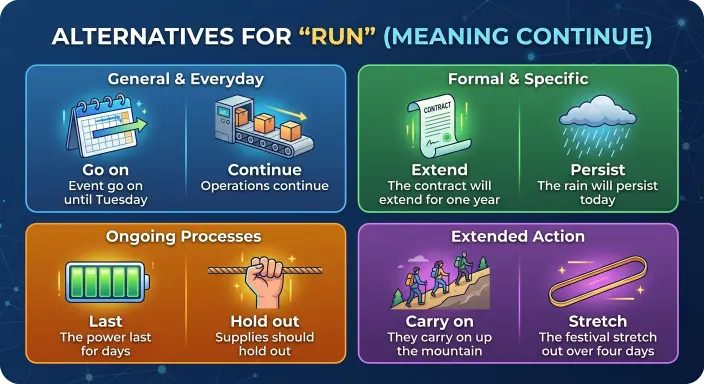
Continue
Meaning: To keep happening or doing something.
Explanation: Continue is a direct and clear alternative when run means persist over time.
Example: The program will continue through December.
Best Use: Academic, business, professional, and everyday writing.
Worst Use: It does not work for every physical or management meaning.
Tone: Neutral.
Last
Meaning: To continue for a particular period.
Explanation: Last is useful when run refers to duration.
Example: The exhibition will last for three weeks.
Best Use: Events, programs, performances, periods, and everyday speech.
Worst Use: Don’t use it when run means managing something.
Tone: Neutral.
Persist
Meaning: To continue despite difficulty or opposition.
Explanation: Persist is stronger than continue and suggests that something keeps going despite obstacles.
Example: The problem persisted after the software update.
Best Use: Academic, technical, medical, and formal writing.
Worst Use: It can sound too formal for a simple conversation.
Tone: Formal-neutral.
Endure
Meaning: To continue for a long time, especially under difficult conditions.
Explanation: Endure adds the idea of hardship or strain.
Example: The tradition has endured for generations.
Best Use: Historical writing, essays, literature, and formal descriptions.
Worst Use: It sounds excessive for ordinary events.
Tone: Formal and expressive.
Proceed
Meaning: To continue or move forward.
Explanation: Proceed works when run means continuing with an action or process.
Example: Once the inspection is complete, construction can proceed.
Best Use: Instructions, business communication, academic writing, and formal notices.
Worst Use: It can sound stiff in casual conversation.
Tone: Formal and professional.
Contextual Synonyms For Run
Flow
Meaning: To move continuously, especially as a liquid.
Explanation: Run can describe liquid moving, as in “Water runs down the wall.” Flow is often a more precise alternative.
Example: Clear water flows through the channel.
Best Use: Science, geography, technical writing, and descriptive prose.
Worst Use: It cannot normally replace run when referring to a person jogging.
Tone: Neutral and descriptive.
Stream
Meaning: To flow continuously in a narrow or directed path.
Explanation: Stream is more specific than flow and can also describe continuous digital delivery of data or media.
Example: Data streams continuously from the sensor.
Best Use: Technology, science, media, and descriptive writing.
Worst Use: It may be inappropriate if the movement is not continuous.
Tone: Technical-neutral.
Compete
Meaning: To take part in a competition.
Explanation: Run can mean competing for an elected position, as in “She is running for mayor.” In that context, compete can sometimes express the idea, but it does not preserve the political meaning exactly.
Example: Three candidates are competing for the position.
Best Use: General competition and explanatory writing.
Worst Use: Don’t replace run for office with compete when the political context itself matters.
Tone: Neutral.
Campaign
Meaning: To actively seek election to a political position.
Explanation: Campaign is a specific alternative to run for office. It describes the activities involved in seeking election.
Example: She is campaigning for a seat in the state legislature.
Best Use: Political reporting and civic writing.
Worst Use: It doesn’t replace physical or business uses of run.
Tone: Neutral-professional.
Extend
Meaning: To continue over a distance or period.
Explanation: Extend works when run describes the length or reach of something.
Example: The trail extends for several miles along the coast.
Best Use: Geography, architecture, planning, and formal descriptions.
Worst Use: It does not mean physical running.
Tone: Formal-neutral.
Spread
Meaning: To move outward across an area.
Explanation: Spread can replace run when something such as paint, fire, a crack, or a pattern moves across a surface.
Example: The crack spread across the wall.
Best Use: Descriptive, technical, and scientific contexts.
Worst Use: It can imply expansion rather than simple movement.
Tone: Neutral.
Informal / Casual Alternatives for Run
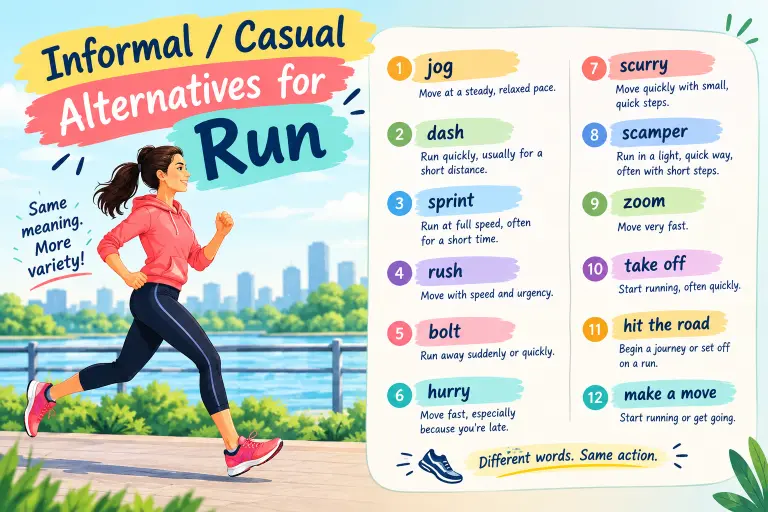
Take Off
Meaning: To leave or move away quickly.
Example: The dog took off as soon as the gate opened.
When it sounds natural: Casual conversation and storytelling.
When to avoid it: Formal reports and academic writing.
Tone: Very conversational.
Bolt
Meaning: To run away suddenly and quickly.
Example: The cat bolted when it heard the noise.
When it sounds natural: Casual speech and vivid storytelling.
When to avoid it: Formal professional writing.
Tone: Informal and energetic.
Race Off
Meaning: To leave or move away quickly.
Example: The kids raced off to the playground.
When it sounds natural: Everyday conversation and informal writing.
When to avoid it: Formal documents.
Tone: Casual and lively.
Head
Meaning: To go toward a place.
Example: I’m heading home after work.
When it sounds natural: Everyday conversation and messages.
When to avoid it: When you specifically mean running.
Tone: Casual and natural.
Dash Off
Meaning: To leave quickly.
Example: I have to dash off before the store closes.
When it sounds natural: Casual conversation and messages.
When to avoid it: Formal workplace documents.
Tone: Informal and friendly.
Hurry Along
Meaning: Move faster or encourage someone to move faster.
Example: We should hurry along if we want to catch the bus.
When it sounds natural: Casual speech.
When to avoid it: Formal instructions.
Tone: Conversational.
True Synonyms vs Contextual Alternatives for Run
| Type | What It Means | Can It Replace the Original? |
|---|---|---|
| True synonym | Has nearly the same meaning in the same sentence | Sometimes, depending on context |
| Near synonym | Shares much of the meaning but adds a nuance | Often, but not universally |
| Contextual alternative | Replaces run only in a particular sense | Yes, in the right context |
| Broader expression | Covers a larger idea than run | Sometimes, but precision may decrease |
| Narrower expression | Describes one specific type of running or operating | Only when that specific meaning applies |
The word run is highly polysemous. Consider the difference:
She runs every morning.
→ She jogs every morning.
Here, jogs narrows the meaning because jogging is a particular kind of running.
She runs a restaurant.
→ She manages a restaurant.
While in this, manages changes the physical-action meaning into a business-management meaning.
The river runs through the valley.
→ The river flows through the valley.
Here, flows is more precise because the subject is water.
The event runs until Friday.
→ The event continues until Friday.
Here, continues emphasizes duration.
This is why a synonym list alone isn’t enough. The sentence determines the appropriate alternative.
Industry-Specific Usage of Synonyms for Run
Business Writing
Business writing uses run in several ways.
- For managing a business:
She manages a regional office.
- For operating facilities:
The company operates five warehouses.
- For supervising work:
The director oversees the implementation process.
- For organizing an event:
The marketing team organized the customer conference.
- For describing a process:
The program continues through the end of the quarter.
The most professional choice is usually the most specific one, not the longest one.
Corporate Communication
Corporate documents frequently use run in phrases such as:
- run a department → manage a department
- run a facility → operate a facility
- run a program → administer a program
- run a meeting → conduct a meeting
- run an event → organize or host an event
- run a test → conduct or perform a test
- run a system → operate a system
The best choice depends on the exact activity.
Academic Writing
Academic writing often benefits from replacing vague uses of run with more precise verbs.
Instead of:
The researchers ran an experiment.
you can write:
The researchers conducted an experiment.
Instead of:
The study ran for six months.
write:
The study continued for six months.
Instead of:
The software runs on the device.
write:
The software operates on the device.
However, run is not automatically informal. In some academic contexts, it is perfectly acceptable. Precision matters more than simply choosing a more complicated word.
Customer Service
Simple language is usually best in customer-facing communication.
Instead of:
The application is not running properly.
you might write:
The application is not working properly.
For a service:
Our support team will guide you through the setup.
For a process:
The verification process will continue after we receive your documents.
Clear wording is usually more helpful than highly formal vocabulary.
Legal Writing
Legal documents use run in several specialized ways, so replacing it requires caution.
For example, operate, administer, conduct, continue, and expire may be more precise depending on the sentence.
Consider:
The agreement runs for five years.
A more formal version might be:
The agreement remains in effect for five years.
The second wording emphasizes legal effect rather than simply duration.
Similarly, run a business and operate a business are not always identical in every legal context. Legal documents should use terminology that accurately reflects the intended legal relationship and the governing document.
Email Communication
For professional email, choose alternatives based on meaning:
- Run a meeting → conduct or chair a meeting
- Run a project → manage a project
- Run a test → conduct or perform a test
- Run a business → operate or manage a business
- Run into a problem → encounter a problem
- Run late → be delayed
- Run out of time → have no time remaining
- Run through a document → review a document
Not every phrase should be changed. Familiar expressions can be more natural than forced substitutions.
Email Examples
Client Communication
Subject: Project Management Update
Hi Daniel,
I’ll be managing the project through the final testing stage. I’ll send you a progress update on Thursday and flag any issues that could affect the delivery date.
Best,
Maya
Project Update
Subject: Testing Schedule
Hi Team,
We’ll conduct the final system tests on Tuesday morning. Please complete your assigned checks by Monday afternoon so we have time to address any problems.
Thanks,
Alex
Meeting
Subject: Tomorrow’s Team Meeting
Hi everyone,
Priya will chair tomorrow’s meeting. The main items are the revised timeline, outstanding tasks, and the client feedback we received this week.
See you tomorrow,
James
Vendor Communication
Subject: Warehouse Operations
Hello Mark,
Our new facility will operate on a Monday-to-Friday schedule beginning next month. Please update your delivery records accordingly.
Regards,
Nora
Academic Communication
Subject: Research Experiment
Dear Professor Lee,
I have completed the preparation for the experiment and plan to conduct the first set of trials tomorrow. I’ll share the results once the initial analysis is complete.
Best regards,
Emma
Customer Service
Subject: Software Issue
Hello Sarah,
We’ve identified an issue affecting how the application functions after the latest update. Our technical team is working on a fix, and we’ll notify you when it is available.
Best,
Customer Support
Internal Workplace Email
Subject: Training Program
Hi Team,
The updated training program will continue through the end of the month. Please complete the remaining modules by Friday.
Thanks,
Michael
Short Dialogue Examples
Workplace
Person A: Who runs the new department?
Person B: Rachel manages it. She also oversees the hiring process.
Classroom
Person A: How should we describe the experiment?
Person B: In the report, say that we conducted the experiment.
Customer Service
Person A: The software won’t run on my computer.
Person B: Let’s check whether the latest version functions correctly on your system.
Casual Conversation
Person A: Are you running this weekend?
Person B: Yes, but I’m just going for a light jog around the park.
Professional Discussion
Person A: How long will the program run?
Person B: It will continue for another six months.
How to Replace “Run” in a Sentence
Example 1
Original:
She runs a successful bakery.
Alternative:
She manages a successful bakery.
Why it works:
Manages makes the business-management meaning explicit.
Example 2
Original:
The athlete ran toward the finish line.
Alternative:
The athlete sprinted toward the finish line.
Why it works:
Sprinted adds the idea of very fast movement. Use it only if speed is part of the intended meaning.
Example 3
Original:
The company runs several warehouses.
Alternative:
The company operates several warehouses.
Why it works:
Operates sounds more precise and professional when discussing facilities.
Example 4
Original:
The meeting will run for two hours.
Alternative:
The meeting will last for two hours.
Why it works:
Last clearly expresses duration.
Example 5
Original:
The researchers ran an experiment.
Alternative:
The researchers conducted an experiment.
Why it works:
Conducted is a common formal choice for research activities.
Example 6
Original:
Water ran down the wall.
Alternative:
Water flowed down the wall.
Why it works:
Flowed gives a clearer picture of liquid movement.
Example 7
Original:
The software runs correctly.
Alternative:
The software functions correctly.
Why it works:
Functions is useful in technical and professional writing.
Example 8
Original:
She ran for mayor.
Alternative:
She campaigned for mayor.
Why it works:
Campigned describes the political activity surrounding an election. It is not a perfect grammatical replacement in every sentence.
Example 9
Original:
The trail runs along the coast.
Alternative:
The trail extends along the coast.
Why it works:
Extends emphasizes the trail’s length and direction rather than movement.
Example 10
Original:
The problem has been running for several weeks.
Alternative:
The problem has persisted for several weeks.
Why it works:
Persisted is more concise and formal when describing a continuing problem.
Which Alternative Should You Choose?
- For formal writing: Use operate, administer, conduct, oversee, supervise, or proceed when the meaning fits.
- For business communication: Choose manage, operate, oversee, coordinate, or direct.
- For academic writing: Conduct, continue, persist, function, and extend are useful depending on context.
- For legal writing: Use the most exact expression, such as remain in effect, operate, administer, continue, or expire, rather than changing run simply for style.
- For professional email: Prefer manage, conduct, operate, continue, and function when they accurately describe the action.
- For everyday conversation: run, jog, hurry, rush, work, and head are often more natural.
- For casual messages: Expressions such as take off, dash off, bolt, and head out can sound natural.
- A good rule is simple: replace “run” only when the alternative makes the meaning clearer.
Grammar & Usage Guide for Run
Run as a Verb
Run is an irregular verb.
Present: I run every morning.
Third-person singular: She runs every morning.
Past: She ran yesterday.
Past participle: She has run five miles.
The past tense is ran, not runned.
Run + Object
When run means manage or operate, it often takes a direct object:
He runs a company.
She runs the department.
They run a restaurant.
Possible alternatives include:
He manages a company.
She heads the department.
They operate a restaurant.
Run + For
When run means seek election, use run for:
She is running for mayor.
Other expressions may describe the political activity:
She is campaigning for mayor.
These phrases are related but not always identical.
Run + Into
Run into has several meanings.
It can mean physically collide:
The car ran into a tree.
It can mean encounter:
We ran into a problem.
In the second meaning, alternatives include encounter, face, or come across.
Run Out Of
Run out of means have none left:
We ran out of coffee.
Possible alternatives:
We used up the coffee.
We have no coffee left.
Do not replace run out of with run alone.
Run Through
Run through can mean review, rehearse, or pass through something.
Let’s run through the presentation.
Alternatives include:
Let’s review the presentation.
Let’s rehearse the presentation.
The correct alternative depends on whether you’re checking content or practicing delivery.
Run Late
Run late means be delayed or behind schedule.
The train is running late.
A formal alternative is:
The train is delayed.
Run Over
Run over can mean exceed a limit:
The meeting ran over by 20 minutes.
It can also mean hit someone or something with a vehicle. Context is therefore essential.
Common Mistakes to Avoid
1. Treating Every Alternative as an Exact Synonym
Jog, manage, flow, and continue describe completely different meanings of run. Always identify the sense first.
2. Using “Jog” for Fast Running
A sprint is not the same as a jog. Jog normally suggests slower, steady movement.
3. Using “Manage” for Physical Movement
You can manage a business, but you don’t normally manage down the street when you mean physically running.
4. Using “Operate” in Casual Situations
I operate a small coffee shop.
is grammatically fine, but:
I run a small coffee shop.
may sound much more natural in everyday conversation.
5. Confusing “Run” and “Ran”
The past tense is ran:
Correct: She ran yesterday.
Incorrect: She run yesterday.
The past participle is run:
She has run five miles.
6. Forgetting Prepositions
Some expressions require particular prepositions:
run into a problem
run out of time
run for office
run through a report
run by someone
Changing the preposition can change the meaning.
7. Making the Meaning Too Narrow
Replacing run with sprint adds speed. Replacing it with jog suggests a moderate pace. Don’t narrow the meaning accidentally.
8. Making Writing Needlessly Formal
Words such as administer and operate aren’t automatically better than run. If the audience expects simple language, run may be the clearest choice.
9. Ignoring Idioms
Phrases such as run out of, run into, and run late have meanings that cannot be understood by simply replacing run with a general synonym.
10. Replacing a Familiar Word Just for Variety
Good writing does not require a different verb every time. If run is accurate and natural, keep it.
When Not to Use Run
1.When a Technical Term Is More Precise
In technical writing, operate or function may be clearer than run.
2.When Formality Requires a More Specific Verb
In an academic report, conducted an experiment may be more precise than ran an experiment.
3.When Duration Is the Main Idea
Use last or continue when the sentence is specifically about duration.
4.When You Mean Liquid Movement
Use flow when it provides a clearer physical description.
5.When You Mean Supervision
Use oversee or supervise if the key idea is monitoring rather than general management.
6.When You Mean Political Activity
Use campaign when describing the activity of seeking election rather than merely stating that someone is a candidate.
Still, run is often the better choice. It is short, familiar, flexible, and natural in everyday English. Don’t replace it just to make a sentence sound more sophisticated.
Advanced Writer Tips for Synonyms for Run
Tone Control
Small word choices can change the feel of a sentence.
Run → natural and direct
Manage → professional
Operate → technical or business-focused
Administer → institutional
Jog → relaxed physical activity
Sprint → fast and energetic
Choose the tone that matches your audience.
Professional Email Etiquette
Use precise verbs without making emails unnecessarily formal.
Instead of:
I will administer the project.
write:
I will manage the project.
Administer is better when you are actually handling an official program or system.
Politeness
Some alternatives can change how an instruction feels.
Run the report again.
sounds direct.
Could you rerun the report when you have a chance?
sounds more polite because the sentence uses a request structure.
The synonym itself isn’t always what creates politeness; the surrounding grammar matters too.
Context Alignment
Ask what run means before choosing a replacement:
- Physical movement?
- Business management?
- Machine operation?
- Duration?
- Liquid movement?
- Political candidacy?
- Competition?
- An event?
- A process?
- An unexpected encounter?
Once the meaning is clear, the correct alternative becomes much easier to find.
Precision
Prefer the most exact verb.
The company operates five factories.
is more specific than:
The company runs five factories.
But:
My uncle runs a small restaurant.
may sound more natural than:
My uncle operates a small restaurant.
Both can be correct. Audience and context decide.
Readability
Simple wording is often stronger.
The meeting lasted two hours.
is clearer than:
The meeting continued in operation for a duration of two hours.
Don’t sacrifice readability in an attempt to avoid repetition.
Related Questions About Synonyms for Run
1.What is another way to say run?
Depending on the meaning, you can say jog, sprint, dash, race, manage, operate, oversee, organize, continue, last, flow, function, or campaign. The correct word depends on whether run refers to movement, management, operation, duration, flow, or another sense.
2.What is a professional synonyms for run?
For business contexts, manage, operate, oversee, administer, direct, and coordinate are useful alternatives. Choose manage for general responsibility, operate for systems or facilities, and oversee for supervision.
3.What is a formal synonyms for run?
Formal alternatives include operate, administer, conduct, supervise, govern, direct, and proceed. The best option depends on the specific meaning of run in the sentence.
4.What can I use instead of run in academic writing?
Use conduct for experiments and studies, continue or last for duration, operate or function for systems, and persist for problems or conditions that continue over time.
5.Is run a formal word?
Yes. Run is a standard word used in both formal and informal English. However, some specific uses can be replaced by more precise terms in technical, academic, or professional writing.
6.Can I use operate instead of run?
Sometimes. Operate works well for businesses, machines, facilities, and systems. It does not replace physical or idiomatic uses of run. For example, “The company operates a factory” works, but “She operates every morning” does not mean “She runs every morning.”
7.What is the difference between run and manage?
Run is broader and more conversational, while manage specifically emphasizes responsibility for people, resources, or operations. “She runs a company” and “She manages a company” are close, but manage focuses more strongly on organizational responsibility.
FAQs About Synonyms for Run
1.What is the closest synonym for run?
There is no single closest synonym because run has many meanings. For physical movement, jog or race may be related. While for management, manage is close. For machine operation, operate is often better. For duration, continue or last may fit.
2.What is the best synonyms for run in business writing?
Manage is usually the safest choice for general business leadership. Operate works well for facilities and systems, while oversee emphasizes supervision. Administer is better for formal programs or institutional processes.
3.What is another word for run fast?
Depending on the situation, use sprint, dash, race, bolt, or hurry. Sprint specifically means running very fast, usually for a short distance. Dash emphasizes sudden movement, while bolt often suggests sudden escape.
4.What is a formal synonyms for “run a business”?
Operate a business and manage a business are strong alternatives. Operate emphasizes running the business as an enterprise, while manage focuses more on handling its people, resources, and activities.
5.What is a synonyms for “run for a position”?
For an election, campaign for is a useful contextual alternative. You can also say seek election to in formal writing. These expressions are related to run for office but emphasize slightly different aspects of the process.
6.What is another word for “run” meaning continue?
Use continue, last, persist, endure, remain, or proceed, depending on the sentence. Last focuses on duration, persist suggests continued existence despite difficulty, and proceed emphasizes moving forward.
7.Can “work” replace “run”?
Sometimes. Work can replace run when discussing whether a machine or system operates correctly: “The printer isn’t working.” It is broader and more conversational than run or function, so it may be less precise in technical writing.
Key Takeaways
- Run has many meanings, so the correct synonym depends on the sentence.
- Use jog, sprint, dash, or race for specific types of physical movement.
- Use manage, operate, oversee, or administer for business and organizational meanings.
- Use continue, last, persist, or endure when run describes duration.
- Keep run when it is already the clearest and most natural word; don’t replace it simply for variety.
Conclusion
The best synonyms for run depend on what the word is doing in a sentence. For physical movement, jog, sprint, dash, and race provide different levels of speed and intensity. For business or organizational responsibility, manage, operate, oversee, direct, and administer offer more specific meanings. When run refers to duration, continue, last, and persist are useful alternatives. For flowing liquids or moving data, flow and stream can be more precise.
The main lesson is to choose meaning before choosing vocabulary. A synonym that works beautifully in one sentence may be completely wrong in another. Run is also not an informal word that must always be replaced in professional writing. Often, it is the clearest option. Use an alternative when it adds precision, improves tone, or removes ambiguity—not simply because you want to avoid repeating a familiar word.
