
You’re looking for synonyms for maybe, the best choice depends on what you want to express: uncertainty, possibility, hesitation, or a polite suggestion.
Maybe is one of the most common words in English for saying that something is possible but not certain. However, writers often need a more formal, precise, or conversational alternative.
Words and phrases such as perhaps, possibly, potentially, conceivably, it is possible that, it may be, might, could, presumably, arguably, and there is a chance can all express related ideas, but they aren’t identical.
Some sound more formal, some indicate stronger or weaker uncertainty, and others work better in questions or suggestions. This guide explains more than 33 useful alternatives with examples so you can choose the right expression for each situation.
Quick Answer: Synonyms for Maybe
Common synonyms for maybe include perhaps, possibly, potentially, conceivably, plausibly, perchance, it may be, it might be, it could be, there is a chance, there is a possibility, potentially, arguably, presumably, and it is possible that. For everyday conversation, perhaps and possibly are natural choices. For formal writing, it is possible that, potentially, and conceivably can be useful.
Quick List of Synonyms for Maybe
Here are useful alternatives grouped by tone and meaning.
Closest Synonyms for Maybe
- Perhaps
- Possibly
- Potentially
- Conceivably
- Perchance
- Plausibly
- It may be
- It might be
- It could be
- There is a possibility
Formal Synonyms for Maybe
- It is possible that
- It is plausible that
- Conceivably
- Potentially
- Presumably
- In some circumstances
- It may be the case that
- There is a possibility that
- It is conceivable that
- It could be argued that
Neutral Synonyms for Maybe
- Perhaps
- Possibly
- Might
- May
- Could
- There is a chance
- There is a possibility
- It seems possible
- It may be
- It might be
Casual Synonyms for Maybe
- Maybe
- Might
- Could be
- Might be
- I guess
- I suppose
- It could happen
- Who knows?
- There’s a chance
- Maybe so
Not all of these are exact synonyms. For example, I guess can communicate uncertainty mixed with personal opinion, while potentially usually describes a possible outcome rather than uncertainty about a personal decision.
Formal Synonyms for Maybe
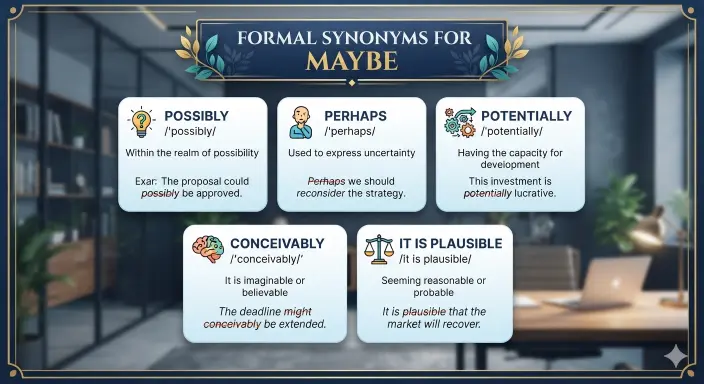
Formal alternatives are useful in academic papers, business reports, professional emails, research writing, and other situations where maybe can sound too conversational.
Perhaps
Meaning: Possibly; it may be true or may happen.
Explanation: Perhaps is the closest formal or neutral alternative to maybe. It can usually replace maybe without changing the basic meaning.
Example: Perhaps the results will change after further testing.
Best Use: Essays, reports, professional communication, and polished everyday writing.
Worst Use: Very casual speech when a simpler maybe sounds more natural.
Tone: Neutral to formal.
Possibly
Meaning: In a way that could happen or be true.
Explanation: Possibly emphasizes possibility and is especially useful when discussing uncertain outcomes.
Example: The package could possibly arrive tomorrow.
Best Use: Professional writing, explanations, predictions, and careful statements.
Worst Use: Situations where it creates unnecessary repetition, such as “could possibly.”
Tone: Neutral to formal.
Potentially
Meaning: Having the possibility of becoming or causing something.
Explanation: Potentially is not always a direct replacement for maybe. It usually points to a possible future effect, outcome, risk, or opportunity.
Example: The new system could potentially reduce processing time.
Best Use: Business, technology, research, and analytical writing.
Worst Use: Simple statements where perhaps is clearer.
Tone: Professional and analytical.
Conceivably
Meaning: In a way that can reasonably be imagined or considered possible.
Explanation: Conceivably presents something as possible, although it may not be especially likely.
Example: The project could conceivably be completed within six months.
Best Use: Formal analysis, academic writing, and careful discussion of possibilities.
Worst Use: Casual conversation, where it can sound stiff.
Tone: Formal.
Plausibly
Meaning: In a way that seems reasonable or believable.
Explanation: Plausibly does more than express possibility. It suggests that the possibility has some reasonable basis.
Example: The decline could plausibly be linked to changing customer preferences.
Best Use: Academic analysis, research, journalism, and professional discussion.
Worst Use: When there is no evidence supporting the proposed explanation.
Tone: Formal and analytical.
It Is Possible That
Meaning: Something may be true or may happen.
Explanation: This is one of the clearest formal alternatives to maybe. It is especially useful when you want to state uncertainty explicitly.
Example: It is possible that the meeting will be postponed.
Best Use: Academic writing, reports, formal emails, and professional communication.
Worst Use: Casual messages where the phrase may sound unnecessarily long.
Tone: Formal and clear.
It May Be
Meaning: Something is possible but uncertain.
Explanation: It may be is concise and formal. It works particularly well when followed by an adjective, noun, or clause.
Example: It may be necessary to revise the schedule.
Best Use: Professional writing, academic writing, instructions, and reports.
Worst Use: Highly casual conversation if maybe would sound more natural.
Tone: Neutral to formal.
It Might Be
Meaning: Something is possible but uncertain.
Explanation: Might generally expresses possibility. Depending on context, it can sound slightly more tentative than may.
Example: It might be difficult to complete the work by Friday.
Best Use: Everyday writing, professional communication, and cautious statements.
Worst Use: When you need to make a confident statement.
Tone: Neutral.
It Could Be
Meaning: Something is one possible explanation or outcome.
Explanation: Could can express possibility, but it may also suggest ability or conditional meaning. Context determines the exact interpretation.
Example: It could be a technical problem.
Best Use: Diagnosing situations, discussing alternatives, and making cautious suggestions.
Worst Use: When the context could make could sound like ability rather than possibility.
Tone: Neutral.
Presumably
Meaning: Based on what is known or expected, something is probably true.
Explanation: Presumably is not an exact synonym for maybe. It normally suggests a reasonable assumption, often with more confidence than maybe.
Example: Presumably, the team has already received the updated schedule.
Best Use: Formal explanations, reports, and analytical writing.
Worst Use: When you genuinely have no basis for the assumption.
Tone: Formal and measured.
There Is a Possibility That
Meaning: Something may happen or be true.
Explanation: This phrase directly communicates uncertainty while keeping the wording professional.
Example: There is a possibility that the launch date will change.
Best Use: Business, professional emails, reports, and formal announcements.
Worst Use: Casual conversation, where it may sound wordy.
Tone: Formal and professional.
It Is Conceivable That
Meaning: Something can reasonably be imagined as possible.
Explanation: This phrase is stronger and more formal than ordinary maybe. It is useful when discussing a possibility that is not necessarily expected.
Example: It is conceivable that demand could increase next year.
Best Use: Formal analysis, academic writing, and strategic discussions.
Worst Use: Simple everyday messages.
Tone: Very formal.
It May Be the Case That
Meaning: A particular situation may be true.
Explanation: This construction is useful when discussing an uncertain fact rather than a future event.
Example: It may be the case that customers prefer the simpler design.
Best Use: Academic and analytical writing.
Worst Use: Conversational English, where it can sound overly elaborate.
Tone: Formal.
Semi-Formal and Neutral Synonyms for Maybe
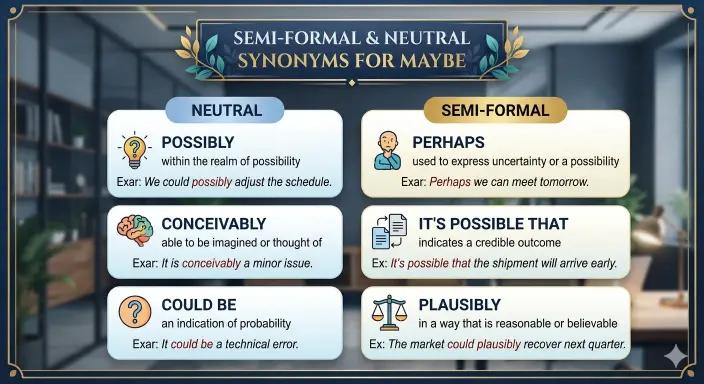
These alternatives work well in everyday writing, school assignments, workplace communication, websites, and general professional contexts.
May
Meaning: Indicates possibility.
Explanation: May is a modal verb rather than a direct synonym for maybe. It often sounds more formal and can express a possible event.
Example: The weather may improve later.
Best Use: Professional, academic, and general writing.
Worst Use: Casual contexts where maybe is more natural.
Tone: Neutral to formal.
Might
Meaning: Indicates a possible situation or event.
Explanation: Might is one of the most useful ways to express uncertainty without sounding overly formal.
Example: We might finish the project early.
Best Use: Conversation, emails, school writing, and professional communication.
Worst Use: When you want to communicate certainty.
Tone: Neutral.
Could
Meaning: Indicates one possible outcome or explanation.
Explanation: Could presents a possibility among alternatives.
Example: The delay could be caused by heavy traffic.
Best Use: Suggestions, explanations, troubleshooting, and everyday writing.
Worst Use: When a sentence requires a clear statement of fact.
Tone: Neutral.
There Is a Chance
Meaning: Something may happen.
Explanation: This phrase is more conversational than there is a possibility but still works in many professional settings.
Example: There is a chance the meeting will finish early.
Best Use: Conversation, emails, and informal professional communication.
Worst Use: Highly formal academic writing.
Tone: Neutral and conversational.
There Is a Possibility
Meaning: Something could happen or be true.
Explanation: This expression is slightly more formal than there is a chance.
Example: There is a possibility of further delays.
Best Use: Workplace communication, reports, announcements, and general writing.
Worst Use: Very casual conversation if maybe would be simpler.
Tone: Neutral to formal.
It Seems Possible
Meaning: Something appears to be possible based on available information.
Explanation: This phrase adds a sense of judgment or observation rather than simply stating uncertainty.
Example: It seems possible that the issue has already been resolved.
Best Use: Professional discussion, analysis, and careful explanations.
Worst Use: When there is no evidence for the impression.
Tone: Neutral.
It Appears That
Meaning: Available evidence suggests something is true.
Explanation: It appears that does not mean exactly the same thing as maybe. It indicates an observation or conclusion based on evidence.
Example: It appears that the problem was caused by an incorrect setting.
Best Use: Reports, emails, research, and professional explanations.
Worst Use: When you are simply guessing.
Tone: Professional.
Likely
Meaning: Probably going to happen or probably true.
Explanation: Likely is stronger than maybe because it suggests a higher level of probability.
Example: The company is likely to announce the results next week.
Best Use: Predictions, reports, news, and professional writing.
Worst Use: When the possibility is genuinely uncertain without a stronger indication.
Tone: Neutral to formal.
Unlikely
Meaning: Not expected to happen or be true.
Explanation: Unlikely isn’t a synonym for maybe by itself. It is useful when you want to express a low probability.
Example: It is unlikely that the event will be canceled.
Best Use: Risk assessments, predictions, professional communication, and analysis.
Worst Use: When you want to avoid suggesting low probability.
Tone: Neutral and precise.
Arguably
Meaning: It can reasonably be argued that something is true.
Explanation: Arguably does not simply mean maybe. It signals that a claim is open to reasonable debate.
Example: The novel is arguably the author’s most influential work.
Best Use: Academic essays, criticism, and analytical writing.
Worst Use: Simple factual statements.
Tone: Formal and analytical.
Presumably
Meaning: Probably, based on what is known.
Explanation: Presumably suggests an assumption supported by available information.
Example: The students have presumably completed the assignment.
Best Use: Formal explanations and professional writing.
Worst Use: When the assumption has no reasonable basis.
Tone: Formal.
Informal and Casual Synonyms for Maybe
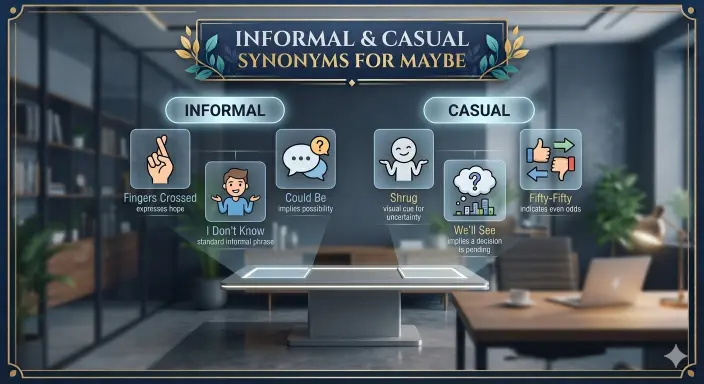
English does not have many casual one-word replacements for maybe. In everyday conversation, people often use short phrases that communicate uncertainty or hesitation.
I Guess
Meaning: I think so, but I am not completely sure.
Example: I guess we could meet after lunch.
When it sounds natural: Casual conversation and friendly messages.
When to avoid it: Formal emails, academic writing, and situations requiring confidence.
Tone: Casual and tentative.
I Suppose
Meaning: I think something is probably true or acceptable, although I am not completely certain.
Example: I suppose we could try again tomorrow.
When it sounds natural: Conversation and informal discussion.
When to avoid it: Formal reports or professional statements where greater precision is needed.
Tone: Casual and slightly hesitant.
Could Be
Meaning: Something is possible.
Example: “Who left this note?” “Could be Jake.”
When it sounds natural: Conversation and informal messages.
When to avoid it: Formal writing.
Tone: Casual.
Might Be
Meaning: Something may be true.
Example: “Is Sarah coming?” “She might be.”
When it sounds natural: Everyday conversation and texting.
When to avoid it: Very formal documents.
Tone: Casual to neutral.
Who Knows?
Meaning: There is no way to know for certain.
Example: Who knows? Maybe we’ll get lucky.
When it sounds natural: Casual conversations and playful discussions.
When to avoid it: Professional reports or serious academic writing.
Tone: Very conversational.
Maybe So
Meaning: Possibly; that could be true.
Example: “Do you think he’ll agree?” “Maybe so.”
When it sounds natural: Informal conversation.
When to avoid it: Formal writing.
Tone: Casual.
True Synonyms vs. Contextual Synonyms for Maybe
Because maybe expresses possibility or uncertainty, many related words overlap with it without having exactly the same meaning.
| Type | What It Means | Can It Replace Maybe? |
|---|---|---|
| True synonym | Expresses essentially the same possibility or uncertainty | Usually |
| Near synonym | Has a similar meaning but may change the level of certainty | Sometimes |
| Contextual alternative | Works only in particular sentence structures | In suitable contexts |
| Broader expression | Covers a wider idea than simple possibility | Sometimes |
| Narrower expression | Communicates a particular kind or degree of possibility | Only in specific contexts |
| Formal equivalent | Expresses possibility in more formal language | Often |
| Casual equivalent | Communicates uncertainty in everyday speech | In informal contexts |
For example, perhaps is very close to maybe. Possibly is also close, while likely changes the probability by suggesting that something is more probable.
Likewise, arguably does not mean maybe. It indicates that a claim can reasonably be debated. Presumably suggests an assumption based on available information. potentially often points toward a possible future effect.
Understanding these differences prevents awkward or misleading substitutions.
Business Writing and Synonyms for Maybe
Business writing usually benefits from precise expressions such as potentially, possibly, may, might, could, likely, and there is a possibility.
Instead of:
Maybe sales will increase next quarter.
A professional report could say:
Sales may increase next quarter.
If the evidence suggests a stronger possibility:
Sales are likely to increase next quarter.
If the outcome depends on several conditions:
Sales could potentially increase following the product launch.
The best choice depends on how confident the writer is.
Corporate Communication and Synonyms for Maybe
Corporate communication should avoid unnecessary uncertainty while still being honest about what is not known.
Useful examples include:
- “The schedule may change depending on supplier availability.”
- “There is a possibility of further revisions.”
- “The team might need additional time.”
- “The change could potentially affect delivery times.”
- “The company is likely to announce an update soon.”
Avoid replacing every instance of maybe with a longer phrase. Clear corporate communication is usually better than artificially formal language.
Academic Writing and Synonyms for Maybe
In academic writing, maybe can sound too conversational. Perhaps, possibly, may, might, could, conceivably, and it is possible that are usually better choices.
For example:
Maybe social media influences consumer behavior.
A more academic version is:
Social media may influence consumer behavior.
For a cautious interpretation:
The findings may suggest that social media influences consumer behavior.
This wording is useful because academic writing often requires careful claims rather than absolute statements.
Customer Service and Synonyms for Maybe
Customer service messages should be clear and reassuring without promising something that isn’t known.
Instead of:
Maybe your package will arrive tomorrow.
Use:
Your package may arrive tomorrow.
Or, if there is evidence:
Your package is likely to arrive tomorrow.
If the timing is uncertain:
There is a possibility that your package may arrive tomorrow.
The right phrase depends on the information available to the representative.
Legal Writing and Synonyms for Maybe
Legal writing requires especially careful language because uncertainty can affect how a statement is interpreted.
Expressions such as may, might, could, potentially, and it is possible that can communicate different levels or types of uncertainty.
For example:
The agreement may be subject to further review.
This is more appropriate for formal legal-style writing than:
Maybe the agreement needs more review.
However, legal terminology should not be casually substituted with ordinary synonyms. The exact wording required depends on the document and jurisdiction. For important legal documents, terminology should be reviewed by an appropriately qualified professional.
Email Communication and Synonyms for Maybe
In professional emails, avoid excessive use of maybe because it can make a message sound uncertain or hesitant. Choose a phrase that accurately reflects your confidence.
Compare:
Maybe we can move the meeting.
with:
We could move the meeting to Thursday.
The second version sounds more direct while still leaving the decision open.
Email Examples Using Synonyms for Maybe
Client Communication — “Possibly”
Hello Daniel,
The shipment is currently being processed, and it could possibly arrive one day earlier than expected.
I’ll confirm the delivery date as soon as the carrier provides the final update.
Best,
Megan
Project Update — “May”
Hi Team,
The testing phase may take an additional two days because we identified a few items that need further review.
I’ll send a revised timeline once the testing team confirms the remaining work.
Thanks,
Alex
Meeting Request — “Could”
Hi Sarah,
Could we move our meeting to Thursday afternoon?
That time would give me enough room to finish the figures we need to discuss. If Thursday doesn’t work, I’m happy to keep the original schedule.
Best,
James
Vendor Communication — “There Is a Possibility”
Hello Mark,
There is a possibility that the delivery date will change because the manufacturer has adjusted its production schedule.
Could you please let us know if you receive a confirmed update?
Regards,
Nina
Academic Communication — “Perhaps”
Dear Professor Smith,
Perhaps I could focus my paper on the relationship between language and identity in the assigned reading.
Would that approach be suitable for the assignment?
Thank you,
Emily
Internal Workplace Email — “Might”
Hi everyone,
We might need to adjust next week’s schedule because two team members will be unavailable.
I’ll confirm the final schedule once I have everyone’s availability.
Thanks,
Ryan
Short Dialogue Examples Using Synonyms for Maybe
Workplace
Person A: Do you think the client will approve the proposal?
Person B: They might, but I think we should be ready to answer a few questions.
Classroom
Person A: Is the professor going to extend the deadline?
Person B: Perhaps. She said she’d make an announcement tomorrow.
Customer Service
Person A: Will my order arrive today?
Person B: It could. The tracking information shows that it’s already at the local facility.
Casual Conversation
Person A: Are you coming to the party tonight?
Person B: Maybe. I guess it depends on how much work I have left.
Professional Discussion
Person A: Could the new strategy improve sales?
Person B: Potentially, although we’d need more data before making a firm prediction.
How to Replace “Maybe” in a Sentence
Example 1
Original: Maybe the weather will improve tomorrow.
Alternative: Perhaps the weather will improve tomorrow.
Why it works: Perhaps is the closest neutral-to-formal replacement and preserves the original meaning.
Example 2
Original: Maybe we should postpone the meeting.
Alternative: We could postpone the meeting.
Why it works: Could turns the statement into a possible suggestion rather than simply expressing uncertainty.
Example 3
Original: Maybe the report contains an error.
Alternative: The report might contain an error.
Why it works: Might fits naturally when proposing an uncertain possibility.
Example 4
Original: Maybe the results will change.
Alternative: The results may change.
Why it works: May is concise and more formal than maybe, making it suitable for reports and academic writing.
Example 5
Original: Maybe the new system will reduce costs.
Alternative: The new system could potentially reduce costs.
Why it works: Potentially emphasizes a possible future benefit. It sounds more analytical.
Example 6
Original: Maybe there will be another delay.
Alternative: There is a possibility of another delay.
Why it works: This version is more formal and works well in professional communication.
Example 7
Original: Maybe the problem comes from the software.
Alternative: The problem may stem from the software.
Why it works: May preserves uncertainty, while stem from clearly describes the possible source.
Example 8
Original: Maybe this is the best option.
Alternative: This is arguably the best option.
Why it works: The meaning changes slightly. Arguably suggests that reasonable people could debate whether it is the best option.
Example 9
Original: Maybe sales will increase.
Alternative: Sales are likely to increase.
Why it works: This is not an exact synonym. Likely expresses a higher level of confidence than maybe.
Example 10
Original: Maybe he already knows.
Alternative: He presumably already knows.
Why it works: Presumably implies that there is some reason to make that assumption, so it is stronger than ordinary uncertainty.
Comparison Table: Synonyms for Maybe
| Phrase | Tone | Meaning / Scope | Best Use | Example |
|---|---|---|---|---|
| Maybe | Neutral | Possible but uncertain | General conversation | Maybe she’ll come. |
| Perhaps | Neutral/Formal | Possible | General and formal writing | Perhaps she’ll come. |
| Possibly | Neutral/Formal | Something could happen | Professional writing | She could possibly come. |
| May | Formal/Neutral | Possibility | Academic and professional | She may come. |
| Might | Neutral | Possible but uncertain | General writing | She might come. |
| Could | Neutral | One possible outcome | Suggestions and explanations | She could come. |
| Potentially | Professional | Possible future effect | Business and technical writing | It could potentially help. |
| Conceivably | Formal | Reasonably imaginable | Formal analysis | It could conceivably work. |
| Plausibly | Formal | Reasonably believable | Academic analysis | The theory could plausibly explain it. |
| Likely | Neutral/Formal | Probably | Predictions | She is likely to come. |
| Presumably | Formal | Probably, based on assumptions | Reports | She presumably knows. |
| Arguably | Formal | Open to reasonable debate | Essays | It is arguably the best choice. |
| There is a chance | Neutral | Something may happen | Conversation and emails | There is a chance he’ll come. |
| There is a possibility | Formal | Something may happen | Professional writing | There is a possibility he’ll come. |
| I guess | Casual | Tentative personal view | Conversation | I guess he’ll come. |
| I suppose | Casual | Tentative acceptance or opinion | Conversation | I suppose he’ll come. |
Which Synonyms for Maybe Should You Choose?
- For formal writing: Choose perhaps, possibly, may, it is possible that, conceivably, or there is a possibility that.
- For business communication: May, might, could, potentially, and there is a possibility are useful because they express uncertainty without sounding casual.
- For academic writing: Prefer may, might, could, perhaps, possibly, conceivably, or it is possible that. Match the wording to the strength of your evidence.
- For legal writing: Use carefully selected modal expressions such as may or could when appropriate. Avoid casual substitutes such as I guess or maybe.
- For professional email: May, might, could, perhaps, and there is a possibility are usually polished and natural.
- For everyday conversation: Maybe, perhaps, might, could be, and I guess work well.
- For casual messages: Keep it simple. Maybe, might, could be, and I guess usually sound more natural than formal expressions.
Grammar and Usage Guide for Maybe
Maybe as an Adverb
Maybe is an adverb meaning “perhaps” or “possibly.”
It commonly appears at the beginning of a sentence:
Maybe we’ll go tomorrow.
It can also appear elsewhere:
We’ll maybe go tomorrow.
The first position is generally clearer and more natural in careful writing.
Maybe vs. May Be
This is one of the most common grammar problems.
Maybe is one word and functions as an adverb:
Maybe she is busy.
May be is two words because may is a modal verb and be is the main verb:
She may be busy.
A useful test is to see whether perhaps can replace the expression.
Perhaps she is busy.
Maybe she is busy.
But:
She perhaps busy. ❌
The second sentence requires may be.
Maybe at the Beginning of a Sentence
Starting with maybe is grammatically correct:
Maybe we should leave early.
In formal writing, however, perhaps or it may be can sometimes create a more polished tone.
Maybe in Questions
Maybe can introduce a tentative suggestion:
Maybe we should ask for help?
It can also appear in short answers:
“Are you coming?”
“Maybe.”
Maybe and Punctuation
When maybe begins a sentence, a comma is often unnecessary:
Maybe we’ll arrive early.
A comma can be used when the writer wants to separate an introductory phrase for emphasis, but ordinary sentences generally read naturally without one.
Maybe vs. Perhaps
These are usually interchangeable:
Maybe she’ll call.
Perhaps she’ll call.
The main difference is tone. Maybe is more conversational, while perhaps can sound slightly more polished.
May vs. Might
Both express possibility.
The package may arrive today.
The package might arrive today.
In many modern contexts, the difference is small. Might often sounds more tentative, but context matters.
Could for Possibility
Could can express one possible outcome:
We could go by train.
It can also describe ability:
She could swim when she was five.
Because of these different meanings, make sure the intended interpretation is clear.
Common Mistakes to Avoid With Synonyms for Maybe
1. Treating Every Alternative as an Exact Synonym
Likely, presumably, and arguably add meanings that maybe does not necessarily contain.
2. Confusing “Maybe” and “May Be”
❌ She maybe tired.
✅ She may be tired.
✅ Maybe she is tired.
This distinction is essential.
3. Using “Potentially” Everywhere
Potentially is useful for possible outcomes, but it can make simple sentences unnecessarily formal.
4. Using “Likely” When You Mean “Maybe”
Likely generally suggests that something has a reasonable chance of happening. It is stronger than simple uncertainty.
5. Using Casual Language in Formal Writing
Expressions such as I guess, who knows, and maybe so usually don’t belong in academic or formal professional writing.
6. Making Uncertainty Too Strong
If you write:
The plan will probably succeed.
you are making a stronger prediction than:
The plan might succeed.
Choose wording that matches your actual level of confidence.
7. Using “Presumably” Without a Basis
Presumably suggests an assumption based on available information. Don’t use it simply as a sophisticated replacement for maybe.
8. Using “Arguably” as a Simple Synonym
Arguably means that a claim can reasonably be defended or debated. It does not simply mean “perhaps.”
9. Overusing Hedging Words
Too many words such as maybe, possibly, perhaps, and might can make writing sound hesitant.
Instead of:
Maybe the company might possibly change the policy.
write:
The company might change the policy.
10. Choosing Formality Over Clarity
A phrase like it is conceivable that may be grammatically correct, but perhaps may communicate the same idea more clearly.
When Not to Use “Maybe”
1. When Writing a Formal Academic Paper
Use perhaps, may, might, possibly, or it is possible that when appropriate.
2. When You Need to Express a Higher Probability
Use likely or probably if the evidence supports a stronger prediction.
3. When You Need to Show Evidence-Based Uncertainty
Use it appears that, the evidence suggests, or similar constructions when you are drawing a conclusion from information.
4. When You Are Making a Professional Recommendation
Instead of:
Maybe you should update the file.
try:
You may want to update the file.
This can sound more polished and tactful.
5. When the Sentence Is Too Vague
If you know why something might happen, explain the uncertainty more precisely.
Instead of:
Maybe the project is delayed.
write:
The project may be delayed because the supplier has not confirmed the shipment.
6. When You Need a Direct Statement
Sometimes uncertainty is unnecessary.
Instead of:
Maybe the meeting is at 3 p.m.
if you know the schedule:
The meeting is at 3 p.m.
7. When “Maybe” Is Actually the Better Choice
Don’t avoid maybe simply because you’re writing for a professional audience. It is a normal English word and can sound natural in appropriate contexts.
For example:
Maybe we should reconsider the plan.
This can be perfectly acceptable in a workplace discussion.
Advanced Writer Tips for Using Synonyms for Maybe
Tone Control
Use maybe for ordinary conversation, perhaps for a polished neutral tone, and it is possible that or conceivably for more formal writing.
Professional Email Etiquette
Avoid unnecessary hesitation. Instead of saying:
Maybe we could possibly schedule another meeting.
write:
Could we schedule another meeting?
The second version is shorter, clearer, and more confident.
Politeness
Uncertainty can sometimes make a suggestion sound softer.
Compare:
Change the deadline.
with:
Perhaps we could change the deadline.
The second sentence is less direct and can feel more collaborative.
Context Alignment
Consider the purpose of the sentence. Are you:
- Making a prediction?
- Offering a suggestion?
- Describing uncertainty?
- Making an assumption?
- Discussing evidence?
- Presenting competing possibilities?
The answer determines the best alternative.
Precision
Choose might or may for possibility, likely for stronger probability, presumably for an assumption, and arguably for a debatable claim.
Readability
Don’t replace a short, clear word with a complicated phrase without a reason.
Maybe the plan will work.
is often better than:
It is conceivable that the proposed strategy may potentially prove successful.
The second sentence adds complexity without adding useful meaning.
Related Questions About Synonyms for Maybe
1. What is another way to say “maybe”?
The simplest alternatives are perhaps, possibly, may, might, and could. Other expressions include there is a chance, there is a possibility, potentially, conceivably, and it is possible that. The best choice depends on how formal you want to sound and how much uncertainty you want to express.
2. What is a professional alternative to “maybe”?
Perhaps, possibly, may, might, could, and there is a possibility are all useful professional alternatives. In a business email, could can be especially useful for suggestions, while may and might work well when describing uncertain outcomes.
3. What is a formal alternative to “maybe”?
Perhaps is the closest simple formal alternative. Other options include possibly, conceivably, potentially, it is possible that, and it may be the case that. Choose based on the exact meaning rather than formality alone.
4. What can I use instead of “maybe” in academic writing?
Use perhaps, may, might, could, possibly, conceivably, or it is possible that. Academic writing often benefits from precise hedging, so choose an expression that accurately reflects how certain the evidence is.
5. Is “maybe” formal?
Maybe is generally considered neutral and conversational rather than strongly formal. It is not incorrect in professional writing, but perhaps or may can sometimes sound more polished. The appropriate choice depends on the audience and context.
6. Can I use “perhaps” instead of “maybe”?
Yes. Perhaps is usually the closest direct replacement for maybe. For example, “Maybe she will call” and “Perhaps she will call” have essentially the same meaning, although perhaps can sound slightly more formal.
7. What is the difference between “maybe” and “possibly”?
Both express uncertainty, and they often overlap. Maybe is a general conversational expression of possibility, while possibly emphasizes the fact that something is possible. In many sentences, either word can work without a significant change in meaning.
FAQs About Synonyms for Maybe
1. What is the best synonym for maybe?
Perhaps is usually the best all-purpose synonym because it preserves the basic meaning of maybe while sounding slightly more polished. Possibly is another close choice. For formal writing, may or it is possible that can be more appropriate.
2. What is a stronger word than maybe?
Words such as likely and probably generally express a higher level of confidence than maybe. However, they are not exact synonyms. If you say something is likely, you’re suggesting that it has a good chance of being true or happening.
3. What is a softer alternative to maybe?
Might, could, and phrases such as it might be can sound tentative. However, the effect depends on context. Might often makes a possibility sound less certain, while could can present one possible option among several.
4. Is “perhaps” more formal than “maybe”?
Usually, yes. Both words are common and correct, but perhaps tends to sound more polished and is more comfortable in formal or academic writing. Maybe is especially natural in conversation and informal messages.
5. Is “possibly” the same as “maybe”?
They are close, but not always identical in style or sentence structure. Possibly directly emphasizes possibility, while maybe is a more general adverb of uncertainty. In many ordinary sentences, however, they can be exchanged.
6. Can “could” replace “maybe”?
Often, but not automatically. Could can express possibility, ability, or a conditional situation. For example, “Maybe we should leave” can become “We could leave,” but the second version sounds more like a suggestion than simple uncertainty.
7. What should I use instead of maybe in a professional email?
Use could for suggestions, may or might for uncertain outcomes, and perhaps for a polished conversational tone. If you need to state uncertainty explicitly, there is a possibility can work well.
Key Takeaways
- Perhaps is usually the closest polished alternative to maybe.
- Use may, might, and could to express possibility in different sentence structures.
- Likely, presumably, and arguably are not exact synonyms because they add different meanings.
- In academic and professional writing, choose wording that accurately reflects your level of certainty.
- Don’t replace maybe automatically; sometimes the original word is the clearest and most natural choice.
Conclusion
The best synonym for maybe depends on what you want the reader to understand. Perhaps is the closest general alternative, while possibly emphasizes possibility. May, might, and could are useful when the sentence requires a modal verb.
For formal writing, phrases such as it is possible that, conceivably, and there is a possibility that can make uncertainty explicit. Meanwhile, likely and presumably should be used carefully because they communicate more than simple uncertainty.
Context matters just as much as tone. A casual message may sound perfectly natural with maybe or I guess, while an academic paper may benefit from may, might, or possibly. In professional emails, could can make suggestions sound polite without sounding hesitant.
The goal isn’t to avoid the word maybe. It is to choose the expression that communicates your intended level of possibility, confidence, and formality with the least unnecessary wording.
