
The right synonyms for showing depends on what you mean by “showing.” You might mean displaying something, explaining an idea, proving a fact, revealing information, expressing an emotion, or guiding someone through a process.
The best alternative changes with the sentence, audience, and level of formality. For example, displaying works well for something visible, while demonstrating suits an explanation or skill.
Revealing suggests making something previously hidden known, and indicating often means pointing to evidence or a sign. This guide covers the most useful alternatives, with examples and practical advice for choosing the right word.
Quick Answer: Synonyms for Showing
Common synonyms for showing include displaying, presenting, demonstrating, revealing, indicating, illustrating, exhibiting, proving, expressing, conveying, highlighting, pointing out, describing, explaining, uncovering, exposing, portraying, featuring, signaling, documenting, and communicating. The best choice depends on whether you mean making something visible, providing evidence, explaining an idea, or expressing a feeling.
Quick List of Synonyms for Showing
Here are useful alternatives grouped by meaning and tone:
Closest Synonyms for Showing
- Displaying
- Presenting
- Demonstrating
- Exhibiting
- Revealing
- Indicating
- Illustrating
- Portraying
- Expressing
- Conveying
Formal Synonyms for Showing
- Demonstrating
- Indicating
- Establishing
- Presenting
- Exhibiting
- Documenting
- Illustrating
- Revealing
- Communicating
- Signaling
- Evidencing
- Depicting
Neutral Synonyms for Showing
- Displaying
- Pointing out
- Explaining
- Describing
- Highlighting
- Providing
- Sharing
- Identifying
- Presenting
- Featuring
Casual Synonyms for Showing
- Pointing to
- Letting someone see
- Bringing up
- Putting on display
- Laying out
- Giving someone a look at
- Making clear
- Letting someone know
Contextual Synonyms for Showing
- Proving
- Expressing
- Uncovering
- Exposing
- Signaling
- Demonstrating
- Documenting
- Portraying
- Reflecting
- Representing
Not every item above is interchangeable with showing. Some carry extra meaning. For example, proving means showing something to be true, while expressing usually means showing an emotion, thought, or attitude.
Formal Synonyms for Showing
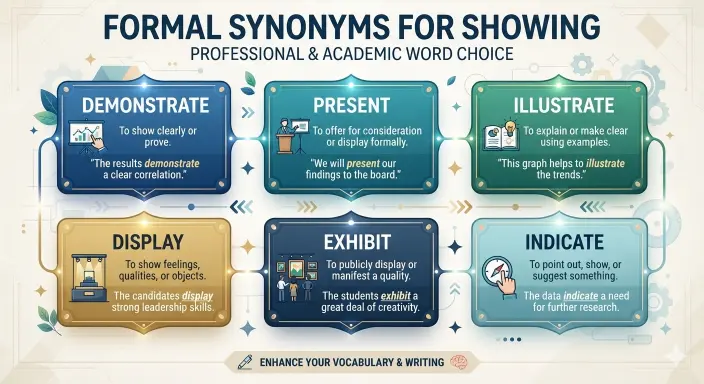
Formal writing often benefits from a more precise verb than showing. The right choice depends on what the sentence is actually saying.
Demonstrating
Meaning: Making something clear through evidence, explanation, or action.
Explanation: Demonstrating is one of the strongest general alternatives to showing. It often suggests that someone makes an idea, skill, result, or fact clear.
Example: The experiment demonstrates the effect of temperature on plant growth.
Best Use: Academic writing, presentations, reports, training, and professional communication.
Worst Use: Avoid it when you simply mean that something is physically visible.
Tone: Formal, precise, and professional.
Indicating
Meaning: Pointing toward a fact, condition, result, or possibility.
Explanation: Indicating is useful when evidence or information suggests something without necessarily proving it.
Example: The survey results indicate a growing interest in remote learning.
Best Use: Research, reports, analysis, business writing, and technical documents.
Worst Use: It may sound inaccurate if the evidence actually proves the claim.
Tone: Formal and analytical.
Presenting
Meaning: Putting information, an object, or an idea before someone for consideration or viewing.
Explanation: Presenting focuses on making information available to an audience. It does not necessarily mean that the information has been proven.
Example: The report presents several possible solutions to the problem.
Best Use: Reports, meetings, presentations, academic writing, and professional documents.
Worst Use: Don’t use it when your meaning is specifically “proving.”
Tone: Professional and neutral-formal.
Establishing
Meaning: Showing or proving that something is true, valid, or accepted.
Explanation: Establishing is stronger than ordinary showing. It suggests that evidence has helped confirm a fact, relationship, or conclusion.
Example: The investigation established a clear connection between the two events.
Best Use: Academic, legal, investigative, and analytical writing.
Worst Use: Avoid it when the evidence is weak or only suggests a possibility.
Tone: Formal and authoritative.
Exhibiting
Meaning: Displaying something so that it can be seen or examined.
Explanation: Exhibiting is especially useful for physical objects, artwork, behavior, or qualities. It can also describe something that clearly displays a characteristic.
Example: The museum is exhibiting several works by local artists.
Best Use: Museums, galleries, formal descriptions, research, and professional writing.
Worst Use: It can sound stiff in ordinary conversation.
Tone: Formal and descriptive.
Documenting
Meaning: Providing a written, visual, or recorded record of something.
Explanation: Documenting is not a direct synonym in every situation. It means showing something through evidence or a record.
Example: The photographs document the building’s condition before renovation.
Best Use: Reports, journalism, research, inspections, and professional records.
Worst Use: Don’t use it if there is no record or evidence involved.
Tone: Formal and factual.
Illustrating
Meaning: Making an idea clearer through an example, image, comparison, or explanation.
Explanation: Illustrating works particularly well when showing an abstract idea through something concrete.
Example: This example illustrates how small changes can affect the final result.
Best Use: Teaching, essays, presentations, guides, and explanatory writing.
Worst Use: It is less suitable when you simply mean displaying a physical object.
Tone: Formal, educational, and clear.
Revealing
Meaning: Making something previously unknown, hidden, or secret known.
Explanation: Revealing adds the idea of uncovering information. It is stronger and more specific than ordinary showing.
Example: The report revealed several weaknesses in the current system.
Best Use: Investigations, reports, journalism, storytelling, and analytical writing.
Worst Use: Don’t use it when the information was already obvious and publicly available.
Tone: Formal, dramatic, or investigative.
Communicating
Meaning: Conveying information, thoughts, feelings, or ideas to another person.
Explanation: Communicating focuses on transferring meaning rather than simply making something visible.
Example: Her tone communicated a strong sense of urgency.
Best Use: Business, education, psychology, professional writing, and interpersonal communication.
Worst Use: It may be too broad when you simply mean “displaying.”
Tone: Professional and neutral.
Signaling
Meaning: Giving a sign or indication of something.
Explanation: Signaling suggests that an action, result, or behavior points toward a particular meaning.
Example: The decline in sales is signaling a change in customer preferences.
Best Use: Business analysis, economics, communication, and formal discussion.
Worst Use: Avoid it if there is no meaningful indication involved.
Tone: Analytical and professional.
Evidencing
Meaning: Providing evidence of something.
Explanation: Evidencing is a formal term that means showing something through evidence. It is less common in everyday English than demonstrating or indicating.
Example: The records provide evidence of consistent improvement.
Best Use: Formal analytical, academic, and professional contexts.
Worst Use: Avoid it in simple everyday writing, where it may sound unnecessarily technical.
Tone: Very formal.
Depicting
Meaning: Representing or showing something in an image, description, film, or other artistic form.
Explanation: Depicting is specifically about representation. It works well for visual or creative content.
Example: The painting depicts a quiet village in winter.
Best Use: Art criticism, literature, film, photography, and descriptive writing.
Worst Use: Don’t use it for ordinary evidence or business data.
Tone: Formal and descriptive.
Semi-Formal and Neutral Synonyms for Showing
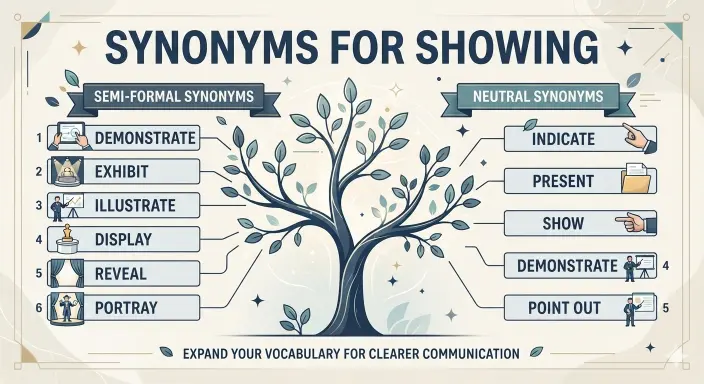
Neutral alternatives are often the safest choices because they work across everyday writing, websites, emails, school assignments, and workplace communication.
Displaying
Meaning: Making something visible or placing it where people can see it.
Explanation: Displaying is one of the closest alternatives when showing means making something visible.
Example: The website is displaying the latest product prices.
Best Use: Websites, stores, screens, photographs, dashboards, and everyday descriptions.
Worst Use: Don’t use it when you mean explaining an abstract idea.
Tone: Neutral and clear.
Highlighting
Meaning: Drawing special attention to something.
Explanation: Highlighting does not mean showing everything. It means directing attention toward a particular point.
Example: The report highlights three major areas for improvement.
Best Use: Reports, presentations, articles, websites, and professional communication.
Worst Use: Avoid it if no special emphasis is intended.
Tone: Neutral and professional.
Pointing Out
Meaning: Directing someone’s attention to something.
Explanation: This phrase is especially useful when showing means helping another person notice something.
Example: The teacher pointed out an error in my calculation.
Best Use: Conversation, teaching, emails, instructions, and workplace discussions.
Worst Use: It can sound slightly direct if used repeatedly in sensitive communication.
Tone: Neutral and conversational.
Explaining
Meaning: Making an idea, process, or situation easier to understand.
Explanation: Explaining is a contextual alternative rather than a perfect synonym. It applies when showing involves helping someone understand.
Example: The instructor explained how the software works.
Best Use: Education, customer service, guides, meetings, and instructions.
Worst Use: Don’t replace showing with explaining when the original sentence refers to visual display.
Tone: Neutral and helpful.
Describing
Meaning: Giving details about something using words.
Explanation: Describing can replace showing when the subject is being made clear through verbal details.
Example: The author describes the character as calm but determined.
Best Use: Essays, stories, reports, reviews, and conversations.
Worst Use: Don’t use it when an image or physical display is doing the work.
Tone: Neutral.
Featuring
Meaning: Including or giving particular prominence to something.
Explanation: Featuring is common for websites, advertisements, articles, films, and product pages.
Example: The homepage features several new products.
Best Use: Marketing, websites, media, entertainment, and product descriptions.
Worst Use: Avoid it when the point is evidence or proof.
Tone: Neutral to promotional.
Expressing
Meaning: Communicating a thought, emotion, attitude, or feeling.
Explanation: Expressing works when showing refers to an internal state made visible through words, actions, or behavior.
Example: She expressed concern about the proposed changes.
Best Use: Emotions, opinions, attitudes, writing, and conversation.
Worst Use: Don’t use it simply to mean placing an object somewhere visible.
Tone: Neutral and personal.
Conveying
Meaning: Communicating or carrying an idea, feeling, or message.
Explanation: Conveying emphasizes the message received by another person.
Example: His expression conveyed a sense of relief.
Best Use: Essays, reviews, communication, literature, and professional writing.
Worst Use: It can sound too abstract for a simple physical display.
Tone: Neutral and polished.
Providing
Meaning: Giving someone information, materials, evidence, or access to something.
Explanation: Providing is useful when showing means supplying information rather than visually displaying it.
Example: The chart provides a clear overview of monthly expenses.
Best Use: Reports, websites, customer service, business writing, and education.
Worst Use: It doesn’t work if the sentence specifically involves visual presentation.
Tone: Neutral and professional.
Identifying
Meaning: Recognizing or naming a particular person, thing, problem, or feature.
Explanation: Identifying can replace showing when the original sentence means making a specific item clear or known.
Example: The analysis identifies several possible causes of the decline.
Best Use: Reports, research, instructions, and analytical writing.
Worst Use: It is not suitable for every instance of displaying something.
Tone: Neutral and analytical.
Informal and Casual Alternatives for Showing
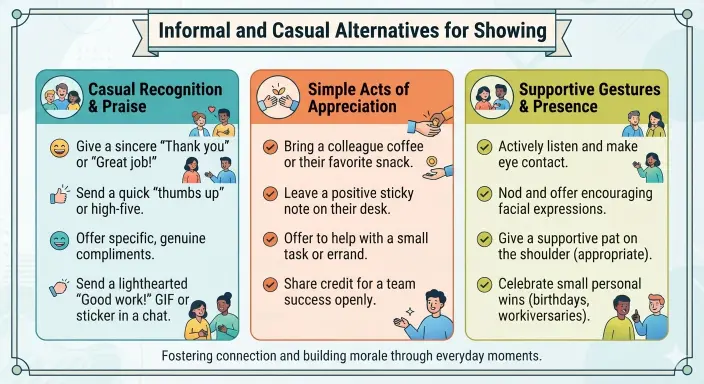
Casual English usually favors short phrases rather than fancy synonyms. These choices work well in conversations, texts, chats, and relaxed writing.
Pointing To
Meaning: Directing attention toward something.
Example: “She’s pointing to the mistake on the screen.”
When it sounds natural: Everyday conversation, classroom talk, and informal explanations.
When to avoid it: Formal reports may benefit from indicating or identifying.
Tone: Casual and direct.
Letting Someone See
Meaning: Allowing another person to look at something.
Example: “Let me let you see the photos.”
When it sounds natural: Friendly conversation and informal situations.
When to avoid it: Professional writing can usually be more concise.
Tone: Very conversational.
Giving Someone a Look At
Meaning: Allowing someone to view something.
Example: “I’ll give you a look at the new design.”
When it sounds natural: Informal conversations and team discussions.
When to avoid it: Academic or formal business writing.
Tone: Casual and friendly.
Bringing Up
Meaning: Introducing a topic, issue, or piece of information.
Example: “She brought up the problem during lunch.”
When it sounds natural: Conversation, texting, meetings, and informal discussion.
When to avoid it: It does not mean physically displaying something.
Tone: Casual.
Laying Out
Meaning: Presenting information in an organized way.
Example: “The manager laid out the plan for the next month.”
When it sounds natural: Workplace conversation and informal explanations.
When to avoid it: It can be too conversational for a formal report.
Tone: Casual to neutral.
True Synonyms vs. Contextual Synonyms for Showing
The biggest mistake is treating every related word as interchangeable. Showing is broad, so the replacement should match the exact action.
| Type | What It Means | Can It Replace the Original? |
|---|---|---|
| True synonym | Has nearly the same basic meaning | Usually |
| Near synonym | Similar meaning with a small difference | Sometimes |
| Contextual alternative | Works only in a particular situation | Depends on context |
| Broader expression | Covers a wider idea than showing | Only in some sentences |
| Narrower expression | Describes one specific kind of showing | Only when that meaning is intended |
For example, displaying is a close match when something is made visible. Demonstrating is better when evidence or a practical example is involved. Revealing adds the idea that information was hidden or unknown. Expressing is appropriate for feelings or opinions.
That distinction keeps your writing accurate instead of simply replacing one word with another from a thesaurus.
Business Writing: Synonyms for Showing
Business writing often becomes stronger when showing is replaced with a more exact verb.
Consider these choices:
- Demonstrating — for results, skills, or capabilities.
- Indicating — for trends and evidence.
- Highlighting — for important findings.
- Presenting — for information or proposals.
- Identifying — for problems or opportunities.
- Documenting — for records and evidence.
- Illustrating — for examples and explanations.
For example:
The data shows an increase in customer demand.
Can become:
The data indicates an increase in customer demand.
Or:
The report highlights an increase in customer demand.
The second version emphasizes importance, while indicates focuses on what the data suggests.
Corporate Communication: Choosing the Right Synonyms
Internal announcements, policies, reports, and presentations need clarity more than impressive vocabulary.
Instead of:
The new policy shows our commitment to employee development.
You might write:
The new policy demonstrates our commitment to employee development.
For a report:
The results indicate that the training program improved performance.
For an announcement:
The new program provides employees with additional training resources.
Choose the verb based on what the sentence actually claims. Stronger words such as establishing or proving should not be used unless the evidence supports that level of certainty.
Academic Writing: Better Synonyms for Showing
Academic writing frequently uses showing, but precise alternatives can make an argument clearer.
Useful choices include:
- Demonstrates — for evidence supporting a conclusion.
- Indicates — for evidence suggesting a result.
- Illustrates — for examples that clarify an idea.
- Reveals — for findings that uncover something.
- Establishes — for evidence that confirms a point.
- Suggests — when the evidence points toward a conclusion.
- Depicts — for images or literary representations.
- Conveys — for meaning, emotion, or ideas.
Example:
The poem shows the speaker’s loneliness.
Depending on the intended meaning:
The poem conveys the speaker’s loneliness.
Or:
The poem reveals the speaker’s growing sense of isolation.
These versions are more precise because they tell the reader how the poem communicates that idea.
Customer Service: Clear and Polite Synonyms
Customer service writing should sound helpful and direct.
Useful alternatives include:
- Show — simple and friendly.
- Explain — when providing instructions.
- Provide — when supplying information.
- Point out — when directing attention.
- Indicate — for system messages or status information.
- Guide — when helping someone through a process.
For example:
The tracking page shows your package status.
A clearer version could be:
The tracking page displays your current package status.
Or:
The tracking information indicates that your package is still in transit.
The best option depends on whether the page visually displays information or whether the information itself suggests a status.
Legal Writing: Precision Matters
Legal writing requires particular care because words can carry specialized meanings. In a general sentence, showing, demonstrating, establishing, and proving may appear related, but they can imply different levels of evidence or certainty.
For example:
The evidence shows that the agreement was signed.
Depending on the intended claim, a writer might use:
The evidence demonstrates that the agreement was signed.
or:
The records establish that the agreement was signed.
Avoid choosing a more forceful term merely because it sounds formal. Proving makes a stronger claim than simply indicating. In legal documents, the exact wording should reflect the applicable facts, evidence, and legal context.
Email Communication: Professional Synonyms for Showing
Professional emails often benefit from simple, specific verbs.
Use:
- Indicate for information or status.
- Demonstrate for results or capabilities.
- Highlight for important points.
- Provide for information or documents.
- Present for proposals or options.
- Point out for a specific detail.
- Explain for instructions.
- Confirm when the purpose is verification rather than showing.
For example:
The attached report shows the latest sales figures.
A polished alternative is:
The attached report provides the latest sales figures.
Or:
The attached report highlights the latest sales trends.
Email Examples Using Synonyms for Showing
Client Communication
Subject: Updated Project Results
Hello Maria,
I’ve attached the latest performance report. The updated figures indicate steady progress across the main project areas.
I’ve also highlighted the two items that still need attention. Please let me know if you’d like to discuss them before Friday’s review.
Best,
Daniel
Project Update
Subject: Design Review Update
Hi Team,
The revised mockups demonstrate how the new layout will work across desktop and mobile screens.
I’ve included both versions in the shared folder. Please review them before tomorrow’s meeting and send any final comments this afternoon.
Thanks,
Aisha
Information Request
Subject: Information for the Proposal
Hi James,
Could you send me the latest figures for the three regions?
The proposal needs to present the current sales picture clearly, so I’d like to use the most recent data available.
Thanks,
Ryan
Customer Service
Subject: Your Order Status
Hello Mr. Carter,
Your tracking information indicates that the package left the distribution center this morning.
The carrier has not provided a delivery time yet, but the tracking page should update as the shipment moves through the network.
Best,
Customer Support
Academic Communication
Subject: Question About the Assignment
Dear Professor Lee,
I’m reviewing the final section of the assignment and would appreciate some clarification about the literary analysis.
Should the essay demonstrate how the theme develops across the entire text, or should I focus primarily on the selected passage?
Thank you,
Nadia
Internal Workplace Email
Subject: Findings From the Survey
Hi everyone,
The employee survey highlights several areas where the current onboarding process could be improved.
I’ve summarized the main findings in the attached document. We can discuss possible changes during Thursday’s meeting.
Best,
Michael
Short Dialogue Examples for Synonyms for Showing
Workplace
Person A: What does this chart show?
Person B: It indicates that sales increased during the second quarter.
Classroom
Person A: How can I make this idea clearer?
Person B: Use an example that illustrates what you mean.
Customer Service
Person A: How can I check my order?
Person B: The tracking page displays the latest shipping information.
Casual Conversation
Person A: Want to see my new photos?
Person B: Sure. Give me a look at them.
Professional Discussion
Person A: Does the report support our conclusion?
Person B: Yes. The results demonstrate a consistent pattern.
How to Replace “Showing” in a Sentence
Example 1
Original: The chart is showing a rise in sales.
Alternative: The chart indicates a rise in sales.
Why it works: Indicates is more precise for data suggesting a trend.
Example 2
Original: The report is showing several problems.
Alternative: The report highlights several problems.
Why it works: Highlights emphasizes that the problems deserve attention.
Example 3
Original: The experiment shows how heat affects the material.
Alternative: The experiment demonstrates how heat affects the material.
Why it works: Demonstrates suits evidence produced through an experiment.
Example 4
Original: The painting shows a family standing near a lake.
Alternative: The painting depicts a family standing near a lake.
Why it works: Depicts is a precise choice for visual representation.
Example 5
Original: Her voice showed her concern.
Alternative: Her voice conveyed her concern.
Why it works: Conveyed focuses on the emotion communicated through her voice.
Example 6
Original: The photographs show the damage.
Alternative: The photographs document the damage.
Why it works: Document adds the idea that the photographs serve as a record.
Example 7
Original: The teacher showed us how to solve the problem.
Alternative: The teacher demonstrated how to solve the problem.
Why it works: Demonstrated clearly describes teaching through an example or procedure.
Example 8
Original: The results show that the plan worked.
Alternative: The results suggest that the plan worked.
Why it works: Suggest is better if the results support the conclusion but do not establish it with certainty.
Example 9
Original: The website shows three payment options.
Alternative: The website displays three payment options.
Why it works: Displays is more specific for information presented visibly on a page.
Example 10
Original: The study shows a connection between sleep and memory.
Alternative: The study indicates a connection between sleep and memory.
Why it works: Indicates avoids overstating what the study establishes.
Comparison Table: Showing and Its Synonyms
| Phrase | Tone | Meaning / Scope | Best Use | Example |
|---|---|---|---|---|
| Showing | Neutral | General display or communication | Everyday writing | The graph is showing the results. |
| Displaying | Neutral | Making something visible | Websites, screens, objects | The screen is displaying the data. |
| Demonstrating | Formal | Making something clear through evidence or action | Academic and professional writing | The test demonstrates the effect. |
| Indicating | Formal | Pointing toward a fact or possibility | Data and analysis | The figures indicate growth. |
| Presenting | Professional | Putting information before an audience | Reports and meetings | The report presents three options. |
| Revealing | Formal | Making hidden information known | Findings and investigations | The audit revealed errors. |
| Illustrating | Formal-neutral | Clarifying with an example or image | Education and essays | The example illustrates the concept. |
| Highlighting | Neutral-professional | Drawing attention to something | Reports and presentations | The report highlights key risks. |
| Expressing | Neutral | Communicating feelings or ideas | Emotions and opinions | She expressed concern. |
| Conveying | Neutral-formal | Communicating meaning or emotion | Writing and communication | His tone conveyed confidence. |
| Proving | Strong | Establishing something as true | Evidence-based claims | The evidence proves the claim. |
| Depicting | Formal | Representing visually or artistically | Art and literature | The painting depicts a city. |
Which Synonyms Should You Choose?
- For formal writing: Choose demonstrating, indicating, establishing, presenting, or illustrating, depending on the meaning.
- For business communication: Indicating, highlighting, presenting, demonstrating, and providing are usually strong choices.
- For academic writing: Prefer demonstrating, indicating, suggesting, illustrating, revealing, or establishing when their meanings fit.
- For legal writing: Choose the most precise term rather than the most formal-sounding one. Establishing and proving should not be used casually because they can imply stronger evidentiary claims.
- For professional email: Providing, indicating, highlighting, presenting, and demonstrating are useful.
- For everyday conversation: Showing, pointing out, explaining, and letting someone see sound natural.
- For casual messages: Short phrases such as pointing to, bringing up, or giving someone a look at can work well.
The safest rule is simple: choose the word that describes the exact kind of showing taking place.
Grammar and Usage Guide for Showing
“Showing” Can Function in Several Ways
Showing is the present participle or gerund form of show.
- As a participle:
The teacher is showing the students a new method.
- As a gerund:
Showing respect for others matters.
- As part of a noun phrase:
The showing of the film begins at eight.
The correct form depends on its grammatical role.
Show Someone Something
English commonly uses the structure:
show + person + thing
Example:
She showed me the report.
You can also say:
show + thing + to + person
Example:
She showed the report to me.
Both are grammatical, although the first is often more natural in everyday English.
Showing vs. Telling
The showing and telling are related but different.
The photograph shows the damage.
The report tells us how the damage occurred.
Showing often involves visual evidence or demonstration. Telling usually involves verbal communication.
Showing vs. Proving
These words should not be treated as exact synonyms.
The evidence shows a possible connection.
is weaker than:
The evidence proves the connection.
Use proves only when the evidence genuinely establishes the claim at the required level of certainty.
Showing vs. Indicating
Indicating often suggests rather than establishes.
The results indicate that demand may increase.
This wording leaves room for uncertainty. That can be more accurate than saying the results “prove” an outcome.
Capitalization
The word showing does not normally require capitalization unless it begins a sentence or appears in a title where title-style capitalization is being used.
Correct:
The report is showing unusual results.
At the beginning:
Showing the results clearly was difficult.
Common Mistakes to Avoid
1. Treating Every Alternative as an Exact Synonym
Demonstrating, revealing, and proving do not mean exactly the same thing. Check the added meaning before replacing showing.
2. Using “Proving” Too Strongly
If evidence only suggests a conclusion, indicating or suggesting may be more accurate than proving.
3. Using “Exhibiting” in Casual Conversation
“Exhibiting” is grammatically correct, but it can sound stiff when talking about ordinary objects or actions.
4. Choosing Formal Words Just to Sound Intelligent
A simple showing may be better than an unnecessarily formal alternative. Clear writing is more valuable than complicated vocabulary.
5. Confusing Display With Explanation
A website can display information, while a teacher may explain it. Those actions overlap but aren’t identical.
6. Ignoring Emotional Meaning
When someone is showing sadness, anger, or concern, expressing or conveying may be more accurate than displaying.
7. Overusing “Indicating”
In research and business writing, repeating indicating in every paragraph can make the prose monotonous. Vary the wording when the meaning genuinely changes.
8. Ignoring the Audience
A phrase such as laying out may sound natural in conversation but less appropriate in a formal research paper.
9. Changing the Level of Certainty
Replacing showing with establishing or proving can make a claim stronger than the evidence supports.
When Not to Use “Showing”
There are several situations where a more precise alternative is better.
1. When You Mean Visual Display
Use displaying when something is physically or digitally visible.
The website displays the current price.
2. When You Mean Evidence
Use demonstrating, indicating, establishing, or proving, depending on the strength of the evidence.
3. When You Mean Emotional Expression
Use expressing or conveying.
His face conveyed disappointment.
4. When You Mean an Artistic Representation
Use depicting or portraying.
5. When You Mean Drawing Attention
Use highlighting or pointing out.
6. When You Mean Making Hidden Information Known
Use revealing or uncovering.
Still, showing is often the better choice. It is short, familiar, flexible, and easy to understand. Don’t replace a perfectly clear word merely to make the sentence sound more sophisticated.
Advanced Writer Tips for Choosing Synonyms for Showing
Tone Control
Use showing for plain, accessible language. Choose demonstrating or indicating for a more formal style. Use conversational expressions such as pointing out when writing dialogue or relaxed messages.
Professional Email Etiquette
Professional writing does not need complicated vocabulary. A sentence such as “The attached document provides the requested figures” is usually stronger than an unnecessarily elaborate alternative.
Politeness
Word choice can affect how direct a statement feels.
The report shows your error.
can sound blunt.
The report highlights an issue with the calculation.
is more neutral and less personal.
Context Alignment
Ask what the subject is actually doing. Is it displaying something? Providing evidence? Expressing emotion? Revealing information? Representing an idea? That question often identifies the correct synonym immediately.
Precision
Choose the narrowest accurate word.
If a chart points toward a trend, use indicating. If an experiment makes a principle clear, use demonstrating. While if a photograph serves as a record, use documenting.
Readability
Don’t replace a familiar word with a longer one without a reason.
The image shows the damaged roof.
is perfectly clear.
The image provides a visual representation of the damaged roofing structure.
is longer without necessarily being better.
Good writing is not about avoiding simple words. It is about using the right words.
Related Questions About Synonyms for Showing
What is another way to say showing?
Depending on the context, you can say displaying, demonstrating, indicating, presenting, revealing, illustrating, highlighting, expressing, conveying, or depicting. The correct choice depends on whether you mean making something visible, providing evidence, communicating an idea, or representing something.
What is a professional synonyms to showing?
Demonstrating, indicating, presenting, highlighting, providing, and documenting are useful professional alternatives. For example, “The data shows a trend” can become “The data indicates a trend,” which sounds precise and natural in business or analytical writing.
What is a formal synonyms to showing?
Demonstrating is one of the closest formal alternatives. Other choices include indicating, establishing, presenting, illustrating, revealing, and documenting. However, each has a slightly different meaning, so the strongest-sounding option is not always the most accurate one.
What can I use instead of showing in academic writing?
Academic writers commonly use demonstrating, indicating, suggesting, illustrating, revealing, establishing, and depicting. Use the word that matches the evidence. For example, suggesting is appropriate when a finding supports an idea without fully establishing it.
Is “showing” formal?
Showing is neutral rather than strongly formal or informal. It is completely acceptable in professional and academic writing, but a more specific alternative can sometimes make the sentence more precise.
Can “displaying” replace showing?
Yes, when showing means making something physically or digitally visible. For example, “The screen is showing the results” can become “The screen is displaying the results.” However, displaying does not normally replace showing when the meaning is proving, explaining, or expressing.
What is the difference between showing and demonstrating?
Showing is broad and can refer to visibility, evidence, explanation, or expression. Demonstrating is more specific and usually suggests making something clear through evidence, an example, or an action. Therefore, demonstrating is often a stronger choice in academic or professional writing.
FAQs
1. What is the closest synonyms for showing?
Displaying is one of the closest synonyms when showing means making something visible. Demonstrating is closer when showing means making an idea or skill clear. Indicating works better when evidence points toward a conclusion. The correct synonym depends on the sentence.
2. Which synonyms for showing is best in academic writing?
Demonstrating, indicating, suggesting, illustrating, and establishing are strong academic choices. Use demonstrating for evidence or examples, indicating for signs or results, and suggesting when the evidence supports but does not fully prove a conclusion.
3. Is “demonstrating” stronger than “showing”?
Usually, yes. Demonstrating often implies that something has been made clear through evidence, an example, or action. Showing is broader and does not necessarily imply a structured demonstration or strong evidence.
4. Can I use “revealing” instead of “showing”?
You can when the sentence involves information becoming known. Revealing adds the idea that something was hidden, unknown, or not previously apparent. It is therefore more specific than showing.
5. What is a good synonyms for showing feelings?
Useful choices include expressing, conveying, displaying, communicating, and revealing. Expressing is especially common for emotions, while conveying focuses on the feeling or message communicated to another person.
6. What is a good synonyms for showing evidence?
Depending on the intended meaning, use demonstrating, indicating, establishing, documenting, or proving. Be careful with proving, because it makes a stronger claim than merely indicating or demonstrating something.
7. What is a good synonyms for showing something visually?
Displaying, presenting, exhibiting, depicting, portraying, and illustrating can work. Displaying is especially natural for screens and objects, while depicting is better for artistic or visual representation.
Key Takeaways
- Showing is a broad word, so the best synonym depends on the exact meaning.
- Use displaying for visible information and demonstrating for evidence, skills, or explanations.
- Choose indicating when something points toward a conclusion rather than fully proving it.
- Use expressing or conveying for emotions, opinions, and messages.
- Don’t choose a formal synonym simply because it sounds sophisticated; choose the most precise and natural word.
Conclusion
The best synonyms for showing are not interchangeable in every sentence. Displaying works for visible information, demonstrating suits evidence or practical examples, and indicating is useful when something points toward a conclusion.
For hidden information, revealing is more precise, while expressing and conveying work well for feelings, opinions, and messages. In creative writing, depicting and portraying can describe artistic representation.
For professional and academic writing, precision matters more than using the most formal word available. Start by identifying what “showing” means in your sentence. Then choose the alternative that preserves the original meaning while matching your audience and tone.
Sometimes the best replacement is a sophisticated verb such as demonstrating. Other times, the simple word showing is already the clearest choice.
