
Finding the right synonyms for give can make your writing more precise, natural, and effective. The verb give is one of the most common words in English, but its meaning changes depending on the sentence. You can give a gift, give advice, give permission, give information, give someone an opportunity, give a speech, or give a reason. Each situation may call for a different alternative.
Some of the closest replacements include provide, offer, supply, present, grant, deliver, donate, and contribute. However, these words are not interchangeable in every sentence. Provide often suggests supplying something needed, while offer suggests making something available.
Grant usually involves permission or a right, and donate implies giving voluntarily for a cause. This guide explains 38+ synonyms for give, including formal, neutral, casual, and context-specific alternatives, with practical examples and grammar tips.
Quick Answer: What Are the Best Synonyms for Give?
The best synonym for give depends on what you are giving and why. Common alternatives include provide, offer, supply, present, grant, donate, contribute, deliver, award, assign, hand, pass, share, and bestow. For professional writing, provide and offer are especially versatile, while grant, award, and allocate are better for specific situations.
Quick List: 38+ Synonyms for Give
Here are useful alternatives organized by meaning and context.
Closest Synonyms for Give
- Provide
- Offer
- Present
- Supply
- Hand
- Pass
- Deliver
- Contribute
- Donate
- Share
- Transfer
- Grant
Formal Synonyms for Give
- Bestow
- Confer
- Grant
- Award
- Allocate
- Assign
- Provide
- Furnish
- Render
- Impart
- Distribute
- Contribute
Neutral Synonyms for Give
- Offer
- Provide
- Supply
- Present
- Deliver
- Share
- Send
- Hand
- Pass
- Transfer
- Extend
- Submit
Contextual Synonyms for Give
- Donate
- Award
- Grant
- Allocate
- Assign
- Issue
- Release
- Deliver
- Administer
- Devote
- Yield
- Produce
Casual Synonyms for Give
- Hand
- Pass
- Send
- Share
- Fork over
- Hand over
- Shell out
- Chip in
The right choice depends on the meaning of give in your original sentence. Some are true or near synonyms, while others are useful only in specific contexts.
Formal Synonyms for Give
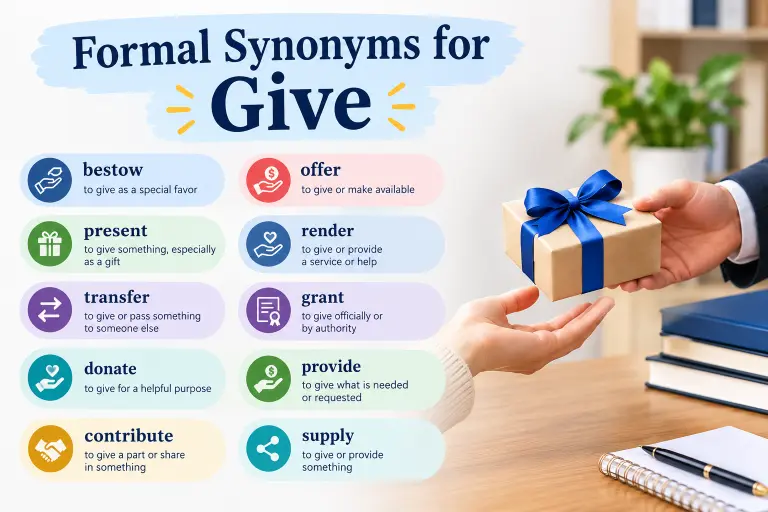
Formal alternatives can improve academic writing, business documents, reports, applications, and official communication. However, a formal word is not automatically a better word. Precision should come first.
Provide
Meaning: To make something available or supply something that is needed.
Explanation: Provide is one of the most useful formal alternatives to give. It commonly refers to information, services, resources, assistance, or opportunities.
Example: The organization provides financial assistance to eligible students.
Best Use: Business writing, academic writing, websites, reports, and professional emails.
Worst Use: Avoid it when give describes a physical action that has nothing to do with supplying something.
Tone: Neutral to formal.
Offer
Meaning: To make something available or express willingness to give or do something.
Explanation: Offer differs slightly from give because it often suggests that the recipient can accept or reject what is being offered.
Example: The company offered employees additional training.
Best Use: Customer service, business communication, invitations, assistance, and opportunities.
Worst Use: Don’t use it when something has already been transferred.
Tone: Professional and approachable.
Grant
Meaning: To officially give permission, a right, request, or benefit.
Explanation: Grant is narrower than give. It usually involves authority or a formal decision.
Example: The committee granted the researcher permission to access the archive.
Best Use: Official documents, legal contexts, institutions, and formal requests.
Worst Use: It sounds unnatural for ordinary gifts or everyday objects.
Tone: Formal and authoritative.
Award
Meaning: To officially give something as a prize, honor, or result of achievement.
Explanation: Award should be used when something is given because a person or group has earned or been selected for it.
Example: The university awarded Maya a scholarship.
Best Use: Scholarships, prizes, contracts, grants, medals, and honors.
Worst Use: Don’t use it for ordinary gifts.
Tone: Formal and institutional.
Bestow
Meaning: To give something valuable, important, or honorable.
Explanation: Bestow is a highly formal alternative. It often appears with words such as honor, title, blessing, or award.
Example: The organization bestowed its highest honor on the scientist.
Best Use: Ceremonial, literary, historical, and formal writing.
Worst Use: Everyday situations such as giving someone a pen or sending an email.
Tone: Very formal and ceremonial.
Confer
Meaning: To officially give a title, degree, honor, or benefit.
Explanation: Confer is a specialized formal word. It is especially common with academic degrees and honors.
Example: The university conferred an honorary degree on the author.
Best Use: Academic, institutional, and ceremonial contexts.
Worst Use: Casual communication and ordinary physical objects.
Tone: Formal.
Allocate
Meaning: To distribute something for a particular purpose.
Explanation: Allocate is useful when resources, money, time, space, or responsibilities are deliberately assigned.
Example: The department allocated additional funds to the research project.
Best Use: Business, finance, management, and planning.
Worst Use: It is too technical for simple personal giving.
Tone: Formal and administrative.
Assign
Meaning: To give someone a task, responsibility, role, or piece of work.
Explanation: Assign is not a general synonym for give. It works when something is officially or deliberately given to someone as a responsibility.
Example: The manager assigned the task to Jordan.
Best Use: Education, management, project work, and administration.
Worst Use: Don’t use it for gifts, money, or ordinary acts of generosity.
Tone: Neutral to formal.
Furnish
Meaning: To provide or supply something, especially information or equipment.
Explanation: Furnish is a formal alternative often used with information, documents, evidence, or equipment.
Example: Please furnish the requested documents by Friday.
Best Use: Official correspondence, contracts, business writing, and formal requests.
Worst Use: It can sound stiff in everyday conversation.
Tone: Formal.
Render
Meaning: To provide or deliver a service, assistance, judgment, or decision.
Explanation: Render has several meanings, but in formal English it can mean to provide something, especially a service or official action.
Example: The organization rendered assistance to the affected community.
Best Use: Legal, professional, technical, and formal writing.
Worst Use: Avoid it as a general substitute for give.
Tone: Formal and specialized.
Impart
Meaning: To communicate or pass knowledge, information, or wisdom to someone.
Explanation: Impart is narrower than give. It is normally used for knowledge, understanding, information, or wisdom.
Example: The instructor imparted valuable practical knowledge to the students.
Best Use: Academic, educational, literary, and formal writing.
Worst Use: Don’t use it for physical objects or money.
Tone: Formal and intellectual.
Distribute
Meaning: To give or spread something among several people or places.
Explanation: Distribute emphasizes division among recipients.
Example: Volunteers distributed food to families in the area.
Best Use: Organizations, logistics, education, charity, and business.
Worst Use: It is unnecessary when something is given to just one person.
Tone: Neutral to formal.
Contribute
Meaning: To give money, effort, ideas, or resources toward a shared purpose.
Explanation: Contribute focuses on adding something to a project, cause, group, or effort rather than simply transferring it.
Example: Several employees contributed ideas during the planning session.
Best Use: Teamwork, fundraising, research, projects, and community activities.
Worst Use: It doesn’t work for every direct exchange.
Tone: Neutral and professional.
Devote
Meaning: To give time, attention, energy, or effort to something.
Explanation: Devote is used for personal resources rather than ordinary objects.
Example: She devoted several hours to preparing the presentation.
Best Use: Essays, personal statements, professional writing, and formal descriptions.
Worst Use: Never use it as a direct substitute for giving a physical gift.
Tone: Formal and purposeful.
Extend
Meaning: To offer or provide something such as help, an invitation, a courtesy, or a welcome.
Explanation: Extend is a formal contextual alternative. Common combinations include extend an invitation, extend assistance, and extend an offer.
Example: We would like to extend an invitation to the annual conference.
Best Use: Business letters, formal invitations, and professional communication.
Worst Use: It can sound overly formal for simple everyday situations.
Tone: Formal and courteous.
Semi-Formal and Neutral Synonyms for Give
These alternatives are useful in everyday writing, workplace communication, school assignments, websites, and ordinary professional conversations.
Supply
Meaning: To provide something that is needed or used.
Explanation: Supply often suggests an ongoing or sufficient amount of something.
Example: The company supplies equipment to local schools.
Best Use: Business, manufacturing, education, and practical communication.
Worst Use: It sounds unnatural for giving a personal gift.
Tone: Neutral and practical.
Present
Meaning: To formally or publicly give something to someone.
Explanation: Present often describes giving an award, gift, certificate, or information.
Example: The director presented the award to the winning team.
Best Use: Ceremonies, meetings, presentations, and formal occasions.
Worst Use: Don’t use it for every ordinary act of giving.
Tone: Neutral to formal.
Deliver
Meaning: To take or send something to a person or place.
Explanation: Deliver focuses on getting something to its intended recipient.
Example: The courier delivered the package this morning.
Best Use: Packages, services, messages, speeches, and business operations.
Worst Use: It can be misleading when there is no movement or transmission involved.
Tone: Neutral and professional.
Share
Meaning: To give part of something to another person or group.
Explanation: Share suggests that the giver and recipient may both have access to or benefit from something.
Example: She shared her notes with the rest of the class.
Best Use: Information, food, ideas, experiences, files, and resources.
Worst Use: It may not fit situations involving complete transfer of ownership.
Tone: Friendly and neutral.
Hand
Meaning: To give something directly to someone, usually by placing it in their hand.
Explanation: Hand describes a physical transfer and is more specific than give.
Example: Please hand me the keys.
Best Use: Everyday conversation and physical objects.
Worst Use: Formal writing when a more precise verb is available.
Tone: Casual and direct.
Pass
Meaning: To move or give something from one person to another.
Explanation: Pass commonly describes physical objects, information, or opportunities moving between people.
Example: Could you pass me the salt?
Best Use: Everyday conversation, meetings, games, and informal situations.
Worst Use: Avoid it when the item is formally transferred or permanently awarded.
Tone: Casual and neutral.
Transfer
Meaning: To move something from one person, account, place, or system to another.
Explanation: Transfer is more precise than give when ownership, responsibility, money, or control changes.
Example: The bank transferred the funds to the new account.
Best Use: Banking, business, technology, education, and administration.
Worst Use: It sounds too technical for ordinary gifts.
Tone: Neutral and formal.
Send
Meaning: To cause something to go to another person or place.
Explanation: Send is appropriate when something is delivered through mail, email, messaging, shipping, or another communication method.
Example: I’ll send you the report this afternoon.
Best Use: Emails, messages, packages, documents, and digital communication.
Worst Use: Don’t use it when you’re physically handing something to someone.
Tone: Neutral.
Issue
Meaning: To officially provide or distribute something.
Explanation: Issue is a formal, narrower alternative commonly used for documents, permits, tickets, statements, and official items.
Example: The office issued a new identification card.
Best Use: Government, business, administration, and official communication.
Worst Use: It is inappropriate for ordinary personal gifts.
Tone: Formal and administrative.
Release
Meaning: To make something available or allow it to leave control.
Explanation: Release can replace give when information, products, funds, statements, or content are made available.
Example: The company released its annual report on Monday.
Best Use: Media, business, technology, publishing, and public communication.
Worst Use: Don’t use it when someone simply hands another person an object.
Tone: Neutral and professional.
Yield
Meaning: To produce, provide, or surrender something.
Explanation: Yield has several meanings and should be used only when the context supports them.
Example: The investment yielded a modest return.
Best Use: Finance, agriculture, economics, and technical writing.
Worst Use: Everyday situations involving ordinary gifts or favors.
Tone: Formal and technical.
Produce
Meaning: To create or generate something.
Explanation: Produce can sometimes replace give when give means “result in” or “cause.”
Example: The new process gave better results.
Alternative: The new process produced better results.
Best Use: Technical, scientific, business, and analytical writing.
Worst Use: It does not mean physically giving an object to another person.
Tone: Neutral and professional.
Informal and Casual Alternatives to Give

English does not have many universal slang replacements for give. Most casual alternatives describe a particular kind of giving.
Hand Over
Meaning: To give something directly, often deliberately or reluctantly.
Example: He handed over the keys before leaving.
When it sounds natural: Everyday speech and informal writing.
When to avoid it: Formal documents unless describing a literal transfer.
Tone: Casual and direct.
Fork Over
Meaning: To reluctantly give money or something valuable.
Example: I had to fork over $20 for the replacement ticket.
When it sounds natural: Informal conversation and humorous writing.
When to avoid it: Professional emails, academic work, and formal communication.
Tone: Informal and slightly humorous.
Shell Out
Meaning: To spend or give money, often unwillingly.
Example: We had to shell out extra money for parking.
When it sounds natural: Casual conversation.
When to avoid it: Business reports and formal financial writing.
Tone: Informal.
Chip In
Meaning: To contribute money, effort, or help.
Example: Everyone chipped in to buy a gift for the teacher.
When it sounds natural: Friendly conversations and group activities.
When to avoid it: Formal business writing.
Tone: Casual and cooperative.
Hand
Example: Can you hand me that notebook?
When it sounds natural: Everyday speech.
When to avoid it: Academic or formal writing where give or provide is more suitable.
Tone: Casual.
Pass
Example: Pass me the remote, please.
When it sounds natural: Informal spoken English.
When to avoid it: Formal contexts involving official transfer or ownership.
Tone: Casual.
True Synonyms vs. Contextual Alternatives for Give
Because give has many meanings, no single synonym can replace it in every sentence.
| Type | What It Means | Can It Replace Give? |
|---|---|---|
| True synonym | Nearly the same meaning in the same context | Usually |
| Near synonym | Similar meaning with a slight difference | Sometimes |
| Contextual alternative | Works for one particular meaning of give | Only in that context |
| Broader expression | Covers a wider idea | Sometimes |
| Narrower expression | Adds a specific type of giving | Only when that meaning is intended |
Consider these examples:
She gave me some information.
She provided me with some information.
This works naturally.
But:
She gave me her old bicycle.
doesn’t normally become:
She provided me with her old bicycle.
The second sentence sounds more like supplying an item than transferring a personal possession.
Likewise:
The university gave him a scholarship.
can become:
The university awarded him a scholarship.
Here, awarded is more precise because the scholarship is a benefit granted through an official decision.
Industry-Specific Usage of Give
Business Writing
Business writing often benefits from provide, offer, supply, allocate, deliver, and present.
Instead of:
The company gives support to new clients.
consider:
The company provides support to new clients.
For resources:
The department allocated additional funds to the project.
For opportunities:
The company offers employees flexible scheduling.
Corporate Communication
Corporate documents should favor precise verbs.
Reports:
“The program provided measurable benefits.”
Policies:
“The policy grants employees access to the new system.”
Announcements:
“The company will issue updated identification cards.”
Internal communication:
“The manager assigned each team member a specific task.”
The key is to match the verb with the action rather than choosing a synonym merely for variety.
Academic Writing
Academic writing often uses provide, present, demonstrate, offer, contribute, and impart.
Example:
The study provides evidence that the method is effective.
Here, provide sounds natural and precise.
For information:
The article presents several possible explanations.
For research contributions:
The study contributes new evidence to the field.
Customer Service
Customer-facing writing should be clear and polite.
Instead of:
We will give you a refund.
you might write:
We will issue your refund within five business days.
Or:
We can offer you a replacement at no additional cost.
These alternatives explain the exact action more clearly.
Legal Writing
Legal documents often require specialized verbs such as grant, assign, transfer, convey, issue, and provide. These terms can carry specific meanings that ordinary give does not.
For example:
The agreement grants the client permission to use the material.
is more precise than:
The agreement gives the client permission to use the material.
Likewise, transfer may refer to a formal change of ownership or rights. Because legal terminology varies by document and jurisdiction, don’t replace a legally significant term simply for stylistic variety.
Email Communication
Professional emails commonly use:
- Provide for information or documents
- Offer for help or opportunities
- Send for messages and files
- Share for information or resources
- Grant for permissions
- Assign for tasks
- Present for formal information or awards
These choices make the purpose of the action easier for the reader to understand.
Email Examples Using Synonyms for Give
Client Communication
Subject: Additional Project Information
Hi Daniel,
I wanted to provide you with the updated project schedule before tomorrow’s meeting. The document includes the revised deadlines and the items currently awaiting approval.
Please let me know if you’d like me to clarify anything.
Best,
Sarah
Project Update
Subject: New Testing Results
Hi Team,
I’m sharing the latest testing results ahead of our Friday review. The results show that the new version performs better under heavier workloads.
We’ll discuss the remaining issues during the meeting.
Thanks,
Michael
Professional Request
Subject: Request for Updated Documents
Hi Laura,
Could you please send the latest version of the contract and pricing sheet? I’d like to review both before our discussion with the client.
Thank you,
James
Customer Service
Subject: Your Replacement Order
Hi Olivia,
We’re happy to offer you a replacement for the damaged item at no additional cost. Your new order has already been processed and will ship within two business days.
Best,
Customer Support
Academic Communication
Subject: Permission to Submit Revised Assignment
Dear Professor Adams,
I would like to request permission to submit a revised version of my research paper. I have addressed the feedback from the first submission and would appreciate the opportunity to make the corrections.
Thank you for considering my request.
Best regards,
Daniel
Internal Workplace Email
Subject: Task Assignments for Next Week
Hi Team,
I’ve assigned each person a section of the upcoming report. Please review your section and let me know by Wednesday if you need additional information.
Thanks,
Maya
Vendor Communication
Subject: Updated Purchase Order
Hello Mark,
Please find the updated purchase order attached. We’ve allocated additional units to the second shipment based on the revised demand forecast.
Regards,
Chris
Short Dialogue Examples Using Alternatives for Give
Workplace
Person A: Can you give me the sales figures?
Person B: Sure. I’ll provide the updated figures before lunch.
Classroom
Person A: Can you give us another example?
Person B: Of course. I’ll present one that shows how the rule works.
Customer Service
Person A: Can you give me a refund?
Person B: Yes. We can issue the refund once the return is processed.
Casual Conversation
Person A: Can you give me the remote?
Person B: Sure. Here you go.
Professional Discussion
Person A: Who will give the presentation?
Person B: Maria will deliver it during the afternoon session.
How to Replace “Give” in a Sentence
Example 1
Original:
The company gives employees training.
Alternative:
The company provides employees with training.
Why it works:
Provide is more natural in professional writing when describing services or resources.
Example 2
Original:
She gave me some useful advice.
Alternative:
She offered me some useful advice.
Why it works:
Offer works well because the advice is being made available to the recipient.
Example 3
Original:
The university gave him a scholarship.
Alternative:
The university awarded him a scholarship.
Why it works:
Award shows that the scholarship was officially granted based on a decision or achievement.
Example 4
Original:
The manager gave me a new task.
Alternative:
The manager assigned me a new task.
Why it works:
Assign specifically describes giving someone responsibility or work.
Example 5
Original:
The organization gave money to the charity.
Alternative:
The organization donated money to the charity.
Why it works:
Donate makes the charitable purpose explicit.
Example 6
Original:
Please give me the documents.
Alternative:
Please provide me with the documents.
Why it works:
Provide sounds more professional in a formal request.
Example 7
Original:
He gave the keys to the receptionist.
Alternative:
He handed the keys to the receptionist.
Why it works:
Handed emphasizes the physical transfer.
Example 8
Original:
The bank gave the money to another account.
Alternative:
The bank transferred the money to another account.
Why it works:
Transfer precisely describes moving funds from one account to another.
Example 9
Original:
The manager gave permission to the employee.
Alternative:
The manager granted permission to the employee.
Why it works:
Grant is a natural formal verb for officially allowing something.
Example 10
Original:
The researcher gave important information to the students.
Alternative:
The researcher imparted important information to the students.
Why it works:
Impart specifically relates to passing knowledge or information, although it sounds more formal.
Comparison Table: Synonyms for Give
| Phrase | Tone | Meaning / Scope | Best Use | Example |
|---|---|---|---|---|
| Provide | Neutral/Formal | Supply something needed | Business, academic | Provide information |
| Offer | Neutral | Make something available | Help, opportunities | Offer assistance |
| Supply | Neutral/Formal | Provide needed resources | Business, logistics | Supply equipment |
| Present | Formal/Neutral | Give publicly or formally | Awards, information | Present an award |
| Grant | Formal | Officially give permission/right | Legal, institutional | Grant permission |
| Award | Formal | Give a prize or benefit | Scholarships, honors | Award a scholarship |
| Allocate | Formal | Set aside resources | Finance, management | Allocate funds |
| Assign | Neutral/Formal | Give a task or responsibility | Work, school | Assign a task |
| Donate | Neutral | Give for a charitable purpose | Charity | Donate money |
| Contribute | Neutral | Add money, effort, or ideas | Projects, causes | Contribute ideas |
| Share | Neutral/Casual | Give part for joint use | Information, resources | Share notes |
| Deliver | Neutral | Take or send to recipient | Packages, services | Deliver a package |
| Transfer | Formal/Neutral | Move ownership or control | Banking, business | Transfer funds |
| Hand | Casual | Physically give | Objects | Hand me the keys |
| Pass | Casual | Move from one person to another | Objects, games | Pass the book |
| Bestow | Very Formal | Give honor or title | Ceremonial writing | Bestow an honor |
| Impart | Formal | Pass knowledge or information | Education | Impart knowledge |
| Distribute | Formal/Neutral | Give among multiple recipients | Supplies, materials | Distribute food |
| Extend | Formal | Offer a courtesy or invitation | Business | Extend an invitation |
| Issue | Formal | Officially provide | Documents, permits | Issue a permit |
Which Alternative Should You Choose?
For Formal Writing
Use provide, grant, confer, furnish, bestow, or allocate, depending on the meaning.
For Business Communication
Choose provide, offer, supply, deliver, allocate, or assign. These verbs clearly describe common workplace actions.
For Academic Writing
Use provide, present, contribute, impart, or offer. Provide is particularly versatile.
For Legal Writing
Use precise terms such as grant, assign, transfer, convey, or issue when their specific meanings apply. Don’t replace legal terminology casually.
For Professional Email
Provide, offer, send, share, and extend are generally effective.
For Everyday Conversation
Give, hand, pass, send, and share usually sound natural.
For Casual Messages
Use hand, pass, share, chip in, or fork over when the context is informal and the meaning fits.
Grammar and Usage Guide for Give
Give as a Transitive Verb
Give commonly takes a direct object.
She gave me a book.
Here, book is the direct object and me is the indirect object.
Give With Two Objects
The common pattern is:
give + person + thing
Example:
He gave Sarah the report.
You can also use:
give + thing + to + person
Example:
He gave the report to Sarah.
Both structures are grammatical.
Give + Gerund
Give appears in several fixed expressions involving -ing forms.
Give it a try.
Give me a chance.
Give it some thought.
These expressions should generally be learned as natural combinations rather than translated word for word.
Give Advice
In standard English, say:
give advice
not:
give an advice
Advice is normally an uncountable noun.
Correct:
She gave me some advice.
Incorrect:
She gave me an advice.
Give Information
Information is also normally uncountable.
Correct:
Please give me some information.
More formal:
Please provide some information.
Give Permission
Common combinations include:
give permission
grant permission
Grant permission is usually more formal.
Give Someone a Chance
This expression means to allow someone an opportunity.
Give him a chance to explain.
A formal alternative is:
Give him an opportunity to explain.
Give a Speech
The phrase give a speech is natural, but deliver a speech is often more formal.
She gave a speech at the ceremony.
She delivered a speech at the ceremony.
Phrasal Verbs With Give
Give also appears in many phrasal verbs whose meanings cannot be predicted from give alone.
Examples include:
- Give up — stop trying or surrender
- Give away — donate or reveal
- Give back — return something
- Give in — stop resisting
- Give out — distribute or stop functioning
- Give off — produce a smell, heat, or light
- Give in to — stop resisting a desire or pressure
- Give rise to — cause something
These are not simple synonyms for give. Their meanings depend on the particle that follows the verb.
Common Mistakes to Avoid With Synonyms for Give
1. Treating Every Alternative as Exact
Provide, donate, award, and grant all involve giving, but each has a different meaning.
2. Using “Donate” for Ordinary Transfers
You donate money or goods to a charity or cause. You normally don’t donate a pen to your coworker unless the context is intentionally charitable.
3. Using “Award” for Ordinary Gifts
An award is normally connected to recognition, achievement, selection, or an official decision.
4. Using “Provide” for Every Meaning
Provide works well for services, resources, information, and support, but it can sound unnatural for simple physical transfers.
5. Confusing “Offer” With “Give”
An offer is something made available. It may not actually be accepted or transferred.
6. Overusing Formal Vocabulary
Words such as bestow, confer, and furnish can make simple writing sound unnecessarily stiff.
7. Using Casual Expressions at Work
Expressions such as fork over and shell out are inappropriate for most professional emails.
8. Changing the Meaning
Replacing give with allocate changes a general act of giving into a deliberate distribution of resources.
9. Ignoring Grammar Patterns
Some alternatives require different structures.
Give me the report.
can become:
Provide me with the report.
But the grammar doesn’t work identically for every synonym.
10. Replacing Give Just to Avoid Repetition
Repetition isn’t always bad. If give is the clearest word, keep it. Good writing values precision over forced vocabulary variety.
When Not to Use “Give”
When the Action Is Official
Use grant, award, or issue when an official authority provides something.
The agency issued a permit.
When You Mean a Charitable Donation
Use donate if the context is charitable.
They donated supplies to the shelter.
When Resources Are Deliberately Divided
Use allocate.
The committee allocated funds to three departments.
When Someone Receives a Task
Use assign.
The teacher assigned the students a research project.
When Money or Ownership Is Moved
Use transfer when the emphasis is on moving funds, ownership, or control.
When You Need a More Precise Professional Verb
A vague sentence such as:
We will give support.
can become:
We will provide technical support.
The second version tells the reader exactly what is being supplied.
When “Give” Is Actually the Better Choice
Don’t avoid give simply because it is common. It is short, flexible, and completely natural in many contexts.
Give me a minute.
Give her the message.
He gave his friend a birthday gift.
Replacing these with formal alternatives may make the writing worse rather than better.
Advanced Writer Tips for Using Synonyms for Give
Tone Control
Use give for simple, direct communication. Choose provide for professional clarity, grant for official permission, and bestow for ceremonial language.
Compare:
The company gave employees access to the software.
The company provided employees with access to the software.
The second version sounds more polished without being unnecessarily formal.
Professional Email Etiquette
Avoid vocabulary that sounds impressive but doesn’t add precision.
Instead of:
We hereby furnish the aforementioned information.
write:
I’ve provided the requested information below.
Clear professional English is usually better than legal-sounding language.
Politeness
The surrounding structure can affect politeness.
Give me the report.
- is direct.
Could you send me the report?
- is more polite.
Could you please provide the report when you have a chance?
- is more formal, although it may be unnecessarily wordy depending on the situation.
Context Alignment
Ask what is actually happening:
- Is something being supplied? → provide
- Is something being made available? → offer
- Is permission being given? → grant
- Is a prize being given? → award
- Is money being donated? → donate
- Is a task being given? → assign
- Are resources being divided? → allocate
- Is knowledge being passed on? → impart
- Is something physically transferred? → hand
- Is money or ownership moved? → transfer
Precision
The strongest synonym is the one that tells the reader what kind of giving occurred.
Compare:
The school gave students computers.
with:
The school provided students with computers.
The second version emphasizes supplying equipment.
But:
The school donated computers to the community center.
adds a charitable context that provide does not.
Readability
Don’t replace a short, familiar word with a complicated phrase unless the change improves accuracy.
Please give me your feedback.
is perfectly natural.
Please furnish me with your evaluative observations.
is unnecessarily formal.
Use sophisticated vocabulary when it communicates something specific, not simply because it sounds advanced.
Related Questions About Synonyms for Give
What is another way to say give?
Common alternatives include provide, offer, supply, present, grant, award, donate, share, deliver, and contribute. The correct choice depends on the type of giving. Provide is useful for resources, offer for availability, and grant for official permission or rights.
What is a professional alternative to give?
Provide is usually the most versatile professional alternative. Depending on context, offer, supply, deliver, assign, and allocate may be more precise.
What is a formal alternative to give?
Formal alternatives include provide, grant, confer, bestow, furnish, render, impart, allocate, and award. Each describes a different type of giving, so meaning should guide the choice.
What can I use instead of give in an essay?
For academic writing, try provide, present, offer, contribute, demonstrate, impart, or grant, depending on the sentence. Provide is particularly useful when discussing evidence, information, resources, or support.
Is give formal or informal?
Give is a neutral, everyday English verb. It works in casual conversation, professional emails, academic writing, and formal speech. Its simplicity does not make it informal or incorrect.
Can provide always replace give?
No. Provide is mainly used when something is supplied, made available, or offered as a resource or service. It may sound unnatural when give describes a simple personal or physical transfer.
What is the difference between give and offer?
Give usually indicates an actual transfer, while offer means making something available for someone to accept or reject. For example, “She gave me a seat” indicates that she actually provided it, while “She offered me a seat” describes the offer itself.
FAQs About Synonyms for Give
What is the closest synonym for give?
There isn’t one universal synonym because give has many meanings. Provide is one of the closest professional alternatives when something is supplied, while offer works when something is made available. For physical transfer, hand or pass may be more accurate.
What is the best synonym for give in professional writing?
Provide is usually the safest choice when referring to information, assistance, resources, or services. Other options may be better for specific actions, such as grant for permission, assign for tasks, and allocate for resources.
What is the difference between provide and give?
Both can mean supplying something, but provide often sounds more professional and emphasizes making something available or meeting a need. Give is broader and works across many more situations, including gifts, physical transfers, permission, advice, and personal actions.
Is “give” too simple for academic writing?
No. Give is grammatically correct and can be appropriate in academic writing. However, a more specific verb may communicate the intended meaning more clearly. For example, provide evidence is often more precise than give evidence.
What is a formal synonym for give permission?
Grant permission is a common formal alternative. In institutional or legal contexts, authorize may also be appropriate when the meaning is to officially allow an action.
What is a synonym for give money?
The best word depends on the purpose. Use donate for charitable giving, contribute for money added to a shared cause or project, allocate for officially setting aside funds, and pay when money is exchanged for goods or services.
How can I avoid repeating the word give?
First identify what give means in each sentence. Replace it only when another verb is more precise. For example, use provide for information, assign for tasks, award for prizes, donate for charity, and transfer for ownership or funds.
Key Takeaways
- Give is a broad verb, so its best synonym depends on the specific action and context.
- Use provide for resources, information, assistance, and services in professional writing.
- Choose offer, grant, award, donate, assign, or allocate when those more specific meanings apply.
- Casual choices such as hand, pass, chip in, and fork over should match the audience and situation.
- Don’t replace give automatically; a simple, accurate word is often better than an unnecessarily formal synonym.
Conclusion
The best synonyms for give aren’t simply the words that look similar in a thesaurus. The right alternative depends on what is being given, who receives it, and why the transfer happens. Provide is one of the most flexible choices for professional and academic writing, while offer works well when something is made available. For more specific situations, use grant for permission, award for prizes or honors, donate for charitable giving, assign for responsibilities, and allocate for resources.
In everyday conversation, there is often no need to replace give. Words such as hand, pass, share, and send can make a sentence more specific when they accurately describe the action. Formal options such as bestow, confer, furnish, and impart have their place, but they should be used selectively. The strongest writer doesn’t simply avoid common words; they choose the verb that communicates the exact meaning with the least confusion.
