
The right synonyms for connect can make your writing more precise, natural, and engaging. The word connect has several meanings: joining physical things, creating relationships, linking ideas, communicating with someone, or forming an emotional bond.
Because of these different meanings, the best alternative depends on the sentence and context.You might use connect in a business email, academic essay, website, technical explanation, customer-service message, or casual conversation.
Words such as link, associate, establish contact, communicate, join, relate, and bond can work, but they are not always interchangeable. This guide explains more than 34 useful alternatives and shows exactly when each one fits.
Quick Answer: Synonyms for Connect
Common synonyms for connect include link, join, unite, associate, relate, attach, combine, tie, bridge, communicate, contact, interact, engage, bond, correspond, establish contact, integrate, coordinate, network, and collaborate. The best choice depends on whether you mean physical connection, communication, logical relationship, technology, or an emotional bond.
Quick List: 34+ Synonyms for Connect
Here are useful alternatives grouped by meaning and tone:
Closest Synonyms for Connect
- Link
- Join
- Unite
- Attach
- Combine
- Tie
- Couple
- Relate
- Associate
- Bind
Formal Synonyms for Connect
- Establish contact
- Establish a relationship
- Integrate
- Coordinate
- Correspond
- Associate
- Interrelate
- Facilitate communication
- Form an association
- Forge a relationship
Neutral and Professional Synonyms for Connect
- Communicate
- Contact
- Interact
- Collaborate
- Network
- Engage
- Coordinate
- Link together
- Bring together
- Build a relationship
Casual Synonyms for Connect
- Get in touch
- Reach out
- Meet up
- Hit it off
- Click
- Keep in touch
- Get together
Contextual Synonyms for Connect
- Bridge
- Relate to
- Identify with
- Tie together
- Integrate
- Pair
- Match
- Correspond with
Formal Synonyms for Connect
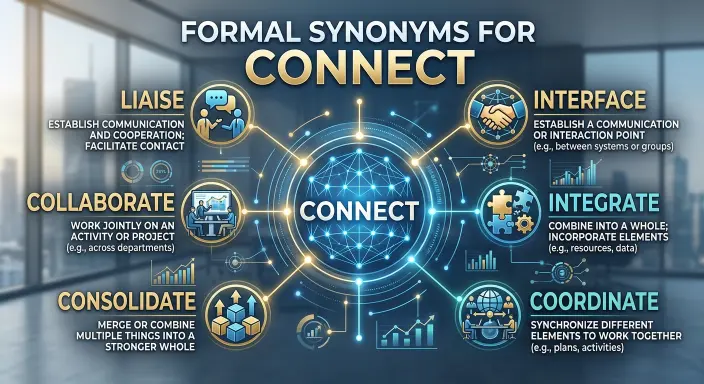
Formal alternatives are useful when you are writing reports, academic papers, business documents, professional emails, or official communications. However, a formal word should only be used when its meaning matches the original.
Establish Contact
Meaning: To begin communication with someone.
Explanation: This is a formal alternative when connect means making contact with a person or organization. It does not mean physically joining things.
Example: The researcher established contact with several local organizations.
Best Use: Business letters, academic writing, professional communication, and official correspondence.
Worst Use: Casual conversations, where get in touch sounds more natural.
Tone: Formal and professional.
Establish a Relationship
Meaning: To begin developing a professional or personal relationship.
Explanation: This phrase is more specific than connect. It focuses on creating an ongoing relationship rather than simply communicating once.
Example: The company hopes to establish a long-term relationship with regional suppliers.
Best Use: Business writing, partnerships, networking, and professional reports.
Worst Use: A simple phone call or brief interaction.
Tone: Formal and purposeful.
Integrate
Meaning: To combine something into a larger system or whole.
Explanation: Integrate works when connecting means making separate parts function together. It is especially common in technology, education, business, and systems management.
Example: The new software integrates customer data from several platforms.
Best Use: Technical, business, academic, and organizational writing.
Worst Use: Describing a friendly conversation.
Tone: Formal and technical.
Coordinate
Meaning: To organize people or activities so they work together.
Explanation: Coordinate is a contextual alternative rather than a perfect synonym. It emphasizes organized cooperation.
Example: The project manager coordinated the efforts of three departments.
Best Use: Business, project management, events, and professional communication.
Worst Use: Describing an emotional connection.
Tone: Professional and organized.
Correspond
Meaning: To communicate through letters, email, or other written messages; it can also mean to match or relate.
Explanation: When connect means maintaining written communication, correspond can be a precise formal alternative.
Example: The professor corresponded with the publisher throughout the summer.
Best Use: Academic, professional, historical, and formal writing.
Worst Use: Informal face-to-face interactions.
Tone: Formal.
Associate
Meaning: To connect one thing, person, or idea with another.
Explanation: Associate often describes a mental, conceptual, or social relationship. It can also refer to people who work or spend time together.
Example: Consumers often associate the brand with reliability.
Best Use: Academic writing, research, marketing, and professional analysis.
Worst Use: Describing a physical cable connection.
Tone: Neutral to formal.
Interrelate
Meaning: To have a connection or relationship with each other.
Explanation: This word emphasizes how multiple things influence or relate to one another.
Example: Economic growth and employment are closely interrelated.
Best Use: Academic essays, research papers, reports, and analytical writing.
Worst Use: Casual conversation.
Tone: Formal and analytical.
Facilitate Communication
Meaning: To make communication easier or possible.
Explanation: This is not a direct synonym for connect, but it is useful when connection means helping people communicate.
Example: The online platform facilitates communication between teachers and students.
Best Use: Business, education, technology, and institutional writing.
Worst Use: Simple personal conversations where the phrase may sound unnecessarily formal.
Tone: Professional and formal.
Form an Association
Meaning: To create a relationship or connection between people, groups, or ideas.
Explanation: This phrase emphasizes the creation of an association rather than simple contact.
Example: The two organizations formed an association to support local businesses.
Best Use: Business, nonprofit, academic, and institutional writing.
Worst Use: Casual social situations.
Tone: Formal.
Forge a Relationship
Meaning: To develop a strong relationship, usually through effort.
Explanation: Forge suggests that the relationship is deliberately built. It often carries a stronger sense of effort than connect.
Example: The program helped students forge relationships with industry professionals.
Best Use: Business, leadership, networking, and professional writing.
Worst Use: A brief or accidental interaction.
Tone: Formal, confident, and purposeful.
Semi-Formal and Neutral Synonyms for Connect
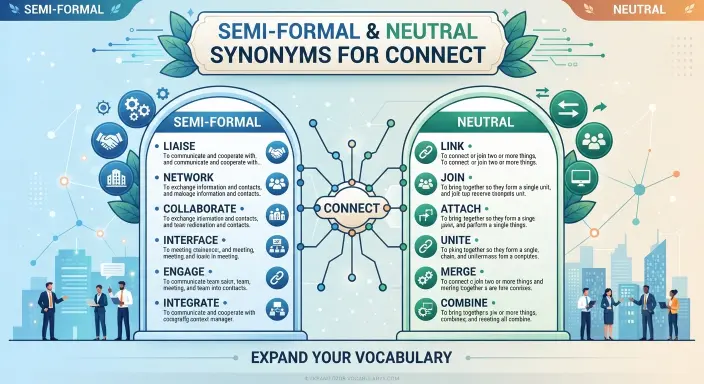
These alternatives are flexible enough for everyday writing, schoolwork, workplace communication, and many professional situations.
Link
Meaning: To join or associate two or more things.
Explanation: Link is one of the closest alternatives to connect. It works for physical, logical, digital, and conceptual relationships.
Example: The study links sleep quality to academic performance.
Best Use: Essays, reports, websites, technology, and general writing.
Worst Use: An emotional relationship if the human element is important.
Tone: Neutral and versatile.
Join
Meaning: To bring things or people together or become part of something.
Explanation: Join is close to connect, but it often implies becoming part of a group or physically meeting something else.
Example: Please join the two sections with a straight line.
Best Use: Groups, objects, meetings, activities, and instructions.
Worst Use: Complex conceptual relationships where relate or associate is more accurate.
Tone: Neutral.
Unite
Meaning: To bring people or things together as one.
Explanation: Unite usually suggests a stronger sense of togetherness than connect.
Example: The event united students from different departments.
Best Use: Groups, communities, causes, and organizations.
Worst Use: A simple technical connection.
Tone: Neutral to formal.
Relate
Meaning: To show or have a relationship with something.
Explanation: Relate is especially useful for ideas, experiences, subjects, and concepts. It can also describe emotional identification.
Example: The second chapter relates directly to the argument presented earlier.
Best Use: Academic writing, explanations, conversations, and personal discussions.
Worst Use: A physical connection between devices.
Tone: Neutral.
Attach
Meaning: To fasten or join one thing to another.
Explanation: Attach is more specific than connect. It normally describes physical objects, files, or digital documents.
Example: Please attach the completed form to your email.
Best Use: Emails, documents, physical objects, and technology.
Worst Use: Emotional or intellectual relationships.
Tone: Neutral and practical.
Combine
Meaning: To put separate things together.
Explanation: Combine emphasizes creating a whole from separate parts.
Example: The designer combined traditional elements with modern features.
Best Use: Writing about ideas, ingredients, data, methods, or design.
Worst Use: A relationship between two people.
Tone: Neutral.
Tie
Meaning: To connect or associate things closely.
Explanation: Tie can describe physical, logical, or emotional relationships. The phrase tie together is especially useful for ideas.
Example: The final paragraph ties the main arguments together.
Best Use: Essays, storytelling, explanations, and general writing.
Worst Use: Formal technical descriptions where a more precise term is available.
Tone: Neutral.
Communicate
Meaning: To exchange information, thoughts, or feelings.
Explanation: Use communicate when connect means interacting through speech, writing, gestures, or technology.
Example: Managers need to communicate clearly with their teams.
Best Use: Workplace writing, customer service, education, and everyday conversation.
Worst Use: Physical objects or systems that are simply joined.
Tone: Neutral and professional.
Contact
Meaning: To communicate with someone.
Explanation: Contact is a straightforward alternative when connect means reaching another person.
Example: Please contact the admissions office for more information.
Best Use: Professional emails, customer service, business communication, and formal instructions.
Worst Use: Emotional connection.
Tone: Neutral and professional.
Interact
Meaning: To communicate or act with another person, group, or system.
Explanation: Interact suggests an exchange rather than a one-way message.
Example: Students interact with their classmates during group activities.
Best Use: Education, websites, workplaces, technology, and social situations.
Worst Use: A simple physical connection.
Tone: Neutral.
Collaborate
Meaning: To work together toward a shared goal.
Explanation: Collaborate is narrower than connect. It implies active cooperation, not merely contact.
Example: The two departments collaborated on the new training program.
Best Use: Business, education, research, creative projects, and professional communication.
Worst Use: A brief introduction.
Tone: Professional.
Network
Meaning: To build professional or social relationships.
Explanation: Network focuses on creating useful connections with other people, especially in professional settings.
Example: She attended the conference to network with industry professionals.
Best Use: Careers, business, conferences, professional events, and LinkedIn-style communication.
Worst Use: A close emotional relationship.
Tone: Professional.
Engage
Meaning: To become involved with someone, something, or an activity.
Explanation: Engage can replace connect when the focus is participation or meaningful interaction.
Example: The teacher used discussion questions to engage the students.
Best Use: Education, marketing, customer service, and professional writing.
Worst Use: A simple physical connection.
Tone: Neutral to professional.
Bring Together
Meaning: To cause people or things to meet or work as a group.
Explanation: This phrase emphasizes the action of creating togetherness.
Example: The workshop brought together designers and software developers.
Best Use: Events, organizations, communities, and general writing.
Worst Use: Technical instructions requiring exact terminology.
Tone: Neutral and natural.
Informal and Casual Synonyms for Connect
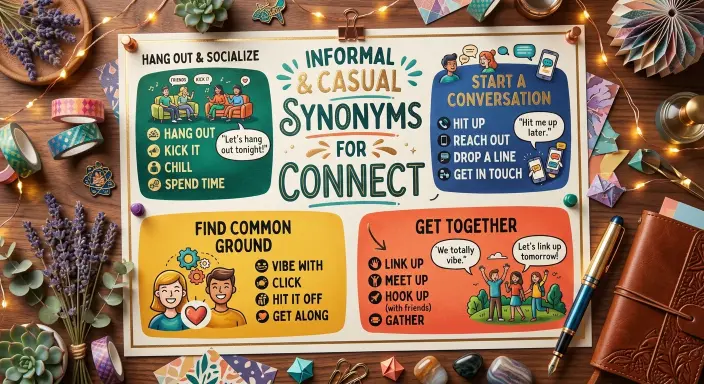
Casual alternatives can make conversation and messages sound warmer and more natural. They are usually unsuitable for formal reports or academic writing.
Get in Touch
Meaning: To communicate with someone.
Example: I’ll get in touch with you next week.
When it sounds natural: Friendly emails, texts, conversations, and everyday professional communication.
When to avoid it: Highly formal reports or legal documents.
Tone: Friendly and conversational.
Reach Out
Meaning: To contact someone, often to offer help, ask a question, or start communication.
Example: Feel free to reach out if you need more information.
When it sounds natural: Emails, customer service, workplace communication, and friendly professional messages.
When to avoid it: When a more direct verb such as contact would be clearer.
Tone: Warm and approachable.
Meet Up
Meaning: To get together with someone in person.
Example: Let’s meet up after class.
When it sounds natural: Friends, classmates, and informal plans.
When to avoid it: Formal business correspondence.
Tone: Casual.
Hit It Off
Meaning: To immediately develop a friendly relationship.
Example: We met at the conference and really hit it off.
When it sounds natural: Conversations about friendships and social relationships.
When to avoid it: Academic, legal, or formal professional writing.
Tone: Very casual and friendly.
Click
Meaning: To feel an immediate sense of understanding or compatibility with someone.
Example: We clicked as soon as we started talking.
When it sounds natural: Casual conversations about personal relationships.
When to avoid it: Formal communication.
Tone: Casual.
Keep in Touch
Meaning: To continue communicating with someone.
Example: We moved to different cities but still keep in touch.
When it sounds natural: Friends, former classmates, colleagues, and personal messages.
When to avoid it: Technical or academic contexts.
Tone: Warm and conversational.
Get Together
Meaning: To meet socially or come together.
Example: Let’s get together this weekend.
When it sounds natural: Informal invitations and everyday conversation.
When to avoid it: Formal event notices or business documents.
Tone: Casual.
True Synonyms vs Contextual Synonyms for Connect
Not every alternative above can replace connect in every sentence. The distinction matters.
| Type | What It Means | Can It Replace the Original? |
|---|---|---|
| True synonym | Has nearly the same core meaning in a particular context | Often |
| Near synonym | Shares much of the meaning but adds a different nuance | Sometimes |
| Contextual alternative | Works only for a specific meaning of connect | Only in the right context |
| Broader expression | Covers a wider idea than simply connecting | Sometimes |
| Narrower expression | Describes one specific type of connection | Only when that meaning is intended |
| Formal equivalent | Expresses the idea in more formal language | Usually, if context matches |
| Casual equivalent | Expresses the idea in informal language | Only in casual contexts |
For example, link is often a close substitute for connecting ideas or systems. Collaborate, however, means working together, so it is narrower. Contact means communicating with someone, while bond emphasizes emotional connection. Integrate means combining something into a larger system. Choosing the right word depends on what kind of connection you mean.
Business Writing: Synonyms for Connect
Business writing often benefits from precise alternatives instead of repeatedly using connect.
- Use link for relationships between data, ideas, or business factors.
- Use coordinate for organized work between teams.
- Use collaborate when people actively work together.
- Use network for professional relationship-building.
- Use establish contact for initial communication.
- Use build a relationship when discussing long-term partnerships.
Example:
Instead of: “We want to connect with new suppliers.”
Try: “We want to establish relationships with new suppliers.”
The second sentence makes the intended business relationship clearer.
Corporate Communication: Professional Synonyms
Corporate communication requires wording that is clear without becoming unnecessarily complicated.
Reports:
“The findings link customer satisfaction to response time.”
Internal communication:
“The new system connects the sales and support teams.”
Announcements:
“The initiative brings together employees from five departments.”
Partnership discussions:
“We hope to establish a long-term relationship with your organization.”
Use connect when it is already the clearest option. Changing every instance simply to avoid repetition can make corporate writing less natural.
Academic Writing: Synonyms for Connect
Academic writing often needs precise relationships between ideas.
Useful choices include:
- Relate — for relationships between ideas or subjects
- Link — for evidence or concepts
- Associate — for relationships between variables or ideas
- Interrelate — for multiple connected factors
- Correspond — for similarities or relationships
- Tie together — useful in less technical academic prose
Example:
Basic: “The author connects poverty with limited educational access.”
More precise: “The author links poverty to limited access to education.”
If the evidence demonstrates a statistical or causal relationship, however, choose wording that accurately reflects that relationship rather than using connect as a vague substitute.
Customer Service: Clear Synonyms
Customer-service language should be polite and easy to understand.
Useful phrases include:
- Contact us
- Get in touch
- Reach out
- Speak with
- Connect with a representative
- Communicate with our support team
Example:
“Please contact our support team if the issue continues.”
For a friendly website, you might write:
“Feel free to reach out if you need help.”
The second version feels warmer, while contact is more direct.
Legal Writing: Choosing Precise Synonyms
Legal writing requires particular care because seemingly similar words can carry different meanings. Connect, associate, link, relate, cause, and establish should not automatically be treated as interchangeable.
For example:
“The evidence connects the defendant to the location.”
This is not necessarily equivalent to:
“The evidence proves the defendant was responsible.”
The second statement makes a much stronger claim. In legal or quasi-legal writing, choose terminology based on the exact relationship supported by the facts. If a document has legal consequences, the appropriate wording may depend on the relevant jurisdiction and document type.
Email Communication: Professional Synonyms
In emails, your choice depends on how formal and direct you want to sound.
- Contact — direct and professional
- Reach out — warm and approachable
- Get in touch — friendly
- Communicate — emphasizes information exchange
- Coordinate — emphasizes arranging work
- Collaborate — emphasizes working together
- Establish contact — formal and appropriate for first communication
A client email might say:
“Please contact me if you have any questions.”
A warmer message might say:
“Please feel free to reach out if anything needs clarification.”
Both work, but the tone is slightly different.
Email Examples Using Synonyms for Connect
Client Communication
Subject: Next Steps for Your Project
Hi Maria,
Thank you for sharing the updated requirements. I’d like to connect with your design team this week so we can clarify the remaining details.
Could you let me know which day works best for a short call?
Best,
Daniel
Project Update
Subject: Coordination for the Product Launch
Hi Team,
We need to coordinate the final launch tasks across marketing, design, and support.
Please review the shared schedule and update your assigned items by Thursday afternoon.
Thanks,
Alex
Professional Introduction
Subject: Introduction and Partnership Discussion
Hello Mr. Patel,
I’m reaching out to establish contact regarding a possible supplier partnership. Your company’s services appear to align with several of our current requirements.
I’d be glad to arrange a short introductory call.
Best regards,
Nina
Customer Service
Subject: Help With Your Account
Hi James,
Thanks for contacting us. If you need further assistance, please get in touch with our support team through the help center.
We’ll be happy to review the issue with you.
Best,
Customer Support
Academic Communication
Subject: Question About the Research Project
Dear Professor Lewis,
I’m reviewing the sources for my research project and would like to better understand how the two theories relate to each other.
Could we discuss this briefly during your office hours?
Thank you,
Emma
Internal Workplace Email
Subject: Cross-Team Planning Meeting
Hi everyone,
I’d like to bring the marketing and sales teams together for a short planning session next Tuesday.
The goal is to coordinate our priorities for the next campaign.
Thanks,
Jordan
Short Dialogue Examples Using Connect Synonyms
Workplace
Person A: Can you connect me with someone from accounting?
Person B: Sure. I’ll put you in touch with Sarah.
Classroom
Person A: How does this paragraph relate to the main argument?
Person B: It provides evidence that supports the argument.
Customer Service
Person A: Who should I contact about a billing problem?
Person B: You can reach out to our billing team directly.
Casual Conversation
Person A: Did you know anyone at the event?
Person B: No, but I clicked with a few people pretty quickly.
Professional Discussion
Person A: How can the two departments work more closely?
Person B: They could collaborate on the next project.
How to Replace “Connect” in a Sentence
Example 1
Original: The bridge connects the two towns.
Alternative: The bridge links the two towns.
Why it works: Links is a natural alternative for a physical connection.
Example 2
Original: I need to connect with the manager.
Alternative: I need to contact the manager.
Why it works: Contact clearly means communicating with the manager.
Example 3
Original: These ideas connect with each other.
Alternative: These ideas relate to each other.
Why it works: Relate is more natural when discussing conceptual relationships.
Example 4
Original: The two teams connected during the conference.
Alternative: The two teams established a professional relationship during the conference.
Why it works: The alternative makes the nature of the connection more specific.
Example 5
Original: The software connects several databases.
Alternative: The software integrates several databases.
Why it works: Integrates suggests that the databases are brought into a functioning system.
Example 6
Original: She connected with the audience.
Alternative: She engaged the audience.
Why it works: Engaged emphasizes active involvement rather than a general feeling of connection.
Example 7
Original: We connected with several professionals at the event.
Alternative: We networked with several professionals at the event.
Why it works: Networked specifically describes professional relationship-building.
Example 8
Original: The story connects the three characters.
Alternative: The story ties the three characters together.
Why it works: Ties together works naturally when explaining how separate elements are related.
Example 9
Original: We connected after several years apart.
Alternative: We got in touch after several years apart.
Why it works: The alternative works if the meaning is renewed communication rather than an emotional bond.
Example 10
Original: The experience connected me to the community.
Alternative: The experience helped me feel part of the community.
Why it works: This version makes the emotional and social meaning clearer.
Comparison Table: Synonyms for Connect
| Phrase | Tone | Meaning / Scope | Best Use | Example |
|---|---|---|---|---|
| Link | Neutral | Join or relate things | Ideas, systems, objects | The report links the two issues. |
| Join | Neutral | Bring together or become part of | Groups and objects | Join the two sections. |
| Unite | Neutral/Formal | Bring together as one | People and groups | The event united the community. |
| Relate | Neutral | Show a relationship | Ideas and subjects | The findings relate to the theory. |
| Associate | Formal | Connect mentally or conceptually | Research and analysis | The brand is associated with quality. |
| Attach | Neutral | Fasten or add to something | Files and objects | Attach the document. |
| Combine | Neutral | Put separate things together | Ideas, data, materials | Combine the two lists. |
| Communicate | Professional | Exchange information | People and organizations | We communicate by email. |
| Contact | Professional | Communicate with someone | Business and support | Contact the office. |
| Interact | Neutral | Exchange actions or information | People and systems | Users interact with the platform. |
| Collaborate | Professional | Work together | Projects and teams | We collaborated on the report. |
| Network | Professional | Build professional relationships | Careers and business | She networks at conferences. |
| Integrate | Formal/Technical | Combine into a system | Technology and organizations | Integrate the new software. |
| Coordinate | Professional | Organize joint activity | Teams and projects | Coordinate the schedules. |
| Reach out | Friendly | Contact someone | Emails and customer service | Reach out with questions. |
| Get in touch | Casual/Neutral | Contact someone | Everyday communication | Get in touch soon. |
| Bond | Emotional | Form a close relationship | Personal relationships | They bonded over music. |
| Bridge | Figurative | Reduce separation | Ideas, groups, cultures | The program bridges communities. |
Which Synonyms for Connect Should You Choose?
- For formal writing: Choose establish contact, associate, integrate, interrelate, or correspond, depending on the intended meaning.
- For business communication: Use connect, coordinate, collaborate, network, establish contact, or build a relationship.
- For academic writing: Relate, link, associate, and interrelate are often more precise than a general use of connect.
- For legal writing: Prefer the most precise factual description. Do not substitute a stronger term simply because it sounds more formal.
- For professional email: Contact is direct; reach out is warmer; get in touch is more conversational.
- For everyday conversation: Connect, relate, get in touch, meet up, and keep in touch are natural choices.
- For casual messages: Click, hit it off, get together, and get in touch can work when the situation is informal.
Grammar and Usage Guide for Connect
Connect as a Verb
Connect is primarily used as a verb.
Examples:
- “The cable connects the computer to the monitor.”
- “I connected with an old friend.”
- “The ideas connect in several ways.”
It can be transitive or intransitive depending on the construction.
Connect Something to Something
Use connect + object + to + object when describing a physical or technical connection.
Correct:
“Connect the printer to the computer.”
Correct:
“The device connects to the network.”
Connect With Someone
Use connect with when you mean communicating, relating, or forming a relationship.
Example:
“She connected with the students.”
In American English, connect with is especially common for personal, professional, and emotional relationships.
Connect To vs. Connect With
The preposition can affect meaning.
Connect to often describes physical, technical, or system relationships:
- Connect the phone to the charger.
- The device connects to Wi-Fi.
Connect with often describes people, ideas, or emotional relationships:
- I connected with the audience.
- She connected with her classmates.
There is some overlap, so context matters.
Connected, Connecting, and Connection
Common forms include:
- Connect — base verb
- Connects — third-person singular
- Connected — past tense/past participle
- Connecting — present participle
- Connection — noun
Examples:
- “The two systems connect.”
- “The systems are connected.”
- “We are connecting the devices.”
- “The connection was interrupted.”
Connect as a Noun?
Connect can also appear as a noun in specialized or informal contexts, but connection is much more standard in general writing.
Natural: “There is a strong connection between the ideas.”
Less natural in formal writing: “There is a strong connect between the ideas.”
Use connection in academic, business, and formal prose.
Common Mistakes With Synonyms for Connect
1. Treating Every Alternative as Exact
Connect, collaborate, and contact do not mean exactly the same thing. Choose based on the relationship you are describing.
2. Using “Collaborate” for Simple Contact
If you only spoke to someone once, collaborate may overstate the relationship. Collaboration requires shared work.
3. Using “Contact” for Emotional Connection
“I contacted my sister” means you communicated with her. It does not necessarily mean you formed an emotional bond.
4. Confusing “Integrate” With “Join”
Integrate usually suggests combining something into a larger system. Join can simply mean bringing two things together or becoming part of a group.
5. Using Casual Phrases in Formal Writing
Expressions such as hit it off and click are natural in conversation but usually inappropriate in academic papers.
6. Making the Sentence More Formal Than Necessary
Replacing every use of connect with interrelate can make ordinary writing stiff. Precision matters more than formality.
7. Ignoring the Preposition
“Connect the device to the network” and “connect with a colleague” use different constructions. Check the intended meaning before choosing the preposition.
8. Using “Associate” When You Mean Physical Attachment
Associate normally describes conceptual or social relationships. It is not the natural word for attaching a cable to a device.
9. Using “Network” for Close Personal Relationships
Network usually suggests professional or social relationship-building rather than deep emotional connection.
10. Choosing a Word Only to Avoid Repetition
Sometimes connect is the clearest option. Replacing it with a less accurate synonym can weaken the sentence instead of improving it.
When Not to Use “Connect”
There are several situations where a more specific word can improve your writing.
1. When You Mean Simple Contact
Instead of:
“I will connect with the office.”
Use:
“I will contact the office.”
Contact is more direct.
2. When You Mean Organized Cooperation
Instead of:
“The teams connected on the project.”
Use:
“The teams collaborated on the project.”
This tells the reader that they actually worked together.
3. When You Mean Physical Attachment
Instead of a vague “connect,” consider attach, fasten, join, or link if that word better describes the physical action.
4. When You Mean Technical Integration
Use integrate when separate software, systems, or databases become part of a unified system.
5. When You Mean Emotional Closeness
Use bond, relate, identify with, or feel close to when the emotional meaning matters.
6. When You Need a More Formal Academic Term
Relate, associate, or interrelate may be more precise in academic analysis.
7. When “Connect” Is Actually Better
Do not replace connect simply for variety. It is short, familiar, flexible, and grammatically natural. In many sentences, it remains the clearest choice.
Advanced Writer Tips for Using Connect Synonyms
Tone Control
- For a formal tone, consider establish contact, integrate, associate, or interrelate.
- For neutral writing, connect, link, relate, and contact are usually easier to read.
- For casual speech, get in touch, click, and get together can sound more natural.
Professional Email Etiquette
Use direct language.
- “Please contact me” is clear.
- “Please reach out” is warmer.
- “Please establish contact” can sound overly formal unless the situation genuinely calls for it.
Politeness
Small changes can affect the feeling of an email:
- “Contact me if you need help.” — direct
- “Please contact me if you need help.” — polite and direct
- “Feel free to reach out if you need help.” — warmer
The best version depends on your relationship with the reader.
Context Alignment
Ask what kind of connection you mean before selecting a synonym. Is it physical, digital, social, professional, emotional, logical, or organizational? This single distinction eliminates many poor substitutions.
Precision
Use link for relationships between ideas, contact for communication, collaborate for shared work, integrate for systems, network for professional relationships, and bond for emotional closeness.
Readability
Prefer a familiar word when it communicates the idea clearly. A simple sentence such as “The two ideas are connected” may be better than “The two concepts are interrelated” if the extra formality adds nothing.
Related Questions About Synonyms for Connect
1. What is another way to say connect?
Depending on the meaning, you can say link, join, relate, contact, communicate, associate, interact, attach, unite, collaborate, or get in touch.
2. What is a professional alternative to connect?
Contact, establish contact, collaborate, coordinate, network, and establish a relationship are useful professional alternatives. Choose according to the exact situation.
3. What is the formal synonyms for connect?
Common formal options include associate, integrate, interrelate, correspond, establish contact, and forge a relationship.
4. Can I use “link” instead of “connect”?
Often, yes. Link is especially useful when describing relationships between ideas, systems, data, objects, or events. It may not work when connect means developing an emotional relationship.
5. Is connect a formal word?
Yes. Connect is a standard, neutral English word that works in both professional and everyday contexts. It is not inherently casual.
6. What is the difference between connect and relate?
Connect is broader and can describe physical, social, technical, and conceptual relationships. Relate usually focuses on a relationship between ideas, subjects, experiences, or people.
7. What is the difference between connect and communicate?
Communicate specifically means exchanging information. Connect can include communication but may also describe physical, technical, social, or emotional relationships.
FAQs About Connect Synonyms
1. What is the closest synonyms for connect?
Link is one of the closest general synonyms for connect, especially when discussing objects, ideas, systems, or relationships. However, join may be closer for physical objects or groups, while contact may be closer when discussing communication between people.
2. Which synonyms for connect is best in academic writing?
Relate, link, associate, and interrelate are useful academic choices. The correct word depends on the relationship being described. For example, relate works well for ideas, while associate can describe a conceptual relationship between variables.
3. What is the professional way to say connect with someone?
You can say contact someone, establish contact with someone, communicate with someone, or reach out to someone. Contact is direct and professional, while reach out has a warmer tone.
4. Is “reach out” the same as “connect”?
Not exactly. Reach out usually means initiating communication, while connect can mean communication, relationship-building, physical joining, or emotional understanding. They overlap when discussing people.
5. What is the synonyms for connect emotionally?
Depending on the sentence, bond, relate, identify with, feel close to, or form a connection with may work. Bond suggests developing a close relationship, while relate can mean recognizing something in another person’s experience.
6. What is the synonyms for connect two ideas?
Link, relate, associate, tie together, and bring together are useful. Link is especially flexible: “The author links the two ideas.”
7. What is the synonyms for connect in technology?
The best word depends on the technical action. Link, attach, integrate, pair, interface, and join can all work in different situations. For example, pair is common for wireless devices, while integrate suggests combining systems or software.
Key Takeaways
- Connect has several meanings, so the best synonym depends on context.
- Use link, join, or relate for many general connections.
- Choose contact, communicate, or reach out when the meaning involves people.
- Use collaborate, coordinate, or network for specific professional relationships.
- Keep connect when it is already the clearest and most natural choice.
Conclusion
The best synonyms for connect are not simply interchangeable words. Link works well for ideas and systems, join for bringing things or people together, contact for communication, relate for conceptual relationships, and integrate for combining systems.
In professional settings, collaborate, coordinate, and network add useful detail, while casual expressions such as get in touch, click, and hit it off create a more conversational tone. The key is to identify what kind of connection you mean before choosing a replacement.
A physical connection may require attach or join, while an emotional relationship may call for bond or relate. Academic writing often benefits from link or associate, and business emails may sound better with contact or reach out.
In many cases, though, the original word connect remains the clearest option. Good word choice is not about using the most complicated synonym; it is about expressing the exact relationship you intend.
