
A conclusion is the final part of something, such as an essay, report, speech, discussion, argument, or process. However, the best synonyms for conclusion depends on what you mean.
You might need a formal word for academic writing, a professional alternative for a report, or a simple phrase for everyday conversation. Choosing the right alternative can make your writing clearer and more precise.
Some words related to conclusion describe a final section, while others describe a decision, judgment, ending, or result. For example, summary focuses on reviewing key points, while inference describes a judgment reached from evidence.
This guide explains more than 38 useful alternatives, shows where each one works, and helps you avoid confusing related terms with exact synonyms.
Quick Answer: What Are the Best Synonyms for Conclusion?
Useful synonyms for conclusion include ending, closing, finish, summary, outcome, result, resolution, decision, judgment, inference, deduction, finding, final thought, final statement, wrap-up, and closing remarks. Formal writing often favors finding, inference, deduction, or summary, while everyday communication commonly uses ending, finish, or wrap-up.
Quick List of Synonyms for Conclusion
Closest Synonyms for Conclusion
- Ending
- Finish
- Closing
- Final part
- Final statement
- Summary
- Wrap-up
- Outcome
- Result
- Resolution
Formal Synonyms for Conclusion
- Inference
- Deduction
- Finding
- Judgment
- Determination
- Decision
- Final assessment
- Final determination
- Closing statement
- Final remarks
Neutral Synonyms for Conclusion
- Summary
- Outcome
- Result
- Final point
- Final thought
- Closing remarks
- End result
- Last section
- Final section
- Overall assessment
Casual Synonyms for Conclusion
- Wrap-up
- Ending
- Finish
- Last part
- Final bit
- Bottom line
- Takeaway
- Closing thought
Contextual Synonyms for Conclusion
- Resolution
- Verdict
- Settlement
- Agreement
- Recommendation
- Implication
- Inference
- Finding
- Decision
- Determination
Formal Synonyms for Conclusion
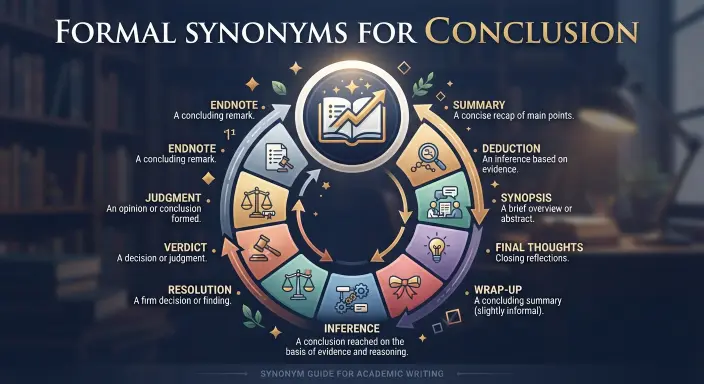
1. Summary
Meaning: A brief restatement of the main points.
Explanation: Summary is often used as an alternative to conclusion when the final section reviews the important ideas. It is not always an exact synonym because a conclusion may interpret or evaluate information rather than simply summarize it.
Example: The report ends with a summary of the key findings.
Best Use: Reports, essays, presentations, and academic writing.
Worst Use: When you need to describe a decision reached from evidence.
Tone: Formal to neutral.
2. Inference
Meaning: A judgment or understanding reached from available evidence.
Explanation: An inference is not simply the end of a document. It is a conclusion drawn by reasoning from facts or clues.
Example: The researchers made an inference based on the observed behavior.
Best Use: Academic, scientific, analytical, and research writing.
Worst Use: As a replacement for every use of conclusion.
Tone: Formal and analytical.
3. Deduction
Meaning: A conclusion reached through logical reasoning.
Explanation: Deduction emphasizes the reasoning process used to reach an answer. It is narrower than conclusion.
Example: The detective’s deduction was based on several pieces of evidence.
Best Use: Logic, mathematics, analysis, investigations, and academic writing.
Worst Use: Referring to the final paragraph of an essay.
Tone: Formal and precise.
4. Finding
Meaning: A fact or result discovered through investigation.
Explanation: A finding often represents what an investigation, study, review, or examination established. It can appear in a concluding section but does not mean the section itself.
Example: The committee’s findings were presented at the end of the report.
Best Use: Research, reports, investigations, and professional communication.
Worst Use: Casual conversation about an essay’s ending.
Tone: Professional and formal.
5. Judgment
Meaning: An opinion or decision reached after considering information.
Explanation: Judgment emphasizes evaluation. It works when a conclusion involves deciding what information means or what should happen next.
Example: The panel reached its judgment after reviewing the evidence.
Best Use: Analytical, professional, legal, and decision-making contexts.
Worst Use: As a simple synonym for the final paragraph.
Tone: Formal.
6. Determination
Meaning: A firm decision reached after consideration.
Explanation: Determination suggests that someone has settled a question or issue. It is more specific than the general word conclusion.
Example: The review resulted in a determination that additional testing was needed.
Best Use: Formal reports, professional decisions, and administrative contexts.
Worst Use: Simple school writing where conclusion or summary is clearer.
Tone: Formal and authoritative.
7. Decision
Meaning: A choice reached after considering available information.
Explanation: A decision can be a conclusion when the conclusion involves choosing an action or position.
Example: The team reached a decision after discussing the proposed changes.
Best Use: Meetings, management, planning, and problem-solving.
Worst Use: A purely descriptive ending with no choice involved.
Tone: Neutral to formal.
8. Final Assessment
Meaning: An overall evaluation made at the end of an analysis.
Explanation: This phrase emphasizes evaluation rather than simply ending a piece of writing.
Example: The final assessment identified several areas that required improvement.
Best Use: Reports, reviews, evaluations, and professional documents.
Worst Use: Informal conversations.
Tone: Formal and professional.
9. Final Determination
Meaning: The final decision about an issue.
Explanation: This phrase is useful when an issue has been reviewed and a definitive decision has been made.
Example: The agency issued its final determination after reviewing the application.
Best Use: Formal administrative and professional writing.
Worst Use: Friendly messages or simple essays.
Tone: Highly formal.
10. Closing Statement
Meaning: A statement made at the end of a speech, document, argument, or discussion.
Explanation: A closing statement is specifically about the final statement rather than the reasoning that produced a conclusion.
Example: She used her closing statement to reinforce the main argument.
Best Use: Speeches, presentations, debates, and formal communication.
Worst Use: When you need to describe an analytical result.
Tone: Formal and polished.
11. Final Remarks
Meaning: Comments made at the end of a communication.
Explanation: Final remarks is a useful alternative when the ending contains brief comments, observations, or thanks.
Example: The director offered final remarks before ending the meeting.
Best Use: Meetings, speeches, presentations, and formal events.
Worst Use: Scientific writing where a precise result is required.
Tone: Formal.
12. Resolution
Meaning: A solution or settlement of an issue.
Explanation: Resolution can function as a contextual alternative when a conclusion brings a problem to an end.
Example: The two departments reached a resolution after several meetings.
Best Use: Conflicts, problems, discussions, and negotiations.
Worst Use: As a replacement for the conclusion of an academic essay.
Tone: Formal to neutral.
Semi-Formal and Neutral Synonyms for Conclusion
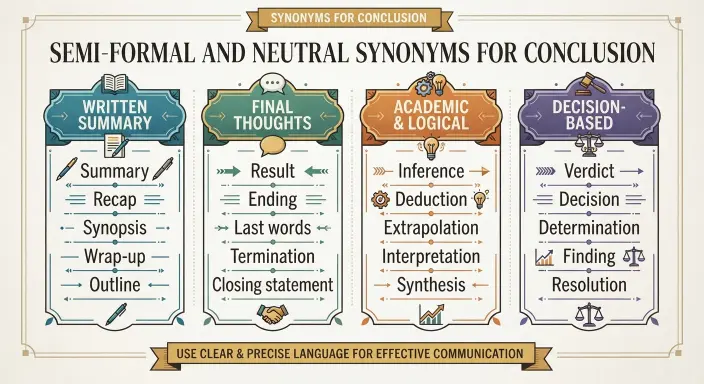
13. Ending
Meaning: The final part of something.
Explanation: Ending is one of the closest everyday alternatives. It can refer to the final part of a story, event, conversation, presentation, or piece of writing.
Example: The ending of the article clearly reinforces its main message.
Best Use: General writing and everyday conversation.
Worst Use: Highly technical reports when greater precision is needed.
Tone: Neutral.
14. Finish
Meaning: The point at which something ends.
Explanation: Finish emphasizes completion rather than a written final section or analytical judgment.
Example: We discussed the results before the finish of the meeting.
Best Use: Everyday speech and informal writing.
Worst Use: Academic conclusions or formal research findings.
Tone: Neutral and conversational.
15. Closing
Meaning: The final part or stage of something.
Explanation: Closing is useful for meetings, speeches, letters, presentations, and business communication.
Example: The speaker used the closing to restate the main recommendation.
Best Use: Presentations, meetings, emails, and professional communication.
Worst Use: Technical analysis where finding or result is more exact.
Tone: Neutral to professional.
16. Outcome
Meaning: The result of an action, process, or situation.
Explanation: An outcome is what happened as a result. It is therefore related to conclusion but does not mean the same thing in every context.
Example: The outcome of the discussion was a revised project schedule.
Best Use: Projects, decisions, studies, and discussions.
Worst Use: Describing the final paragraph of an essay.
Tone: Neutral and professional.
17. Result
Meaning: Something that happens because of an action or process.
Explanation: Result works when conclusion refers to what an investigation or process produced.
Example: The results support the original hypothesis.
Best Use: Research, analysis, work, and everyday communication.
Worst Use: Referring specifically to a document’s final section.
Tone: Neutral.
18. Final Point
Meaning: The last idea or argument presented.
Explanation: This phrase is particularly useful when concluding an explanation or argument.
Example: As a final point, the author emphasizes the importance of education.
Best Use: Essays, presentations, discussions, and speeches.
Worst Use: Describing a numerical result.
Tone: Neutral.
19. Final Thought
Meaning: The last idea or reflection offered.
Explanation: Final thought often sounds more personal and reflective than conclusion.
Example: My final thought is that the proposal deserves further discussion.
Best Use: Blogs, speeches, opinion writing, and presentations.
Worst Use: Highly technical reports.
Tone: Neutral and reflective.
20. Closing Remarks
Meaning: Comments made near the end of a speech, meeting, or communication.
Explanation: These are usually spoken rather than analytical. They can summarize key ideas or thank the audience.
Example: The manager gave a few closing remarks before the meeting ended.
Best Use: Meetings, speeches, conferences, and professional communication.
Worst Use: Scientific conclusions.
Tone: Professional and courteous.
21. Final Section
Meaning: The last section of a document.
Explanation: This is a structural description, not a direct synonym for an analytical conclusion.
Example: The final section summarizes the report’s main findings.
Best Use: Websites, reports, instructions, and documents.
Worst Use: When you need to describe a logical judgment.
Tone: Neutral.
22. Overall Assessment
Meaning: A general evaluation after considering the available information.
Explanation: It emphasizes judgment and evaluation rather than simply marking the end of a text.
Example: The overall assessment suggests that the project met most of its goals.
Best Use: Reviews, reports, evaluations, and professional writing.
Worst Use: Casual messages.
Tone: Professional.
23. End Result
Meaning: The final result produced by a process.
Explanation: End result stresses what eventually happened. It is sometimes redundant because result already implies an outcome.
Example: The end result was a simpler and more efficient process.
Best Use: Everyday and professional communication.
Worst Use: Highly polished academic writing where result is usually enough.
Tone: Neutral.
24. Takeaway
Meaning: The main lesson, idea, or point someone should remember.
Explanation: A takeaway can appear at the end of an article or presentation, but it does not necessarily mean the conclusion itself.
Example: The main takeaway is that small changes can improve the process.
Best Use: Presentations, articles, meetings, training, and educational content.
Worst Use: Formal legal or scientific conclusions when precision matters.
Tone: Neutral and modern.
25. Bottom Line
Meaning: The most important point or final practical result.
Explanation: Bottom line is useful when reducing a discussion to its central message or practical outcome.
Example: The bottom line is that we need more time before making a decision.
Best Use: Business conversations, presentations, and everyday speech.
Worst Use: Formal academic essays.
Tone: Conversational and direct.
Informal and Casual Synonyms for Conclusion
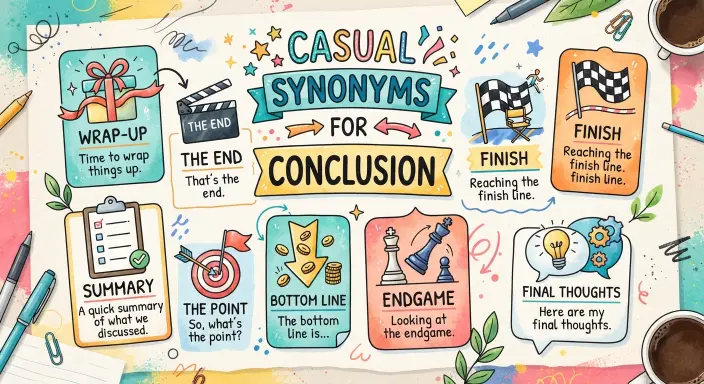
26. Wrap-Up
Meaning: The final summary or closing part.
Example: Let’s finish with a quick wrap-up of the main points.
When it sounds natural: Meetings, presentations, articles, podcasts, and casual workplace conversations.
When to avoid it: Formal academic or legal documents.
Tone: Friendly and conversational.
27. Last Part
Meaning: The section or portion that comes at the end.
Example: I liked the last part of the presentation.
When it sounds natural: Everyday conversation.
When to avoid it: Formal reports and academic writing.
Tone: Very simple and casual.
28. Final Bit
Meaning: The last small part of something.
Example: I’ll handle the final bit of the report tomorrow.
When it sounds natural: Informal conversation and messages.
When to avoid it: Client emails, academic papers, and formal documents.
Tone: Casual.
29. Closing Thought
Meaning: A final idea or reflection.
Example: Here’s one closing thought before we move on.
When it sounds natural: Speeches, blogs, discussions, and friendly professional communication.
When to avoid it: Highly technical contexts.
Tone: Warm and conversational.
30. The Bottom Line
Meaning: The most important final point.
Example: The bottom line is that the plan needs more work.
When it sounds natural: Business discussions and everyday speech.
When to avoid it: Formal academic conclusions where a more precise term is available.
Tone: Direct and conversational.
31. Wrap-Up Point
Meaning: A final point that brings a discussion together.
Example: My wrap-up point is simple: we need clearer instructions.
When it sounds natural: Meetings, presentations, and casual discussions.
When to avoid it: Legal and highly formal writing.
Tone: Casual to neutral.
True Synonyms vs. Contextual Synonyms for Conclusion
Not every word above can replace conclusion in every sentence. The distinction matters because conclusion has several meanings: a final section, an ending, a judgment, or a result reached through reasoning.
| Type | What It Means | Can It Replace the Original? |
|---|---|---|
| True synonym | A word with essentially the same meaning in a particular context | Often |
| Near synonym | Similar meaning but with a small difference in emphasis | Sometimes |
| Contextual alternative | Works in a specific situation but changes the meaning slightly | Only in the right context |
| Broader expression | Covers a wider idea than conclusion | Sometimes |
| Narrower expression | Refers to one specific kind of conclusion | Only when that meaning applies |
| Formal equivalent | A more formal way to express a similar idea | Often in formal contexts |
| Casual equivalent | An informal expression used in everyday communication | Only in casual contexts |
For example, ending is close when conclusion means the final part of something. Inference is more specific because it means a conclusion reached from evidence. Summary focuses on restating information. Outcome describes what happened, while resolution suggests that an issue has been settled.
Industry-Specific Usage of Conclusion Synonyms
Business Writing: Conclusion Synonyms
Business documents often need a concise ending that tells readers what the information means or what should happen next.
Useful choices include:
- Summary — for reviewing key information
- Recommendation — when proposing an action
- Finding — for reporting an investigation
- Outcome — for describing what happened
- Final assessment — for evaluation
- Bottom line — for less formal business communication
Example:
“Based on the data reviewed, our final assessment is that the current process should be revised.”
Corporate Communication and Conclusion Synonyms
Corporate reports, internal announcements, and presentations benefit from precise wording.
Instead of repeatedly writing “in conclusion,” consider:
- “Overall, the findings indicate…”
- “The review found that…”
- “The final assessment is…”
- “The key takeaway is…”
- “Based on these findings…”
This approach often sounds more natural than repeatedly announcing that the writing is ending.
Academic Writing and Conclusion Synonyms
Academic writing requires particular care because different words describe different functions.
Use:
- Summary for a brief review of major points
- Inference for a reasoned interpretation
- Deduction for a logically derived conclusion
- Finding for a result of research
- Implication for what a result suggests
- Final assessment for an overall evaluation
For example:
“The findings suggest that access to reliable information influenced the participants’ decisions.”
That sentence communicates the result directly instead of simply saying, “In conclusion.”
Customer Service and Conclusion Synonyms
Customer service messages usually benefit from clear, friendly language.
Good choices include:
- Final update
- Resolution
- Outcome
- Summary
- Next step
- Final response
Example:
“We’ve completed our review, and the resolution is to issue a replacement.”
Here, resolution is more useful than conclusion because the customer needs to know how the problem was settled.
Legal Writing and Conclusion Synonyms
Legal writing requires precision because words can have specialized meanings depending on the document and jurisdiction.
Possible terms include:
- Finding
- Determination
- Judgment
- Decision
- Ruling
- Resolution
These terms are not interchangeable in every legal context. For example, a judgment can refer to a formal judicial decision, while a finding may describe a fact established through a legal or administrative process. A casual term such as wrap-up should not replace precise legal terminology.
Email Communication
For professional emails, alternatives to conclusion include:
- Final point
- Summary
- Final update
- Key takeaway
- Outcome
- Next step
- Closing thought
Example:
“The key takeaway is that we’ll need two additional days to complete testing.”
That sounds more direct than a sentence such as “In conclusion, we need two additional days.”
Email Examples Using Conclusion Synonyms
Email 1 — Client Summary
Subject: Project Review Summary
Hi Jordan,
Thank you for reviewing the latest project results. The summary is that the first phase is complete, while the testing phase still needs a few additional days.
I’ll send the updated schedule tomorrow.
Best,
Maya
Email 2 — Internal Project Update
Subject: Final Assessment of the Campaign
Hi Team,
We’ve reviewed the campaign results from the past month. The final assessment is that the new landing page performed well, but the signup process needs further refinement.
I’ll share the specific recommendations in our next meeting.
Thanks,
Daniel
Email 3 — Academic Communication
Subject: Research Paper Findings
Dear Professor Lee,
I’ve completed the analysis of the survey data. The main finding is that participants responded more positively when the instructions were shorter and more specific.
I’ve included the supporting data in the attached section of the paper.
Best regards,
Nora
Email 4 — Customer Service
Subject: Update on Your Support Request
Hello Mr. Patel,
We’ve completed our review of your request. The resolution is to replace the damaged item at no additional cost.
The replacement will be shipped within three business days.
Regards,
Customer Support
Email 5 — Meeting Follow-Up
Subject: Meeting Wrap-Up
Hi Everyone,
Thanks for joining today’s meeting. As a quick wrap-up, we’ve agreed to revise the launch schedule, confirm the final budget, and meet again next Tuesday.
I’ll send the updated timeline shortly.
Best,
Chris
Email 6 — Vendor Communication
Subject: Final Decision on the Order
Hello Sarah,
We’ve completed our review of the revised quotation. Our decision is to proceed with the updated order, subject to the delivery date remaining unchanged.
Please confirm the expected shipping date.
Best,
Alex
Short Dialogue Examples Using Conclusion Synonyms
Workplace
Person A: What should I tell the team about the report?
Person B: Give them the bottom line first: the current process needs two changes.
Classroom
Person A: Should the conclusion repeat every argument?
Person B: No. A strong summary should bring the main ideas together without copying the whole essay.
Customer Service
Person A: Has the issue been resolved?
Person B: Yes. The resolution is a replacement, and it should arrive this week.
Casual Conversation
Person A: Did you like the movie?
Person B: Mostly. The ending was a little predictable, though.
Professional Discussion
Person A: What’s the final assessment?
Person B: The proposal is workable, but we need more cost information before moving ahead.
How to Replace “Conclusion” in a Sentence
Example 1
Original: The conclusion of the report was clear.
Alternative: The final assessment of the report was clear.
Why it works: This works when the ending contains an evaluation rather than simply a closing section.
Example 2
Original: The conclusion of the study supports the hypothesis.
Alternative: The finding of the study supports the hypothesis.
Why it works: Finding is more specific for research results.
Example 3
Original: In conclusion, the plan needs revision.
Alternative: Overall, the plan needs revision.
Why it works: Removing the transition makes the sentence shorter and more direct.
Example 4
Original: We reached the conclusion that the process was inefficient.
Alternative: We determined that the process was inefficient.
Why it works: Determined emphasizes the act of reaching a reasoned judgment.
Example 5
Original: The conclusion of the story surprised me.
Alternative: The ending of the story surprised me.
Why it works: Ending is the natural choice when talking about the final part of a story.
Example 6
Original: The conclusion of the discussion was an agreement.
Alternative: The outcome of the discussion was an agreement.
Why it works: Outcome describes what resulted from the discussion.
Example 7
Original: The conclusion should summarize the main arguments.
Alternative: The final section should summarize the main arguments.
Why it works: Final section identifies the location in the document without implying a particular type of reasoning.
Example 8
Original: We need a strong conclusion to the presentation.
Alternative: We need a strong closing to the presentation.
Why it works: Closing sounds natural for presentations and speeches.
Example 9
Original: Her conclusion was based on the available evidence.
Alternative: Her inference was based on the available evidence.
Why it works: Inference specifically describes a judgment drawn from evidence.
Example 10
Original: Let’s discuss the conclusion of the meeting.
Alternative: Let’s discuss the outcome of the meeting.
Why it works: If you mean what the meeting accomplished, outcome is more precise.
Comparison Table for Conclusion Synonyms
| Phrase | Tone | Meaning / Scope | Best Use | Example |
|---|---|---|---|---|
| Conclusion | Neutral/formal | Final section or judgment | Essays, reports | The conclusion summarizes the argument. |
| Summary | Neutral/formal | Review of key points | Reports, essays | The summary covers the main findings. |
| Ending | Neutral | Final part | Stories, articles | The ending was unexpected. |
| Closing | Neutral/professional | Final part or stage | Meetings, speeches | The closing was brief. |
| Finding | Formal | Result of investigation | Research, reports | The finding supports the claim. |
| Inference | Formal | Judgment from evidence | Analysis | The inference follows from the data. |
| Deduction | Formal | Logical conclusion | Reasoning | Her deduction was sound. |
| Judgment | Formal | Evaluated decision | Analysis, decisions | The panel reached a judgment. |
| Determination | Formal | Firm decision | Professional contexts | The determination was documented. |
| Outcome | Neutral | Result of a process | Projects, meetings | The outcome was positive. |
| Resolution | Formal/neutral | Settlement or solution | Problems, disputes | They reached a resolution. |
| Takeaway | Neutral | Main lesson or point | Presentations, articles | The key takeaway is simple. |
| Wrap-up | Casual | Final summary | Meetings, conversations | Here’s a quick wrap-up. |
| Bottom line | Casual/neutral | Most important final point | Business, speech | The bottom line is cost. |
| Final thought | Neutral | Last idea or reflection | Blogs, speeches | My final thought is this. |
Which Conclusion Synonyms Should You Choose?
- For formal writing: Use summary, finding, inference, determination, final assessment, or conclusion, depending on the exact meaning.
- For business communication: Choose outcome, finding, final assessment, recommendation, or key takeaway.
- For academic writing: Use conclusion, summary, finding, inference, deduction, or implication according to the function of the sentence.
- For legal writing: Use the precise term required by the legal context, such as judgment, finding, determination, decision, or ruling, rather than a casual substitute.
- For professional email: Summary, final update, outcome, key takeaway, and next step usually sound natural.
- For everyday conversation: Ending, finish, final part, outcome, or bottom line are easy to understand.
- For casual messages: Wrap-up, ending, final thought, last part, or final bit can work.
The most important question is not “Which synonym sounds more sophisticated?” It is “What exactly do I mean by conclusion?”
Grammar and Usage Guide for Conclusion
Conclusion as a Noun
Conclusion is primarily a noun.
Example:
“The conclusion of the report was persuasive.”
It can refer to either a final section or a judgment reached through reasoning.
Conclusion From or Conclusion That?
When describing reasoning, conclusion from is common:
“She reached a conclusion from the available evidence.”
You can also use:
“They reached the conclusion that the plan needed revision.”
Reach a Conclusion
The phrase reach a conclusion is very common.
Correct:
“The researchers reached a conclusion after reviewing the data.”
You can also say:
- draw a conclusion
- come to a conclusion
- arrive at a conclusion
- reach a conclusion
Draw a Conclusion
Draw a conclusion emphasizes reasoning from evidence.
“The results allow us to draw several conclusions.”
In Conclusion
In conclusion is grammatically correct, but it can become repetitive in essays if used mechanically. Often, you can make the writing more direct by stating the final idea without announcing that you are concluding.
Instead of:
“In conclusion, the evidence supports the argument.”
Try:
“Overall, the evidence supports the argument.”
Plural Form: Conclusions
The plural conclusions is used when referring to multiple judgments or final findings.
Example:
“The researchers reached several conclusions.”
Don’t use conclusions simply because a paper has several paragraphs at the end. The plural refers to multiple conclusions or judgments.
Common Mistakes to Avoid With Conclusion Synonyms
1. Treating Every Alternative as an Exact Synonym
Summary, outcome, inference, and ending have different meanings. Choose according to context.
2. Using “Summary” for Every Conclusion
A summary repeats or condenses key information. A conclusion may also interpret evidence or make a final judgment.
3. Confusing Outcome With Conclusion
An outcome is what happened. A conclusion may be the judgment someone reached about what happened.
4. Using “Inference” for a Document’s Final Section
An inference is a reasoned judgment, not necessarily the final paragraph of an essay.
5. Using Casual Language in Formal Writing
Words such as wrap-up and final bit can sound too informal in academic or legal writing.
6. Choosing a Formal Word Simply Because It Sounds Sophisticated
Determination may sound impressive, but decision could be clearer when describing an ordinary choice.
7. Repeating “In Conclusion” Too Often
Using the same transition repeatedly can make writing feel mechanical. Try overall, ultimately, the findings suggest, or simply begin with the final point.
8. Changing the Meaning While Replacing the Word
Replacing conclusion with result changes the focus from a judgment to an outcome. That may or may not be appropriate.
9. Ignoring Audience and Purpose
A research paper, customer email, and casual text message require different vocabulary.
When Not to Use “Conclusion”
You may want to avoid conclusion when a more precise word communicates the idea better.
- When you mean a research result: Use finding or result.
- When you mean a logical judgment: Use inference or deduction when appropriate.
- When you mean what happened after an event: Use outcome or result.
- When you mean a solution to a problem: Use resolution.
- When you mean a decision: Use decision or determination.
- When you mean the final part of a story: Use ending.
- When you mean a casual final summary: Use wrap-up.
- When a direct sentence is clearer: Remove phrases such as in conclusion and state the point directly.
However, conclusion is often the best choice when you are specifically referring to the final section of an essay, report, argument, or formal piece of writing.
Advanced Writer Tips for Using Conclusion Synonyms
Tone Control
Match the word to the setting. Ending sounds simple and natural. Determination sounds official. Inference sounds analytical. Wrap-up sounds conversational.
Professional Email Etiquette
Professional emails usually sound stronger when the final point is stated directly.
Instead of:
“In conclusion, we have decided to delay the launch.”
Try:
“Our decision is to delay the launch.”
The second version gives the reader the important information immediately.
Politeness
Some alternatives can sound more direct than conclusion. In sensitive communication, combine precise wording with polite language.
“Our final assessment suggests that we may need additional information.”
This is softer than presenting an uncertain judgment as an absolute fact.
Context Alignment
Think about what the noun describes:
- Final paragraph → conclusion / final section
- Main points repeated → summary
- Evidence-based judgment → inference
- Logical reasoning → deduction
- Research result → finding
- What happened → outcome
- Problem solved → resolution
- Choice made → decision
Precision
The most effective synonym is usually the one that adds the correct meaning, not the one that sounds most formal.
Readability
Avoid replacing a simple word with a complicated phrase when no extra meaning is gained.
For example:
“The final determination was that the project should continue.”
can often become:
“The decision was to continue the project.”
Clear writing is usually more useful than unnecessarily formal writing.
Related Questions About Conclusion Synonyms
1. What is another way to say conclusion?
Depending on the context, you can say ending, summary, closing, outcome, result, finding, inference, decision, resolution, or final assessment.
2. What is the professional synonyms for conclusion?
Final assessment, finding, outcome, summary, determination, and key takeaway can work in professional communication, depending on what you mean.
3. What is the formal synonyms for conclusion?
Useful formal alternatives include inference, deduction, finding, determination, judgment, final assessment, and final determination.
4. What can I use instead of “in conclusion”?
Try overall, ultimately, in summary, to summarize, based on these findings, the evidence suggests, or simply state your final point directly.
5. Is “conclusion” formal?
Yes. Conclusion is neutral-to-formal and is completely appropriate for academic, professional, and everyday contexts. It is not restricted to formal writing.
6. Can “summary” replace “conclusion”?
Sometimes. A summary reviews the main points, while a conclusion may interpret those points or state what they mean. They overlap, but they are not always interchangeable.
7. What is the difference between conclusion and outcome?
A conclusion is often a judgment or final section, while an outcome is what happened as the result of a process, event, or decision.
FAQs About Conclusion Synonyms
1. What is the closest synonyms for conclusion?
Ending is one of the closest alternatives when conclusion means the final part of something. When conclusion means a judgment reached through reasoning, inference or deduction may be more precise.
2. Is “ending” the same as “conclusion”?
Not always. Ending simply identifies the final part, while conclusion can also describe a reasoned judgment or final section that brings an argument together.
3. Is “summary” a synonym for conclusion?
It can be a contextual synonym, especially when the conclusion mainly restates key points. However, a conclusion may include interpretation, evaluation, or a final claim that a summary does not contain.
4. What is the good synonyms for conclusion in an essay?
Conclusion itself is usually clear, but final section, summary, final point, or closing remarks may work depending on what the section does. For the transition in conclusion, simply stating the final argument can often be stronger.
5. What is the good synonyms for conclusion in a report?
Summary, finding, final assessment, outcome, or determination can work. Choose based on whether you are summarizing information, reporting results, evaluating evidence, or recording a decision.
6. What is the casual synonyms for conclusion?
Wrap-up, ending, final part, final thought, and bottom line are common casual or conversational alternatives. Their suitability depends on the setting.
7. Can “result” replace “conclusion”?
Sometimes, but the meanings are different. Result describes what an action, experiment, or process produced. Conclusion often describes the judgment or final statement drawn from that information.
Key Takeaways
- Conclusion can mean a final section, ending, judgment, or result reached through reasoning.
- Use summary when you are restating the main points rather than making a new judgment.
- Choose finding, inference, or deduction when the context involves evidence and reasoning.
- Use outcome, resolution, or decision when the intended meaning is more specific.
- Match the tone to the audience: ending and wrap-up are conversational, while determination and final assessment are more formal.
Conclusion
The best synonym for conclusion depends on what you want the word to communicate. If you mean the final part of an essay or report, ending, closing, or final section can work. If you mean a condensed review of key ideas, summary is usually more accurate.
For evidence-based reasoning, inference, deduction, and finding provide greater precision. Meanwhile, outcome, decision, and resolution describe specific kinds of final results.
For everyday communication, simpler choices such as ending, wrap-up, and bottom line often sound natural. In professional and academic writing, more precise terms such as final assessment, finding, or determination may be appropriate.
The key is to choose based on meaning rather than simply searching for a more sophisticated word. A well-chosen alternative makes the sentence clearer, keeps the tone appropriate, and helps readers understand exactly what you mean.
