
The right synonyms for innovative can make your writing more precise, especially when describing ideas, products, technology, methods, businesses, or people who introduce meaningful change.
Although words such as creative, original, and groundbreaking are related, they do not always carry exactly the same meaning.The best alternative depends on what you want to emphasize.
You might need a formal word for an academic paper, a professional term for a business report, or a more natural phrase for everyday conversation. This guide explains more than 33 useful alternatives, including their meanings, tone, context, and practical examples.
Quick Answer: What Are the Best Synonyms for Innovative?
The best synonyms for innovative include original, inventive, creative, pioneering, groundbreaking, novel, forward-thinking, cutting-edge, revolutionary, imaginative, progressive, transformative, and visionary. However, each word has a slightly different focus. Creative emphasizes ideas, while pioneering suggests being among the first and groundbreaking suggests a major change or breakthrough.
Quick List: 33+ Synonyms for Innovative
Closest Synonyms for Innovative
- Original
- Inventive
- Creative
- Novel
- Pioneering
- Groundbreaking
- Revolutionary
- Imaginative
- Resourceful
- Ingenious
- Unconventional
- Fresh
- Modern
- Transformative
Formal Synonyms for Innovative
- Pioneering
- Groundbreaking
- Transformative
- Progressive
- Forward-thinking
- Visionary
- Novel
- Advanced
- Original
- Inventive
- Cutting-edge
- Trailblazing
Neutral and Professional Synonyms for Innovative
- New
- Modern
- Creative
- Original
- Fresh
- Effective
- Advanced
- Unique
- Different
- Forward-looking
- Next-generation
Informal and Casual Synonyms for Innovative
- Fresh
- Clever
- Outside-the-box
- New-school
- Game-changing
- Ahead of the curve
- Something new
Accuracy note: Not every word above is a perfect synonym. Creative focuses on producing new ideas, advanced emphasizes development or capability, and game-changing suggests a major effect. Choosing the right term makes your writing more precise.
Formal Synonyms for Innovative
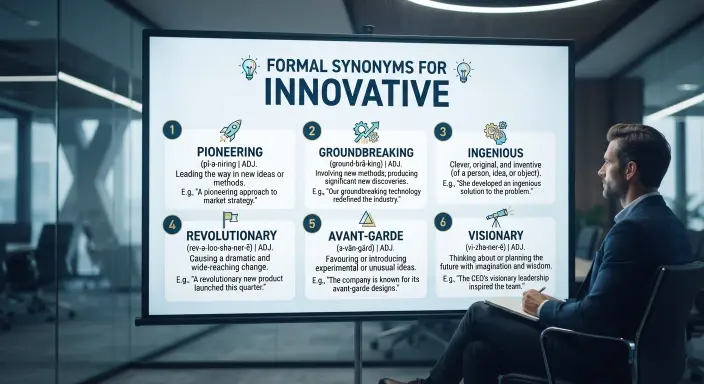
Formal alternatives work well in academic papers, business reports, professional presentations, proposals, and official communication.
Pioneering
Meaning: Introducing something new or developing an approach before others.
Explanation: Pioneering is one of the strongest alternatives to innovative. It often suggests that a person, organization, or method is among the first to introduce an important development.
Example: The company developed a pioneering approach to renewable energy storage.
Best Use: Research, technology, business, science, and major developments.
Worst Use: Avoid it for a small improvement that is not particularly new.
Tone: Formal, confident, and achievement-focused.
Groundbreaking
Meaning: Introducing something that produces an important change.
Explanation: Groundbreaking suggests that an idea or discovery breaks from established practices and has significant importance.
Example: Researchers developed a groundbreaking method for detecting the disease at an early stage.
Best Use: Major discoveries, technologies, research, and important achievements.
Worst Use: Do not use it simply because something is new.
Tone: Strong, formal, and emphatic.
Transformative
Meaning: Causing a major change in something.
Explanation: Transformative focuses more on the effect of an idea than on its originality. An innovative system may be transformative if it significantly changes how something works.
Example: The new training program had a transformative effect on employee development.
Best Use: Business, education, technology, policy, and organizational change.
Worst Use: Avoid it for minor improvements.
Tone: Formal and analytical.
Progressive
Meaning: Supporting or introducing new methods, ideas, or developments.
Explanation: Progressive can describe something modern and willing to move beyond traditional practices. It is broader than innovative.
Example: The school adopted progressive teaching methods that encourage active learning.
Best Use: Education, organizations, social development, and professional writing.
Worst Use: It may be vague if you specifically need to emphasize originality.
Tone: Formal and positive.
Forward-Thinking
Meaning: Focused on future needs, possibilities, or developments.
Explanation: A forward-thinking person or organization anticipates future changes rather than simply reacting to current conditions.
Example: The company has a forward-thinking approach to digital education.
Best Use: Business strategy, leadership, technology, and planning.
Worst Use: Avoid it when you need evidence that an idea is actually new.
Tone: Professional and future-oriented.
Visionary
Meaning: Showing imaginative ideas about what could happen or be achieved in the future.
Explanation: Visionary often describes people, leaders, or ideas with an ambitious view of the future. It does not automatically mean that the idea has already been implemented.
Example: The founder was recognized for her visionary approach to sustainable design.
Best Use: Leadership, entrepreneurship, technology, arts, and long-term strategy.
Worst Use: Avoid using it as a neutral description when you only mean “new.”
Tone: Formal, admiring, and ambitious.
Novel
Meaning: New, original, or different from what has existed before.
Explanation: Novel is especially useful in academic and professional writing. It highlights newness rather than necessarily claiming that something is revolutionary.
Example: The study presents a novel method for analyzing consumer behavior.
Best Use: Academic research, science, technology, and professional reports.
Worst Use: It may sound overly formal in casual conversation.
Tone: Formal and precise.
Advanced
Meaning: Highly developed or technically sophisticated.
Explanation: Advanced is related to innovation but is not an exact synonym. Something can be advanced without being particularly original.
Example: The laboratory uses advanced imaging equipment.
Best Use: Technology, science, engineering, medicine, and professional descriptions.
Worst Use: Do not use it when originality is the main point.
Tone: Professional and technical.
Cutting-Edge
Meaning: At the newest or most advanced stage of development.
Explanation: Cutting-edge suggests that something is at the forefront of current development. It can describe technology, research, design, or methods.
Example: The company uses cutting-edge software to improve data security.
Best Use: Technology, science, design, business, and marketing.
Worst Use: Avoid it when describing an ordinary new product.
Tone: Professional, modern, and energetic.
Trailblazing
Meaning: Creating a new path or approach that others may follow.
Explanation: Trailblazing is close to pioneering. It emphasizes leading the way into a new area.
Example: Her trailblazing research changed how scientists understood the process.
Best Use: Research, leadership, technology, culture, and major achievements.
Worst Use: It can sound exaggerated for routine innovation.
Tone: Formal, powerful, and celebratory.
Inventive
Meaning: Skilled at creating new ideas, methods, or solutions.
Explanation: Inventive emphasizes imagination combined with the ability to develop something useful or original.
Example: The engineer proposed an inventive solution to the design problem.
Best Use: Problem-solving, engineering, design, writing, and creative work.
Worst Use: It may not fit a large organizational strategy where innovative or transformative is more suitable.
Tone: Professional and positive.
Ingenious
Meaning: Clever, original, and effective.
Explanation: Ingenious is especially useful when an innovation solves a difficult problem in a clever way.
Example: The team created an ingenious system for reducing water waste.
Best Use: Engineering, design, problem-solving, and practical inventions.
Worst Use: It is less suitable when discussing broad organizational change.
Tone: Formal to neutral, with strong praise.
Original
Meaning: New and not copied from another source.
Explanation: Original is one of the safest alternatives to innovative, but it emphasizes uniqueness rather than usefulness or technological progress.
Example: The designer presented an original concept for the new website.
Best Use: Art, writing, design, products, ideas, and creative work.
Worst Use: Avoid it if you need to show that an idea significantly improves an existing system.
Tone: Neutral and professional.
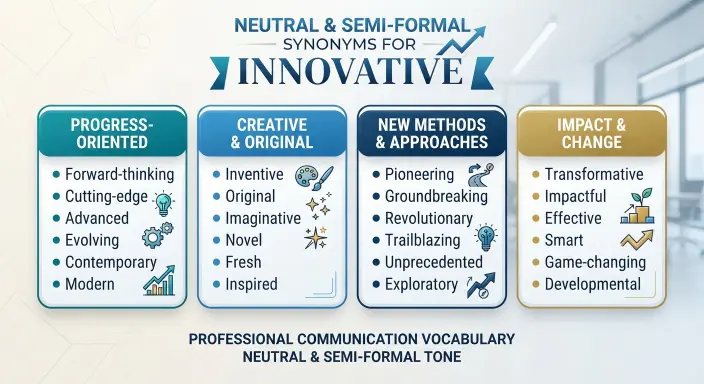
Semi-Formal and Neutral Synonyms for Innovative
Creative
Meaning: Able to produce new and imaginative ideas.
Explanation: Creative is perhaps the most common related word. However, creativity does not necessarily produce practical innovation.
Example: We need a creative solution to this communication problem.
Best Use: Ideas, writing, design, advertising, education, and problem-solving.
Worst Use: Avoid it when you specifically mean technological advancement.
Tone: Friendly, positive, and professional.
Fresh
Meaning: New, different, or interesting.
Explanation: Fresh is useful when an idea offers a new perspective without making a strong claim about its importance.
Example: The team brought a fresh perspective to the project.
Best Use: Marketing, brainstorming, meetings, writing, and everyday communication.
Worst Use: It can sound too casual for highly technical reports.
Tone: Neutral and conversational.
Unique
Meaning: Different from others or distinctive.
Explanation: Unique focuses on distinctiveness rather than innovation. Something can be unique without being useful or new.
Example: The company developed a unique approach to customer onboarding.
Best Use: Branding, design, products, and creative descriptions.
Worst Use: Avoid using it as a direct replacement for innovative when the idea is not actually new.
Tone: Neutral and positive.
Modern
Meaning: Related to current times, styles, methods, or technology.
Explanation: Modern means current or contemporary, while innovative means introducing new ideas or methods. A modern system is not automatically innovative.
Example: The office uses modern communication tools.
Best Use: Design, technology, workplaces, architecture, and general descriptions.
Worst Use: Avoid it when you need to emphasize originality.
Tone: Neutral.
Resourceful
Meaning: Skilled at finding clever and practical ways to solve problems.
Explanation: Resourceful describes a person’s ability to work with available resources. It can overlap with innovation but focuses more on adaptability and practical problem-solving.
Example: The resourceful team found a way to complete the project with limited equipment.
Best Use: People, teams, problem-solving, and challenging situations.
Worst Use: It is not a direct substitute for an innovative product or technology.
Tone: Positive and practical.
Imaginative
Meaning: Showing a strong ability to form creative ideas.
Explanation: Imaginative emphasizes mental creativity. It does not necessarily suggest that the idea is practical or technologically advanced.
Example: The students developed an imaginative approach to the science project.
Best Use: Education, arts, writing, design, and creative problem-solving.
Worst Use: Avoid it if the main point is measurable technological advancement.
Tone: Neutral and positive.
Unconventional
Meaning: Different from traditional or commonly accepted methods.
Explanation: Unconventional describes something that does not follow normal practice. It may be innovative, but it does not guarantee that the approach is effective or original.
Example: The startup uses an unconventional approach to employee training.
Best Use: Business, education, design, marketing, and problem-solving.
Worst Use: Avoid it if you want a clearly positive word.
Tone: Neutral; sometimes slightly provocative.
Forward-Looking
Meaning: Focused on future needs and opportunities.
Explanation: Forward-looking is useful when discussing plans or strategies designed with future developments in mind.
Example: The organization created a forward-looking technology strategy.
Best Use: Strategy, planning, business, education, and policy discussions.
Worst Use: It is less suitable when describing a specific invention.
Tone: Professional and neutral.
Next-Generation
Meaning: Representing a newer stage of development.
Explanation: Next-generation is often used for products, technology, systems, and services. It suggests advancement but does not always mean the product is truly innovative.
Example: The company released a next-generation battery system.
Best Use: Technology, engineering, products, and marketing.
Worst Use: Avoid it in academic writing unless the term has a clear technical meaning.
Tone: Modern and professional.
Different
Meaning: Not the same as something else.
Explanation: Different is much broader than innovative. It can describe any variation, even one that is neither new nor useful.
Example: The team tested a different approach to scheduling.
Best Use: Everyday and neutral writing.
Worst Use: Avoid it when you need to communicate meaningful originality.
Tone: Very neutral.
Game-Changing
Meaning: Likely to produce a major change in how something is done.
Explanation: Game-changing is a contextual alternative rather than an exact synonym. It emphasizes impact, not simply originality.
Example: The new payment system could be game-changing for small retailers.
Best Use: Business, technology, marketing, and informal professional communication.
Worst Use: Avoid it in highly formal writing unless the context supports such strong language.
Tone: Energetic and emphatic.
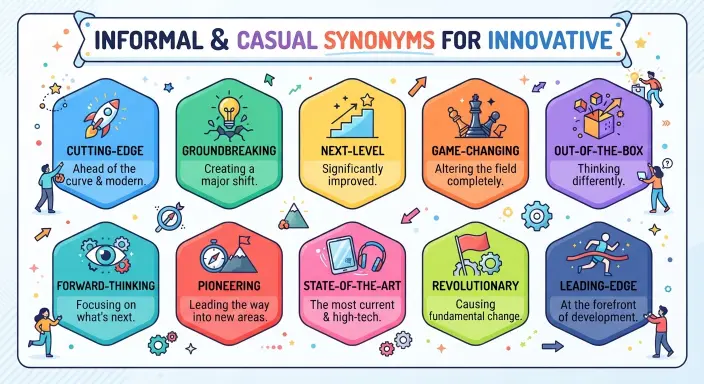
Informal and Casual Synonyms for Innovative
Outside-the-Box
Meaning: Unusual and not limited by traditional thinking.
Example: We need some outside-the-box ideas for the campaign.
When it sounds natural: Brainstorming, meetings, casual workplace conversations, and creative discussions.
When to avoid it: Formal academic writing and precise technical reports.
Tone: Casual and energetic.
Ahead of the Curve
Meaning: More advanced or informed than most others in the same area.
Example: That company is ahead of the curve in using artificial intelligence.
When it sounds natural: Business conversations, technology discussions, and casual professional writing.
When to avoid it: Legal documents and highly formal academic writing.
Tone: Conversational and confident.
New-School
Meaning: Based on newer ideas, methods, or styles rather than traditional ones.
Example: She’s using a new-school approach to teaching online.
When it sounds natural: Casual conversation, culture, education, and creative industries.
When to avoid it: Formal reports and academic papers.
Tone: Casual and modern.
Clever
Meaning: Showing intelligence or skill in solving a problem.
Example: That’s a clever way to organize the data.
When it sounds natural: Everyday conversation and informal workplace discussion.
When to avoid it: It may undersell a major innovation.
Tone: Casual and positive.
Fresh
Meaning: New or different in an appealing way.
Example: The designer came up with a fresh idea for the campaign.
When it sounds natural: Conversation, marketing, creative work, and informal messages.
When to avoid it: Technical contexts where precision matters.
Tone: Casual to neutral.
Something New
Meaning: A new idea, method, product, or approach.
Example: The team wanted to try something new with the website.
When it sounds natural: Everyday conversation and informal discussion.
When to avoid it: Formal reports where a more precise description is needed.
Tone: Very casual and simple.
True Synonyms vs Contextual Synonyms for Innovative
Not all alternatives carry the same meaning. This distinction matters because replacing innovative with the wrong word can accidentally change your message.
| Type | What It Means | Can It Replace “Innovative”? |
|---|---|---|
| True or very close synonym | New and original in a useful or meaningful way | Usually |
| Near synonym | Similar idea but emphasizes another quality | Often, depending on context |
| Contextual alternative | Works in a particular situation but has a different core meaning | Sometimes |
| Broader expression | Covers innovation but also many other possibilities | Sometimes |
| Narrower expression | Refers to a specific type of innovation | Only in the right context |
| Formal equivalent | A more professional way to express a similar idea | Yes, in suitable contexts |
| Casual equivalent | Informal wording that conveys a similar idea | Yes, in casual contexts |
For example, creative is related to innovative, but creativity is about generating ideas, while innovation usually involves introducing something new or useful. Groundbreaking is stronger because it suggests substantial impact. Modern simply means current, so it should not automatically replace innovative.
Business Writing: Synonyms for Innovative
Business writing often benefits from precise alternatives rather than repeated use of innovative.
- Use innovative when you want to describe a new and useful approach:
The company introduced an innovative customer-support platform.
- Use forward-thinking for strategy:
The leadership team developed a forward-thinking growth strategy.
- Use pioneering for leadership in a new area:
The company pioneered a new approach to remote training.
- Use transformative when emphasizing results:
The new system has had a transformative effect on workflow.
- Use cost-effective or efficient instead if the real advantage is lower cost or better performance rather than originality.
Corporate Communication: Professional Synonyms
In corporate reports, presentations, and internal announcements, words should match the evidence behind the claim.
- Innovative — new and useful
- Forward-thinking — focused on future needs
- Progressive — willing to adopt new approaches
- Advanced — technically developed
- Transformative — produces major change
- Pioneering — among the first to introduce something
- Strategic — designed around a specific goal
- Original — distinctive or not copied
For example:
Our research team developed a novel approach to reducing processing time.
This is more precise than simply describing the approach as “very innovative.”
Academic Writing: Synonyms for Innovative
Academic writing usually benefits from restrained and precise language.
Useful choices include:
- Novel
- Original
- Pioneering
- Innovative
- Unconventional
- Advanced
- Emerging
- Newly developed
For example:
This study proposes a novel framework for examining online learning behavior.
Avoid using groundbreaking or revolutionary unless the evidence genuinely supports such a strong claim. Academic writing often works better when the wording describes exactly what is new.
Customer Service: Polite Synonyms
Customer service writing rarely needs dramatic words such as revolutionary. Clear, specific language is usually better.
Instead of:
We have an innovative solution to your problem.
Consider:
We have a new solution that may resolve the issue.
Or:
We have introduced an improved process to make this easier.
If the system truly represents a new approach, innovative can still work. The key is not to use it as empty promotional language.
Legal Writing: Use Precise Language
Legal writing requires particular care because descriptive words can carry implications that the underlying facts may not support.
Terms such as innovative, groundbreaking, revolutionary, and unique can be subjective. If the important point is that a process was newly introduced, wording such as newly developed, newly implemented, or original may be more precise, depending on the facts.
For example:
The company implemented a newly developed verification process in 2026.
This makes a factual claim without automatically suggesting that the process was groundbreaking.
Email Communication: Professional Synonyms for Innovative
In professional emails, choose wording based on what you actually want to communicate.
- Innovative — new and useful
- Creative — imaginative
- Novel — new and distinctive; more formal
- Practical — useful in real situations
- Effective — produces the desired result
- Forward-thinking — focused on future needs
- Original — distinctive
- New approach — simple and direct
For most business emails, new approach, creative approach, or new solution can sound more natural than repeatedly using innovative.
Email Examples Using Synonyms for Innovative
Email 1: Client Communication
Subject: A new approach for the campaign
Hi Maria,
I wanted to share a new approach our team developed for the upcoming campaign. Instead of using separate landing pages for each audience, we can use one flexible page with personalized sections.
I think this could make the campaign easier to manage while giving each audience a more relevant experience.
Best,
Daniel
Email 2: Project Update
Subject: Update on the product design
Hi Team,
We’ve completed the first version of the new product design. The latest concept takes a more creative approach to navigation and reduces the number of steps needed to complete an order.
I’ll walk everyone through the changes at tomorrow’s meeting.
Thanks,
Alex
Email 3: Research Discussion
Subject: Novel method for the next study
Professor Lee,
I have been reviewing the data and found a novel method that may help us compare the two groups more efficiently.
I’ve included the basic procedure in the attached notes and would appreciate your feedback before I develop it further.
Best regards,
Nadia
Email 4: Internal Workplace Email
Subject: A forward-thinking training idea
Hi everyone,
I’d like to suggest a forward-thinking approach to employee training. We could create short modules that employees can complete when their schedules allow rather than requiring one long session.
This could give teams more flexibility while keeping the material consistent.
Best,
Jordan
Email 5: Vendor Communication
Subject: New solution for inventory tracking
Hello Mr. Patel,
Thank you for demonstrating the updated inventory platform. The new solution appears to address several of the tracking problems we’ve experienced.
Could you send us the technical specifications and implementation timeline?
Regards,
Megan
Email 6: Customer Service
Subject: An improved way to manage your account
Hello James,
Thank you for contacting us. We’ve recently introduced an improved account-management process that should make it easier to update your information online.
If you’d like, I can also guide you through the first update.
Best,
Customer Support Team
Short Dialogue Examples Using Innovative Synonyms
Workplace
Person A: Do you think this idea is innovative enough?
Person B: It is creative, but I think we should explain what makes it different from the current system.
Classroom
Person A: What word can I use instead of innovative?
Person B: Try novel if you’re writing an academic assignment.
Customer Service
Person A: We need an innovative solution.
Person B: Let’s call it a new solution unless we can explain exactly what’s new about it.
Casual Conversation
Person A: Your new app idea is pretty innovative.
Person B: Thanks! I wanted to try something outside-the-box.
Professional Discussion
Person A: Is “revolutionary” too strong for the report?
Person B: Probably. “Novel” or “innovative” would be more measured.
How to Replace “Innovative” in a Sentence
1. Emphasizing creativity
Original:
The team developed an innovative campaign.
Alternative:
The team developed a creative campaign.
Why it works:
Creative emphasizes imagination but does not necessarily claim that the campaign represents a major innovation.
2. Emphasizing originality
Original:
She proposed an innovative design.
Alternative:
She proposed an original design.
Why it works:
Original highlights that the design is distinctive or not copied.
3. Emphasizing major change
Original:
The company introduced an innovative system.
Alternative:
The company introduced a transformative system.
Why it works:
Transformative focuses on the system’s ability to produce substantial change.
4. Emphasizing leadership
Original:
The researchers developed an innovative technique.
Alternative:
The researchers developed a pioneering technique.
Why it works:
Pioneering suggests that the researchers are among the first to introduce the technique.
5. Academic writing
Original:
The paper presents an innovative model.
Alternative:
The paper presents a novel model.
Why it works:
Novel is concise and common in formal academic contexts when emphasizing newness.
6. Future-oriented strategy
Original:
The company has an innovative business strategy.
Alternative:
The company has a forward-thinking business strategy.
Why it works:
The alternative emphasizes preparation for future conditions rather than originality alone.
7. Technical development
Original:
The laboratory uses innovative equipment.
Alternative:
The laboratory uses advanced equipment.
Why it works:
Advanced emphasizes technical development. It does not necessarily claim that the equipment is newly invented.
8. Informal communication
Original:
That’s an innovative way to solve the problem.
Alternative:
That’s a clever way to solve the problem.
Why it works:
Clever sounds more natural in everyday conversation and emphasizes practical intelligence.
9. Emphasizing unusual thinking
Original:
We need an innovative solution.
Alternative:
We need an outside-the-box solution.
Why it works:
The casual alternative emphasizes unconventional thinking. It is less suitable for formal documents.
10. Emphasizing strong impact
Original:
The new technology is innovative.
Alternative:
The new technology could be game-changing.
Why it works:
Game-changing makes a stronger claim about impact, so it should be used only when that level of emphasis is justified.
Comparison Table: Synonyms for Innovative
| Phrase | Tone | Meaning / Scope | Best Use | Example |
|---|---|---|---|---|
| Innovative | Professional | New and useful | General professional writing | An innovative platform |
| Original | Neutral | Distinctive or not copied | Design and ideas | An original concept |
| Creative | Neutral | Imaginative and idea-focused | Campaigns and problem-solving | A creative solution |
| Novel | Formal | New or distinctive | Academic writing | A novel method |
| Pioneering | Formal | Among the first | Research and technology | A pioneering study |
| Groundbreaking | Strong formal | Major and important change | Major discoveries | A groundbreaking discovery |
| Transformative | Formal | Producing major change | Business and education | A transformative program |
| Forward-thinking | Professional | Focused on future needs | Strategy | A forward-thinking plan |
| Advanced | Technical | Highly developed | Technology | Advanced equipment |
| Cutting-edge | Modern | At the forefront | Technology and research | Cutting-edge software |
| Inventive | Professional | Creative and resourceful | Design and solutions | An inventive approach |
| Ingenious | Positive | Clever and effective | Problem-solving | An ingenious solution |
| Unconventional | Neutral | Different from tradition | New approaches | An unconventional method |
| Visionary | Formal | Ambitious future-oriented thinking | Leadership | A visionary leader |
| Game-changing | Casual/strong | Producing major effects | Business and marketing | A game-changing product |
| Outside-the-box | Casual | Unconventional thinking | Brainstorming | An outside-the-box idea |
Which Synonyms Should You Choose?
For Formal Writing
Choose novel, pioneering, groundbreaking, transformative, or inventive depending on the exact meaning.
- New research method → novel
- First major development → pioneering
- Major breakthrough → groundbreaking
- Major change in practice → transformative
- Clever new solution → inventive
For Business Communication
Innovative, forward-thinking, transformative, creative, and original are useful choices.
If you are describing strategy, forward-thinking may be more precise. If you are describing measurable change, transformative may fit better.
For Academic Writing
Prefer novel, original, pioneering, or innovative.
Use strong words such as groundbreaking only when the evidence and context justify them.
For Legal Writing
Favor factual descriptions such as newly developed, newly implemented, original, or advanced, depending on what the evidence establishes.
Avoid subjective promotional language when precision matters.
For Professional Emails
Use new approach, creative approach, new solution, original idea, innovative approach, or forward-thinking strategy.
A simple phrase is often better than a dramatic one.
For Everyday Conversation
Use creative, clever, fresh, new, different, or outside-the-box.
These sound more natural than highly formal terms such as pioneering or transformative.
For Casual Messages
Try fresh, clever, new-school, game-changing, or ahead of the curve when the context supports them.
Grammar and Usage Guide for “Innovative”
Innovative Is an Adjective
Innovative describes a noun.
an innovative product
an innovative teacher
an innovative approach
an innovative company
You would not normally use it as a noun by itself.
Incorrect:
The innovative of the company was impressive.
Better:
The company’s innovation was impressive.
Innovative vs. Innovation
Innovative is an adjective.
The company created an innovative product.
Innovation is a noun.
The company’s innovation changed the market.
Innovate is a verb.
The company continues to innovate.
Innovative + Noun
Common combinations include:
- innovative solution
- innovative approach
- innovative idea
- innovative product
- innovative technology
- innovative design
- innovative method
- innovative strategy
- innovative system
- innovative process
- innovative business model
Highly Innovative
You can use an adverb to modify innovative.
The company developed a highly innovative product.
However, avoid stacking unnecessary modifiers:
a very highly extremely innovative solution
A simpler description is usually stronger.
More Innovative and Most Innovative
Because innovative is an adjective, comparative and superlative forms are possible.
This approach is more innovative than the previous one.
The team presented the most innovative design in the competition.
Use these forms only when there is a meaningful basis for comparison.
Innovative Approach vs. Innovation
These phrases are related but not identical.
We introduced an innovative approach.
This describes the method.
We introduced an innovation.
This describes the new idea, method, product, or change itself.
Capitalization
Innovative is normally lowercase unless it begins a sentence or appears in a proper title.
The company developed an innovative platform.
Not:
The company developed an Innovative platform.
Common Mistakes to Avoid With Synonyms for Innovative
1. Treating “Creative” as an Exact Synonym
A creative idea is not necessarily an innovation. Creativity produces possibilities; innovation often involves putting new ideas into practice.
2. Using “Modern” to Mean “Innovative”
Modern means current or contemporary. Something can be modern without introducing anything new.
3. Calling Everything “Groundbreaking”
Groundbreaking is a strong claim. Save it for developments that represent a meaningful breakthrough.
4. Using “Revolutionary” Too Easily
Revolutionary suggests an unusually large transformation. It can sound exaggerated when describing a minor improvement.
5. Using Casual Expressions in Formal Writing
Phrases such as new-school, game-changing, and outside-the-box may sound out of place in an academic paper or legal document.
6. Ignoring the Difference Between New and Useful
Something may be original without being useful. If usefulness is central to your message, choose wording that communicates practical value.
7. Using “Unique” Incorrectly
Unique means distinct or one of a kind, not necessarily innovative.
8. Repeating “Innovative” Too Often
Using the same adjective throughout an article can make your writing feel repetitive. Replace it only when the alternative adds a real difference in meaning.
9. Choosing “Advanced” When You Mean Original
Advanced describes a high level of development. It does not necessarily mean that something is new.
10. Ignoring the Audience
A phrase that works in a brainstorming session may not work in a research paper. Match vocabulary to the reader and purpose.
When Not to Use “Innovative”
When You Mean “Creative”
If you are describing imagination rather than implementation, creative may be more accurate.
She wrote a creative story.
Calling the story innovative may suggest a broader departure from established forms.
When You Mean “Current”
Use modern or contemporary when you simply mean something belongs to the present period.
The building has a modern design.
When You Mean “Technically Advanced”
Use advanced if technical sophistication is the main point.
The facility uses advanced imaging equipment.
When You Mean “First”
Use pioneering when being among the first matters.
The researchers pioneered a new treatment method.
When You Mean “Major Change”
Use transformative or groundbreaking if the impact is the central idea and the evidence supports that description.
When the Word Sounds Promotional
If a report needs neutral language, replace vague praise with a factual description.
Instead of:
We created an innovative process.
Try:
We introduced a new process that reduces the number of approval steps.
The second version tells the reader what changed rather than simply praising it.
When “Innovative” Is Actually the Better Choice
Keep innovative when you genuinely mean that something introduces new and useful ideas or methods and no narrower alternative communicates the full meaning.
Advanced Writer Tips for Using Synonyms for Innovative
Tone Control
Use vocabulary to control the strength of your claim.
- Neutral: new, original, creative
- Professional: innovative, forward-thinking, inventive
- Formal: novel, pioneering, transformative
- Strong: groundbreaking, revolutionary
- Casual: fresh, clever, outside-the-box
This lets you adjust your language without changing the central idea too much.
Professional Email Etiquette
Avoid using innovative as a generic compliment. Specific wording sounds more credible.
Instead of:
We have an innovative solution.
Try:
We developed a new solution that reduces manual data entry.
The second sentence gives the reader something concrete.
Politeness
Words such as creative and interesting can provide positive feedback without making a large claim.
For example:
That’s a creative suggestion.
may sound more measured than:
That’s a groundbreaking suggestion.
Context Alignment
Ask what quality you actually want to emphasize:
- Newness → novel
- Originality → original
- Creativity → creative
- Cleverness → ingenious
- Leadership → pioneering
- Future focus → forward-thinking
- Technical development → advanced
- Major impact → transformative
- Major breakthrough → groundbreaking
Precision
The strongest synonym is not always the strongest-sounding word. It is the word that communicates the intended meaning most accurately.
If a product is technologically advanced but not original, use advanced. While if it is among the first of its kind, use pioneering. If it changes an entire process, transformative may be appropriate.
Readability
Simple words often work better than impressive ones.
Instead of:
The organization implemented a pioneering transformative initiative.
Try:
The organization introduced a new approach that changed how the team works.
Clear writing gives readers the information they need without unnecessary exaggeration.
Related Questions About Synonyms for Innovative
1. What is another way to say innovative?
You can say original, creative, inventive, novel, pioneering, groundbreaking, forward-thinking, transformative, or advanced, depending on the context.
2. What is a professional synonyms for innovative?
Forward-thinking, inventive, novel, pioneering, and transformative are useful professional alternatives. The best choice depends on whether you mean originality, leadership, future planning, or major impact.
3. What is the formal synonyms for innovative?
Novel, pioneering, groundbreaking, transformative, and inventive are among the strongest formal options.
4. What can I use instead of innovative in an essay?
For academic writing, try novel, original, pioneering, innovative, or unconventional. Novel is especially useful when you want to emphasize that an approach is new.
5. Is innovative a formal word?
Yes. Innovative is appropriate in professional, academic, business, and general writing. It is not restricted to formal contexts, but it can sound promotional when used too frequently.
6. Is creative the same as innovative?
No. They overlap, but creative emphasizes the generation of new ideas, while innovative generally emphasizes introducing new or improved ideas, methods, products, or practices.
7. What is the difference between innovative and groundbreaking?
Innovative describes something new and useful or original. Groundbreaking is stronger and suggests that the development represents a significant breakthrough or change.
FAQs About Synonyms for Innovative
1. What is the closest synonyms for innovative?
Inventive, original, novel, and pioneering are among the closest alternatives. The best choice depends on what kind of innovation you are describing.
2. Which synonyms for innovative is best for academic writing?
Novel is often a strong choice because it clearly communicates newness without making an unnecessarily dramatic claim. Original and pioneering can also work when their specific meanings fit.
3. What is a strong synonyms for innovative?
Groundbreaking, pioneering, revolutionary, and transformative are strong alternatives. They should be used carefully because they imply more than simple newness.
4. Can “creative” replace “innovative”?
Sometimes, but not always. Creative focuses on imagination and idea generation, while innovative more strongly suggests the introduction or application of something new.
5. Is “modern” a synonym for innovative?
Not exactly. Modern means current or contemporary. An innovative product may be modern, but a modern product is not necessarily innovative.
6. What is a casual way to say innovative?
In casual speech, you can use fresh, clever, outside-the-box, new-school, or ahead of the curve, depending on the situation.
7. How do I avoid overusing the word innovative?
Replace it only when the replacement adds precision. Use creative for ideas, novel for academic newness, pioneering for first-mover status, advanced for technical development, and transformative for major effects.
Key Takeaways
- Innovative describes something that introduces new or useful ideas, methods, products, or approaches.
- Use creative for imagination, novel for newness, and original for distinctiveness.
- Choose pioneering when being among the first matters and groundbreaking when a major breakthrough is involved.
- Use advanced for technical development rather than assuming advanced means innovative.
- Match the synonym to your audience, purpose, evidence, and desired level of emphasis.
Conclusion
Choosing among the many synonyms for innovative is less about finding a replacement and more about finding the exact meaning you want to express. Creative highlights imagination, original highlights distinctiveness, and novel emphasizes newness.
For major developments, pioneering, groundbreaking, and transformative can be more precise. In professional writing, forward-thinking works well for future-focused strategy, while advanced is useful when technical development matters.
Casual settings allow expressions such as fresh, clever, and outside-the-box. However, these should not automatically replace formal terminology. The strongest writing uses the word that fits the evidence and context rather than choosing the most impressive-sounding option.
Before replacing innovative, ask yourself what you really mean: new, creative, technically advanced, unusual, pioneering, or highly impactful. That small distinction can make your writing clearer, more credible, and much more natural.
