
Finding the right synonyms for normal can make your writing more precise, natural, and appropriate for the situation. The word normal is common and useful, but it can mean several different things: usual, expected, ordinary, typical, standard, or free from something unusual. Because of these differences, simply replacing normal with a random synonym can change the meaning of a sentence.
The best alternative depends on what you actually mean. For example, usual works well for something that regularly happens, typical describes what is representative, standard refers to an accepted level or requirement, and ordinary means not special or unusual. This guide covers more than 33 alternatives, including formal, neutral, casual, professional, academic, and context-specific choices.
Quick Answer: Synonyms for Normal
Common synonyms for normal include usual, typical, ordinary, standard, regular, customary, conventional, routine, expected, common, average, everyday, familiar, traditional, mainstream, natural, unremarkable, usual, prevalent, and ordinary. The best choice depends on whether normal means usual, expected, typical, standard, or not unusual.
Quick List of Synonyms for Normal
Closest Synonyms for Normal
- Usual
- Typical
- Ordinary
- Regular
- Standard
- Customary
- Conventional
- Routine
- Expected
- Common
Formal Synonyms for Normal
- Conventional
- Customary
- Standard
- Typical
- Ordinary
- Usual
- Established
- Prevailing
- Conventional
- Unexceptional
- Unremarkable
- Representative
Neutral Synonyms for Normal
- Regular
- Common
- Familiar
- Everyday
- Routine
- Expected
- Average
- Typical
- Usual
- Ordinary
- Standard
- Natural
Casual Alternatives for Normal
- Usual
- Typical
- Everyday
- Nothing unusual
- Same as usual
- Same as always
- Pretty standard
- Nothing out of the ordinary
These alternatives aren’t interchangeable in every sentence. The exact meaning of normal matters.
Formal Synonyms for Normal
Usual — One of the Closest Synonyms for Normal
Meaning: Something that commonly happens or occurs in the expected way.
Explanation: Usual is one of the safest replacements for normal when you mean “what generally happens.” It focuses on familiarity or frequency rather than a formal standard.
Example: The office will return to its usual schedule next Monday.
Best Use: Business writing, emails, everyday writing, and professional communication.
Worst Use: When normal means an official standard or required level.
Tone: Neutral and natural.
Typical — A Precise Alternative for Normal
Meaning: Representative of the usual characteristics of a person, group, or situation.
Explanation: Typical is useful when something represents what is generally expected or commonly seen. It doesn’t necessarily mean that every example follows the same pattern.
Example: This is typical behavior for the species during the winter months.
Best Use: Academic writing, reports, descriptions, and everyday communication.
Worst Use: When discussing an official requirement or technical specification.
Tone: Neutral, precise, and informative.
Ordinary — A Formal Alternative for Normal
Meaning: Common, everyday, or not unusual.
Explanation: Ordinary emphasizes the absence of anything special or exceptional. It can sometimes carry a slightly negative suggestion that something is unremarkable.
Example: The building looks ordinary from the outside.
Best Use: General writing, descriptions, literature, and formal prose.
Worst Use: When you want to say something meets an official standard.
Tone: Neutral, sometimes slightly dismissive.
Standard — A Professional Synonym for Normal
Meaning: Accepted as a usual level, quality, method, or requirement.
Explanation: Standard is appropriate when normal refers to an accepted rule, benchmark, specification, or expected level.
Example: The company uses standard procedures for processing customer requests.
Best Use: Business, technical writing, policies, education, and professional communication.
Worst Use: Casual descriptions of people or personal behavior.
Tone: Formal and professional.
Customary — A Formal Synonym for Normal
Meaning: Commonly done according to established custom or practice.
Explanation: Customary focuses on habits and established practices. It is especially useful when something is considered normal because people traditionally do it that way.
Example: It is customary to introduce new employees during the monthly meeting.
Best Use: Formal writing, cultural descriptions, business policies, and historical writing.
Worst Use: When you simply mean something happens frequently.
Tone: Formal and polished.
Conventional — A Formal Alternative for Normal
Meaning: Following commonly accepted methods, beliefs, or practices.
Explanation: Conventional describes something that follows established or widely accepted patterns. It can also suggest the opposite of unusual or innovative.
Example: The company chose a conventional approach to project management.
Best Use: Academic writing, business writing, cultural analysis, and professional communication.
Worst Use: When you mean something happens regularly at a particular time.
Tone: Formal and analytical.
Routine — A Useful Formal Alternative for Normal
Meaning: Happening regularly as part of a familiar pattern.
Explanation: Routine is narrower than normal. It suggests repetition and predictability rather than simply being typical.
Example: The technician performed a routine inspection of the equipment.
Best Use: Workplace writing, healthcare contexts, operations, schedules, and procedures.
Worst Use: When you mean “healthy,” “acceptable,” or “typical” rather than regularly performed.
Tone: Neutral and professional.
Expected — A Contextual Synonym for Normal
Meaning: Considered likely or anticipated.
Explanation: Expected works when something is normal because people anticipated it. It is not a universal replacement for normal.
Example: Some delays are expected during the holiday season.
Best Use: Reports, forecasts, workplace communication, academic writing, and customer service.
Worst Use: When something is simply common but was not anticipated.
Tone: Neutral and professional.
Established — A Formal Alternative for Normal
Meaning: Accepted, recognized, or in use for some time.
Explanation: Established describes something that has become accepted or well known. It can replace normal when the idea involves an accepted method or practice.
Example: We followed the company’s established procedure for handling complaints.
Best Use: Corporate communication, policies, reports, and formal writing.
Worst Use: Simple descriptions of everyday events.
Tone: Formal and authoritative.
Prevailing — A Formal Alternative for Normal
Meaning: Most common, widely accepted, or currently dominant.
Explanation: Prevailing is useful when something is the dominant condition, opinion, practice, or trend. It is more formal than normal.
Example: The prevailing market conditions have affected consumer spending.
Best Use: Academic writing, economics, reports, journalism, and professional analysis.
Worst Use: Casual conversation.
Tone: Formal and analytical.
Unexceptional — A Precise Alternative for Normal
Meaning: Not unusual, remarkable, or extraordinary.
Explanation: Unexceptional directly conveys the idea that something falls within an ordinary range. It can sound less positive than normal.
Example: The inspection found no unexceptional features requiring further investigation.
Best Use: Formal descriptions and analytical writing.
Worst Use: Compliments or enthusiastic descriptions.
Tone: Formal and restrained.
Unremarkable — A Formal Alternative for Normal
Meaning: Not unusual or noteworthy.
Explanation: Unremarkable often means that nothing stood out as unusual. It can be useful when writing objective descriptions, but it may imply that something was not impressive.
Example: The results were largely unremarkable.
Best Use: Analytical, technical, and descriptive writing.
Worst Use: When you want to praise something or emphasize positive normality.
Tone: Formal and objective.
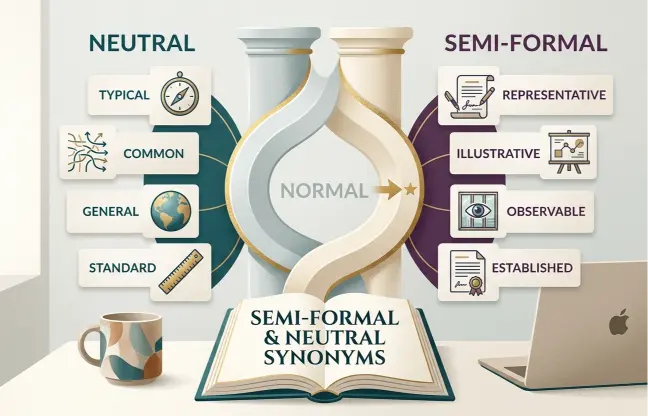
Semi-Formal and Neutral Synonyms for Normal
Regular — A Versatile Synonym for Normal
Meaning: Happening repeatedly, consistently, or according to a pattern.
Explanation: Regular can mean normal in some contexts, but it often refers specifically to frequency or consistency.
Example: The store has regular business hours from Monday through Friday.
Best Use: Work, schedules, emails, websites, and everyday writing.
Worst Use: When you mean “average” or “not unusual” in a broader sense.
Tone: Neutral and practical.
Common — A Broad Alternative for Normal
Meaning: Frequently found, seen, or experienced.
Explanation: Common focuses on frequency. Something can be common without being considered normal in every social or cultural setting.
Example: It is common for students to feel nervous before an important exam.
Best Use: General writing, education, websites, and explanations.
Worst Use: When you mean an official standard.
Tone: Neutral and accessible.
Familiar — A Contextual Alternative for Normal
Meaning: Known from previous experience.
Explanation: Familiar emphasizes recognition rather than normality. Something can feel familiar even if it isn’t statistically common.
Example: The new software has a familiar interface.
Best Use: Product descriptions, websites, customer communication, and everyday writing.
Worst Use: When you need to say something is objectively typical.
Tone: Friendly and neutral.
Everyday — A Natural Alternative for Normal
Meaning: Ordinary and encountered as part of daily life.
Explanation: Everyday is useful when normal means ordinary or routine in daily life. It is especially natural in consumer and lifestyle writing.
Example: These shoes are designed for everyday use.
Best Use: Websites, marketing, blogs, product descriptions, and casual writing.
Worst Use: Formal academic or technical writing where greater precision is needed.
Tone: Friendly and accessible.
Average — A Narrower Alternative for Normal
Meaning: Typical in relation to a numerical or statistical group.
Explanation: Average should not be treated as a universal synonym for normal. It usually refers to a middle or calculated value.
Example: The average temperature in July is 88°F.
Best Use: Statistics, comparisons, reports, data, and measurements.
Worst Use: When you simply mean usual or acceptable.
Tone: Neutral and analytical.
Natural — A Contextual Alternative for Normal
Meaning: Occurring naturally or without artificial intervention.
Explanation: Natural can sometimes mean normal in phrases such as “a natural reaction,” but the two words are not generally interchangeable. Natural concerns origin or behavior rather than frequency.
Example: Feeling nervous before a presentation is a natural reaction.
Best Use: Health education, psychology, science, lifestyle writing, and everyday explanations.
Worst Use: When you mean statistically common or officially accepted.
Tone: Neutral and reassuring.
Familiar — A Useful Contextual Alternative
Meaning: Easily recognized because it has been experienced before.
Explanation: Something familiar may feel normal because you know it well. However, familiarity and normality are different ideas.
Example: The teacher used a familiar example to explain the new concept.
Best Use: Education, websites, customer service, and communication.
Worst Use: Formal statistical descriptions.
Tone: Neutral and approachable.
Mainstream — A Social and Cultural Alternative
Meaning: Widely accepted, practiced, or followed by the general population.
Explanation: Mainstream can replace normal when discussing ideas, culture, products, opinions, or practices that are widely accepted.
Example: Streaming has become a mainstream way to watch television.
Best Use: Media, culture, marketing, technology, and social commentary.
Worst Use: Technical contexts where a measurable standard is intended.
Tone: Neutral and contemporary.
Conventional — A Neutral-Formal Alternative
Meaning: Based on commonly accepted ideas or methods.
Explanation: Conventional emphasizes accepted practice rather than frequency. It is especially useful when comparing traditional methods with newer or unconventional ones.
Example: The researchers compared the new technique with a conventional treatment method.
Best Use: Academic, professional, technical, and business writing.
Worst Use: When you simply mean “happens every day.”
Tone: Professional and analytical.
Traditional — A Contextual Alternative for Normal
Meaning: Following customs or practices that have existed for a long time.
Explanation: Traditional describes something established through history or culture. It is not necessarily the same as normal.
Example: The restaurant serves traditional dishes from the region.
Best Use: Culture, food, history, travel, and lifestyle writing.
Worst Use: Modern situations where tradition is irrelevant.
Tone: Neutral and descriptive.
Representative — A Precise Academic Alternative
Meaning: Typical of a larger group or category.
Explanation: Representative is useful when one example reflects the broader group. It is more precise than normal in analytical writing.
Example: The sample was considered representative of the larger population.
Best Use: Research, statistics, reports, academic writing, and surveys.
Worst Use: Casual conversation.
Tone: Formal and analytical.
Informal and Casual Alternatives for Normal
Nothing Unusual
Meaning: Nothing strange or unexpected happened.
Example: How was your day? Nothing unusual—just the usual work and errands.
When it sounds natural: Conversation, texting, and informal writing.
When to avoid it: Formal reports and academic papers.
Tone: Casual and reassuring.
Same as Usual
Meaning: Happening in the familiar or expected way.
Example: The morning commute was the same as usual.
When it sounds natural: Everyday conversation, texts, emails to friends, and casual writing.
When to avoid it: Formal documents.
Tone: Casual and familiar.
Same as Always
Meaning: Continuing in the same familiar way.
Example: He’s same as always—friendly and full of energy.
When it sounds natural: Conversation and informal messages.
When to avoid it: Professional or academic writing.
Tone: Casual.
Pretty Standard
Meaning: Ordinary or expected.
Example: The setup was pretty standard for this type of event.
When it sounds natural: Casual workplace conversations, technology discussions, and everyday speech.
When to avoid it: Formal reports or academic writing.
Tone: Casual to neutral.
Nothing Out of the Ordinary
Meaning: Nothing unusual happened.
Example: The meeting was nothing out of the ordinary.
When it sounds natural: Conversation, informal emails, and general writing.
When to avoid it: Formal academic writing.
Tone: Conversational.
Run-of-the-Mill
Meaning: Ordinary, common, or not especially interesting.
Example: It was a pretty run-of-the-mill office day.
When it sounds natural: Casual speech and informal writing.
When to avoid it: Professional praise or formal documents.
Tone: Casual and sometimes slightly dismissive.
True Synonyms vs Contextual Alternatives for Normal
The word normal covers several meanings, so some alternatives are close while others only work in specific situations.
| Type | What It Means | Can It Replace “Normal”? |
|---|---|---|
| True synonym | Closely expresses the idea of usual or ordinary | Usually |
| Near synonym | Shares the general idea but adds another meaning | Often, depending on context |
| Contextual alternative | Works only for a particular sense of normal | Sometimes |
| Broader expression | Covers a wider idea than normal | Only in certain sentences |
| Narrower expression | Describes one specific aspect of normality | Only when that aspect is intended |
For example, usual is one of the closest replacements for normal in everyday situations. Typical is useful when something represents a common pattern. Standard works when a rule, benchmark, or accepted level is involved. Routine emphasizes repetition, while average has a more specific statistical meaning.
Words such as natural, familiar, common, and mainstream may overlap with normal but should not automatically replace it.
Business Writing: Synonyms for Normal
Business writing often benefits from replacing vague uses of normal with a more precise word.
Instead of:
We expect normal delivery times.
Consider:
We expect standard delivery times.
If you’re describing a recurring process:
The request will be handled through our usual procedure.
If you’re describing an anticipated situation:
Some delays are expected during the annual maintenance period.
For business documents, standard, usual, regular, expected, established, and typical are often more useful than simply repeating normal.
Corporate Communication: Synonyms for Normal
Corporate communication needs clarity because words may appear in reports, policies, announcements, and internal messages.
Normal in Reports
Instead of:
Sales remained normal during the quarter.
Write:
Sales remained consistent with typical seasonal patterns during the quarter.
The second version gives readers more information.
Normal in Policies
If a policy refers to a required process, standard or established may be more precise.
Employees should follow the company’s standard procedure for reporting incidents.
Normal in Announcements
For an expected return to regular operations:
Services will return to the usual schedule on Monday.
Normal in Internal Communication
For an ordinary workday:
Operations are continuing as usual.
These alternatives help corporate writing sound specific rather than vague.
Academic Writing: Synonyms for Normal
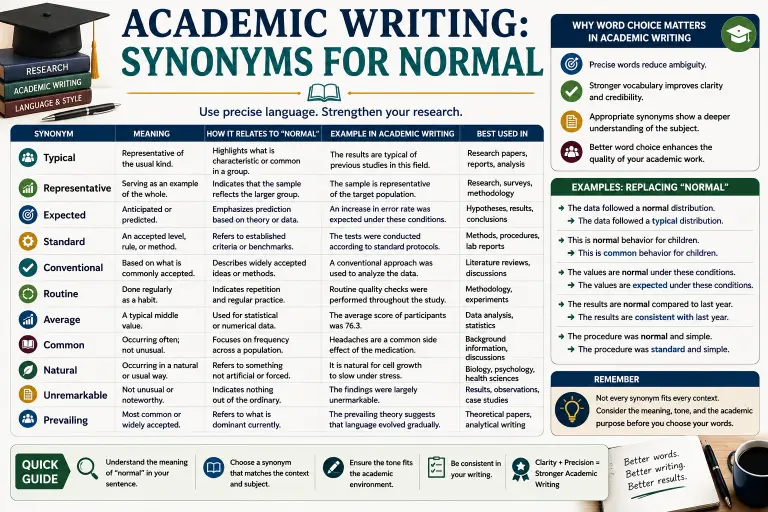
Academic writing often requires more precision than the word normal provides.
Consider:
The participants showed normal behavior.
That statement may be unclear because normal could mean statistically typical, socially expected, healthy, or simply unremarkable.
Better options might include:
- Typical behavior
- Expected behavior
- Common behavior
- Behavior consistent with previous observations
- Behavior within the observed range
For example:
The participants displayed behavior consistent with the pattern observed in the control group.
That sentence provides more information than simply saying the behavior was “normal.”
In research and statistics, terms such as average, typical, representative, expected, or within the observed range may be more accurate, depending on what the evidence actually shows.
Customer Service: Synonyms for Normal
Customer service communication should sound reassuring without becoming vague.
Instead of:
That’s normal.
Try:
That’s expected during the setup process.
Or:
That’s a common part of the installation process.
Or:
The system is operating as expected.
These versions tell the customer more and avoid making a broad claim.
If you’re responding to a problem, normal can sometimes sound dismissive. A more helpful approach is to explain what the customer should expect and what would indicate a genuine problem.
Legal Writing: Synonyms for Normal
Legal writing requires particular care because normal can be vague. A contract, policy, or legal document may need a specific definition instead of an everyday adjective.
Depending on the intended meaning, a legal or formal document might use terms such as:
- Standard
- Ordinary
- Customary
- Usual
- Reasonable
- Expected
- Established practice
However, these words are not interchangeable legal terms. For example, reasonable introduces a concept that is different from normal, while customary may refer to established practice.
If a legal document depends on what constitutes a “normal” condition, the safer drafting approach is usually to define the condition, measurement, standard, or procedure clearly rather than rely on a vague synonym.
Email Communication: Synonyms for Normal
Professional emails often sound better when normal is replaced with a more specific word.
Useful options include:
- Usual
- Standard
- Expected
- Typical
- Regular
- Routine
- Established
For example:
We expect the system to return to normal operation by 3 p.m.
could become:
We expect the system to return to regular operation by 3 p.m.
Or, if the company has a defined operating standard:
The system should return to standard operating conditions by 3 p.m.
The second version is more technical, so the right choice depends on the context.
Email Examples Using Synonyms for Normal
Client Email Using Expected
Subject: Delivery Schedule Update
Hi Daniel,
I wanted to confirm that your order is progressing as expected. We currently anticipate delivery on Thursday.
If anything changes, I’ll let you know as soon as we receive an updated schedule.
Best,
Sarah
Internal Email Using Usual
Subject: Monday Office Schedule
Hi Team,
Monday’s meeting schedule will follow our usual format. The first session will begin at 9:00 a.m., followed by the department updates.
Please send any agenda items by Friday afternoon.
Best,
Mark
Customer Service Email Using Standard
Subject: Your Account Setup
Hi Olivia,
Your account has been set up successfully. The next step is our standard verification process, which usually takes a short amount of time.
We’ll contact you once the verification is complete.
Best,
Customer Support
Academic Email Using Typical
Subject: Question About the Assignment
Dear Professor Lewis,
I noticed that my results differ slightly from the typical pattern discussed in class. Could you please confirm whether I should include those differences in the final analysis?
Thank you for your guidance.
Best regards,
Emily
Vendor Email Using Regular
Subject: Delivery Schedule
Hello James,
Could you please confirm whether next month’s deliveries will continue on the regular schedule?
We are planning our inventory based on the current timetable.
Best,
David
Project Email Using Routine
Subject: Routine System Maintenance
Hi Everyone,
The scheduled routine maintenance will take place Saturday evening. During this period, access to the reporting system may be temporarily unavailable.
Normal access should resume once the maintenance is complete.
Thanks,
Alex
Short Dialogue Examples Using Synonyms for Normal
Workplace
Person A: Is the software working correctly now?
Person B: Yes. It’s operating as expected.
Classroom
Person A: Is it typical for the results to vary this much?
Person B: Some variation is typical, but we should check the sample size.
Customer Service
Person A: The screen looks different after the update. Is that normal?
Person B: Yes. That’s expected with the new version.
Casual Conversation
Person A: How was your weekend?
Person B: Pretty standard. I ran errands and watched a movie.
Professional Discussion
Person A: Should we use the same process as last quarter?
Person B: Yes, unless there’s a reason to change it. That’s our usual approach.
How to Replace “Normal” in a Sentence
Example 1: Everyday Situation
Original: Everything is normal today.
Alternative: Everything is as usual today.
Why it works: As usual sounds more natural when describing a familiar situation.
Example 2: Workplace Procedure
Original: We followed the normal procedure.
Alternative: We followed the standard procedure.
Why it works: Standard is more precise when referring to an established process.
Example 3: Expected Event
Original: Some delays are normal during the holidays.
Alternative: Some delays are expected during the holidays.
Why it works: Expected clearly communicates anticipation.
Example 4: Academic Description
Original: The result is normal for this group.
Alternative: The result is typical for this group.
Why it works: Typical is more appropriate when describing a representative pattern.
Example 5: Repeated Activity
Original: The inspection was normal.
Alternative: The inspection was routine.
Why it works: This works if the intended meaning is that the inspection was a regular procedure, not that the findings were normal.
Example 6: Statistical Context
Original: The student’s score was normal.
Alternative: The student’s score was within the expected range.
Why it works: The alternative is more precise and avoids the ambiguity of normal.
Example 7: Cultural Context
Original: This is a normal traditional practice.
Alternative: This is a customary practice.
Why it works: Customary specifically connects the practice with established custom.
Example 8: Business Report
Original: Customer demand was normal this month.
Alternative: Customer demand was consistent with typical monthly patterns.
Why it works: The alternative explains what “normal” means instead of leaving the reader to guess.
Example 9: Casual Conversation
Original: My day was normal.
Alternative: My day was nothing out of the ordinary.
Why it works: The replacement sounds more conversational.
Example 10: Technical Context
Original: The equipment is operating normally.
Alternative: The equipment is operating as expected.
Why it works: As expected clearly communicates that the equipment is behaving according to anticipated conditions.
Comparison Table: Synonyms for Normal
| Phrase | Tone | Meaning / Scope | Best Use | Example |
|---|---|---|---|---|
| Usual | Neutral | What commonly happens | Everyday writing | We followed the usual process. |
| Typical | Neutral | Representative of a pattern | Academic, general | This is typical behavior. |
| Ordinary | Neutral | Not unusual or special | General descriptions | It was an ordinary day. |
| Standard | Formal | Accepted level or method | Business, technical | Use the standard procedure. |
| Regular | Neutral | Repeated or consistent | Schedules, routines | We have regular meetings. |
| Customary | Formal | Based on established custom | Formal writing | It is customary to greet guests. |
| Conventional | Formal | Widely accepted method | Academic, business | They chose a conventional approach. |
| Routine | Neutral | Repeated or familiar procedure | Work, operations | A routine inspection was completed. |
| Expected | Professional | Anticipated or predicted | Reports, emails | Delays are expected. |
| Common | Neutral | Frequently occurring | General writing | This is a common issue. |
| Average | Analytical | Statistical middle or typical value | Data | The average score was 82. |
| Everyday | Casual | Ordinary daily experience | Blogs, websites | It is useful for everyday tasks. |
| Familiar | Friendly | Known from experience | Customer service | The interface feels familiar. |
| Mainstream | Contemporary | Widely accepted | Culture, media | The technology is mainstream. |
| Unremarkable | Formal | Not noteworthy | Reports | The results were unremarkable. |
Which Synonym for Normal Should You Choose?
Best Synonym for Normal in Formal Writing
Choose usual, typical, customary, conventional, or standard based on the intended meaning. Customary and conventional sound more formal, while usual remains simple and natural.
Best Synonym for Normal in Business Communication
Use standard for procedures, usual for recurring practices, expected for anticipated events, and typical for patterns.
Best Synonym for Normal in Academic Writing
Prefer typical, representative, expected, average, or conventional when they accurately describe the evidence. Avoid using normal when it could have several interpretations.
Best Synonym for Normal in Legal Writing
Use the specific term that reflects the intended legal or factual meaning. Standard, customary, ordinary, or reasonable may work in particular contexts, but they are not automatically interchangeable.
Best Synonym for Normal in Professional Email
Usual, standard, expected, typical, and regular are usually safe choices. Select the word that explains what you mean rather than simply making the sentence sound more formal.
Best Synonym for Normal in Everyday Conversation
Usual, typical, regular, everyday, and nothing unusual are natural choices.
Best Synonym for Normal in Casual Messages
Try same as usual, pretty standard, nothing unusual, or nothing out of the ordinary.
Grammar and Usage Guide for Normal
Normal as an Adjective
Normal is primarily an adjective.
Example: The system is operating normally.
Here, normally is the adverb.
Normal vs Normally
Use normal to describe a noun or condition:
The temperature is normal.
Use normally to describe how an action occurs:
The system normally starts at 8 a.m.
Normal and Prepositions
Common combinations include:
- Normal for
- Normal to
- Normal in
- Normal under
- Return to normal
- Back to normal
- Normal operating conditions
Examples:
This level of variation is normal for this type of test.
It’s normal to feel nervous before an exam.
The system should return to normal tomorrow.
Normal vs Normally in “Return to Normal”
The phrase return to normal is standard when describing a situation becoming usual again.
Correct: Operations returned to normal.
You can also say:
Operations returned to their usual schedule.
Normal vs Normality
Normal is an adjective:
The results are normal.
Normality is a noun referring to the state or condition of being normal:
The system gradually returned to normality.
However, normality is more formal and less common in everyday writing.
Normal vs Norm
A norm is an accepted standard, pattern, or expectation.
The behavior is within the social norm.
Norm is not simply another grammatical form of normal. The meanings overlap but differ.
Capitalization
Normal is not normally capitalized unless it begins a sentence or appears in a title.
Correct: The results were normal.
Singular and Plural Forms
The adjective normal does not change for singular or plural nouns.
A normal day.
Normal days.
Do not write normals when you simply need the adjective.
Common Mistakes to Avoid With Synonyms for Normal
Treating Every Alternative as an Exact Synonym
Average, standard, usual, and typical overlap with normal but have different meanings. Choose based on context.
Using Average to Mean Normal
Average usually involves a numerical or statistical idea. A common situation is not automatically average.
Using Routine to Mean Normal in Every Context
Routine suggests repetition. It does not automatically mean healthy, acceptable, or typical.
Using Natural as a Universal Replacement
Something can be natural without being common or normal. Likewise, something can be common without being natural.
Using Overly Formal Language
Prevailing or unexceptional may be unnecessary in a simple email. Clear language is often better.
Using Casual Expressions in Formal Writing
Phrases such as pretty standard and run-of-the-mill are inappropriate for many academic or formal documents.
Making “Normal” Sound Like a Judgment
When describing people, behavior, or health, normal can unintentionally suggest that other experiences are abnormal or inferior. In sensitive contexts, more specific terms such as typical, expected, common, or within the observed range may be more respectful and accurate.
Replacing Normal Without Checking the Meaning
Before changing the word, ask what normal means in the sentence: usual, typical, standard, expected, healthy, or ordinary.
Using Vague Professional Language
Replacing normal with another vague adjective does not automatically improve writing.
Vague: The results were standard.
Better: The results were consistent with the expected range.
When Not to Use “Normal”
When You Mean a Specific Standard
Use standard if you’re referring to an established requirement or procedure.
Follow the standard operating procedure.
When You Mean Something Happens Regularly
Use regular or routine.
The equipment receives routine maintenance.
When You Mean Something Was Expected
Use expected.
Minor delays were expected during the transition.
When You Mean Something Is Representative
Use typical or representative.
The sample was representative of the larger group.
When You Mean a Statistical Value
Use average or a more specific statistical term.
The average response time was 3.2 seconds.
When You Need to Avoid Ambiguity
Replace normal with a measurable or clearly defined description.
Instead of:
The temperature is normal.
Try:
The temperature is within the recommended operating range.
When You Are Describing Sensitive Human Experiences
Be careful with normal when discussing health, behavior, ability, development, or identity. A person or experience does not need to be labeled “normal” to be valid. More precise terms such as typical, common, expected, or within the observed range may communicate the intended idea without creating an unnecessary judgment.
When “Normal” Is Actually the Better Choice
Don’t replace normal just for the sake of variety. It is a clear, familiar word when the intended meaning is broad and obvious.
For example:
Everything is back to normal.
This is more natural than:
Everything has returned to its conventional state.
The first sentence is simple, idiomatic, and immediately understood.
Advanced Writer Tips for Synonyms for Normal
Tone Control
For formal writing, consider customary, conventional, prevailing, established, or standard.
While for neutral writing, use usual, typical, regular, expected, or common.
For casual writing, try same as usual, pretty standard, or nothing out of the ordinary.
Professional Email Etiquette
Avoid replacing normal with a complicated word just to sound professional.
Instead of:
The prevailing operational conditions have returned to their customary state.
Write:
Operations have returned to normal.
Simple wording often sounds more confident.
Politeness
A sentence such as:
That’s normal.
may sound dismissive when someone is reporting a problem.
A better customer-service response could be:
That’s expected during this step, and the process should finish shortly.
The second version acknowledges the situation while giving useful information.
Context Alignment
Ask what kind of “normal” you mean:
- Usual → usual
- Representative → typical
- Accepted procedure → standard
- Repeated process → routine
- Anticipated → expected
- Statistically middle → average
- Widely practiced → common
- Traditional → customary
- Accepted method → conventional
Precision
The best synonym is usually the one that adds information.
Instead of choosing the most sophisticated word, choose the word that answers the reader’s likely question.
Readability
Don’t turn a simple sentence into complicated prose.
Simple: The system is working normally.
Clearer when context allows: The system is operating as expected.
Too complicated: The system is functioning in accordance with prevailing operational parameters.
The first two are easier to read and usually more useful.
Related Questions About Synonyms for Normal
What is another way to say normal?
Depending on the context, you can say usual, typical, ordinary, regular, standard, customary, conventional, expected, common, routine, or everyday. Usual is one of the safest general alternatives, while more specific choices can communicate the intended meaning more clearly.
What is a professional alternative to normal?
Standard, typical, expected, usual, established, and regular are useful professional alternatives. Choose standard for accepted procedures, expected for anticipated events, and typical for representative patterns.
What is a formal alternative to normal?
Good formal alternatives include customary, conventional, established, prevailing, unexceptional, and standard. The right choice depends on whether you mean accepted practice, common conditions, or something that is not unusual.
What can I use instead of normal in a sentence?
Start by identifying the intended meaning. Use usual for familiar situations, typical for representative examples, standard for accepted procedures, routine for repeated activities, and expected for anticipated events.
Is normal a formal word?
Yes. Normal is a standard word that works in both formal and informal English. It is not inherently casual. However, it can be too vague for technical, academic, statistical, or legal contexts where a more precise term is needed.
Can I use typical instead of normal?
Often, but not always. Typical means representative of what is common or expected, while normal has a broader range of meanings. Use typical when you specifically mean that something reflects a common pattern.
What is the difference between normal and usual?
Normal can mean usual, expected, ordinary, or within an accepted range. Usual focuses more specifically on what commonly happens or what someone normally does. In everyday sentences, they can often overlap.
FAQs About Synonyms for Normal
What is the closest synonym for normal?
Usual is one of the closest general synonyms when normal means something that commonly happens. Typical is another strong option when you mean something representative of a familiar pattern.
What is a better word than normal?
There isn’t one universally better word. Usual, typical, standard, expected, routine, or ordinary may be better depending on the sentence. Precision matters more than choosing a supposedly stronger synonym.
What is a formal word for normal?
Customary, conventional, established, standard, prevailing, and unexceptional can work in formal contexts. However, normal itself is perfectly acceptable in many formal sentences.
Is “ordinary” the same as “normal”?
They overlap, but they aren’t identical. Ordinary emphasizes something being everyday or not special, while normal can also mean expected, standard, or within an accepted range.
Is “average” a synonym for normal?
Only in some statistical contexts. Average usually refers to a calculated or typical numerical value. It should not be used as a general replacement for normal.
What is the opposite of normal?
Depending on the meaning, possible opposites include unusual, abnormal, atypical, extraordinary, irregular, unconventional, or unexpected. The correct opposite depends on what sense of normal you are using.
What is a casual way to say normal?
Natural casual options include same as usual, nothing unusual, pretty standard, nothing out of the ordinary, and same as always. These expressions work best in conversations and informal messages.
Key Takeaways
- Usual is one of the safest general alternatives when normal means something familiar or commonly occurring.
- Use typical for representative patterns and standard for accepted procedures, levels, or requirements.
- Choose routine for repeated activities and expected for situations that were anticipated.
- Avoid using average, natural, or common as automatic replacements because each has a narrower or different meaning.
- In sensitive or technical contexts, replace vague uses of normal with precise descriptions such as expected, typical, standard, or within the observed range.
Conclusion
Choosing among synonyms for normal is less about finding a bigger or more sophisticated word and more about identifying the exact meaning you want to communicate.
Normal can mean usual, typical, ordinary, standard, expected, routine, or acceptable, so the best alternative changes with the sentence. Usual works well for familiar events, typical for representative examples, standard for accepted procedures, routine for repeated activities, and expected for anticipated situations.
For formal writing, words such as customary, conventional, and established can add precision. In everyday conversation, simpler expressions such as same as usual or nothing out of the ordinary sound more natural.
In academic, technical, legal, or sensitive contexts, avoid vague substitutions and state exactly what you mean. The strongest writing isn’t the writing with the fanciest synonym. It’s the writing that gives readers the clearest meaning with the least confusion.
