
Finding the right synonyms for long depends heavily on what “long” means in the sentence. You might be talking about time, physical distance, length, writing, hair, duration, or even an emotional desire such as “long for.”
Words such as lengthy, extended, prolonged, distant, enduring, drawn-out, elongated, and lasting can all relate to “long,” but they are not interchangeable in every situation.
The best alternative also depends on tone. A report may benefit from “prolonged,” while everyday conversation sounds more natural with “extended” or “far.”
This guide explains more than 33 useful alternatives, separates true synonyms from contextual choices, and shows how to use them naturally in professional, academic, casual, and everyday writing.
Quick Answer: Synonyms for Long
Common synonyms for long include lengthy, extended, prolonged, lasting, enduring, extensive, elongated, drawn-out, sustained, continued, far, distant, remote, tall, and lengthy in duration. The correct choice depends on whether “long” describes time, distance, physical size, written content, or another meaning.
Quick List: 40 Useful Synonyms for Long
Here are useful alternatives grouped by meaning rather than treating every word as an exact replacement:
Closest Synonyms for Long
- Lengthy
- Extended
- Prolonged
- Enduring
- Lasting
- Sustained
- Continued
- Extensive
- Drawn-out
- Elongated
Synonyms for Long Describing Time
- Protracted
- Persistent
- Ongoing
- Prolonged
- Extended
- Lengthy
- Sustained
- Enduring
- Lasting
- Chronic
Synonyms for Long Describing Distance
- Far
- Distant
- Remote
- Faraway
- Outlying
- Farthest
- Extensive
Contextual Alternatives for Physical Length
- Elongated
- Extended
- Stretched
- Lengthy
- Linear
- Tall*
- High*
Contextual Alternatives for Writing or Speech
- Detailed
- Extensive
- Comprehensive
- Protracted
- Drawn-out
- Wordy
*“Tall” and “high” are not general synonyms for “long.” They work only in specific contexts involving height or vertical measurement.
Formal Synonyms for Long
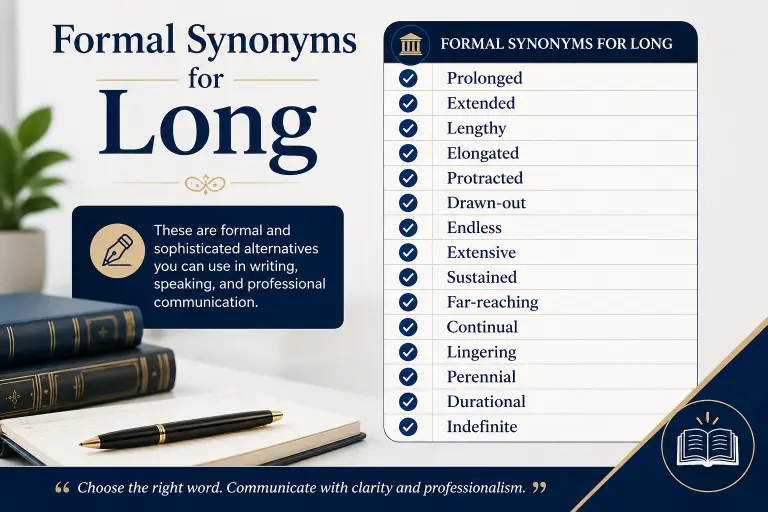
Formal writing often needs a more precise word than “long.” The following choices work particularly well in academic, professional, technical, and official contexts.
Lengthy
Meaning: Something that has considerable length or takes a considerable amount of time.
Explanation: “Lengthy” is one of the closest formal alternatives to “long.” It can describe documents, meetings, discussions, processes, and periods.
Example: The committee held a lengthy discussion about the proposed changes.
Best Use: Reports, essays, professional writing, and formal descriptions.
Worst Use: Very casual conversation, where “long” is usually more natural.
Tone: Formal and neutral.
Prolonged
Meaning: Continuing for longer than expected or necessary.
Explanation: “Prolonged” often suggests that something has lasted unusually long. It can sometimes carry a slightly negative feeling.
Example: The project was delayed by a prolonged period of bad weather.
Best Use: Reports, medical or technical contexts, news writing, and formal descriptions.
Worst Use: Simple statements such as “I had a prolonged lunch.” It sounds unnecessarily formal.
Tone: Formal and sometimes serious.
Extended
Meaning: Made longer or continuing beyond an expected point.
Explanation: “Extended” is especially useful when something has been lengthened or given additional time.
Example: The company offered an extended warranty on the new product.
Best Use: Business writing, contracts, schedules, policies, and professional communication.
Worst Use: When you simply mean physical length and no extension has occurred.
Tone: Professional and neutral.
Protracted
Meaning: Continuing for an unusually long time.
Explanation: “Protracted” is stronger than ordinary “long.” It often implies that something has continued longer than desirable.
Example: The negotiations became protracted after both sides rejected the initial proposal.
Best Use: Formal reports, legal discussions, politics, and academic writing.
Worst Use: Friendly everyday conversations.
Tone: Formal and serious.
Extensive
Meaning: Covering a large amount, area, or scope.
Explanation: “Extensive” is not a direct replacement for every meaning of “long.” It is useful when “long” refers to breadth, quantity, range, or scope.
Example: The researchers conducted an extensive review of previous studies.
Best Use: Academic, professional, and technical writing.
Worst Use: “She has extensive hair” when you simply mean her hair is long.
Tone: Formal and polished.
Enduring
Meaning: Continuing for a long time, especially despite difficulty or change.
Explanation: “Enduring” emphasizes persistence rather than simple duration.
Example: The novel has had an enduring influence on modern literature.
Best Use: Describing relationships, influence, traditions, values, or effects.
Worst Use: Basic measurements such as “an enduring table.”
Tone: Formal and expressive.
Sustained
Meaning: Continuing at a particular level over a period of time.
Explanation: “Sustained” focuses on continuity or maintained effort rather than length alone.
Example: The program requires sustained effort from participants.
Best Use: Academic, business, scientific, and professional writing.
Worst Use: Simple physical measurements.
Tone: Formal and precise.
Protracted
Meaning: Extended over an unusually long period.
Explanation: This word is particularly useful when the length of an event creates difficulty or delay.
Example: The dispute resulted in a protracted legal process.
Best Use: Legal, political, business, and formal writing.
Worst Use: Casual messages.
Tone: Formal and serious.
Continued
Meaning: Going on without stopping.
Explanation: “Continued” emphasizes that something did not stop. It does not always mean that the thing itself was objectively long.
Example: Continued delays affected the construction schedule.
Best Use: Reports, updates, announcements, and professional communication.
Worst Use: Describing the physical length of an object.
Tone: Neutral to formal.
Lasting
Meaning: Continuing for a considerable period.
Explanation: “Lasting” often emphasizes an effect or condition that remains over time.
Example: The experience had a lasting impact on her career.
Best Use: Writing about effects, impressions, relationships, changes, and influence.
Worst Use: A physical object when you simply mean its dimensions.
Tone: Neutral and polished.
Semi-Formal and Neutral Synonyms for Long
Not every sentence needs a formal replacement. In most everyday and workplace situations, neutral alternatives are clearer and more natural.
Lengthy
Meaning: Long in duration or physical extent.
Example: We had a lengthy meeting this morning.
Best Use: Work, school, reports, and everyday writing.
Worst Use: Highly casual situations where “long” sounds simpler.
Tone: Neutral.
Extended
Meaning: Longer than usual or originally planned.
Example: The deadline was extended by two weeks.
Best Use: Work, school, schedules, and announcements.
Worst Use: When nothing has actually been extended.
Tone: Neutral and professional.
Lasting
Meaning: Continuing over time.
Example: The training created lasting benefits for the team.
Best Use: Describing effects, relationships, and results.
Worst Use: Simple distance measurements.
Tone: Neutral.
Ongoing
Meaning: Still happening or continuing.
Explanation: “Ongoing” is useful for activities and situations that have not ended.
Example: The investigation is ongoing.
Best Use: Workplace updates, news, projects, and formal communication.
Worst Use: Physical objects.
Tone: Neutral and professional.
Persistent
Meaning: Continuing despite attempts to stop, change, or remove something.
Example: Persistent rain caused flooding in several areas.
Best Use: Problems, symptoms, efforts, conditions, and behaviors.
Worst Use: Neutral physical measurements.
Tone: Neutral, sometimes negative.
Drawn-Out
Meaning: Taking longer than necessary or expected.
Example: The meeting became a drawn-out discussion about minor details.
Best Use: Everyday writing and conversational descriptions.
Worst Use: Formal reports unless the slightly critical tone is intended.
Tone: Informal to neutral.
Extensive
Meaning: Large in amount, range, or scope.
Example: The website contains extensive information about the service.
Best Use: Websites, reports, academic work, and business communication.
Worst Use: Direct physical measurements where “long” is more precise.
Tone: Neutral to formal.
Comprehensive
Meaning: Including nearly all important parts or details.
Explanation: “Comprehensive” is a contextual alternative when “long” refers to detailed content.
Example: She prepared a comprehensive guide for new employees.
Best Use: Reports, guides, websites, research, and educational content.
Worst Use: A road, rope, or physical object.
Tone: Professional.
Detailed
Meaning: Containing many specific facts or pieces of information.
Example: He gave us a detailed explanation of the problem.
Best Use: Essays, instructions, reports, and professional communication.
Worst Use: When the only relevant feature is duration.
Tone: Neutral and professional.
Wordy
Meaning: Using more words than necessary.
Example: The introduction is informative but slightly wordy.
Best Use: Writing feedback and editing.
Worst Use: As a neutral synonym for every long document. “Wordy” usually implies excessive length.
Tone: Neutral but often mildly critical.
Informal and Casual Alternatives for Long
English has fewer true casual synonyms for “long” than it has formal ones. In everyday speech, people often use simple expressions rather than sophisticated replacements.
Far
Meaning: A great distance away.
Example: The grocery store isn’t far from here.
When it sounds natural: Everyday conversations about distance.
When to avoid it: Do not use “far” to replace “long” when discussing time or physical length.
Tone: Casual and neutral.
Really Long
Meaning: Much longer than expected or ordinary.
Example: That movie was really long.
When it sounds natural: Casual conversation, texts, and social media.
When to avoid it: Formal reports or academic writing.
Tone: Casual.
Super Long
Meaning: Extremely long.
Example: That was a super long flight.
When it sounds natural: Friendly conversations and informal messages.
When to avoid it: Business reports, formal emails, and academic work.
Tone: Very casual.
Drawn-Out
Meaning: Longer than necessary.
Example: The conversation felt drawn-out.
When it sounds natural: Informal criticism of meetings, conversations, stories, or events.
When to avoid it: Formal documents unless you intentionally want a critical tone.
Tone: Informal and slightly negative.
Forever
Meaning: An exaggerated way to say something seems to take a very long time.
Example: This download is taking forever.
When it sounds natural: Casual speech and messages.
When to avoid it: Formal writing. It is usually figurative, not literal.
Tone: Casual and expressive.
True Synonyms vs. Contextual Alternatives for Long
The word “long” has several meanings, so accuracy matters. A word that works for duration may not work for distance or physical dimensions.
| Type | What It Means | Can It Replace “Long”? |
|---|---|---|
| True synonym | Has nearly the same meaning in the same context | Usually |
| Near synonym | Similar meaning but with a slight difference | Sometimes |
| Contextual alternative | Works only in a particular situation | Only in that context |
| Broader expression | Covers a wider idea than “long” | Sometimes |
| Narrower expression | Describes one specific type of “long” | Only in certain sentences |
For example, lengthy can replace “long” in “a long meeting.” However, far works for “a long distance” only when the focus is how distant something is. Similarly, wordy can describe a long piece of writing, but it adds the idea that the writing uses more words than necessary.
Industry-Specific Synonyms for Long
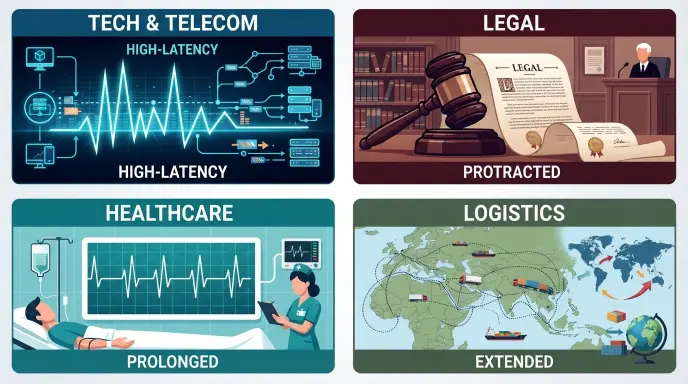
Business Writing: Synonyms for Long
Business writing usually benefits from precise alternatives rather than simply replacing “long” with a more complicated word.
Use:
- Extended for deadlines, contracts, and schedules
- Lengthy for meetings, reports, and discussions
- Ongoing for projects and processes
- Prolonged for delays or problems
- Comprehensive for reports and guides
- Detailed for explanations and instructions
Example:
Instead of “We experienced a long delay,” a report could say, “We experienced a prolonged delay.”
That change makes the cause or impact sound more formal without changing the basic meaning.
Corporate Communication: Synonyms for Long
Corporate communication requires careful tone. “Long” is not wrong, but a more specific term can make an announcement clearer.
Example:
“The project has been ongoing for six months.”
This is better than “The project has been long for six months,” which is grammatically and stylistically unnatural.
For documents, “lengthy” may be appropriate:
“Please review the lengthy proposal before Friday.”
For a report containing substantial information, comprehensive may be better:
“The team prepared a comprehensive review of the current process.”
Academic Writing: Synonyms for Long
Academic writing should favor precision over impressive vocabulary.
Useful choices include:
- Lengthy
- Extensive
- Prolonged
- Sustained
- Comprehensive
- Detailed
- Enduring
- Continued
- Protracted
Example:
Weak: “The researchers had a long discussion.”
Better: “The researchers engaged in an extensive discussion of the findings.”
However, “extensive” changes the emphasis. It suggests breadth or depth, not simply duration.
Customer Service: Synonyms for Long
Customer-service language should be clear and polite.
Instead of:
“Sorry for the long wait.”
You could say:
“We apologize for the extended wait.”
Or, in a warmer message:
“Thank you for your patience during the longer-than-expected wait.”
The last version is especially useful when you want to acknowledge inconvenience without sounding overly formal.
Legal Writing: Synonyms for Long
Legal writing requires particular care because duration, deadlines, terms, and obligations can have specific meanings.
Useful words may include extended, prolonged, continued, ongoing, or indefinite, but these are not automatically interchangeable.
For example:
- “extended deadline” means a deadline has been moved later.
- “prolonged dispute” emphasizes unusual duration.
- “ongoing proceedings” means the proceedings have not ended.
- “indefinite period” means no definite end point has been established.
A casual phrase such as “really long” should not replace precise legal language. In legal documents, the exact meaning matters more than stylistic variety.
Email Communication: Synonyms for Long
Professional emails often sound better when “long” is replaced with a more specific word.
- Lengthy meeting — emphasizes duration.
- Extended deadline — indicates additional time.
- Detailed report — emphasizes information.
- Ongoing project — indicates that work continues.
- Prolonged delay — emphasizes an unusually long delay.
- Comprehensive document — emphasizes broad coverage.
Email Examples Using Synonyms for Long
Client Email: Extended
Subject: Extended Project Timeline
Hi Jordan,
I wanted to let you know that the project timeline has been extended by one week. Our team needs a little more time to complete the final quality checks.
We expect to deliver the completed materials next Friday.
Thank you for your patience.
Best,
Maya
Internal Workplace Email: Lengthy
Subject: Lengthy Meeting Tomorrow
Hi Team,
Tomorrow’s planning meeting may be slightly lengthy because we need to review the final project schedule and assign responsibilities for the next phase.
Please review the current schedule before the meeting so we can focus on decisions rather than background information.
Thanks,
Daniel
Customer Service Email: Longer-Than-Expected
Subject: Update on Your Order
Hello Sarah,
Thank you for contacting us. Your order is taking longer than expected because the item is currently being transferred from another warehouse.
We expect the shipment to leave within the next two business days. We apologize for the delay and appreciate your patience.
Best,
Customer Support
Academic Email: Extensive
Subject: Question About the Research Assignment
Dear Professor Lee,
I am reviewing the requirements for the research assignment and would like to confirm whether an extensive literature review is expected.
I want to make sure I focus on the most relevant sources rather than include material that falls outside the topic.
Thank you,
Alex
Vendor Email: Prolonged
Subject: Prolonged Delivery Delay
Hello Mark,
I am following up regarding the shipment scheduled for this week. We have now experienced a prolonged delay, and the revised delivery date would help us plan our production schedule.
Could you please confirm the latest expected delivery date?
Regards,
Nina
Short Dialogues Using Synonyms for Long
Workplace
Person A: How was the client meeting?
Person B: It was pretty lengthy, but we finally agreed on the timeline.
Classroom
Person A: Was the lecture difficult?
Person B: Not really. It was just longer than I expected.
Customer Service
Person A: I’m sorry for the wait.
Person B: That’s okay. I understand there was an unexpected delay.
Casual Conversation
Person A: How far is the restaurant?
Person B: Not far. It’s about a ten-minute walk.
Professional Discussion
Person A: Why is the project still unfinished?
Person B: The approval process has been prolonged because several departments requested changes.
How to Replace “Long” in a Sentence
Example 1
Original: The meeting was long.
Alternative: The meeting was lengthy.
Why it works: “Lengthy” is a natural neutral-to-formal alternative when duration is the focus.
Example 2
Original: We had a long delay.
Alternative: We experienced a prolonged delay.
Why it works: “Prolonged” emphasizes that the delay lasted unusually long.
Example 3
Original: The deadline was long.
Alternative: The deadline was extended.
Why it works: The original sentence is awkward. “Extended” correctly describes a deadline that has been moved to a later date.
Example 4
Original: She wrote a long report.
Alternative: She wrote a comprehensive report.
Why it works: “Comprehensive” suggests that the report covers the subject thoroughly. It does not merely describe its physical length.
Example 5
Original: We went on a long journey.
Alternative: We went on an extended journey.
Why it works: “Extended” can emphasize unusual duration, although “long journey” remains perfectly natural.
Example 6
Original: He gave a long explanation.
Alternative: He gave a detailed explanation.
Why it works: “Detailed” changes the focus from length to the amount of information provided.
Example 7
Original: The store is a long way from here.
Alternative: The store is far from here.
Why it works: “Far” is the natural choice when discussing distance.
Example 8
Original: The discussion became very long.
Alternative: The discussion became drawn-out.
Why it works: “Drawn-out” suggests that the discussion continued longer than necessary and adds a mildly negative tone.
Example 9
Original: They have a long-standing relationship.
Alternative: They have an enduring relationship.
Why it works: “Enduring” emphasizes the relationship’s ability to continue over time.
Example 10
Original: The problem has lasted a long time.
Alternative: The problem has persisted for an extended period.
Why it works: The alternative is more formal and appropriate for a report or professional explanation.
Comparison Table: The Best Synonyms for Long
| Phrase | Tone | Meaning / Scope | Best Use | Example |
|---|---|---|---|---|
| Lengthy | Neutral/formal | Considerable length or duration | Meetings, documents | A lengthy report |
| Extended | Neutral/formal | Made longer or continued | Deadlines, periods | An extended deadline |
| Prolonged | Formal | Unusually long duration | Delays, problems | A prolonged delay |
| Protracted | Formal | Excessively extended | Disputes, negotiations | A protracted dispute |
| Lasting | Neutral | Continuing over time | Effects, relationships | A lasting impression |
| Enduring | Formal | Continuing despite change | Influence, values | Enduring influence |
| Extensive | Formal | Large in scope or amount | Research, reviews | Extensive research |
| Detailed | Neutral | Rich in specific information | Reports, explanations | A detailed report |
| Comprehensive | Formal | Broad and complete | Guides, studies | A comprehensive guide |
| Ongoing | Neutral | Still continuing | Projects, investigations | An ongoing project |
| Drawn-out | Informal | Longer than necessary | Meetings, discussions | A drawn-out debate |
| Far | Neutral/casual | Great distance | Places, travel | A faraway town |
| Elongated | Formal/technical | Physically lengthened | Shapes, objects | An elongated shape |
| Wordy | Neutral | Too many words | Writing feedback | A wordy paragraph |
Which Alternative Should You Choose for Long?
For Formal Writing
Choose lengthy, prolonged, protracted, extensive, sustained, or enduring, depending on the meaning.
- Long meeting → lengthy meeting
- Long delay → prolonged delay
- Long dispute → protracted dispute
- Long research → extensive research
For Business Communication
Extended, ongoing, lengthy, and detailed are usually the safest choices.
Use “extended” for timelines and deadlines, “ongoing” for current projects, and “detailed” when the content—not the physical length—is the main point.
For Academic Writing
Prefer extensive, prolonged, sustained, comprehensive, detailed, or lengthy where appropriate.
Don’t replace every “long” with a sophisticated word. Academic writing values accuracy more than vocabulary complexity.
For Legal Writing
Choose the exact term required by the document’s meaning. Extended, continued, prolonged, indefinite, and ongoing can have different implications.
For Professional Email
Use extended for schedules, lengthy for meetings or documents, and detailed for explanations.
For Everyday Conversation
Usually keep long. Use far for distance and drawn-out when you want to criticize excessive duration.
For Casual Messages
Natural phrases such as really long, super long, or forever may work.
Example:
“That movie was super long!”
Grammar and Usage Guide for Long
Long as an Adjective
The word “Long” can describe physical length or duration.
She bought a long dress.
We had a long meeting.
Long as an Adverb
It can describe duration.
How long will you stay?
I haven’t seen him for long.
Long With “For”
Use for to express a duration.
We waited for a long time.
She has lived there for many years.
Long With “Since”
Use since with a starting point.
He has worked here since 2020.
Not:
He has worked here for 2020.
A Long Time
“A long time” is a noun phrase.
It took a long time to finish the project.
Long-Term
Use long-term before a noun when describing something intended to continue for a significant period.
We need a long-term strategy.
When it follows a linking verb, style guides commonly use the hyphenless form:
The strategy is long term.
Long-Lasting
Use long-lasting as a compound adjective before a noun.
We need a long-lasting solution.
Long Standing vs. Long-Standing
When meaning “existing for a long time,” use long-standing.
They have a long-standing agreement.
“Standing” without the hyphen has a different grammatical role.
Longer and Longest
“Long” has regular comparative and superlative forms:
- long
- longer
- longest
This road is longer than the other one.
That was the longest meeting of the week.
Common Mistakes With Synonyms for Long
1. Treating Every Alternative as Exact
“Extensive,” “far,” and “lengthy” do not mean exactly the same thing. Always consider what type of “long” you mean.
2. Using “Far” for Time
“Far” normally describes distance.
Incorrect:
The meeting was far.
Better:
The meeting was long.
Or:
The meeting was lengthy.
3. Using “Prolonged” as a Positive Word Everywhere
“Prolonged” often suggests an unwanted or unusually long duration.
The patient experienced prolonged discomfort.
It may sound strange in a sentence about a pleasant short vacation.
4. Using “Wordy” as a Neutral Synonym
“Wordy” usually implies that writing contains unnecessary words.
A long report is not necessarily wordy.
5. Confusing “Extensive” With “Long”
An extensive report may be long, but its defining feature is broad coverage or scope.
6. Overusing Formal Vocabulary
Replacing every “long” with “protracted” can make simple writing sound stiff.
We had a protracted lunch.
This is technically understandable but unnatural in most contexts.
7. Changing the Meaning
“Detailed” means informative, not simply long.
A short document can be highly detailed.
8. Using “Tall” as a General Replacement
“Tall” normally refers to vertical height.
a tall building
You cannot generally replace “long” with “tall.”
9. Ignoring Hyphenation
Compound expressions such as long-term, long-lasting, and long-standing require attention to their grammatical position.
10. Choosing Variety Over Precision
A thesaurus can give you many alternatives, but the most impressive-looking word is not necessarily the best one. Choose the word that expresses the intended meaning most clearly.
When Not to Use “Long”
There are situations where another word is more precise.
When You Mean Distance
Instead of:
The airport is long from here.
Use:
The airport is far from here.
When You Mean an Extended Deadline
Instead of:
We have a long deadline.
Use:
We have an extended deadline.
When You Mean Detailed Content
Instead of:
She wrote a long explanation.
Consider:
She wrote a detailed explanation.
When You Mean Excessive Duration
Instead of:
The meeting was long.
You could say:
The meeting was drawn-out.
This adds the idea that it lasted unnecessarily.
When You Mean Broad Coverage
Instead of:
The report is long.
Use:
The report is comprehensive.
This works when the report covers many relevant areas.
When You Need Technical Precision
A specific measurement is better than “long.”
Instead of:
The cable is very long.
Write:
The cable is 20 feet long.
The original word “long” is still the better choice when you are simply describing length and there is no reason to change the wording.
Advanced Writer Tips for Choosing Synonyms for Long
Tone Control
Use lengthy for neutral formality, prolonged for unusually long duration, and drawn-out for a more conversational or critical tone.
Compare:
The meeting was lengthy.
The meeting was prolonged.
The meeting was drawn-out.
Each sentence creates a slightly different impression.
Professional Email Etiquette
Don’t use a complicated synonym simply to sound professional. “Long” is often perfectly acceptable.
Instead of:
We apologize for the protracted duration of your wait.
Write:
We apologize for the prolonged wait.
Or simply:
We apologize for the longer-than-expected wait.
Clear writing usually sounds more professional than inflated wording.
Politeness
Word choice can soften criticism.
The meeting was long.
is neutral.
The meeting was drawn-out.
suggests that the meeting was unnecessarily long.
If you’re giving feedback to a colleague, the first version may be more diplomatic.
Context Alignment
Ask what “long” actually describes:
- Time? → prolonged, extended, lengthy
- Distance? → far, distant, remote
- Physical shape? → elongated, extended
- Information? → detailed, comprehensive
- Effect? → lasting, enduring
- Continuation? → ongoing, sustained
This simple check prevents most synonym errors.
Precision
Don’t confuse duration with content.
“A long report” can mean many pages.
“A comprehensive report” means it covers the subject broadly.
“A detailed report” means it contains specific information.
“A wordy report” means it may contain unnecessary words.
Readability
Shorter words are often better.
Instead of:
The organization experienced a protracted period of operational difficulty.
you might write:
The organization faced a long period of operational difficulty.
If the audience doesn’t need the formal tone, the simpler sentence is clearer.
Related Questions About Synonyms for Long
What Is Another Way to Say Long?
Another way to say “long” depends on meaning. For duration, use lengthy, extended, prolonged, lasting, or protracted. While for distance, far, distant, or remote may work. For writing, detailed, extensive, comprehensive, or wordy can be more precise.
What Is a Professional Alternative to Long?
Extended, lengthy, prolonged, ongoing, detailed, and comprehensive are useful professional alternatives. The best choice depends on what “long” describes. For example, use “extended deadline,” “lengthy meeting,” and “comprehensive report” rather than replacing “long” with one word everywhere.
What Is a Formal Alternative to Long?
Common formal alternatives include lengthy, prolonged, protracted, extensive, sustained, enduring, and comprehensive. However, these words have different meanings. “Protracted” often suggests excessive duration, while “extensive” usually refers to scope or coverage.
What Can I Use Instead of Long in Academic Writing?
Academic writing may benefit from extensive, prolonged, sustained, comprehensive, detailed, lengthy, or enduring, depending on context. Avoid replacing “long” automatically. A precise word that explains why something is long is usually more useful.
Is Long a Formal Word?
Yes. “Long” is a standard, neutral English word and is completely acceptable in formal writing. You do not need to replace it simply because you’re writing an academic or professional document.
Can “Lengthy” Replace “Long”?
Often, yes. “Lengthy” is a close synonym when you mean something has considerable duration or physical extent. However, it is usually used as an adjective before nouns, such as “a lengthy report” or “a lengthy discussion.”
What Is the Difference Between Long and Prolonged?
“Long” simply describes considerable duration or length. “Prolonged” usually suggests that something continued for an unusually long period, often longer than expected or desirable. For example, “a long meeting” is neutral, while “a prolonged meeting” can imply excessive duration.
FAQs
What is the closest synonym for long?
Lengthy is often one of the closest alternatives when “long” means having considerable duration or physical extent. However, “lengthy” does not work in every situation. For distance, “far” or “distant” may be more natural, while “extended” works better for something deliberately made longer.
What is a good synonym for long in a sentence?
The best synonym depends on the sentence. Use lengthy for meetings or documents, prolonged for unusually long situations, extended for additional time, far for distance, and detailed when the main idea is the amount of information.
What is a better word than long for professional writing?
There is no single “better” word. Extended, lengthy, ongoing, detailed, comprehensive, and prolonged are useful in different professional contexts. Choose the word that communicates the specific meaning instead of choosing a more complicated word simply to sound formal.
What is the formal synonym for a long time?
Depending on context, alternatives include an extended period, a prolonged period, an extended duration, or a considerable period. “For a long time” is also perfectly acceptable in formal writing when no greater precision is needed.
What is a synonym for long in distance?
For distance, useful alternatives include far, distant, remote, faraway, and outlying. “Far” is the most natural everyday choice, while “remote” often suggests that a place is isolated or difficult to reach.
What is a synonym for long in writing?
For writing, lengthy describes substantial length, detailed emphasizes information, comprehensive emphasizes coverage, extensive emphasizes scope, and wordy suggests unnecessary words. These distinctions are useful when editing essays, reports, articles, or emails.
Is “protracted” a positive or negative synonym for long?
“Protracted” is usually neutral to negative because it often implies that something lasted longer than expected, necessary, or desirable. A “protracted dispute” suggests difficulty, while a simple “long relationship” does not carry that negative implication.
Key Takeaways
- Long is a broad word, so the best synonym depends on whether you mean time, distance, physical size, or content.
- Use lengthy for considerable duration, extended for added time, and prolonged for unusually long situations.
- Use far, distant, or remote when “long” refers to physical distance.
- Choose detailed, extensive, or comprehensive when describing the content or scope of writing.
- Don’t replace “long” automatically; the simplest accurate word is often the strongest choice.
Conclusion
The best synonyms for long are not interchangeable in every sentence. Words such as lengthy, extended, prolonged, protracted, lasting, enduring, extensive, detailed, and comprehensive each highlight a different aspect of length, duration, scope, or continuation.
For distance, words such as far, distant, and remote are usually more natural. For casual conversation, simple expressions like really long or drawn-out may sound better than formal vocabulary.
The key is to identify what “long” actually means before choosing a replacement. If you’re describing time, consider duration-focused words. But if you’re describing information, choose a word that reflects detail or scope. If you’re writing professionally, favor precision over unnecessary complexity. And if “long” already communicates your meaning clearly, there’s no need to replace it. Good word choice isn’t about using the fanciest synonym; it’s about selecting the clearest word for the reader, purpose, and context.
