
The right synonyms for helped can make your writing more precise, especially when the original word feels repetitive. “Helped” can mean assisted someone, supported a person, made something easier, contributed to a result, guided someone, rescued someone, or played a part in an outcome.
Each meaning calls for a slightly different alternative.The word appears everywhere: school assignments, resumes, business reports, emails, applications, essays, workplace reviews, and everyday conversations.
Choosing a more specific word can tell readers exactly what kind of assistance took place. This guide covers formal, neutral, professional, academic, and casual alternatives, along with examples showing when each one works best.
Quick Answer: Synonyms for Helped
Common synonyms for helped include assisted, supported, aided, contributed, facilitated, guided, encouraged, enabled, served, collaborated, cooperated, advised, counseled, backed, benefited, improved, strengthened, advanced, rescued, relieved, and intervened. The best choice depends on whether “helped” means providing assistance, offering support, making something possible, or contributing to a result.
Quick List: 37+ Synonyms for Helped
Here are useful alternatives grouped by meaning and tone:
Closest Synonyms for Helped
- Assisted
- Aided
- Supported
- Backed
- Served
- Assisted with
- Gave assistance to
- Provided support to
- Contributed to
- Helped out
Formal Synonyms for Helped
- Assisted
- Aided
- Facilitated
- Enabled
- Supported
- Advanced
- Promoted
- Furthered
- Contributed to
- Guided
- Advised
- Counseled
- Strengthened
- Improved
- Expedited
- Benefited
Neutral Synonyms for Helped
- Worked with
- Supported
- Guided
- Encouraged
- Contributed to
- Improved
- Assisted
- Cooperated
- Collaborated
- Made easier
- Took part in
- Provided support
Casual Synonyms for Helped
- Helped out
- Backed
- Gave a hand
- Lent a hand
- Pitched in
- Stepped in
- Had someone’s back
- Took care of
- Worked alongside
Contextual Synonyms for Helped
- Enabled
- Facilitated
- Rescued
- Protected
- Relieved
- Advised
- Trained
- Mentored
- Guided
- Motivated
- Encouraged
- Contributed
Not all of these are perfect replacements. Enabled, for example, means making something possible, while rescued suggests removing someone from danger or difficulty. Contributed means playing a part in a result, which can be much weaker than directly helping someone.
Formal Synonyms for Helped
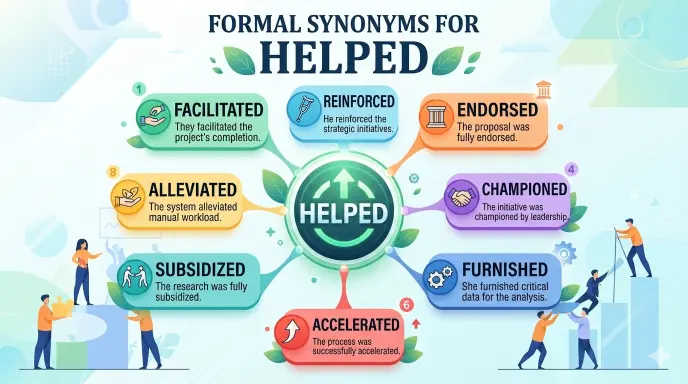
Formal alternatives are especially useful in academic writing, resumes, reports, professional documents, and official communication. The best choice should describe the specific kind of assistance rather than simply make the sentence sound more sophisticated.
Assisted
Meaning: Gave help or support to someone.
Explanation: Assisted is probably the safest formal replacement for helped. It preserves the basic meaning without adding a major new idea.
Example: The research assistant assisted the professor with data collection.
Best Use: Resumes, reports, academic writing, workplace communication, and formal documents.
Worst Use: It can sound unnecessarily formal in casual conversation.
Tone: Professional and formal.
Aided
Meaning: Helped someone or something achieve a result.
Explanation: Aided is a close synonym, although it often sounds more formal or literary than helped.
Example: The new software aided the team in organizing its records.
Best Use: Formal writing, reports, historical writing, and academic contexts.
Worst Use: It may sound stiff in a friendly email or casual conversation.
Tone: Formal and somewhat traditional.
Facilitated
Meaning: Made a process or action easier.
Explanation: Facilitated does not simply mean gave direct help. It often means removing obstacles or creating conditions that allow something to happen more easily.
Example: The new scheduling system facilitated communication between departments.
Best Use: Business reports, project management, education, and professional writing.
Worst Use: Avoid it if someone simply carried a box or performed a small favor.
Tone: Professional and precise.
Enabled
Meaning: Made something possible.
Explanation: Enabled focuses on the result of the assistance. It suggests that without the action, a person or process might not have been able to proceed in the same way.
Example: The grant enabled the students to continue their research.
Best Use: Academic writing, business reports, technology, project descriptions, and professional documents.
Worst Use: Don’t use it when the assistance had little effect on whether something could happen.
Tone: Formal and results-focused.
Supported
Meaning: Gave assistance, encouragement, resources, or backing.
Explanation: Supported is broader than assisted. It can describe practical help, emotional support, financial backing, or organizational assistance.
Example: The manager supported the team during the transition.
Best Use: Workplace writing, performance reviews, academic writing, and personal contexts.
Worst Use: It may be too vague when the exact action matters.
Tone: Professional, neutral, and flexible.
Contributed To
Meaning: Played a part in producing a result.
Explanation: Contributed to is useful when the person or action was one factor among several. It does not necessarily mean direct assistance.
Example: Her research contributed to the development of the new treatment method.
Best Use: Academic writing, reports, resumes, and project descriptions.
Worst Use: Don’t use it when someone provided direct, hands-on assistance and you want to emphasize that action.
Tone: Formal and analytical.
Advanced
Meaning: Helped something move forward or develop.
Explanation: Advanced suggests progress toward a goal rather than ordinary assistance.
Example: The campaign advanced the organization’s environmental goals.
Best Use: Formal reports, professional writing, policy discussions, and academic contexts.
Worst Use: It can sound exaggerated for a minor contribution.
Tone: Formal and goal-oriented.
Promoted
Meaning: Helped encourage the growth, development, or acceptance of something.
Explanation: Promoted can replace helped when an action encouraged a condition or goal. It should not be confused with promoting a product or receiving a job promotion.
Example: The program promoted greater cooperation among students.
Best Use: Academic, educational, nonprofit, business, and policy writing.
Worst Use: Avoid it when the person simply provided direct assistance.
Tone: Formal and purposeful.
Furthered
Meaning: Helped advance or develop a goal, cause, or purpose.
Explanation: Furthered is a formal alternative that emphasizes progress toward an objective.
Example: The partnership furthered the organization’s research goals.
Best Use: Formal reports, academic writing, organizational documents, and discussions of causes or goals.
Worst Use: It can sound overly formal for ordinary actions.
Tone: Formal and polished.
Guided
Meaning: Helped someone by giving direction or showing them what to do.
Explanation: Guided is more specific than helped. It implies direction, advice, instruction, or mentorship.
Example: The instructor guided students through the research process.
Best Use: Education, training, management, mentoring, and professional development.
Worst Use: Don’t use it if the person offered only physical or financial assistance.
Tone: Professional and supportive.
Advised
Meaning: Helped by giving recommendations or information.
Explanation: Advised is appropriate when assistance came through suggestions or expert guidance.
Example: The consultant advised the company on how to improve its workflow.
Best Use: Business, education, professional services, and formal communication.
Worst Use: It is inaccurate if no advice was actually given.
Tone: Professional and authoritative.
Counseled
Meaning: Gave advice or guidance, often about an important personal, educational, or professional matter.
Explanation: Counseled is narrower than helped and can imply a structured advisory relationship.
Example: The advisor counseled students about their career options.
Best Use: Education, professional guidance, counseling contexts, and formal writing.
Worst Use: Avoid using it for a simple favor or minor suggestion.
Tone: Formal and supportive.
Strengthened
Meaning: Made something stronger or more effective.
Explanation: Strengthened works when the assistance improved a person, relationship, argument, organization, or process.
Example: The training strengthened the team’s communication skills.
Best Use: Reports, evaluations, academic writing, and professional development.
Worst Use: Don’t use it when the help had no clear strengthening effect.
Tone: Formal and results-oriented.
Improved
Meaning: Made something better.
Explanation: Improved can replace helped when the main result was a positive change. It focuses on the outcome rather than the assistance itself.
Example: The new procedure improved customer response times.
Best Use: Reports, business writing, academic work, and performance descriptions.
Worst Use: It does not clearly identify who provided the help.
Tone: Neutral to formal.
Expedited
Meaning: Helped something happen faster.
Explanation: Expedited is a specialized alternative. It means assistance reduced delays or accelerated a process.
Example: The additional staff expedited the application review.
Best Use: Business, administration, logistics, and formal workplace writing.
Worst Use: Don’t use it simply to mean “helped.”
Tone: Formal and specific.
Benefited
Meaning: Produced an advantage or positive effect for someone or something.
Explanation: Benefited changes the focus from the person giving help to the person or thing receiving a positive effect.
Example: The revised schedule benefited both employees and customers.
Best Use: Reports, academic writing, evaluations, and formal analysis.
Worst Use: It is not the right choice when you need to emphasize active assistance.
Tone: Formal and analytical.
Semi-Formal and Neutral Synonyms for Helped
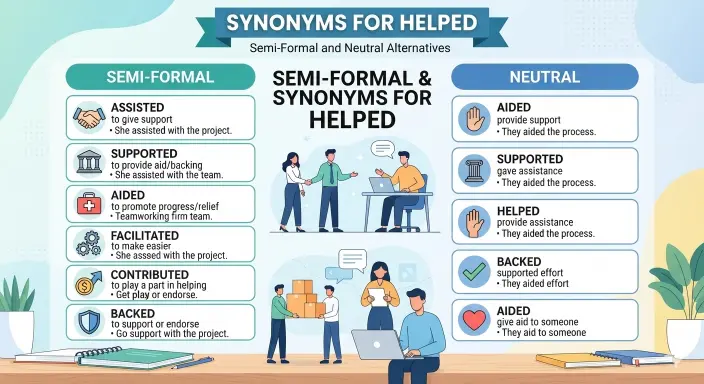
Neutral words are often the best choice for everyday professional writing because they remain clear without sounding stiff.
Supported
Meaning: Provided assistance, encouragement, or resources.
Explanation: Supported is broad and works in both professional and personal contexts.
Example: My supervisor supported me during the transition to the new role.
Best Use: Work, school, personal writing, and emails.
Worst Use: Avoid it when a more specific action would make the sentence clearer.
Tone: Neutral and professional.
Worked With
Meaning: Cooperated with someone to accomplish something.
Explanation: Worked with is not an exact synonym for helped. It emphasizes collaboration rather than one person assisting another.
Example: I worked with the marketing team to prepare the presentation.
Best Use: Resumes, workplace communication, project descriptions, and interviews.
Worst Use: Don’t use it if you were simply providing assistance without collaboration.
Tone: Neutral and professional.
Guided
Meaning: Helped by providing direction.
Explanation: This is especially useful when someone taught, coached, or directed another person.
Example: The teacher guided the students through the assignment.
Best Use: School, training, management, and mentoring.
Worst Use: It may misrepresent a situation if no direction was provided.
Tone: Neutral-professional.
Encouraged
Meaning: Helped by giving confidence, motivation, or emotional support.
Explanation: Encouraged describes a specific kind of help. It focuses on motivation rather than practical assistance.
Example: Her feedback encouraged me to continue working on the project.
Best Use: Education, personal writing, leadership, and workplace communication.
Worst Use: Don’t use it if someone actually performed the task for you.
Tone: Warm and supportive.
Cooperated
Meaning: Worked together willingly toward a shared purpose.
Explanation: Cooperated emphasizes mutual effort. It is not the same as one person helping another.
Example: The two departments cooperated to solve the scheduling problem.
Best Use: Workplace, school, projects, and formal descriptions of teamwork.
Worst Use: Avoid it when only one person provided assistance.
Tone: Neutral and professional.
Collaborated
Meaning: Worked jointly with others on a project or goal.
Explanation: Collaborated usually implies shared responsibility and contribution rather than one-sided help.
Example: The designers collaborated with engineers to develop the prototype.
Best Use: Resumes, business writing, academic work, and project descriptions.
Worst Use: It can exaggerate a simple support role.
Tone: Professional.
Made Easier
Meaning: Reduced difficulty.
Explanation: This phrase is useful when the main effect of the help was making a task or process less difficult.
Example: The checklist made the application process easier.
Best Use: Websites, instructions, customer communication, and everyday writing.
Worst Use: It is less concise in highly formal writing.
Tone: Plain and clear.
Provided Assistance
Meaning: Gave help or support.
Explanation: This is a direct, slightly formal phrase that can replace helped in professional settings.
Example: The staff provided assistance to visitors during the event.
Best Use: Customer service, workplace writing, official communication, and reports.
Worst Use: It may sound bureaucratic in casual conversation.
Tone: Formal-neutral.
Provided Support
Meaning: Gave practical, emotional, financial, or organizational assistance.
Explanation: Provided support is broader than helped and can be useful when the exact type of assistance is clear from context.
Example: The team provided support to new employees during training.
Best Use: Business, education, customer service, and professional communication.
Worst Use: Avoid it if you need to identify a specific action.
Tone: Neutral-professional.
Contributed
Meaning: Added something that helped produce a result.
Explanation: Contributed is useful when several people or factors played a role.
Example: Everyone contributed to the success of the event.
Best Use: Teamwork, academic writing, workplace reports, and resumes.
Worst Use: It does not necessarily mean direct assistance.
Tone: Neutral and professional.
Assisted With
Meaning: Helped with a particular task or activity.
Explanation: This is one of the most useful alternatives for resumes because it identifies an area of responsibility without overstating ownership.
Example: Assisted with inventory management and customer inquiries.
Best Use: Resumes, job descriptions, workplace documents, and formal applications.
Worst Use: It can sound vague if the actual accomplishment can be described more specifically.
Tone: Professional.
Informal and Casual Synonyms for Helped
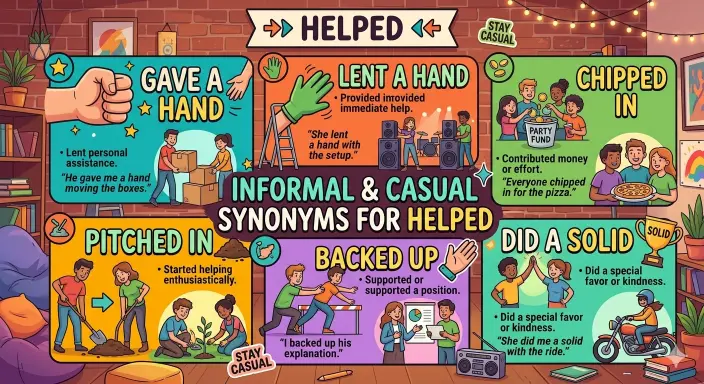
Casual English often uses short phrases that sound natural in conversation. These aren’t always suitable for formal writing.
Helped Out
Meaning: Gave someone a hand with a problem or task.
Example: My neighbor helped me out when my car wouldn’t start.
When it sounds natural: Everyday conversation, texts, and friendly messages.
When to avoid it: Resumes, academic essays, and formal reports.
Tone: Friendly and casual.
Gave a Hand
Meaning: Provided practical assistance.
Example: Thanks for giving me a hand with these boxes.
When it sounds natural: Informal conversation and friendly requests.
When to avoid it: Formal workplace documents.
Tone: Casual and warm.
Lent a Hand
Meaning: Offered help, usually with a task.
Example: Everyone lent a hand after the storm.
When it sounds natural: Friendly conversation and informal writing.
When to avoid it: Academic and highly formal writing.
Tone: Casual and friendly.
Pitched In
Meaning: Joined others in helping with a task.
Example: The whole team pitched in to clean the office.
When it sounds natural: Team settings and casual workplace conversation.
When to avoid it: Formal reports where a more precise verb is needed.
Tone: Casual and cooperative.
Stepped In
Meaning: Took action to help when a problem arose.
Example: Sarah stepped in when the customer needed additional assistance.
When it sounds natural: Conversation, workplace stories, and informal writing.
When to avoid it: Don’t use it if the person was simply performing their normal duties.
Tone: Casual to neutral.
Had Someone’s Back
Meaning: Supported or defended someone.
Example: I knew my friends had my back during the difficult situation.
When it sounds natural: Very casual conversations and social messages.
When to avoid it: Professional documents and formal emails.
Tone: Very informal.
True Synonyms vs. Contextual Synonyms for Helped
The word helped has a broad meaning, so many alternatives only work in certain contexts.
| Type | What It Means | Can It Replace the Original? |
|---|---|---|
| True synonym | Has nearly the same basic meaning as helped | Usually |
| Near synonym | Has a similar meaning but adds a small difference | Sometimes |
| Contextual alternative | Works when helped has a particular meaning | Only in the right context |
| Broader expression | Covers a wider type of support or contribution | Sometimes |
| Narrower expression | Describes one specific kind of help | Only when that action occurred |
For example, assisted is a close replacement in many professional sentences. Guided is narrower because it implies direction. Encouraged is also narrower because it focuses on emotional or motivational support.
Likewise, collaborated does not simply mean helped. It suggests that two or more people worked together. Enabled emphasizes making an action possible, while facilitated focuses on making a process easier.
Business Writing: Better Synonyms for Helped
Business writing becomes stronger when the writer identifies the exact contribution.
Instead of:
The new system helped employees work faster.
You could write:
The new system enabled employees to complete tasks faster.
If the system removed obstacles:
The new system facilitated faster task completion.
If the change directly improved performance:
The new system improved task completion times.
For a resume:
Assisted the sales team with client research and account preparation.
Or, if the work was collaborative:
Collaborated with the sales team to prepare client research.
The key difference is ownership. Assisted with suggests a supporting role, while led, managed, or developed would indicate greater responsibility.
Corporate Communication: Professional Alternatives
Internal reports and company announcements often use supported, enabled, facilitated, contributed to, advanced, and strengthened.
Examples:
The training program supported employees during the transition.
The new platform enabled teams to share documents more efficiently.
The revised workflow facilitated faster approvals.
Cross-team cooperation strengthened communication.
These alternatives help avoid repeating “helped” while also telling readers what actually happened.
Academic Writing: Synonyms for Helped
Academic writing benefits from precision. Instead of automatically replacing helped, decide whether you mean contributed, supported, enabled, demonstrated, encouraged, or improved.
For example:
The evidence helped explain the character’s behavior.
Possible alternatives include:
The evidence contributed to an explanation of the character’s behavior.
The evidence helped clarify the character’s behavior.
The evidence provided insight into the character’s behavior.
Be careful with proved. Helping establish an argument is not necessarily the same as proving it.
Customer Service: Clear Alternatives
Customer service language should be easy to understand.
Useful options include:
- Assisted
- Helped
- Guided
- Provided support
- Explained
- Resolved
- Addressed
- Supported
For example:
Our representative helped the customer reset the account.
can become:
Our representative guided the customer through the account reset process.
That version is more specific because it tells the reader what kind of help was provided.
Legal Writing: Use Precise Language
Legal and official writing requires care because a synonym can change the intended meaning.
Assisted, supported, advised, represented, facilitated, and contributed to can describe different forms of involvement. They should not be treated as interchangeable.
For example:
The consultant helped the organization prepare the documents.
could mean many things. If the consultant actually gave professional advice, advised may be appropriate. If the consultant physically prepared the documents, assisted with preparing may be more accurate.
Avoid choosing a stronger term simply because it sounds more formal. Words such as enabled, established, or ensured may make a claim that goes beyond what actually occurred.
Email Communication: Professional Synonyms for Helped
For professional emails, these choices are particularly useful:
- Assisted — direct professional assistance.
- Supported — ongoing or broad assistance.
- Guided — instructions or direction.
- Provided — supplying information or resources.
- Contributed to — part of a larger effort.
- Facilitated — making a process easier.
- Enabled — making something possible.
Instead of:
Thank you for helping me with the presentation.
you could write:
Thank you for assisting me with the presentation.
For a warmer professional message:
Thank you for supporting me throughout the presentation process.
Email Examples Using Synonyms for Helped
Client Communication
Subject: Support With Your Account
Hello Ms. Patel,
I’m glad we were able to assist you with the account update.
The requested changes have now been completed. Please review the updated information when you have a chance, and let us know if anything needs to be corrected.
Best,
Jordan
Project Update
Subject: Project Progress Update
Hi Team,
The revised workflow has facilitated faster review of incoming requests.
We’ve also identified two areas where we can reduce unnecessary steps. I’ll bring those suggestions to tomorrow’s meeting.
Best,
Daniel
Request for Assistance
Subject: Help With the Research Data
Hi Professor Adams,
Thank you for your guidance on the research project.
Your comments enabled me to reorganize the data more clearly. I’ve attached the revised table for your review.
Best,
Nadia
Internal Workplace Email
Subject: New Employee Training
Hi Marcus,
Thanks for supporting the new team members during their first week.
Your walkthrough of the reporting system made the transition much easier for everyone. I appreciate you taking the extra time to answer their questions.
Best,
Elena
Customer Service
Subject: Your Service Request
Hello Mr. Wilson,
Thank you for contacting us.
Our support team guided you through the account recovery process, and your access has now been restored. If you experience another issue, please contact us again.
Kind regards,
Customer Support
Academic Communication
Subject: Feedback on My Draft
Dear Dr. Carter,
Thank you for reviewing my essay draft. Your comments helped clarify the main argument and showed me where additional evidence was needed.
I’ve revised those sections and attached the updated version.
Best regards,
Sam
Vendor Communication
Subject: Delivery Schedule
Hello Kevin,
Thank you for assisting with the revised delivery schedule.
The updated dates work for our team. Please confirm that the shipment will leave your facility on Monday as discussed.
Best,
Rachel
Short Dialogue Examples for Synonyms for Helped
Workplace
Person A: Who helped you finish the report?
Person B: Maria assisted me with the final data check.
Classroom
Person A: How did you understand the difficult chapter?
Person B: My teacher guided me through the main ideas.
Customer Service
Person A: Did someone help you reset the account?
Person B: Yes. The support agent guided me through each step.
Casual Conversation
Person A: Thanks for helping me move the table.
Person B: No problem. I was happy to give you a hand.
Professional Discussion
Person A: What did the new software change?
Person B: It enabled us to complete the process much faster.
How to Replace “Helped” in a Sentence
Example 1
Original: She helped me with the assignment.
Alternative: She assisted me with the assignment.
Why it works: Assisted is a direct, more formal alternative. The meaning stays almost the same.
Example 2
Original: The training helped employees understand the system.
Alternative: The training enabled employees to understand the system more effectively.
Why it works: Enabled emphasizes the role the training played in making understanding possible.
Example 3
Original: The manager helped the new employees.
Alternative: The manager guided the new employees.
Why it works: This version is better if the manager provided instructions or direction.
Example 4
Original: The new policy helped communication between departments.
Alternative: The new policy facilitated communication between departments.
Why it works: Facilitated specifically suggests that the policy made communication easier.
Example 5
Original: Her advice helped me finish the project.
Alternative: Her advice contributed to the successful completion of the project.
Why it works: The alternative emphasizes that her advice was one factor in the result.
Example 6
Original: The extra staff helped us finish the work sooner.
Alternative: The extra staff expedited the work.
Why it works: Expedited specifically means helped something happen faster.
Example 7
Original: My friends helped me during a difficult time.
Alternative: My friends supported me during a difficult time.
Why it works: Supported better captures emotional and ongoing assistance.
Example 8
Original: Everyone helped with the event.
Alternative: Everyone contributed to the event’s success.
Why it works: Contributed emphasizes shared participation rather than one-sided assistance.
Example 9
Original: The teacher helped students feel more confident.
Alternative: The teacher encouraged students to become more confident.
Why it works: Encouraged identifies the specific kind of help: motivation and confidence-building.
Example 10
Original: The new tool helped the team work together.
Alternative: The new tool supported collaboration within the team.
Why it works: The alternative identifies the specific benefit rather than using the broad word helped.
Comparison Table: Helped and Its Alternatives
| Phrase | Tone | Meaning / Scope | Best Use | Example |
|---|---|---|---|---|
| Helped | Neutral | General assistance | Everyday writing | She helped me finish the task. |
| Assisted | Formal-neutral | Gave direct assistance | Work and resumes | She assisted the manager. |
| Aided | Formal | Provided assistance | Reports and academic writing | The tool aided the process. |
| Supported | Neutral-professional | Gave broad assistance or backing | Work and personal contexts | He supported the team. |
| Facilitated | Formal | Made a process easier | Business and reports | The system facilitated communication. |
| Enabled | Formal | Made something possible | Academic and business writing | The grant enabled research. |
| Guided | Neutral-professional | Helped through direction | Education and training | She guided the students. |
| Encouraged | Neutral | Gave motivation or confidence | School and personal contexts | His feedback encouraged me. |
| Contributed to | Formal-neutral | Played a part in an outcome | Reports and resumes | Her work contributed to the result. |
| Collaborated | Professional | Worked jointly | Projects and resumes | They collaborated on the design. |
| Improved | Neutral | Made something better | Reports and analysis | The update improved performance. |
| Strengthened | Formal-neutral | Made something stronger | Reports and evaluations | Training strengthened the team. |
| Advised | Formal | Helped through recommendations | Business and professional contexts | The consultant advised the company. |
| Expedited | Formal | Helped something happen faster | Administration and business | Staff expedited the review. |
| Helped out | Casual | Gave informal assistance | Conversation | He helped out with dinner. |
| Pitched in | Casual | Joined others in helping | Teams and informal settings | Everyone pitched in. |
Which Synonyms for Helped Should You Choose?
- For formal writing: Use assisted, aided, facilitated, enabled, contributed to, or advanced, depending on the meaning.
- For business communication: Supported, assisted, facilitated, enabled, contributed to, and strengthened are reliable choices.
- For academic writing: Prefer contributed to, facilitated, enabled, supported, guided, or advanced when they accurately describe the evidence or action.
- For legal writing: Choose the most precise factual description. Don’t substitute a stronger word simply to make the sentence sound formal.
- For professional emails: Assisted, supported, guided, provided, and helped are all useful. Choose based on the relationship and context.
- For everyday conversation: Helped, gave a hand, helped out, and lent a hand sound natural.
- For casual messages: Helped out, pitched in, stepped in, and had my back can work when the situation is informal.
A simple test helps: ask “What exactly did the person do?” If they gave advice, use advised.
- If they gave direction, use guided.
- If they made a process easier, use facilitated.
- If they made something possible, use enabled.
Grammar and Usage Guide for “Helped”
Helped Is the Past Tense and Past Participle of Help
Use helped for completed actions.
She helped me yesterday.
It can also follow forms of “have”:
She has helped me several times.
Help Someone Do Something
A common structure is:
help + person + base verb
Example:
She helped me finish the report.
You can also use:
She helped me to finish the report.
Both are grammatical. The version without to is often more direct and natural.
Help With Something
Use help with when naming the task or area of assistance.
He helped with the project.
She helped with the presentation.
For a person:
She helped me with the presentation.
Help Someone With Something
This structure is extremely common:
The technician helped me with my computer.
Professional alternatives can preserve the structure:
The technician assisted me with my computer.
Help Someone To Do Something
The verb help can take either the bare infinitive or to-infinitive:
She helped me solve the problem.
She helped me to solve the problem.
Both are correct.
Help vs. Helped
Use help for present or general situations:
I help customers every day.
Use helped for past situations:
I helped customers during the event.
Helped vs. Had Helped
Use had helped when one past helping action happened before another past event.
She had helped me before I started the project.
This is the past perfect form.
Punctuation
The word helped does not require special punctuation. Punctuation depends on the sentence around it.
Correct:
The training helped employees understand the new system.
Incorrect:
The training helped, employees understand the new system.
Don’t insert a comma between helped and its direct complement.
Common Mistakes to Avoid
1. Treating Every Alternative as an Exact Synonym
Collaborated, guided, enabled, and encouraged describe specific forms of help. They should only replace helped when those details are true.
2. Using “Aided” Everywhere
Aided is grammatically correct, but it can sound formal or old-fashioned in ordinary conversation. Assisted or helped may sound more natural.
3. Overusing “Facilitated”
Facilitated means made a process easier. It is not a universal replacement for helped.
4. Making a Resume Sound Inflated
Replacing every “helped” with grander words can make your experience sound exaggerated. If you assisted with a task, assisted with may be more honest than led or directed.
5. Confusing Collaboration With Assistance
Collaborated implies joint work. If you only supported another person, supported or assisted is more accurate.
6. Changing the Level of Responsibility
“Helped manage the project” does not necessarily mean “managed the project.” Don’t choose a synonym that gives you more responsibility than you actually had.
7. Using Casual Phrases in Formal Writing
Expressions such as gave a hand, pitched in, and had someone’s back belong mainly in casual contexts.
8. Using “Enabled” Without a Real Result
Enabled implies that an action made something possible. If the action only provided minor assistance, assisted may be more accurate.
9. Ignoring Emotional Meaning
If someone helped through encouragement or emotional support, supported or encouraged may communicate the situation better than a generic word.
10. Replacing Simple Words Just to Sound Formal
Sometimes helped is the clearest option. A synonym is useful only when it improves precision, tone, or variety.
When Not to Use “Helped”
There are situations where replacing helped can make a sentence clearer.
1. When You Know the Exact Action
Instead of:
She helped the students.
write:
She guided the students through the assignment.
The second sentence provides useful information.
2. When Writing a Resume
“Helped with marketing” is vague. A more precise description might be:
Assisted with social media planning and content preparation.
Even better, if accurate:
Prepared weekly social media content for the marketing team.
3. When You Need to Explain a Result
Instead of:
The software helped the company reduce errors.
you might write:
The software reduced errors by automating data checks.
The second version describes the actual effect.
4. When “Helped” Is Repetitive
If the same word appears several times in a paragraph, use accurate alternatives such as supported, guided, contributed to, or facilitated where appropriate.
5. When the Audience Needs Precision
Technical, academic, and professional readers may need to know exactly what kind of assistance occurred.
6. When the Original Word Is Too Vague
If “helped” could mean almost anything, replace it with a more informative verb.
Still, helped is often the better choice in ordinary writing. It is short, familiar, and flexible. Don’t sacrifice clarity just to avoid repetition.
Advanced Writer Tips for Synonyms for Helped
Tone Control
Use helped for simple, natural communication. Use assisted for a professional tone, aided for more formal writing, and helped out for casual conversation.
Professional Email Etiquette
Choose wording that sounds professional without becoming stiff.
Thank you for assisting me with the report.
is polished.
Thank you for providing assistance in relation to the completion of the report.
is unnecessarily complicated.
Politeness
The phrase helped me can sound warm and personal. Assisted me is more professional but slightly less conversational.
For a customer:
Thank you for helping me resolve this issue.
may feel warmer than:
Thank you for assisting me in resolving this issue.
Both are correct; the first is more natural in many customer interactions.
Context Alignment
Think about the type of help:
- Advice → advised
- Direction → guided
- Motivation → encouraged
- Team effort → collaborated
- General assistance → assisted
- Process improvement → facilitated
- Making something possible → enabled
- Shared contribution → contributed to
- Emotional backing → supported
Precision
Avoid choosing a synonym based only on how formal it sounds. Facilitated may look impressive, but helped could be more accurate if the situation involved simple assistance.
Readability
Short, familiar words often produce better sentences.
The new checklist helped staff avoid mistakes.
is clear.
The new checklist facilitated the avoidance of errors among staff.
is more formal but less natural.
Use the shorter version unless the context calls for greater formality.
Related Questions About Synonyms for Helped
What is another way to say helped?
Depending on the context, you can say assisted, supported, aided, guided, encouraged, enabled, facilitated, contributed to, collaborated, or provided assistance. Each option adds a slightly different meaning, so choose based on the type of help involved.
What is a professional synonyms for helped?
Assisted is usually the safest professional alternative. Supported, facilitated, enabled, guided, and contributed to are also useful when they accurately describe the person’s role.
What is a formal synonyms for helped?
Assisted and aided are close formal alternatives. Facilitated, enabled, advanced, furthered, and contributed to can be better when you want to describe a particular kind of assistance or result.
What can I use instead of helped on a resume?
Use a specific verb that accurately describes your contribution. Good choices include assisted, supported, coordinated, guided, contributed, collaborated, improved, facilitated, and trained. Avoid choosing a stronger verb unless it genuinely reflects your responsibility.
Is helped a formal word?
Helped is neutral and completely acceptable in formal writing. It is not inherently informal. However, a more precise alternative such as assisted, facilitated, or contributed to can sometimes make a professional sentence more informative.
Can assisted replace helped?
Yes, in many situations. Assisted is one of the closest professional alternatives to helped. However, it can sound more formal and may suggest a supporting role, so helped can still be preferable in conversational or warm writing.
What is the difference between helped and supported?
Helped is broad and can describe almost any type of assistance. Supported usually suggests ongoing backing, encouragement, resources, or assistance. Someone can support you without directly performing a task for you.
FAQs
1. What is the best synonyms for helped?
Assisted is the best general formal synonym, but there is no single best choice for every sentence. Use guided for direction, supported for ongoing assistance, enabled for making something possible, and facilitated for making a process easier.
2. What is a strong synonyms for helped on a resume?
Assisted, supported, facilitated, contributed to, collaborated, and improved can work well on resumes. The strongest choice is the one that accurately describes what you did. Avoid replacing “helped” with an exaggerated verb that suggests responsibility you did not have.
3. Is “aided” the same as “helped”?
They are close synonyms, but aided is more formal and less common in everyday conversation. It can work well in reports and academic writing, but helped or assisted may sound more natural in many professional contexts.
4. What is a synonyms for helped with?
Common alternatives include assisted with, supported, contributed to, worked on, collaborated on, and provided assistance with. The best option depends on whether the person worked independently, supported someone else, or participated as part of a team.
5. What is a synonyms for helped someone?
Useful alternatives include assisted someone, supported someone, guided someone, advised someone, encouraged someone, and aided someone. Each phrase describes a different kind of assistance.
6. What is the difference between assisted and helped?
Assisted is more formal and often emphasizes a supporting role. Helped is broader and more natural in everyday English. For example, “I helped my friend” is casual and flexible, while “I assisted the manager” sounds more professional.
7. What is the best synonyms for helped in academic writing?
There is no universal replacement. Contributed to, facilitated, supported, enabled, guided, and advanced can all work, depending on the sentence. Academic writing benefits most from a word that precisely describes the relationship between an action and its result.
Key Takeaways
- Assisted is the safest formal alternative to helped in many professional contexts.
- Use guided when the help involved direction, instruction, or mentoring.
- Choose facilitated when something made a process easier and enabled when it made an outcome possible.
- Use supported for broad, ongoing, emotional, or organizational assistance.
- On resumes and in academic writing, choose the most precise verb rather than simply using the most formal-sounding synonym.
Conclusion
The best synonyms for helped depend on what kind of assistance actually took place. Assisted and aided are close formal alternatives, while supported works well for broad or ongoing assistance. If someone gave direction, guided is more precise.
While if an action made something possible, enabled is stronger. If it made a process easier, facilitated is often the right choice. For shared work, collaborated or contributed to may be more accurate than simply saying helped.
In professional and academic writing, precision matters more than using complicated vocabulary. A good synonym should preserve the original meaning while telling the reader something useful about the action.
At the same time, don’t avoid helped simply because it is a common word. It remains clear, natural, and perfectly acceptable in many situations. Choose the alternative that fits the action, audience, tone, and level of responsibility.
