
The right synonyms for analyze can make your writing more precise, especially when you are describing how someone studies information, examines evidence, or breaks a complex subject into smaller parts.
Although words such as examine, evaluate, assess, and investigate are closely related to analyze, they do not always mean exactly the same thing.The best alternative depends on what you are actually doing.
A researcher may examine data, a manager may evaluate performance, a scientist may investigate a result, and a student may interpret a passage.
This guide explains more than 33 useful alternatives, including formal, neutral, academic, professional, and casual choices, so you can select a word that fits your meaning and audience.
Quick Answer: What Are the Best Synonyms for Analyze?
The closest synonyms for analyze include examine, evaluate, assess, study, inspect, investigate, review, interpret, break down, scrutinize, explore, and dissect. The best choice depends on your purpose. Use examine for careful study, evaluate for judging quality or value, interpret for explaining meaning, and scrutinize for very close inspection.
Quick List of Synonyms for Analyze
Here are useful alternatives grouped by meaning and tone:
Closest Synonyms for Analyze
- Examine
- Study
- Evaluate
- Assess
- Investigate
- Inspect
- Review
- Interpret
- Scrutinize
- Explore
Formal and academic Synonyms for Analyze
- Examine closely
- Evaluate
- Assess
- Investigate
- Scrutinize
- Interpret
- Dissect
- Deconstruct
- Critically examine
- Appraise
- Determine
- Characterize
Neutral Synonyms for Analyze
- Look at
- Study
- Review
- Break down
- Consider
- Explore
- Compare
- Identify
- Examine
- Understand
Contextual Synonyms for Analyze
- Diagnose
- Audit
- Test
- Measure
- Research
- Calculate
- Compare
- Inspect
- Classify
- Evaluate
Casual Synonyms for Analyze
- Look into
- Look over
- Break down
- Take a closer look at
- Dig into
- Pick apart
Not every word above is a perfect replacement. For example, diagnose usually means identifying the cause of a problem, while audit refers to a systematic examination of records or processes.
Formal Synonyms for Analyze
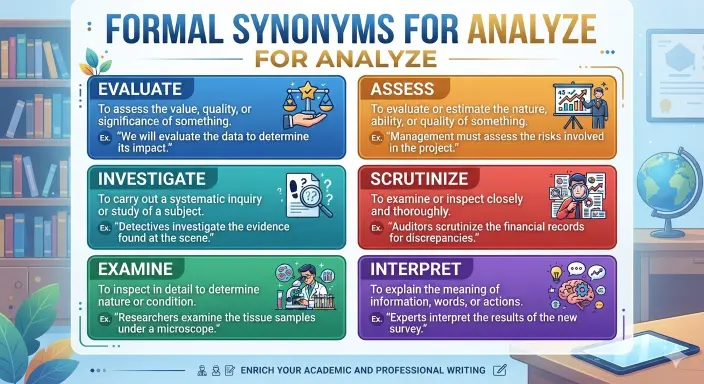
1. Examine
Meaning: To study something carefully.
Explanation: Examine is one of the closest and most flexible alternatives to analyze. It suggests careful attention but does not always imply the detailed breakdown associated with analysis.
Example: The researchers examined the survey responses for recurring patterns.
Best Use: Academic writing, reports, research, professional communication.
Worst Use: It may be too general when you need to emphasize detailed interpretation.
Tone: Formal to neutral.
2. Evaluate
Meaning: To judge the quality, effectiveness, value, or importance of something.
Explanation: Evaluate overlaps with analyze, but it adds the idea of making a judgment. You analyze information to understand it; you evaluate something to determine how well it performs or how valuable it is.
Example: The committee evaluated the proposal before approving the project.
Best Use: Business reports, academic writing, performance reviews.
Worst Use: Avoid it when you only mean “study” and no judgment is involved.
Tone: Formal and professional.
3. Assess
Meaning: To judge or estimate the nature, quality, importance, or effect of something.
Explanation: Assess is especially useful when analysis leads to a judgment or measurement.
Example: The doctor assessed the patient’s condition before recommending treatment.
Best Use: Professional reports, education, healthcare, business, risk analysis.
Worst Use: It may be less precise if the task involves purely descriptive analysis.
Tone: Formal and professional.
4. Investigate
Meaning: To examine something systematically to discover facts or causes.
Explanation: Investigate usually suggests searching for information or finding out why something happened. It often involves analysis as part of a larger process.
Example: The team investigated the cause of the software failure.
Best Use: Research, journalism, science, workplace problems.
Worst Use: It can sound excessive for a simple review.
Tone: Formal and investigative.
5. Scrutinize
Meaning: To examine something extremely carefully.
Explanation: Scrutinize is stronger than examine. It implies close attention, often because errors, weaknesses, or important details need to be found.
Example: The editor scrutinized the manuscript for factual errors.
Best Use: Legal documents, financial reports, academic work, editing.
Worst Use: It may sound too intense for a routine review.
Tone: Formal and precise.
6. Interpret
Meaning: To explain or determine the meaning of information, evidence, or a text.
Explanation: Interpret is not a complete synonym for analyze. Analysis can lead to interpretation, but interpretation focuses specifically on meaning.
Example: Students were asked to interpret the poem’s final stanza.
Best Use: Literature, research, data, art, communication.
Worst Use: Avoid it when you only mean collecting or organizing information.
Tone: Formal and academic.
7. Appraise
Meaning: To evaluate something carefully, often to determine its value or quality.
Explanation: Appraise has a more specialized sense than analyze. It is particularly useful when judging worth, quality, or condition.
Example: An independent expert appraised the property before the sale.
Best Use: Property, professional evaluation, formal assessments.
Worst Use: It is unnatural for many ordinary analytical tasks.
Tone: Formal.
8. Dissect
Meaning: To separate something into parts for detailed examination.
Explanation: In figurative writing, dissect means to analyze something very closely by breaking it into components.
Example: The professor dissected the argument to reveal its weaknesses.
Best Use: Academic analysis, literary criticism, detailed discussion.
Worst Use: It can sound overly aggressive or dramatic in routine business writing.
Tone: Formal, analytical, sometimes vivid.
9. Deconstruct
Meaning: To break something down and examine how its parts create meaning or function.
Explanation: Deconstruct is narrower than analyze and is common in literary, cultural, philosophical, and critical discussions.
Example: The essay deconstructs common assumptions about success.
Best Use: Critical theory, literature, cultural studies.
Worst Use: Avoid it as a fancy replacement for every instance of analyze.
Tone: Academic and specialized.
10. Appraise Closely
Meaning: To judge something after careful consideration.
Explanation: This expression emphasizes detailed judgment rather than simple observation.
Example: The board appraised the potential risks before making a decision.
Best Use: Formal evaluations and decision-making.
Worst Use: Everyday conversation.
Tone: Formal.
11. Critically Examine
Meaning: To examine something carefully while questioning its strengths, weaknesses, assumptions, or evidence.
Explanation: This phrase is particularly common in academic assignments. It signals that the writer should not merely describe a subject.
Example: The paper critically examines the effects of social media on communication.
Best Use: Essays, research papers, academic criticism.
Worst Use: Casual conversation.
Tone: Academic and formal.
12. Characterize
Meaning: To describe the distinctive features or qualities of something.
Explanation: Characterize can be an analytical alternative when the goal is to identify what defines a subject rather than fully break it apart.
Example: The researchers characterized the material according to its physical properties.
Best Use: Scientific and academic writing.
Worst Use: Simple everyday analysis.
Tone: Formal and technical.
Semi-Formal and Neutral Synonyms for Analyze
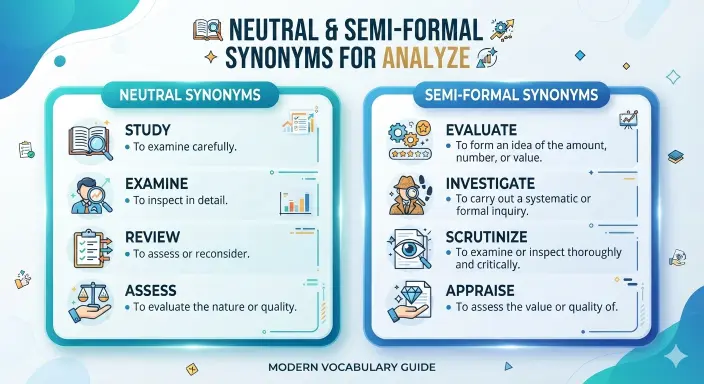
13. Study
Meaning: To examine something carefully in order to understand it.
Explanation: Study is one of the most natural alternatives to analyze. It works in academic, professional, and everyday contexts.
Example: We studied the customer feedback before changing the service.
Best Use: School, work, research, everyday writing.
Worst Use: It may not communicate the depth of a highly technical analysis.
Tone: Neutral.
14. Review
Meaning: To examine something again or systematically.
Explanation: Review often means looking over existing information rather than performing deep analysis from scratch.
Example: Please review the report before the meeting.
Best Use: Emails, workplace communication, documents.
Worst Use: Avoid it if you specifically mean detailed statistical or technical analysis.
Tone: Neutral and professional.
15. Inspect
Meaning: To look at something carefully, usually to find problems or confirm its condition.
Explanation: Inspect focuses on physical condition, accuracy, or compliance more than abstract interpretation.
Example: The technician inspected the equipment for damage.
Best Use: Quality control, maintenance, safety, physical objects.
Worst Use: Literary or conceptual analysis.
Tone: Neutral to formal.
16. Explore
Meaning: To examine a subject in order to understand or discover more about it.
Explanation: Explore is broader and less rigid than analyze. It often suggests considering possibilities rather than reaching a firm conclusion.
Example: The article explores the reasons behind the change in consumer behavior.
Best Use: Essays, websites, research, discussions.
Worst Use: Avoid it when you need to communicate a strict technical analysis.
Tone: Neutral and approachable.
17. Consider
Meaning: To think carefully about something.
Explanation: Consider is broader than analyze. It works when analysis is one part of thoughtful decision-making.
Example: The manager considered the financial data before approving the purchase.
Best Use: Decisions, discussions, professional writing.
Worst Use: It can be too vague for technical analysis.
Tone: Neutral.
18. Break Down
Meaning: To divide something complicated into smaller parts so it is easier to understand.
Explanation: This is an excellent plain-English alternative to analyze, especially when explaining a complex idea to a general audience.
Example: The instructor broke down the problem into three simple steps.
Best Use: Teaching, presentations, blogs, everyday communication.
Worst Use: Very formal academic or legal writing.
Tone: Neutral and accessible.
19. Compare
Meaning: To examine two or more things to identify similarities and differences.
Explanation: Compare is a narrower analytical activity. It should replace analyze only when comparison is the actual task.
Example: The report compares sales figures from the two regions.
Best Use: Research, essays, product reviews, business reports.
Worst Use: When there is only one subject and no comparison.
Tone: Neutral and professional.
20. Identify
Meaning: To recognize or determine something.
Explanation: Analysis often helps you identify patterns, causes, trends, or problems. However, identify focuses on the result rather than the full analytical process.
Example: The analysis identified several weaknesses in the proposal.
Best Use: Reports, research, troubleshooting.
Worst Use: As a replacement when you need to emphasize the examination process.
Tone: Neutral and professional.
21. Look At
Meaning: To examine or consider something.
Explanation: Look at is a simple, flexible expression that works well in plain English.
Example: Let’s look at the results before deciding what to do.
Best Use: Meetings, conversation, presentations.
Worst Use: Formal academic writing when a more precise verb is available.
Tone: Casual to neutral.
22. Research
Meaning: To gather and study information about a subject.
Explanation: Research is broader than analyze. It may include collecting information, evaluating sources, analyzing evidence, and reporting findings.
Example: The team researched customer preferences before launching the product.
Best Use: Academic, business, scientific, and professional contexts.
Worst Use: When you mean only examining information already collected.
Tone: Neutral to formal.
23. Determine
Meaning: To establish or discover something through examination or reasoning.
Explanation: Determine focuses on reaching an answer or conclusion rather than the analytical process itself.
Example: The engineers analyzed the data to determine the source of the problem.
Best Use: Reports, research, technical writing.
Worst Use: As a direct replacement when no conclusion is being reached.
Tone: Formal and neutral.
24. Measure
Meaning: To determine the size, amount, level, or degree of something.
Explanation: Measure is a specialized alternative. It works when analysis involves quantifying a particular variable.
Example: The study measured changes in employee satisfaction.
Best Use: Research, statistics, science, business analytics.
Worst Use: Qualitative analysis where no numerical measurement occurs.
Tone: Technical and neutral.
25. Test
Meaning: To examine something to determine how well it works or whether it meets a standard.
Explanation: Testing can be part of analysis, but the words are not interchangeable in every situation.
Example: The engineers tested the system before analyzing its performance.
Best Use: Science, technology, products, education.
Worst Use: Literary or purely conceptual analysis.
Tone: Neutral and technical.
Informal and Casual Synonyms for Analyze
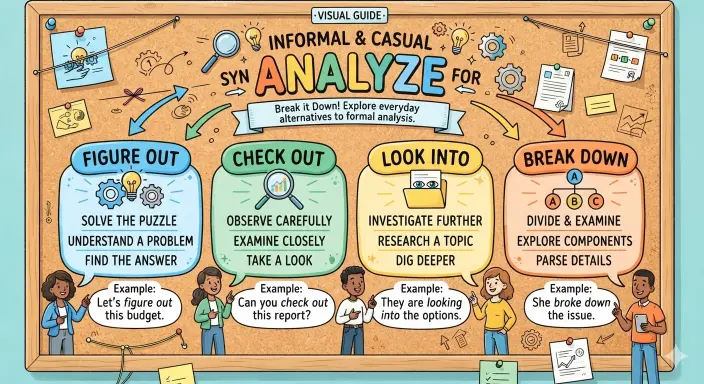
26. Look Into
Meaning: To investigate or examine something.
Example: I’ll look into the issue and get back to you tomorrow.
When it sounds natural: Conversation, friendly workplace messages, simple emails.
When to avoid it: Formal academic reports or highly technical documents.
Tone: Casual and approachable.
27. Look Over
Meaning: To examine something briefly or generally.
Example: Can you look over my presentation before the meeting?
When it sounds natural: Everyday conversation, school, workplace communication.
When to avoid it: When you mean a deep or systematic analysis.
Tone: Casual.
28. Dig Into
Meaning: To examine something with considerable attention or effort.
Example: We need to dig into the sales numbers before changing the strategy.
When it sounds natural: Conversations, informal workplace discussions, blogs.
When to avoid it: Formal academic writing.
Tone: Conversational and energetic.
29. Pick Apart
Meaning: To examine something in great detail, often by focusing on flaws.
Example: The reviewers picked apart the proposal during the meeting.
When it sounds natural: Informal discussions and criticism.
When to avoid it: Polite client communication or neutral professional writing.
Tone: Casual and sometimes negative.
30. Take a Closer Look At
Meaning: To examine something more carefully.
Example: Let’s take a closer look at the survey results.
When it sounds natural: Meetings, presentations, emails, conversation.
When to avoid it: Formal writing where examine or assess is more concise.
Tone: Neutral and conversational.
31. Break Apart
Meaning: To separate something into individual parts for examination.
Example: The teacher broke apart the argument so the class could understand each point.
When it sounds natural: Teaching and informal explanations.
When to avoid it: Technical writing when deconstruct or analyze is more precise.
Tone: Casual to neutral.
32. Figure Out
Meaning: To discover or understand something.
Example: We need to figure out why the numbers changed.
When it sounds natural: Conversation and informal messages.
When to avoid it: Academic papers, formal reports, and legal documents.
Tone: Casual.
33. Pick Through
Meaning: To examine something carefully by considering individual parts or details.
Example: She picked through the records looking for inconsistencies.
When it sounds natural: Informal descriptions of detailed searching.
When to avoid it: Most formal professional writing.
Tone: Casual.
34. Sort Through
Meaning: To examine and organize a collection of information or items.
Example: We spent the afternoon sorting through the survey responses.
When it sounds natural: Everyday and workplace communication.
When to avoid it: When you mean sophisticated interpretation rather than reviewing material.
Tone: Neutral and conversational.
True Synonyms vs Contextual Synonyms for Analyze
Not every alternative listed above can replace analyze in every sentence. The difference usually comes down to purpose.
| Type | What It Means | Can It Replace the Original? |
|---|---|---|
| True synonym | Has almost the same core meaning | Usually |
| Near synonym | Shares much of the meaning but adds a slight difference | Often, depending on context |
| Contextual alternative | Works in a particular situation but has a different core meaning | Sometimes |
| Broader expression | Covers analysis plus other activities | Only when the broader meaning fits |
| Narrower expression | Describes one specific type of analysis | Only in the right context |
For example, examine is usually a close substitute:
Researchers analyzed the evidence.
Researchers examined the evidence.
But evaluate changes the emphasis:
Researchers evaluated the evidence.
This suggests they judged its quality, reliability, or significance.
Likewise, interpret emphasizes meaning:
The students interpreted the poem.
That is not identical to saying they analyzed the poem. They may have analyzed its structure, language, themes, and symbols before developing an interpretation.
Business Writing: Better Synonyms for Analyze
Business writing often benefits from specific verbs instead of repeatedly using analyze.
- Evaluate — for judging performance or options.
- Assess — for risks, needs, conditions, or potential outcomes.
- Review — for documents, reports, or existing information.
- Examine — for careful investigation.
- Compare — for products, costs, results, or strategies.
- Measure — for numerical performance.
- Identify — for finding trends, problems, or opportunities.
For example:
We analyzed three suppliers.
This is acceptable, but:
We compared three suppliers based on cost, delivery time, and quality.
is more specific and informative.
Corporate Communication: Choosing Precise Synonyms
Reports and internal communications often become clearer when the verb explains exactly what happened.
Instead of:
The team analyzed employee feedback.
try:
The team reviewed employee feedback and identified three recurring concerns.
The second sentence tells readers both the analytical activity and the result.
For a management report, assess, evaluate, review, identify, and examine are often useful choices because they make the purpose of the work clearer.
Academic Writing: Synonyms for Analyze
Academic writing requires special care because assignment verbs often carry specific expectations.
Analyze usually means breaking a subject into parts and explaining how those parts relate to one another.
Useful academic alternatives include:
- Examine
- Critically examine
- Evaluate
- Assess
- Interpret
- Compare
- Investigate
- Explore
- Deconstruct
- Dissect
Consider the difference:
Analyze the author’s argument.
This asks you to break down the argument and examine its evidence, reasoning, assumptions, and structure.
Evaluate the author’s argument.
This places more emphasis on judging its effectiveness, strength, or validity.
Interpret the author’s argument.
This focuses more strongly on explaining its meaning or significance.
Using the exact verb requested by an assignment is usually safer than replacing it simply for variety.
Customer Service: Clear Synonyms for Analyze
Customer-facing language should be understandable and reassuring.
Instead of:
We will analyze your complaint.
you might write:
We will review your complaint carefully.
Or:
We will investigate the issue and update you as soon as possible.
Review often sounds less technical than analyze, while investigate is useful when the company needs to find the cause of a problem.
Legal Writing: Using Analyze Carefully
Legal writing often requires precise terminology. Words that seem interchangeable in ordinary English may carry different implications in a legal context.
For general legal writing, examine, review, assess, evaluate, and consider may work depending on the intended meaning. However, a casual phrase such as figure out or dig into should generally not replace a precise formal verb in a legal document.
For example:
The attorney reviewed the contract for potential issues.
is clearer and more professional than:
The attorney looked over the contract.
The correct legal wording depends on the document and jurisdiction, so writers should preserve the precise intended meaning rather than choose a synonym simply for variety.
Email Communication: Professional Synonyms for Analyze
In professional emails, analyze is perfectly acceptable, but alternatives can make the purpose clearer.
- Review — “I’ll review the figures.”
- Examine — “We’ll examine the issue.”
- Assess — “We’ll assess the impact.”
- Evaluate — “We’ll evaluate the options.”
- Investigate — “We’ll investigate the discrepancy.”
- Compare — “We’ll compare the two proposals.”
- Look into — suitable for a less formal email.
The best email wording is usually specific rather than unnecessarily sophisticated.
Email Examples Using Synonyms for Analyze
1. Client Communication — Review
Subject: Review of Your Project Requirements
Hi Daniel,
Thank you for sending the updated requirements. Our team will review the document today and confirm whether any additional information is needed before development begins.
I’ll send you an update by tomorrow afternoon.
Best,
Maya
2. Project Update — Assess
Subject: Project Risk Assessment
Hi Team,
We’ve reviewed the latest project timeline and are assessing the impact of the two-day delay. At this point, the final delivery date may remain unchanged, but we’ll confirm this after checking the remaining tasks.
I’ll share the updated schedule this afternoon.
Best,
Chris
3. Vendor Communication — Compare
Subject: Supplier Comparison
Hi Elena,
We have received both proposals and are comparing them based on price, delivery time, warranty coverage, and service terms.
I’ll send our recommendation once the comparison is complete.
Regards,
James
4. Customer Service — Investigate
Subject: Update on Your Account Issue
Hello Mr. Patel,
Thank you for bringing this issue to our attention. We are investigating the discrepancy in your account and checking the related transaction records.
We’ll contact you as soon as we have confirmed what happened.
Sincerely,
Customer Support Team
5. Academic Communication — Examine
Subject: Question About the Research Assignment
Dear Professor Lee,
I am working on the research assignment and plan to examine how the two authors present the idea of social responsibility.
Could you please confirm whether you would like the discussion to focus mainly on the texts or also include outside sources?
Thank you,
Aisha
6. Internal Workplace Email — Evaluate
Subject: Evaluating the New Software Options
Hi everyone,
I’ve gathered the information from the three vendors. We’ll evaluate the options based on cost, security features, training requirements, and integration with our current systems.
I’ll bring the comparison to Friday’s meeting.
Thanks,
Marcus
Short Dialogue Examples Using Synonyms for Analyze
Workplace
Person A: Have you analyzed the customer feedback yet?
Person B: I’m reviewing it now. I’ve already identified two common complaints.
Classroom
Person A: What does the professor mean by “analyze the poem”?
Person B: You need to break it down and explain how its language, images, and themes work together.
Customer Service
Person A: What will happen next?
Person B: We’ll investigate the issue and contact you once we know more.
Casual Conversation
Person A: Why did the project fail?
Person B: We should dig into the numbers before we blame anyone.
Professional Discussion
Person A: Should we analyze both proposals?
Person B: Yes. Let’s compare their costs and assess the risks before choosing one.
How to Replace “Analyze” in a Sentence
Example 1
Original: The researchers analyzed the results.
Alternative: The researchers examined the results.
Why it works: Examined preserves the general meaning while sounding natural and professional.
Example 2
Original: We analyzed the company’s performance.
Alternative: We evaluated the company’s performance.
Why it works: Evaluated emphasizes judging performance rather than simply studying it.
Example 3
Original: The manager analyzed the risk.
Alternative: The manager assessed the risk.
Why it works: Assess is particularly natural for judging the level or potential impact of risk.
Example 4
Original: The team analyzed the cause of the error.
Alternative: The team investigated the cause of the error.
Why it works: Investigated emphasizes the search for the underlying cause.
Example 5
Original: The students analyzed the novel.
Alternative: The students examined the novel.
Why it works: Examined is broad enough to cover themes, characters, structure, language, and other features.
Example 6
Original: The professor analyzed the argument.
Alternative: The professor dissected the argument.
Why it works: Dissected suggests a very detailed breakdown and therefore creates a stronger emphasis.
Example 7
Original: The team analyzed the two proposals.
Alternative: The team compared the two proposals.
Why it works: Compared is more precise when the main task is identifying similarities and differences.
Example 8
Original: The researcher analyzed the meaning of the interview responses.
Alternative: The researcher interpreted the interview responses.
Why it works: Interpreted focuses specifically on understanding and explaining meaning.
Example 9
Original: We analyzed the problem.
Alternative: We looked into the problem.
Why it works: Looked into is natural in conversation and informal workplace communication, but it is less formal.
Example 10
Original: The teacher analyzed the complex equation.
Alternative: The teacher broke down the complex equation.
Why it works: Broke down makes the idea more accessible and emphasizes explaining individual parts.
Comparison Table: Synonyms for Analyze
| Phrase | Tone | Meaning / Scope | Best Use | Example |
|---|---|---|---|---|
| Examine | Formal/neutral | Study carefully | Research, work | Examine the evidence. |
| Evaluate | Formal | Judge quality or value | Business, academics | Evaluate the proposal. |
| Assess | Formal | Judge condition, risk, or impact | Work, research | Assess the risk. |
| Investigate | Formal | Search for facts or causes | Problems, research | Investigate the error. |
| Scrutinize | Formal | Examine extremely closely | Documents, evidence | Scrutinize the contract. |
| Study | Neutral | Carefully learn about something | School, research | Study the results. |
| Review | Neutral/professional | Look over existing material | Work, emails | Review the report. |
| Interpret | Academic | Explain meaning | Literature, data | Interpret the findings. |
| Explore | Neutral | Examine possibilities or ideas | Essays, discussions | Explore the issue. |
| Compare | Neutral | Identify similarities/differences | Reports, research | Compare the options. |
| Break down | Neutral/casual | Divide into understandable parts | Teaching | Break down the problem. |
| Look into | Casual | Investigate | Conversation, emails | Look into the complaint. |
| Dig into | Casual | Examine deeply | Discussion | Dig into the numbers. |
| Pick apart | Casual | Examine critically | Informal criticism | Pick apart the argument. |
Which Synonyms for Analyze Should You Choose?
1. For Formal Writing
Choose examine, assess, evaluate, investigate, scrutinize, or critically examine.
If you want a general formal replacement, examine is usually the safest.
2. For Business Communication
Choose evaluate when judging options, assess for risks or impact, review for documents, and compare when examining alternatives.
3. For Academic Writing
Use examine, evaluate, interpret, investigate, compare, or critically examine based on the assignment’s exact purpose.
Do not replace analyze just to avoid repetition if the original word is actually the most accurate choice.
4. For Legal Writing
Prefer precise formal terms such as examine, review, assess, or evaluate when they accurately describe the action. Avoid casual expressions.
5. For Professional Email
Review is often the most natural choice:
I’ll review the figures and send you an update.
Use investigate when you need to find a cause and assess when you need to judge impact or risk.
6. For Everyday Conversation
Use look at, look into, break down, or take a closer look at.
7. For Casual Messages
Dig into, figure out, look into, and pick apart can sound natural, depending on the situation.
Grammar and Usage Guide for “Analyze”
Analyze as a Verb
Analyze is normally a transitive verb, meaning it usually takes a direct object.
We analyzed the data.
The students analyzed the poem.
The company analyzed customer feedback.
You generally do not need a preposition between analyze and the object.
Analyze vs Analyze Data
The natural construction is:
We analyzed the data.
Not:
We analyzed about the data.
However, you can say:
We conducted an analysis of the data.
Analyze vs Analysis
Analyze is the verb.
Researchers analyze the results.
Analysis is the noun.
Researchers conducted an analysis of the results.
The plural form is analyses, pronounced differently from analysis.
The report includes several analyses of the results.
Analyze vs Analyse
Analyze is the standard American English spelling.
Analyse is commonly used in British English.
Since this article uses American English, analyze is the preferred spelling.
Common Word Combinations
Natural combinations include:
- Analyze data
- Analyze results
- Analyze information
- Analyze evidence
- Analyze trends
- Analyze patterns
- Analyze performance
- Analyze behavior
- Analyze a problem
- Analyze an argument
- Analyze a situation
- Analyze customer feedback
- Analyze market conditions
These combinations help make analytical writing more specific.
Common Mistakes When Using Synonyms for Analyze
1. Treating Every Alternative as Identical
Evaluate, interpret, and investigate have different purposes. Choose according to meaning rather than simply replacing words.
2. Using “Evaluate” When You Only Mean “Study”
Evaluation usually involves judgment. If no judgment is made, examine or study may be more accurate.
3. Using “Interpret” for Every Type of Analysis
Interpretation focuses on meaning. It is not always equivalent to analyzing data, systems, or physical objects.
4. Using Casual Language in Formal Writing
Phrases such as figure out and dig into can weaken the tone of an academic or legal document.
5. Overusing “Scrutinize”
Scrutinize suggests unusually close examination. It may sound dramatic for a routine review.
6. Using “Research” as an Exact Replacement
Research can include collecting information, studying sources, analyzing evidence, and presenting findings. It is broader than analyze.
7. Using “Compare” Without a Comparison
You should use compare only when two or more subjects are being examined for similarities or differences.
8. Choosing a More Complicated Word Just to Sound Formal
A simple word such as examine is often stronger than an unnecessarily technical alternative.
9. Ignoring the Audience
A scientific paper may benefit from characterize or quantify, while a general-audience article may be clearer with examine or break down.
10. Changing the Meaning to Avoid Repetition
Sometimes analyze is the most accurate word. Replacing it with a weaker or different term can make the sentence less precise.
When Not to Use “Analyze”
You may want to replace analyze when:
- You are judging quality or effectiveness — use evaluate.
- You are judging risk or impact — use assess.
- You are searching for a cause — use investigate.
- You are explaining meaning — use interpret.
- You are comparing two or more things — use compare.
- You are speaking casually — use look into or look at.
- You are explaining a complicated idea simply — use break down.
- You are examining something extremely closely — use scrutinize.
Still, analyze is often the better choice when you genuinely mean systematically breaking information or a subject into parts to understand it. Precision matters more than avoiding repetition.
Advanced Writer Tips for Choosing Synonyms for Analyze
Tone Control
Use analyze, examine, assess, and evaluate for formal writing. For a conversational style, try look at, look into, or break down.
Professional Email Etiquette
Choose verbs that tell the reader what you will actually do.
Instead of:
I will analyze this.
write:
I’ll review the document and identify any issues.
The second version gives the reader more useful information.
Politeness
A softer phrase can sound more collaborative.
We’ll review the issue.
may sound less severe than:
We’ll scrutinize the issue.
Likewise, look into can feel approachable in customer communication.
Context Alignment
Think about the purpose of the analysis. Are you studying, judging, comparing, interpreting, measuring, or investigating? The answer usually reveals the best verb.
Precision
Avoid using analyze when a more specific verb tells readers exactly what happened.
We analyzed the data.
is accurate but broad.
We compared the quarterly figures and identified a decline in sales.
is much more informative.
Readability
Short, familiar verbs often improve clarity. Examine is usually easier to understand than a specialized term such as deconstruct.
Related Questions About Synonyms for Analyze
What is another way to say analyze?
Common alternatives include examine, study, assess, evaluate, investigate, review, interpret, scrutinize, and explore. The best choice depends on what kind of analysis you are performing.
What is a professional synonyms for analyze?
Examine, assess, evaluate, review, and investigate are strong professional choices. Pick the one that describes the exact task rather than choosing the most formal-sounding word.
What is a formal synonyms for analyze?
Examine, evaluate, assess, investigate, scrutinize, and critically examine are useful formal alternatives.
What can I use instead of analyze in an essay?
Try examine, evaluate, assess, interpret, compare, investigate, or critically examine. The assignment’s instruction should determine which word is most accurate.
Is analyze a formal word?
Yes. Analyze is standard in academic, professional, scientific, business, and everyday English. It does not need to be replaced simply because the writing is formal.
Can I use “examine” instead of “analyze”?
Often, yes. Examine is one of the closest alternatives, but it can be broader and may not always suggest breaking something into individual parts.
What is the difference between analyze and evaluate?
Analyze focuses on examining parts, relationships, evidence, or structure. Evaluate focuses on judging quality, effectiveness, value, or significance. Evaluation often uses analysis as part of the process.
FAQs About Synonyms for Analyze
What is the closest synonym for analyze?
Examine is one of the closest general synonyms. It means to study something carefully, although it does not always emphasize breaking the subject into smaller parts.
Which synonym for analyze is best for academic writing?
Examine, evaluate, assess, interpret, investigate, and critically examine are strong academic choices. The correct option depends on the task.
What is the best synonym for analyze in business writing?
Evaluate is useful for judging options or performance, assess works well for risk and impact, and review is natural for documents and existing information.
Is “assess” the same as “analyze”?
Not exactly. Assess usually means judging or estimating something, while analyze focuses more on detailed examination. An assessment may be based on analysis.
Is “examine” more formal than “analyze”?
Neither is automatically more formal. Both are standard in professional and academic writing. Examine can sometimes sound slightly less technical and more general.
Can “investigate” replace “analyze”?
Sometimes. Investigate is appropriate when the purpose is to discover facts, causes, or explanations. It is broader than simply analyzing information.
What is a casual way to say analyze?
Depending on the context, you can say look at, look into, break down, dig into, or take a closer look at. These expressions are generally less formal than analyze.
Key Takeaways
- Examine is one of the safest general alternatives to analyze.
- Use evaluate when the goal is to judge quality, value, or effectiveness.
- Choose assess for risks, conditions, effects, or potential outcomes.
- Use interpret, compare, investigate, or measure when those specific analytical activities are intended.
- For casual communication, look into, break down, and dig into can sound more natural.
Conclusion
Choosing the right synonym for analyze is less about finding a more complicated word and more about expressing the exact action you mean. Examine and study are broad, reliable choices, while evaluate adds judgment, assess focuses on condition or risk, investigate emphasizes finding facts or causes, and interpret centers on meaning. Other options, such as compare, measure, scrutinize, and break down, describe specific types of analytical work.
Your audience also matters. Academic and professional writing generally favors precise verbs such as examine or evaluate, while everyday conversation can sound more natural with look into or break down. Most importantly, do not replace analyze simply to avoid repetition.
If it accurately describes systematic examination and interpretation, it may still be the strongest word. The best alternative is always the one that preserves your intended meaning while fitting the tone and context.
