
The word white can describe a color, a pale appearance, a clean surface, snow-like brightness, or even something that is blank or unmarked. Because its meaning changes with context, choosing the right synonyms for white is not always as simple as replacing one color word with another.
Ivory may suggest warmth, while snowy emphasizes brightness and chalky can suggest a dull or powdery surface. People often search for synonyms for white when they want more precise, descriptive, formal, or creative language.
A designer may need a specific shade name, a writer may want stronger imagery, and a student may be looking for a more polished word. This guide explains the closest alternatives, their subtle differences, their best uses, and situations where replacing white would actually change the meaning.
Quick Answer
The closest synonyms for white include ivory, snowy, pale, creamy, milky, alabaster, pearly, and chalky. However, these words are not always interchangeable. Some describe specific shades or textures, while others emphasize brightness, softness, or appearance. Choose the alternative based on the exact color, context, tone, and effect you want.
Quick List — Fast Reader Section
Here are useful synonyms for white, grouped by meaning and tone.
Closest Synonyms to White
- Ivory
- Snowy
- Pale
- Milky
- Creamy
- Off-white
- Alabaster
- Pearly
- Chalky
- Colorless
Formal or Descriptive Synonyms For White
- Ivory
- Alabaster
- Pearlescent
- Opalescent
- Achromatic
- Unpigmented
- Bleached
- Snow-white
- Pure white
- Neutral white
Neutral Synonyms For White
- Cream
- Eggshell
- Bone
- Linen
- Pearl
- Frosted
- Light-colored
- Pale
- Off-white
- Milky
Casual or Everyday Synonyms For White
- Cream
- Off-white
- Snowy
- Pale
- Bright
- Milky
- Clean-looking
Contextual or Creative Synonyms For White
- Porcelain
- Chalk
- Frost
- Cloud-like
- Winter-white
- Ghostly
- Pearly
- Moon-white
- Silver-white
Remember that several words on this list are shade names or descriptive alternatives rather than exact synonyms. That distinction matters.
Formal Synonyms for White
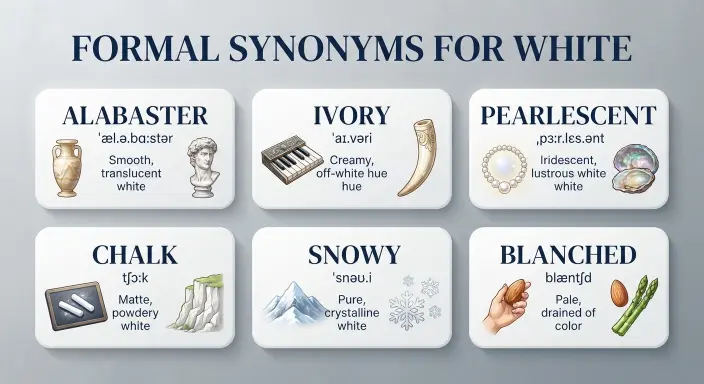
Formal writing usually benefits from precise color descriptions rather than decorative substitutes. The best choice depends on what you are describing.
Ivory
Meaning: A warm, slightly yellowish or creamy white.
Explanation: Ivory is one of the most useful alternatives to white when you want to describe a warmer shade. It is not an exact synonym because ivory has a recognizable yellow or cream undertone.
Example: The invitation was printed on elegant ivory paper.
Best Use: Design descriptions, fashion, interiors, stationery, publishing, and product descriptions.
Worst Use: Scientific or technical contexts where an exact color specification is required.
Tone: Elegant, refined, warm.
Alabaster
Meaning: A very pale white associated with the appearance of alabaster stone.
Explanation: Alabaster often describes smooth, pale, almost translucent-looking surfaces. It can also be used figuratively for skin or sculpture.
Example: The gallery displayed an alabaster sculpture near the entrance.
Best Use: Art, architecture, literature, interiors, and descriptive writing.
Worst Use: Ordinary situations where simple white would be clearer.
Tone: Literary, sophisticated, descriptive.
Snow-White
Meaning: Extremely bright or pure white, like fresh snow.
Explanation: Snow-white emphasizes brightness and purity rather than merely identifying a color.
Example: The cottage had a snow-white exterior.
Best Use: Descriptive writing, advertising, fashion, fiction, and visual descriptions.
Worst Use: Technical documents requiring standardized color terminology.
Tone: Vivid, clean, expressive.
Achromatic
Meaning: Having no hue or being without chromatic color.
Explanation: Achromatic belongs mainly to technical and artistic vocabulary. White, black, and gray can be discussed as achromatic colors, although the terms are not interchangeable in every context.
Example: The artist used an achromatic palette for the entire series.
Best Use: Art, photography, design, color theory, and technical writing.
Worst Use: Casual conversation.
Tone: Technical, academic, precise.
Unpigmented
Meaning: Lacking added pigment or coloration.
Explanation: Unpigmented describes the absence of pigment rather than simply naming the visual color white. It is therefore a contextual alternative, not a direct replacement.
Example: The material remained unpigmented to preserve its natural appearance.
Best Use: Scientific, manufacturing, artistic, and technical contexts.
Worst Use: Everyday descriptions of clothing or rooms.
Tone: Technical, objective.
Pearlescent
Meaning: Having a pearly appearance with a soft reflective or iridescent quality.
Explanation: Pearlescent can describe a white or pale surface that reflects light in a pearl-like way. It adds a visual effect that ordinary white does not express.
Example: The car was finished in a pearlescent white.
Best Use: Automotive, cosmetics, fashion, product design, and visual arts.
Worst Use: A plain matte white object.
Tone: Technical, elegant, visually rich.
Opalescent
Meaning: Showing a soft, shifting play of colors similar to opal.
Explanation: Opalescent is not a direct synonym for white. It can describe a pale, milky surface with subtle color reflections.
Example: The glass had an opalescent white finish.
Best Use: Glasswork, jewelry, art, cosmetics, and descriptive writing.
Worst Use: Basic color labeling.
Tone: Artistic, sophisticated.
Bleached
Meaning: Made lighter by removing or reducing color.
Explanation: Bleached describes a process or resulting appearance, not white itself. It can suggest that the original color has been removed.
Example: The fabric had a bleached appearance after repeated washing.
Best Use: Textiles, materials, hair, photography, and technical descriptions.
Worst Use: A naturally white object.
Tone: Neutral, technical.
Pure White
Meaning: A clean, strong white without an obvious tint.
Explanation: This phrase is more precise than simply saying white when you want to emphasize the absence of noticeable undertones.
Example: The walls were painted pure white.
Best Use: Interior design, product descriptions, fashion, and visual instructions.
Worst Use: Objects that are clearly cream, ivory, or gray-white.
Tone: Clear, precise, neutral.
Neutral White
Meaning: White without a strong warm or cool color cast.
Explanation: Neutral white is particularly useful when discussing lighting, paint, photography, or design. It is narrower than the general word white.
Example: The photographer selected neutral white lighting for accurate color reproduction.
Best Use: Photography, lighting, design, and technical communication.
Worst Use: Creative writing where a vivid description is more appropriate.
Tone: Technical, professional.
Semi-Formal and Neutral Synonyms for White
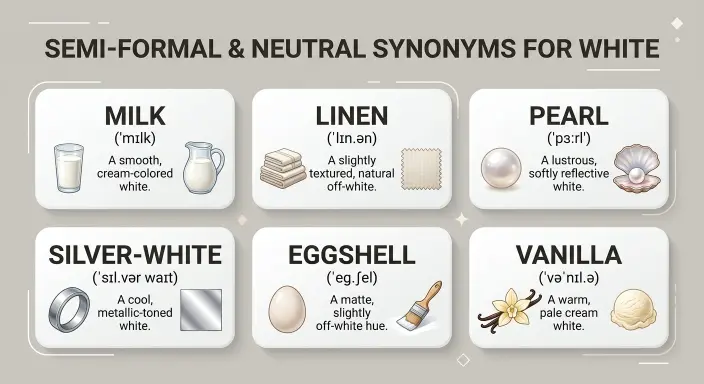
These alternatives work well in everyday writing, professional descriptions, websites, school assignments, and general communication.
Off-White
Meaning: A color close to white but not completely pure white.
Explanation: Off-white is one of the most practical alternatives because it covers many slightly tinted whites. It may include cream, ivory, beige-white, or gray-white shades.
Example: The designer chose an off-white background for the website.
Best Use: Design, clothing, interiors, websites, and product descriptions.
Worst Use: A surface that is unmistakably bright pure white.
Tone: Neutral, practical.
Cream
Meaning: A soft white with a warm yellow or beige undertone.
Explanation: Cream is a specific warm shade rather than an exact synonym for white.
Example: She chose a cream sweater for the ceremony.
Best Use: Clothing, interiors, food descriptions, invitations, and everyday conversation.
Worst Use: Cool or bright white objects.
Tone: Warm, familiar.
Eggshell
Meaning: A soft, slightly warm white resembling the inside or appearance of an eggshell.
Explanation: Eggshell is often used for paint and interior design. It can also refer to a finish rather than just a color.
Example: We painted the hallway an eggshell shade.
Best Use: Paint, interiors, home improvement, and design.
Worst Use: General writing where readers do not need that level of shade detail.
Tone: Neutral, design-focused.
Bone
Meaning: A pale off-white with a slightly warm or grayish appearance.
Explanation: Bone is a color term used in fashion, interiors, materials, and design. It is darker or warmer than many forms of pure white.
Example: The cabinets were finished in a soft bone color.
Best Use: Product descriptions, fashion, interiors, and design.
Worst Use: Describing a brilliant white surface.
Tone: Neutral, understated.
Pearl
Meaning: A soft white with a subtle luminous quality.
Explanation: Pearl often suggests a slightly glowing or reflective white. It can be a shade name or a descriptive comparison.
Example: The fabric had a delicate pearl finish.
Best Use: Fashion, jewelry, cosmetics, interiors, and creative descriptions.
Worst Use: A dull, flat white surface.
Tone: Elegant, polished.
Milky
Meaning: Soft white or pale like milk.
Explanation: Milky emphasizes softness, opacity, or a cloudy appearance. It can describe liquids, glass, eyes, or other surfaces.
Example: The bottle was made from milky white glass.
Best Use: Product descriptions, food and drink writing, art, and sensory descriptions.
Worst Use: Formal technical documents unless the term accurately describes the material.
Tone: Soft, visual.
Chalky
Meaning: White or pale with a dry, powdery appearance.
Explanation: Chalky describes texture and appearance together. It can imply that a surface looks like chalk rather than simply being white.
Example: The old wall had a chalky white finish.
Best Use: Paint, walls, materials, art, and descriptive prose.
Worst Use: Smooth glossy surfaces.
Tone: Descriptive, slightly rustic.
Pale
Meaning: Light in color or lacking strong color.
Explanation: Pale is broader than white. A pale object can be pale blue, pale yellow, pale pink, or pale gray. It should replace white only when the exact color is not essential.
Example: She wore a pale dress with a simple design.
Best Use: General descriptions when the color is light but not necessarily white.
Worst Use: When you need to communicate that something is specifically white.
Tone: Neutral, broad.
Porcelain
Meaning: A very pale, smooth white resembling porcelain.
Explanation: Porcelain is a descriptive color comparison rather than an exact synonym. It often suggests a smooth, clean, refined appearance.
Example: The bathroom featured porcelain-white tiles.
Best Use: Interiors, cosmetics, fashion, art, and descriptive writing.
Worst Use: Rough or heavily textured surfaces.
Tone: Refined, visual.
Linen
Meaning: A soft, muted off-white often associated with natural linen fabric.
Explanation: Linen usually suggests a warm, natural white rather than a brilliant one.
Example: The room was decorated in soft linen tones.
Best Use: Interior design, fashion, home décor, and branding.
Worst Use: Bright white technical surfaces.
Tone: Natural, understated.
Informal and Casual Synonyms For White
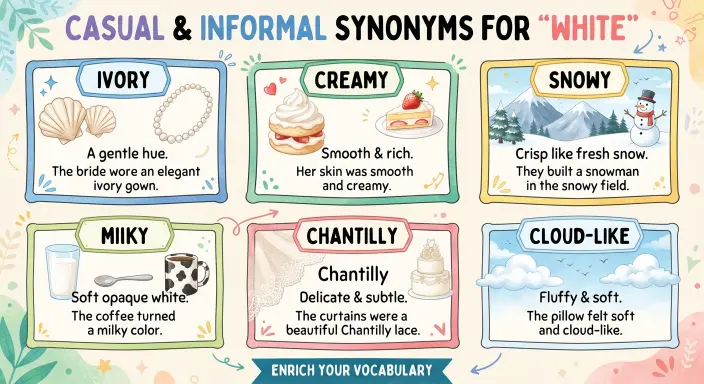
English does not have many true slang synonyms for white. Instead, casual speech usually uses familiar shade descriptions or comparisons.
Snowy
Meaning: Very white or bright.
Example: “The mountains look snowy from here.”
When it sounds natural: Everyday descriptions, travel conversations, and casual writing.
When to avoid it: Technical color specifications.
Tone: Casual, vivid.
Creamy
Meaning: Soft and warm like cream.
Example: “I like the creamy color of these curtains.”
When it sounds natural: Home décor, clothing, food, and casual conversation.
When to avoid it: When the object is pure, cool white.
Tone: Friendly, descriptive.
Milky
Meaning: Soft or cloudy white.
Example: “The glass has a milky look.”
When it sounds natural: Everyday visual descriptions.
When to avoid it: Formal writing unless the comparison is useful.
Tone: Casual, visual.
Bright
Meaning: Strongly light or visually intense.
Example: “The kitchen has bright walls.”
When it sounds natural: Everyday conversation and simple descriptions.
When to avoid it: If you specifically need to identify the color as white, because bright does not necessarily mean white.
Tone: Simple, conversational.
Clean-Looking
Meaning: Visually fresh, neat, and often associated with white or light colors.
Example: “The white cabinets give the room a clean-looking style.”
When it sounds natural: Interior design and casual conversation.
When to avoid it: When discussing exact color.
Tone: Casual and subjective.
True Synonyms vs Contextual Synonyms for White
Not every alternative above means exactly the same thing. The distinction becomes especially important in professional and descriptive writing.
| Type | What It Means | Can It Replace “White”? |
|---|---|---|
| True synonym | Has essentially the same core meaning | Sometimes |
| Near synonym | Very similar but adds a shade or quality | Often, with care |
| Contextual alternative | Works in a particular situation | Only in the right context |
| Broader expression | Covers white but also other colors | Sometimes |
| Narrower expression | Describes one specific type of white | Only when accurate |
| Formal equivalent | More technical or specialized wording | In suitable contexts |
| Casual equivalent | Informal descriptive wording | In casual contexts |
For example, ivory is narrower than white because ivory is a particular warm shade. Pale is broader because something can be pale blue or pale pink. Snow-white is a descriptive equivalent that emphasizes extreme brightness. Achromatic is technical and does not mean simply “white.”
Industry-Specific Usage of Synonyms for White
Business Writing
Business writing usually favors clarity over decorative color language. Use white, off-white, neutral white, or a specific standardized color name when accuracy matters.
Example:
“The packaging uses an off-white background with dark blue text.”
For a product brief, ivory or cream can be useful when the exact shade affects the product’s appearance.
Corporate Communication
Reports, presentations, policies, and internal documents generally need simple and consistent terminology.
Good: “The new template uses a neutral white background.”
Less precise: “The new template uses a snowy background.”
The second sentence sounds more creative than corporate. Use descriptive shade names only when visual appearance is relevant.
Academic Writing
Academic writing should favor precise terms and explain specialized color terminology when necessary.
Example: “The artist contrasts a bright white foreground with darker geometric forms.”
In art, design, chemistry, history, or visual studies, terms such as achromatic, unpigmented, or off-white may be appropriate if they accurately describe the subject.
Customer Service
Customer service messages should use familiar color terms that customers can understand quickly.
Example: “The replacement item is available in ivory rather than bright white.”
Avoid unnecessarily technical expressions such as achromatic unless the customer is specifically discussing color theory or technical specifications.
Legal Writing
Legal writing generally requires precise identification rather than creative color vocabulary. If a contract, specification, description, or dispute depends on color, use the exact terminology defined by the relevant document or standard.
For example, off-white, ivory, and white should not automatically be treated as legally identical. A color description can have a narrower meaning in a particular agreement or product specification.
Email Communication
Professional emails usually work best with simple terms such as white, off-white, ivory, cream, or neutral white.
Example:
“Could you confirm whether the final covers should be white or ivory?”
That is clearer than using an artistic term such as alabaster unless the recipient already uses that terminology.
Email Examples Using Synonyms to White
1. Client Communication — Off-White
Subject: Packaging Color Confirmation
Hi Sarah,
Could you confirm whether you prefer the background in pure white or off-white? The off-white version gives the packaging a slightly warmer appearance.
Once you confirm, we’ll use that color for the final design.
Best,
Daniel
2. Interior Design — Ivory
Subject: Curtain Color Selection
Hi Mia,
I recommend the ivory fabric rather than bright white. It will work better with the warm wood tones already used in the room.
I’ve included the shade in the latest design proposal.
Best,
Lauren
3. Academic Communication — Achromatic
Subject: Question About the Color Analysis
Professor Lee,
I’m revising my discussion of the painting and wanted to confirm whether it would be accurate to describe the palette as achromatic.
The composition uses white, black, and several shades of gray, so I believe the term fits the analysis.
Thank you,
Marcus
4. Vendor Communication — Cream
Subject: Fabric Color for the New Order
Hello James,
We would like to proceed with the cream fabric for the next order. Please confirm that this is the warmer shade shown in the latest sample.
Thanks,
Nina
5. Internal Workplace Email — Neutral White
Subject: Presentation Template Update
Hi Team,
I’ve updated the presentation template with a neutral white background to improve readability across the slides.
Please use this version for the client meeting on Thursday.
Thanks,
Alex
6. Customer Service — Pearl
Subject: Color Availability
Hello,
The item is available in pearl, which is a softer white with a subtle reflective finish. It is slightly different from standard white.
Please let us know if you would like us to reserve that version.
Best,
Customer Support
Short Dialogue Examples
Workplace
Person A: Which background should we use for the report?
Person B: Neutral white would be safest. It keeps the text easy to read.
Classroom
Person A: Can I call this shade white?
Person B: You can, but ivory would be more precise because it has a warmer tone.
Customer Service
Person A: Is the replacement available in white?
Person B: Yes. We also have an off-white option if you prefer something warmer.
Casual Conversation
Person A: What color is your new sofa?
Person B: It’s kind of creamy, not bright white.
Professional Discussion
Person A: Should we describe the finish as white?
Person B: I’d use pearlescent white because the surface reflects light.
How to Replace “White” in a Sentence
Example 1
Original: The walls are white.
Alternative: The walls are ivory.
Why it works: This makes the description more specific and suggests a warmer shade.
Example 2
Original: She wore a white dress.
Alternative: She wore a snow-white dress.
Why it works: Snow-white creates a stronger visual impression of brightness.
Example 3
Original: The website uses a white background.
Alternative: The website uses an off-white background.
Why it works: Off-white suggests a softer shade while keeping the original meaning broadly intact.
Example 4
Original: The room has white walls.
Alternative: The room has cream-colored walls.
Why it works: Cream-colored adds a warm yellowish undertone that ordinary white does not specify.
Example 5
Original: The sculpture is white.
Alternative: The sculpture is alabaster.
Why it works: This can make the description more artistic, but it should only be used if the sculpture’s appearance actually resembles alabaster.
Example 6
Original: The image has a white background.
Alternative: The image has a neutral white background.
Why it works: This is more precise when the goal is to indicate a white without a strong warm or cool cast.
Example 7
Original: The glass looks white.
Alternative: The glass looks milky.
Why it works: Milky suggests a cloudy or opaque appearance, so the meaning becomes more descriptive.
Example 8
Original: The surface is white.
Alternative: The surface is chalky white.
Why it works: The alternative adds a dry, powdery visual quality.
Example 9
Original: The fabric is white.
Alternative: The fabric is pearl white.
Why it works: Pearl white suggests a soft, luminous appearance rather than a flat white.
Example 10
Original: The room was painted white.
Alternative: The room was painted eggshell.
Why it works: Eggshell identifies a softer shade and can also refer to a particular paint finish.
Comparison Table: Useful Synonyms For White
| Phrase | Tone | Meaning / Scope | Best Use | Example |
|---|---|---|---|---|
| White | Neutral | General color | Any context | A white shirt |
| Ivory | Elegant | Warm white | Fashion, décor | Ivory fabric |
| Off-white | Neutral | Slightly tinted white | Design, products | Off-white walls |
| Cream | Warm | Yellowish white | Décor, clothing | Cream curtains |
| Snow-white | Vivid | Very bright white | Creative writing | Snow-white clouds |
| Alabaster | Literary | Pale stone-like white | Art, description | Alabaster sculpture |
| Pearl | Elegant | Soft luminous white | Fashion, design | Pearl finish |
| Eggshell | Design-focused | Soft white/finish | Paint, interiors | Eggshell paint |
| Milky | Descriptive | Cloudy soft white | Glass, liquids | Milky glass |
| Chalky | Descriptive | Powdery white | Surfaces | Chalky walls |
| Achromatic | Technical | Without hue | Art, color theory | Achromatic palette |
| Neutral white | Technical | White without strong cast | Lighting, photography | Neutral white light |
| Pearlescent | Specialized | Reflective, pearl-like | Cars, cosmetics | Pearlescent finish |
| Pale | Broad | Light color of any hue | General description | Pale fabric |
Which Synonyms Should You Choose?
- For formal writing: Use ivory, alabaster, achromatic, unpigmented, or neutral white only when the specific meaning fits.
- For business communication: Choose white, off-white, ivory, cream, or neutral white. These are clear and easy to understand.
- For academic writing: Use white for general description and specialized terms such as achromatic when discussing color theory, art, or design.
- For legal writing: Prefer the exact color terminology established by the relevant document, specification, or agreement. Avoid decorative substitutes.
- For professional emails: White, off-white, ivory, and cream are usually the safest choices.
- For everyday conversation: White, cream, off-white, pale, and milky sound natural depending on the object.
- For casual messages: Snowy, creamy, milky, or bright can work when you are describing an appearance rather than specifying an exact color.
- For creative writing: Snow-white, pearly, alabaster, porcelain, and frost-white can create stronger imagery.
Grammar and Usage Guide for White
White as an Adjective
The most common use of white is as an adjective before a noun.
- She bought a white dress.
- We painted the white walls.
- He drives a white car.
White as a Noun
The White can also function as a noun when referring to the color itself.
- White is a popular choice for minimalist interiors.
- The artist used white to create contrast.
White as a Verb
The verb white is uncommon in everyday modern English. In most contexts, writers should choose a more precise verb such as whiten.
- Better: The treatment whitened the fabric.
- Less natural: The treatment whited the fabric.
Compound Color Terms
Use hyphens when a color phrase functions as a compound adjective before a noun.
- a snow-white dress
- a pearl-white finish
- a milky-white surface
When the phrase follows the noun, the construction may be written differently depending on the intended usage.
- The dress is snow white.
- The surface looks milky white.
White vs. Off-White
The White usually suggests the basic color, while off-white indicates a shade close to white but with a noticeable undertone.
- The paper is white.
- The paper is off-white with a warm tint.
White vs. Pale
These words are not interchangeable in every sentence.
- White identifies a color.
- Pale describes low color intensity or lightness.
- Something can be pale blue, pale green, or pale pink, so pale is broader than white.
White vs. Colorless
Colorless means lacking visible color. It does not necessarily look white.
Clear glass, for example, can be colorless but not white.
Capitalization
Color names such as white, ivory, cream, and black are normally lowercase.
- a white shirt
- an ivory chair
- a cream wall
Capitalize a color only when it forms part of a proper name or title that requires capitalization.
Common Mistakes to Avoid
1. Treating Every Shade as an Exact Synonym
Ivory and cream are not identical to pure white. They describe specific shades.
2. Using “Pale” When Exact Color Matters
Pale can refer to many colors. Use white when the reader needs to know the exact basic color.
3. Calling “Achromatic” a Simple Synonym
Achromatic is a technical term meaning without hue. It can include white, black, and gray.
4. Using Creative Words in Technical Writing
Terms such as snowy or pearly may sound attractive but can be too vague for specifications.
5. Confusing Color With Finish
Eggshell may describe both a color and a paint finish. Context determines the intended meaning.
6. Using “Colorless” for White
A white object visibly has color. Colorless generally means that no color is present.
7. Overusing Decorative Descriptions
A paragraph filled with ivory, snowy, alabaster, and pearly can become distracting. Choose the word that communicates the intended image.
8. Ignoring Undertones
Two whites can look very different because one is warm and another is cool. If undertones matter, specify them.
9. Using “Bright” as an Exact Color Name
Bright describes intensity, not a particular hue. A bright object could be red, blue, yellow, or white.
When Not to Use “White”
There are situations where replacing white makes the sentence less clear.
1. When the Exact Color Is White
If the object is simply white, there is no need to make the sentence more complicated.
Clear: The document has a white background.
2. When Technical Accuracy Matters
Specifications, instructions, and product details may require a recognized color term rather than an artistic description.
3. When the Alternative Adds an Unwanted Meaning
Calling something cream implies warmth. Calling it milky implies softness or cloudiness. If those qualities are not present, keep white.
4. When the Audience Needs Simple Language
Customer instructions and everyday communication usually benefit from familiar vocabulary.
5. When a Creative Alternative Becomes Vague
“Pearly” sounds descriptive, but it may not tell a reader exactly which color you mean.
6. When the Original Word Is Already Precise
Sometimes white is the best possible word. Good writing is not about replacing familiar words simply to sound sophisticated.
Advanced Writer Tips for Choosing Synonyms to White
Tone Control
Use plain white for neutral communication. Choose ivory or pearl for an elegant tone. Use snow-white or alabaster for stronger visual imagery.
Professional Email Etiquette
Avoid overly artistic color terms in workplace emails unless the subject involves design, fashion, branding, photography, or another visual field.
Instead of:
Please use the alabaster background.
Consider:
Please use the off-white background.
The second version is easier to understand.
Politeness
Color alternatives can also affect how a recommendation sounds.
Direct: “Use white.”
Softer: “I’d recommend the off-white option.”
The second phrasing focuses on a suggestion rather than an instruction.
Context Alignment
Think about what you are describing before choosing the alternative. A wall, fabric, light source, flower, document, and painting may all need different vocabulary.
Precision
Ask what quality you want to communicate:
- Basic color → white
- Warm white → ivory / cream
- Slightly tinted white → off-white
- Very bright white → snow-white
- Soft luminous white → pearl
- Powdery appearance → chalky
- Cloudy appearance → milky
- Technical lack of hue → achromatic
Readability
Do not choose a complicated color term when a simple one works better.
Less clear: The office features an achromatic chromatic scheme.
Clearer: The office uses a white, black, and gray color scheme.
Specialized vocabulary is valuable only when it adds useful precision.
Related Questions About Synonyms for White
1. What is another way to say white?
Common alternatives include ivory, off-white, cream, snowy, pearl, alabaster, and milky. The best choice depends on the shade and context.
2. What is a professional synonyms to white?
Off-white, ivory, neutral white, and pure white are useful professional alternatives. For technical fields, achromatic may be appropriate when its specific meaning fits.
3. What is a formal synonyms for white?
There is no single formal replacement that works everywhere. Ivory, alabaster, achromatic, and unpigmented can work in particular contexts, but each changes or narrows the meaning.
4. What can I use instead of white in creative writing?
Try snow-white, pearly, alabaster, porcelain, milky, or frost-white when the comparison accurately creates the image you want.
5. Is white a formal word?
Yes. White is a standard, neutral English word and is perfectly appropriate in formal, academic, professional, and everyday writing.
6. Can ivory replace white?
Sometimes. Ivory describes a particular warm white, so it should replace white only when that warmer shade is intended.
7. What is the difference between white and off-white?
White refers to the basic color, while off-white describes a shade close to white with a noticeable warm, cool, gray, beige, or other undertone.
FAQs
1. What is the closest synonyms for white?
There is no single perfect substitute in every context. Ivory, off-white, and snow-white are among the closest descriptive alternatives, but each adds a particular shade or quality.
2. Is ivory the same as white?
No. Ivory is a warm shade of white with a slight yellow, cream, or beige undertone. It can be used as an alternative when that specific appearance is intended.
3. Is cream the synonyms for white?
Cream is a near synonym rather than an exact one. It describes a warmer, softer shade with yellow or beige undertones.
4. What is a fancy word for white?
Depending on the context, alabaster, pearlescent, opalescent, or ivory can create a more sophisticated effect. These are descriptive alternatives rather than universal replacements.
5. What is the poetic synonyms for white?
Snow-white, pearly, alabaster, porcelain, and frost-white can work well in poetic or literary writing. The best choice depends on the image you want to create.
6. Is “pale” another word for white?
Not exactly. Pale is broader than white because it describes light or weak coloration of many hues. Something can be pale blue, pale green, or pale yellow.
7. What is the technical term for white?
There is no universal technical synonym for white. Achromatic is useful in color theory because it describes colors without hue, including white, black, and gray. In lighting, neutral white can describe a particular type of white light.
Key Takeaways
- White is already a neutral and precise word, so it does not always need replacement.
- Ivory, cream, and off-white describe warmer or softer variations of white.
- Snow-white, pearly, and alabaster add visual or literary qualities rather than simply naming the color.
- Achromatic and neutral white are specialized terms suited to technical, artistic, or design contexts.
- Always choose the alternative based on shade, audience, tone, and purpose, not simply on the desire to use a different word.
Conclusion
Choosing among synonyms for white is really a matter of precision. The simple word white works well in almost every setting, but alternatives can help you communicate a particular shade, texture, brightness, or visual mood.
Ivory and cream suggest warmth, off-white indicates a subtle tint, and snow-white emphasizes brightness. Meanwhile, pearl, alabaster, porcelain, and milky can add richer visual detail. For professional and academic writing, clarity should come first.
Terms such as neutral white, pure white, and achromatic are useful when the subject requires greater precision. In creative writing, more expressive choices can make descriptions vivid without becoming confusing. The key is not to replace white automatically.
Instead, identify the exact quality you want the reader to notice, then select the word that communicates that quality naturally and accurately.
