
The right synonyms for kind person can make your writing more precise, warm, and natural. While “kind person” is simple and widely understood, different situations may call for words that highlight generosity, compassion, friendliness, patience, thoughtfulness, or good character.
The best alternative depends on exactly what you want to describe.You might need a stronger expression for a professional recommendation, a warm word for a friend, or a more precise description for an essay, biography, email, or character profile.
This guide explains more than 33 useful alternatives, including formal, neutral, casual, and contextual choices, so you can choose a phrase that matches both your meaning and your audience.
Quick Answer: Synonyms for Kind Person
Common synonyms for kind person include compassionate person, caring person, considerate person, generous person, thoughtful person, benevolent person, sympathetic person, gracious person, warm-hearted person, gentle person, helpful person, and good-hearted person. Some alternatives emphasize generosity or compassion rather than kindness itself, so the best choice depends on the context.
Quick List of Synonyms for Kind Person
Here are useful alternatives at a glance:
Closest Synonyms for Kind Person
- Compassionate person
- Caring person
- Considerate person
- Thoughtful person
- Good-hearted person
- Warm-hearted person
- Benevolent person
- Generous person
- Gentle person
- Sympathetic person
Formal Synonyms for Kind Person
- Benevolent individual
- Compassionate individual
- Considerate individual
- Generous individual
- Altruistic individual
- Charitable person
- Gracious individual
- Humane person
- Kind-hearted individual
Neutral and Professional Synonyms for Kind Person
- Caring individual
- Supportive person
- Helpful person
- Thoughtful individual
- Respectful person
- Understanding person
- Friendly person
- Warm person
- Person of good character
- Person with a caring nature
Informal and Casual Synonyms for Kind Person
- Good-hearted person
- Sweet person
- Nice person
- Good soul
- Big-hearted person
- Warm-hearted person
- Gentle soul
- Lovely person
Some of these are not exact synonyms. For example, generous person focuses more on giving, while supportive person focuses on helping others. Nice person is broader and less precise.
Formal Synonyms for Kind Person
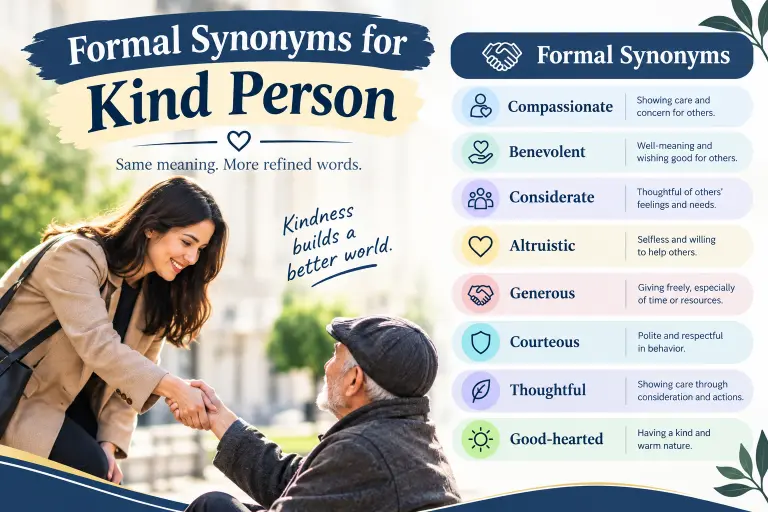
Formal alternatives work well in recommendations, professional profiles, academic writing, biographies, evaluations, and official descriptions. They often sound more precise than “kind person.”
1. Benevolent Individual
Meaning: A person who wishes to help others and promote their well-being.
Explanation: “Benevolent” is one of the strongest formal alternatives for a kind person. It emphasizes goodwill and a desire to do good.
Example: The director was known as a benevolent individual who supported several community programs.
Best Use: Formal profiles, biographies, reports, and professional descriptions.
Worst Use: Casual conversations, where it may sound unnecessarily formal.
Tone: Formal, respectful, and dignified.
2. Compassionate Individual
Meaning: A person who understands or cares about the suffering of others.
Explanation: This phrase highlights empathy and concern rather than general friendliness.
Example: She is a compassionate individual who listens carefully to people facing difficult circumstances.
Best Use: Healthcare, education, social work, biographies, and professional recommendations.
Worst Use: Situations where you only mean that someone is friendly.
Tone: Formal, warm, and empathetic.
3. Considerate Individual
Meaning: Someone who thinks about other people’s feelings, needs, and comfort.
Explanation: “Considerate” describes kindness shown through thoughtful behavior.
Example: He is a considerate individual who always respects his colleagues’ time.
Best Use: Workplace reviews, recommendations, and professional communication.
Worst Use: Describing major acts of charity when generosity is the main point.
Tone: Polished, respectful, and neutral.
4. Altruistic Person
Meaning: Someone who acts for the benefit of others without focusing mainly on personal gain.
Explanation: “Altruistic” is narrower than “kind person.” It emphasizes selfless behavior.
Example: Her altruistic approach has benefited many families in the community.
Best Use: Academic writing, nonprofit contexts, psychology, and formal profiles.
Worst Use: A simple description of someone who is polite or friendly.
Tone: Formal and analytical.
5. Generous Person
Meaning: Someone who willingly gives time, money, attention, or assistance.
Explanation: Generosity is an important form of kindness, but not every kind person is generous in a material sense.
Example: He is a generous person who regularly gives his time to help new employees.
Best Use: Fundraising, workplace descriptions, personal recommendations, and biographies.
Worst Use: When the person’s kindness is mainly emotional or compassionate.
Tone: Positive and professional.
6. Charitable Person
Meaning: Someone who gives help, money, or resources to people in need.
Explanation: This is more specific than “kind person” because it often suggests giving to people or causes in need.
Example: She is a charitable person who supports several local organizations.
Best Use: Community profiles, biographies, fundraising contexts, and formal descriptions.
Worst Use: When describing everyday politeness.
Tone: Formal and positive.
7. Humane Person
Meaning: A person who treats others with compassion, care, and respect.
Explanation: “Humane” emphasizes compassion and the avoidance of cruelty.
Example: The organization seeks humane leaders who treat every employee with dignity.
Best Use: Ethical, institutional, academic, and professional contexts.
Worst Use: Casual descriptions of a friendly acquaintance.
Tone: Formal and ethical.
8. Gracious Individual
Meaning: Someone who is polite, generous, considerate, and pleasant.
Explanation: “Gracious” can describe kindness expressed through manners, hospitality, generosity, or acceptance.
Example: The host was a gracious individual who made every guest feel welcome.
Best Use: Formal appreciation, speeches, biographies, and professional writing.
Worst Use: When you specifically mean emotional compassion.
Tone: Elegant, formal, and warm.
9. Kind-Hearted Individual
Meaning: A person with a naturally caring and compassionate character.
Explanation: This is very close to “kind person” and emphasizes someone’s inner character.
Example: Everyone remembers him as a kind-hearted individual who treated people with respect.
Best Use: Tributes, biographies, personal profiles, and heartfelt writing.
Worst Use: Highly technical or strictly academic writing.
Tone: Warm, sincere, and slightly literary.
10. Person of Good Character
Meaning: Someone whose behavior shows strong moral and personal qualities.
Explanation: This is broader than “kind person.” It can include honesty, responsibility, fairness, and integrity as well as kindness.
Example: Her teachers described her as a person of good character and strong principles.
Best Use: Recommendations, school evaluations, biographies, and formal references.
Worst Use: When kindness is the only quality you want to describe.
Tone: Formal and respectful.
Semi-Formal and Neutral Synonyms for Kind Person
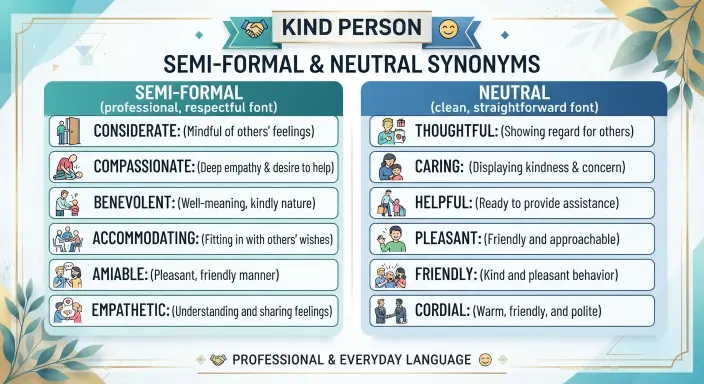
Neutral alternatives are usually the easiest choices for everyday writing, websites, workplace communication, and ordinary conversations.
1. Caring Person
Meaning: Someone who genuinely cares about other people.
Explanation: “Caring” focuses on concern and emotional support.
Example: Maria is a caring person who always checks on her coworkers.
Best Use: Personal descriptions, workplace profiles, and everyday writing.
Worst Use: When you need to emphasize generosity specifically.
Tone: Warm and neutral.
2. Thoughtful Person
Meaning: Someone who pays attention to other people’s needs and feelings.
Explanation: A thoughtful person often shows kindness through small, considerate actions.
Example: James is a thoughtful person who remembers important details about his friends.
Best Use: Recommendations, messages, profiles, and everyday conversation.
Worst Use: When describing large-scale charitable work.
Tone: Warm and natural.
3. Supportive Person
Meaning: Someone who helps and encourages others.
Explanation: “Supportive” is particularly useful when kindness involves emotional or practical assistance.
Example: My manager is a supportive person who encourages everyone to develop new skills.
Best Use: Workplace, school, relationships, and personal recommendations.
Worst Use: When you only mean someone is polite.
Tone: Positive and professional.
4. Helpful Person
Meaning: Someone who willingly assists others.
Explanation: This alternative emphasizes useful action rather than personality alone.
Example: Our new neighbor is a helpful person who offered to carry the boxes.
Best Use: Everyday descriptions and workplace communication.
Worst Use: Formal writing where a more specific quality is needed.
Tone: Simple and neutral.
5. Understanding Person
Meaning: Someone who listens and accepts another person’s situation or feelings.
Explanation: “Understanding” emphasizes patience and empathy.
Example: She is an understanding person who gives people time to explain themselves.
Best Use: Relationships, education, counseling-related descriptions, and everyday writing.
Worst Use: When the person’s main quality is generosity.
Tone: Warm and reassuring.
6. Friendly Person
Meaning: Someone who is pleasant, approachable, and welcoming.
Explanation: Friendliness overlaps with kindness but is not identical. A friendly person is usually easy to talk to, while a kind person may show care in quieter ways.
Example: Our new teacher is a friendly person who makes students feel comfortable.
Best Use: Introductions, profiles, school writing, and casual descriptions.
Worst Use: When describing serious acts of compassion.
Tone: Casual to neutral.
7. Respectful Person
Meaning: Someone who treats other people with consideration and dignity.
Explanation: Respect is closely connected to kindness but represents a different quality.
Example: She is a respectful person who listens to different opinions.
Best Use: Workplace, education, professional recommendations, and character descriptions.
Worst Use: When you specifically want to express warmth or generosity.
Tone: Neutral and professional.
8. Warm Person
Meaning: Someone who is emotionally welcoming, friendly, and pleasant.
Explanation: “Warm” describes personality more than specific acts of kindness.
Example: He is a warm person who makes new team members feel welcome.
Best Use: Personal profiles, introductions, recommendations, and everyday writing.
Worst Use: Technical or highly formal documents.
Tone: Friendly and positive.
9. Person with a Caring Nature
Meaning: Someone whose personality naturally shows concern for others.
Explanation: This phrase is useful when describing a person’s general character rather than one particular action.
Example: Her caring nature makes her an excellent mentor.
Best Use: Bios, recommendations, school writing, and personal profiles.
Worst Use: Short, direct business writing where “caring” is enough.
Tone: Warm and neutral.
10. Thoughtful Individual
Meaning: A person who carefully considers other people’s needs or feelings.
Explanation: This is a slightly more professional version of “thoughtful person.”
Example: He is a thoughtful individual who considers how decisions affect the entire team.
Best Use: Professional recommendations and workplace profiles.
Worst Use: Casual texting, where it can sound stiff.
Tone: Semi-formal and positive.
11. Good-Natured Person
Meaning: Someone who is naturally pleasant, patient, and easygoing.
Explanation: “Good-natured” is broader than “kind.” It describes an agreeable personality rather than kindness alone.
Example: Despite the stressful situation, she remained a good-natured person.
Best Use: Character descriptions, biographies, and everyday writing.
Worst Use: When you specifically mean compassion.
Tone: Friendly and neutral.
12. Sympathetic Person
Meaning: Someone who understands and responds with concern to another person’s difficulties.
Explanation: This word focuses on emotional understanding and compassion.
Example: He was a sympathetic person who always listened when his friends needed support.
Best Use: Personal writing, counseling contexts, and character descriptions.
Worst Use: When you mean someone is simply cheerful or sociable.
Tone: Warm and empathetic.
Informal and Casual Synonyms for Kind Person
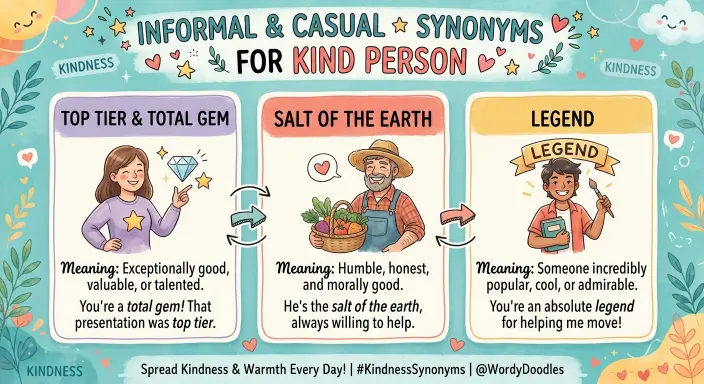
Casual language can make descriptions sound more personal and natural.
1. Good-Hearted Person
Meaning: Someone who naturally wants to do good and treat people well.
Example: She’s a good-hearted person who would never ignore someone in need.
When it sounds natural: Friendly conversations, social posts, personal stories, and casual writing.
When to avoid it: Formal reports or academic papers.
Tone: Warm and affectionate.
2. Sweet Person
Meaning: Someone who is pleasant, caring, thoughtful, or affectionate.
Example: Your sister sounds like a really sweet person.
When it sounds natural: Conversations, texts, social media, and personal descriptions.
When to avoid it: Legal, academic, or highly formal writing.
Tone: Casual and affectionate.
3. Big-Hearted Person
Meaning: Someone who is especially generous or compassionate.
Example: He’s a big-hearted person who always makes time for people who need help.
When it sounds natural: Personal stories, compliments, and informal writing.
When to avoid it: Formal professional reports.
Tone: Warm, expressive, and casual.
4. Good Soul
Meaning: A person regarded as genuinely caring, decent, or kind.
Example: She’s a good soul who always looks out for her friends.
When it sounds natural: Conversations, tributes, and personal messages.
When to avoid it: Academic and business writing.
Tone: Warm and affectionate.
5. Lovely Person
Meaning: Someone pleasant, kind, and enjoyable to be around.
Example: I met your colleague yesterday. She’s a lovely person.
When it sounds natural: Everyday conversation and informal recommendations.
When to avoid it: Formal evaluations where more precise language is expected.
Tone: Friendly and warm.
6. Gentle Soul
Meaning: Someone with a calm, caring, and non-aggressive personality.
Example: He was a gentle soul who treated everyone with patience.
When it sounds natural: Personal stories, tributes, and expressive writing.
When to avoid it: Technical or professional contexts.
Tone: Emotional and slightly poetic.
True Synonyms vs Contextual Synonyms for Kind Person
Not every phrase above means exactly the same thing. The distinction matters because kindness can involve compassion, generosity, friendliness, patience, respect, or helpful behavior.
| Type | What It Means | Can It Replace “Kind Person”? |
|---|---|---|
| True or very close synonym | Someone who treats others with care and goodwill | Yes, in many contexts |
| Near synonym | A person with a closely related positive quality | Usually, but meaning may shift |
| Contextual alternative | Highlights one particular aspect of kindness | Yes, when that aspect is intended |
| Broader expression | Describes overall character, including kindness and other traits | Sometimes |
| Narrower expression | Describes a specific form of kindness | Only when that specific meaning fits |
| Formal equivalent | A polished expression suited to formal writing | Yes, in appropriate contexts |
| Casual equivalent | A relaxed, conversational description | Yes, in informal settings |
For example, compassionate person is close to “kind person,” but compassion usually involves concern for suffering. Generous person emphasizes giving. Friendly person emphasizes sociability. supportive person emphasizes assistance and encouragement.
Business Writing: Choosing Synonyms for Kind Person
Business writing usually benefits from specific qualities rather than vague praise.
Instead of:
She is a kind person.
You might write:
She is a considerate colleague who consistently treats team members with respect.
Or:
He is a supportive manager who encourages employees to share ideas.
Useful choices include:
- Considerate
- Supportive
- Respectful
- Thoughtful
- Helpful
- Compassionate
- Generous
- Gracious
For performance reviews, choose the word that describes an observable behavior. “Supportive” is stronger than simply calling someone “nice” because it tells the reader how that person behaves.
Corporate Communication and Kind Person Synonyms
Corporate communication should remain professional without sounding cold.
- For an employee profile, you could write:
She is a thoughtful and supportive leader who listens carefully to her team.
- For an internal announcement:
We appreciate Daniel’s considerate approach and his willingness to assist new team members.
- For a recommendation:
He is a respectful, dependable, and compassionate colleague who consistently supports others.
Avoid overly emotional phrases such as “good soul” or “sweet person” in formal corporate documents.
Academic Writing and Synonyms for Kind Person
Academic writing requires precision. Instead of repeatedly using “kind person,” choose a word that identifies the exact behavior being discussed.
Examples:
- Compassionate individual — emphasizes empathy.
- Altruistic individual — emphasizes selfless action.
- Benevolent individual — emphasizes goodwill.
- Considerate individual — emphasizes awareness of others.
- Humane individual — emphasizes compassionate treatment.
- Generous individual — emphasizes giving.
For example:
The protagonist is portrayed as a compassionate individual who responds to the suffering of others.
This is more informative than:
The protagonist is a kind person.
Customer Service and Kind Person Synonyms
Customer service communication should sound polite, clear, and sincere.
Useful alternatives include:
- Helpful
- Understanding
- Patient
- Considerate
- Supportive
- Friendly
- Respectful
- Compassionate
Example:
Thank you for your patience and for being so understanding about the situation.
If you are describing an employee, “helpful” or “patient” may communicate more than “kind.”
Legal Writing and Kind Person Synonyms
Legal writing generally avoids vague character labels unless the person’s character is directly relevant to the document.
Instead of simply writing:
He is a kind person.
A formal document may need a specific description of conduct:
He provided assistance to vulnerable members of the community.
or:
She demonstrated consistent concern for the welfare of others.
Words such as humane, compassionate, or benevolent can be useful in descriptive writing, but they should not be treated as legal terms with identical meanings. The exact wording should match the facts being documented.
Email Communication: Professional Synonyms for Kind Person
Professional emails usually work better when they describe a specific behavior.
Instead of:
John is a kind person.
Try:
John has been very supportive throughout the project.
Or:
Maria has been extremely considerate of the team’s workload.
Or:
Thank you for being so understanding about the change in schedule.
The strongest professional wording often connects the positive quality to an action.
Email Examples Using Synonyms for Kind Person
Email 1: Client Appreciation
Subject: Thank You for Your Understanding
Dear Ms. Carter,
Thank you for being so understanding about the scheduling change. Your flexibility made it much easier for our team to reorganize the project without affecting the final deadline.
We truly appreciate your patience and consideration.
Best,
Daniel
Email 2: Workplace Recognition
Subject: Recognition for Your Support
Hi Sarah,
I wanted to thank you for being such a supportive colleague during the recent project. You took time to answer questions, help new team members, and keep everyone informed.
Your thoughtful approach made a real difference.
Best,
Michael
Email 3: Recommendation
Subject: Recommendation for Alex
Dear Hiring Manager,
I am pleased to recommend Alex for the position. He is a considerate and dependable colleague who treats everyone with respect. He is also generous with his time and regularly helps team members solve problems.
I am confident that he would be a positive addition to your organization.
Sincerely,
Laura
Email 4: Customer Service
Subject: Thank You for Your Patience
Dear Mr. Lee,
Thank you for your patience while we resolved the issue with your order. We also appreciate your understanding throughout the process.
Your courteous approach made the situation much easier for our support team.
Kind regards,
Customer Support
Email 5: Academic Communication
Subject: Thank You for Your Guidance
Dear Professor Williams,
Thank you for your thoughtful feedback on my paper. Your comments helped me understand where my argument needed more support, and I appreciate the time you took to explain your suggestions.
Best regards,
Emily
Email 6: Internal Workplace Message
Subject: Thank You for Helping the Team
Hi James,
I just wanted to recognize how helpful you’ve been this week. You stepped in whenever someone needed assistance and made sure the new team members felt comfortable.
Your supportive attitude has been greatly appreciated.
Thanks,
Rachel
Short Dialogue Examples Using Kind Person Synonyms
Workplace
Person A: Who helped you understand the new system?
Person B: Nina did. She’s such a supportive person. She stayed late to walk me through it.
Classroom
Person A: What do you think about the new teacher?
Person B: She’s very understanding. She gives everyone time to ask questions.
Customer Service
Person A: How was the support agent?
Person B: Really helpful. He was patient and explained everything clearly.
Casual Conversation
Person A: What is your new neighbor like?
Person B: She’s a lovely person. She brought us dinner when we moved in.
Professional Discussion
Person A: Why do people trust David so much?
Person B: He’s a considerate person. He listens before making decisions.
How to Replace “Kind Person” in a Sentence
1. General kindness
Original:
She is a kind person.
Alternative:
She is a caring person.
Why it works: “Caring” keeps the general meaning while emphasizing concern for others.
2. Emotional support
Original:
He is a kind person who always listens.
Alternative:
He is an understanding person who always listens.
Why it works: “Understanding” better highlights empathy and patience.
3. Generosity
Original:
Maria is a kind person who often gives to others.
Alternative:
Maria is a generous person who often gives to others.
Why it works: “Generous” identifies the specific form of kindness.
4. Workplace support
Original:
Our manager is a kind person who helps the team.
Alternative:
Our manager is a supportive person who helps the team.
Why it works: “Supportive” sounds more precise and professional.
5. Consideration
Original:
He is a kind person who respects everyone’s needs.
Alternative:
He is a considerate person who respects everyone’s needs.
Why it works: “Considerate” focuses on awareness of other people’s needs.
6. Compassion
Original:
She is a kind person who cares about people in difficult situations.
Alternative:
She is a compassionate person who cares about people in difficult situations.
Why it works: “Compassionate” specifically connects kindness with suffering or hardship.
7. Informal compliment
Original:
He’s a kind person.
Alternative:
He’s a good-hearted person.
Why it works: The alternative sounds warmer and more personal, but it is less suitable for formal writing.
8. Stronger character description
Original:
She is a kind person with strong moral values.
Alternative:
She is a person of good character with strong moral values.
Why it works: The alternative broadens the description beyond kindness to overall character.
9. Friendly personality
Original:
He is a kind person who makes everyone feel welcome.
Alternative:
He is a warm person who makes everyone feel welcome.
Why it works: “Warm” emphasizes the welcoming side of his personality.
10. Selfless behavior
Original:
She is a kind person who puts others first.
Alternative:
She is an altruistic person who puts others first.
Why it works: “Altruistic” gives the sentence a more formal and specific meaning.
Comparison Table: Best Synonyms for Kind Person
| Phrase | Tone | Meaning / Scope | Best Use | Example |
|---|---|---|---|---|
| Caring person | Warm | Shows concern for others | Everyday writing | She is a caring person. |
| Compassionate person | Formal/neutral | Concern for suffering | Professional writing | He is compassionate. |
| Considerate person | Neutral | Thinks about others’ needs | Workplace | She is considerate. |
| Thoughtful person | Neutral | Shows attention and care | Personal/work | He is thoughtful. |
| Generous person | Neutral | Gives freely | Personal/community | She is generous. |
| Supportive person | Professional | Helps and encourages | Work/school | He is supportive. |
| Understanding person | Warm | Shows empathy and patience | Personal | She is understanding. |
| Friendly person | Neutral | Pleasant and approachable | Introductions | He’s friendly. |
| Benevolent individual | Formal | Wishes to do good | Formal writing | A benevolent individual |
| Altruistic person | Formal | Acts for others’ benefit | Academic writing | An altruistic person |
| Good-hearted person | Casual | Naturally kind | Conversation | He’s good-hearted. |
| Big-hearted person | Casual | Very generous or caring | Personal writing | She’s big-hearted. |
| Sweet person | Casual | Pleasant and caring | Conversation | She’s a sweet person. |
| Person of good character | Formal | Strong overall character | Recommendations | He is a person of good character. |
Which Synonyms for Kind Person Should You Choose?
- For formal writing: Choose benevolent individual, compassionate individual, considerate individual, or humane person, depending on the exact meaning.
- For business communication: Supportive, considerate, thoughtful, and respectful are usually the most natural choices.
- For academic writing: Use compassionate, altruistic, benevolent, or humane when the specific meaning fits the argument.
- For legal or official writing: Describe the person’s actual conduct rather than relying on a broad character label.
- For professional emails: Understanding, supportive, helpful, and considerate are particularly useful.
- For everyday conversation: Caring, thoughtful, friendly, good-hearted, and lovely person sound natural.
- For casual messages: Sweet person, good soul, and big-hearted person can sound warmer and more personal.
Grammar and Usage Guide for Synonyms for Kind Person
“Kind Person” as a Noun Phrase
“Kind person” is a noun phrase consisting of the adjective kind and the noun person.
Examples:
- She is a kind person.
- He was a very kind person.
- They described her as a kind person.
Because “person” is a singular countable noun, use an article such as a or the when appropriate.
Adjective Alternatives
Many alternatives can be used directly before “person”:
- a caring person
- a thoughtful person
- a generous person
- a compassionate person
- a considerate person
- a friendly person
You can also use some adjectives without “person” when the context is clear:
She is compassionate.
He is considerate.
“Person” vs. “Individual”
“Individual” is more formal than “person” in many contexts.
Compare:
She is a kind person.
She is a compassionate individual.
The second sentence sounds more formal and may fit a professional profile or academic discussion better.
Singular and Plural Forms
Use person for one individual:
He is a thoughtful person.
Use people for more than one:
They are thoughtful people.
“Persons” is uncommon in ordinary conversation and is generally used only in specific formal or legal contexts.
Hyphenation
Compound adjectives may require hyphens when they come before a noun:
- a kind-hearted person
- a good-hearted person
- a warm-hearted person
- a big-hearted person
After the noun, usage can differ:
She is kind-hearted.
Natural Word Combinations
Some combinations sound especially natural:
- genuinely kind
- deeply compassionate
- extremely thoughtful
- highly considerate
- incredibly generous
- naturally caring
- warm and friendly
- kind and supportive
Avoid stacking too many similar adjectives:
She is a kind, caring, compassionate, thoughtful, generous, warm, friendly person.
This sounds repetitive. Choose two or three qualities that matter most.
Common Mistakes to Avoid
1. Treating Every Alternative as an Exact Synonym
“Friendly,” “generous,” “supportive,” and “compassionate” describe different qualities. Choose according to the behavior you mean.
2. Using “Nice” for Every Meaning
“Nice person” is broad and informal. It does not tell readers why the person is kind.
3. Using “Altruistic” Too Casually
“Altruistic” suggests selfless concern for others. It is more specific and formal than “kind.”
4. Confusing Friendly With Kind
A friendly person is approachable and sociable. A kind person may be quiet but still consistently considerate and caring.
5. Overusing Formal Vocabulary
Words such as “benevolent individual” can sound unnatural in a simple conversation.
6. Using Casual Expressions in Formal Writing
“Good soul” and “sweet person” work well in personal messages but usually do not belong in academic papers or formal reports.
7. Making Vague Character Claims
In professional writing, explain the behavior behind the compliment whenever possible.
Instead of:
He is a kind person.
Try:
He regularly supports new employees and listens carefully to their concerns.
8. Ignoring Context
The right synonym depends on whether you are discussing generosity, empathy, friendliness, patience, respect, or general character.
When Not to Use “Kind Person”
There are several situations where a more specific expression improves the sentence.
When You Mean Generosity
Use generous person if the individual gives time, money, resources, or assistance.
When You Mean Emotional Understanding
Use compassionate or understanding person if the main quality is empathy.
When You Mean Workplace Support
Use supportive colleague or supportive person.
When You Mean Respectful Behavior
Use considerate or respectful person.
When You Mean Friendliness
Use friendly or warm person.
When You Need Formal Language
Use compassionate individual, benevolent individual, or person of good character, depending on the context.
When “Kind Person” Is Actually Better
Do not replace the phrase simply to sound sophisticated. “Kind person” is clear, natural, and widely understood. In everyday writing, it is often better than a more complicated alternative.
Advanced Writer Tips for Choosing Synonyms for Kind Person
Tone Control
Use caring and thoughtful for a warm but neutral tone. Choose compassionate or benevolent for a more formal tone. Use good-hearted or sweet when the writing is personal and relaxed.
Professional Email Etiquette
Professional writing sounds stronger when praise is connected to behavior.
Instead of:
You’re such a kind person.
Try:
Thank you for being so understanding and supportive throughout the project.
This sounds sincere without becoming overly personal.
Politeness
Kindness and politeness are related but different. Respectful describes how someone treats others, while compassionate describes concern for another person’s difficulty.
Context Alignment
Ask what kind of kindness you are describing:
- Giving → generous
- Emotional concern → compassionate
- Attention to others → considerate
- Encouragement → supportive
- Care → caring
- Good manners → gracious
- Friendly personality → warm or friendly
- Selflessness → altruistic
Precision
The strongest synonym is not always the most impressive-sounding one. Choose the word that tells readers exactly what the person does or how the person behaves.
Readability
Short expressions often work best:
She is caring.
He is thoughtful.
Maria is supportive.
A precise adjective can remove unnecessary words without changing the message.
Related Questions About Synonyms for Kind Person
1. What is another way to say “kind person”?
You can say caring person, compassionate person, considerate person, thoughtful person, generous person, supportive person, good-hearted person, or warm-hearted person, depending on the exact meaning.
2. What is the professional synonyms to “kind person”?
Considerate person, supportive person, compassionate individual, and thoughtful individual are useful professional choices.
3. What is the formal synonyms to “kind person”?
Benevolent individual, compassionate individual, altruistic person, and humane person can work in formal contexts.
4. What can I use instead of “kind person” in an essay?
Choose a precise word such as compassionate, altruistic, benevolent, or considerate. The best choice depends on the behavior being analyzed.
5. Is “kind person” formal?
“Kind person” is neutral rather than highly formal. It is appropriate in everyday conversation and many types of writing, but a more specific adjective may work better in professional or academic contexts.
6. Can “nice person” replace “kind person”?
Sometimes, but “nice” is broader and more casual. It can describe someone pleasant or agreeable without necessarily suggesting compassion or generosity.
7. What is the difference between “kind” and “compassionate”?
Kind is a broad term for behavior that shows care, generosity, or consideration. Compassionate specifically emphasizes concern for people who are suffering or experiencing difficulty.
FAQs About Synonyms for Kind Person
1. What is the best synonyms for a kind person?
There is no single best synonym for every situation. Caring is a strong general choice, while compassionate emphasizes empathy, generous emphasizes giving, and considerate emphasizes awareness of other people’s needs.
2. What is a strong word for a very kind person?
Compassionate, benevolent, generous, altruistic, and big-hearted can describe strong forms of kindness. The best word depends on whether the kindness involves empathy, giving, selflessness, or general warmth.
3. What is a formal word for someone who is kind?
Benevolent is a formal word that describes someone who wishes to do good. Compassionate, humane, and altruistic are also useful when their specific meanings fit.
4. What is a cute way to describe a kind person?
In casual conversation, you can say sweet person, good soul, good-hearted person, lovely person, or gentle soul. These expressions sound personal rather than professional.
5. Is “good-hearted” the same as “kind”?
They are very close. “Good-hearted” focuses on someone’s naturally good and caring character, while “kind” can describe either a person’s general nature or a specific helpful action.
6. Can I use “compassionate” instead of “kind”?
Yes, when the kindness involves empathy or concern for someone experiencing pain or difficulty. “Compassionate” is narrower than “kind,” so it should not replace it in every sentence.
7. Which synonym for kind person is best for a resume?
Instead of simply describing yourself as a “kind person,” use job-relevant qualities such as supportive, considerate, collaborative, respectful, patient, or compassionate and connect them to actual workplace behavior.
Key Takeaways
- Caring, thoughtful, and considerate are natural choices for general kindness.
- Use compassionate when the focus is empathy or concern for suffering.
- Choose generous when kindness involves giving time, money, resources, or help.
- Supportive, respectful, and understanding work especially well in professional contexts.
- Casual expressions such as good-hearted, sweet, and big-hearted are warmer but less suitable for formal writing.
Conclusion
The best synonyms for kind person depend on the exact quality you want to highlight. Caring, thoughtful, and considerate are versatile choices for everyday and professional writing, while compassionate works well for empathy and generous focuses on giving.
For more formal contexts, benevolent, altruistic, humane, and compassionate individual can provide greater precision. In casual conversations, expressions such as good-hearted person, sweet person, and big-hearted person sound warm and natural.
You do not need to replace “kind person” every time it appears. The original phrase is clear and useful. Replace it when a more specific word better explains the person’s behavior, personality, or character.
Good word choice is less about finding the fanciest synonym and more about choosing the expression that communicates the exact kind of kindness you mean
