
Finding the right synonyms for lead can make your writing more precise, especially because lead has several meanings. It can mean guiding people, being ahead of others, causing an outcome, directing a project, introducing a topic, or serving as the main person or thing. Each meaning calls for different alternatives.
For example, guide, direct, and manage can replace lead when someone is in charge. Cause, result in, and bring about work when lead means producing an outcome. In business writing, oversee or spearhead may sound more specific. In everyday speech, guide, head, or go first may feel more natural. This guide explains more than 39 useful alternatives, with examples showing exactly when each one works—and when it does not.
Quick Answer
The best synonym for lead depends on its meaning. Use guide for showing the way, direct for giving instructions, manage for handling people or work, oversee for supervising, cause for producing an outcome, and precede for going before something. Other contextual alternatives include head, conduct, steer, prompt, produce, result in, spearhead, and initiate.
Quick List — Fast Reader Section
Here are useful alternatives grouped by meaning.
Closest Synonyms to Lead
- Guide
- Direct
- Head
- Manage
- Conduct
- Steer
- Govern
- Command
- Supervise
- Oversee
- Coordinate
- Organize
Formal Synonyms to Lead
- Administer
- Preside over
- Chair
- Orchestrate
- Spearhead
- Facilitate
- Superintend
- Initiate
- Precede
- Generate
Cause-and-Effect Synonyms to Lead
- Cause
- Produce
- Prompt
- Trigger
- Bring about
- Result in
- Give rise to
- Contribute to
- Culminate in
- Bring on
Direction or Movement Synonyms to Lead
- Guide
- Direct
- Steer
- Escort
- Conduct
- Navigate
- Show the way
- Go before
- Precede
- Point toward
Informal or Contextual Synonyms to Lead
- Head
- Run
- Take charge of
- Go first
- Set the pace
- Get things moving
- Kick-start
- Put someone on the path to
Not all of these are interchangeable. Some replace lead only when the original word is being used in a particular sense.
Formal Synonyms for Lead
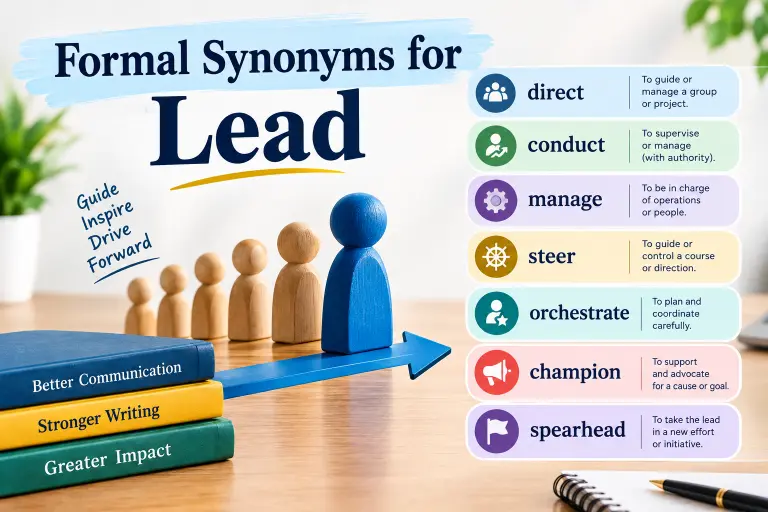
Direct
Meaning: To control, guide, or give instructions.
Explanation: Direct is one of the closest formal alternatives when lead means guiding people or activities. It emphasizes control and instruction more than inspiration.
Example: The project manager will direct the implementation team.
Best Use: Business reports, professional documents, instructions, and management contexts.
Worst Use: Avoid it when you mean simply walking in front of someone.
Tone: Formal, authoritative, precise.
Oversee
Meaning: To supervise work or a process.
Explanation: Oversee means to watch and manage an activity to make sure it is done properly. It usually suggests supervision rather than hands-on leadership.
Example: Maria will oversee the final stage of the construction project.
Best Use: Workplace writing, project management, administration, and reports.
Worst Use: It may be inaccurate if the person actively performs most of the work rather than supervises it.
Tone: Professional and managerial.
Supervise
Meaning: To monitor and guide people doing work.
Explanation: Supervise is narrower than lead. A supervisor watches performance and provides direction, while a leader may also set a vision or motivate a team.
Example: Two senior technicians supervise the new employees.
Best Use: Workplaces, schools, training programs, and operations.
Worst Use: It can sound too procedural when discussing inspirational leadership.
Tone: Formal and practical.
Administer
Meaning: To manage or organize an activity, system, or organization.
Explanation: Administer works when lead refers to managing a formal program, process, or institution.
Example: The department administers the scholarship program.
Best Use: Government, education, healthcare, nonprofit, and institutional writing.
Worst Use: It sounds unnatural for a sentence about inspiring a team.
Tone: Formal and institutional.
Preside Over
Meaning: To officially lead or be in charge of a meeting, organization, or formal activity.
Explanation: This phrase emphasizes an official position of authority.
Example: The chairperson presided over the annual meeting.
Best Use: Meetings, ceremonies, committees, boards, and formal organizations.
Worst Use: It is too formal for ordinary conversations.
Tone: Highly formal.
Chair
Meaning: To lead a meeting, committee, or organization in an official capacity.
Explanation: Chair is a concise professional alternative to lead when someone is responsible for a committee or meeting.
Example: Dr. Patel chairs the research committee.
Best Use: Academic, corporate, nonprofit, and organizational contexts.
Worst Use: Don’t use it when someone merely participates in a meeting.
Tone: Professional and official.
Orchestrate
Meaning: To organize and coordinate several parts of an activity.
Explanation: Orchestrate suggests careful planning and coordination. It is stronger and more vivid than simply saying someone led an activity.
Example: The director orchestrated the company’s product launch.
Best Use: Business writing, journalism, strategic communication, and polished prose.
Worst Use: It may sound exaggerated for a small or routine task.
Tone: Formal and sophisticated.
Spearhead
Meaning: To be the main person driving a project or initiative.
Explanation: Spearhead is a strong alternative to lead when someone starts and actively pushes an important effort forward.
Example: Elena spearheaded the company’s sustainability initiative.
Best Use: Business articles, professional biographies, reports, and achievement statements.
Worst Use: Avoid it for ordinary responsibilities where there is no major initiative.
Tone: Strong, energetic, professional.
Facilitate
Meaning: To make an activity or process easier.
Explanation: Facilitate is not a direct synonym for lead. A facilitator helps a group work effectively without necessarily controlling it.
Example: The consultant facilitated a discussion between the two departments.
Best Use: Meetings, workshops, education, mediation, and collaborative work.
Worst Use: It can weaken the meaning if the person actually had full authority.
Tone: Professional and collaborative.
Govern
Meaning: To control or rule an organization, institution, or area.
Explanation: Govern is appropriate when lead involves formal authority over a group, institution, or political unit.
Example: The board governs the organization according to its bylaws.
Best Use: Government, law, institutions, and formal organizational structures.
Worst Use: It is too strong for ordinary team leadership.
Tone: Formal and authoritative.
Conduct
Meaning: To organize, direct, or carry out an activity.
Explanation: Conduct can replace lead when someone directs a meeting, investigation, study, or similar formal activity.
Example: The researchers conducted a detailed investigation.
Best Use: Academic, scientific, legal, and professional writing.
Worst Use: It does not normally replace lead when discussing long-term team leadership.
Tone: Formal and professional.
Semi-Formal & Neutral Synonyms to Lead
Guide
Meaning: To show someone the right direction or help them make progress.
Explanation: Guide is one of the most flexible alternatives to lead. It usually suggests support rather than authority.
Example: The mentor guided the students through their first research project.
Best Use: Education, mentoring, coaching, instructions, and everyday writing.
Worst Use: It may be too gentle when someone has formal command.
Tone: Neutral, supportive, and approachable.
Manage
Meaning: To control, organize, or be responsible for people or work.
Explanation: Manage overlaps with lead, but it emphasizes organization and responsibility rather than vision or inspiration.
Example: James manages a team of twelve designers.
Best Use: Business, workplaces, projects, and everyday professional communication.
Worst Use: It may not capture the inspirational side of leadership.
Tone: Neutral and professional.
Head
Meaning: To be in charge of a group, organization, or activity.
Explanation: Head is a natural replacement for lead in many professional sentences.
Example: Priya heads the marketing department.
Best Use: Business, news writing, biographies, and everyday professional speech.
Worst Use: It can be ambiguous in sentences where head means physical direction.
Tone: Neutral and direct.
Coordinate
Meaning: To organize different people or activities so they work together.
Explanation: Coordinate focuses on cooperation and organization rather than authority.
Example: Sam coordinated the volunteers during the event.
Best Use: Projects, events, teamwork, logistics, and workplace communication.
Worst Use: It may understate someone’s role if they were the actual leader.
Tone: Neutral and professional.
Organize
Meaning: To arrange and manage people, tasks, or activities.
Explanation: Organize can replace lead when the main responsibility involves planning and arranging an activity.
Example: Nina organized the community fundraiser.
Best Use: Events, projects, school activities, and everyday communication.
Worst Use: It does not necessarily indicate that the person had leadership authority.
Tone: Neutral.
Steer
Meaning: To guide something toward a particular direction or result.
Explanation: Steer is often metaphorical. It suggests influencing the direction of a project, discussion, organization, or decision.
Example: The new director steered the company toward a more sustainable business model.
Best Use: Business writing, strategy discussions, journalism, and figurative language.
Worst Use: It may sound overly metaphorical in highly technical writing.
Tone: Neutral to polished.
Command
Meaning: To have authority over people or a group.
Explanation: Command is much stronger than lead. It implies formal authority and obedience.
Example: The officer commanded the unit during the operation.
Best Use: Military, historical, and strongly hierarchical contexts.
Worst Use: It can sound harsh in ordinary workplace writing.
Tone: Strong and authoritative.
Navigate
Meaning: To guide through a difficult process or situation.
Explanation: Navigate is a contextual alternative. It works especially well when leadership involves handling uncertainty or complexity.
Example: The team leader helped the company navigate a difficult transition.
Best Use: Business, education, problem-solving, and figurative writing.
Worst Use: It should not replace lead if the emphasis is formal authority.
Tone: Neutral and modern.
Take Charge Of
Meaning: To assume responsibility or control.
Explanation: This phrase is useful when someone actively accepts responsibility for a task or situation.
Example: Marcus took charge of the event when the original organizer became unavailable.
Best Use: Workplace communication and everyday speech.
Worst Use: It can sound too informal for some academic or legal documents.
Tone: Direct and moderately informal.
Run
Meaning: To manage or operate something.
Explanation: Run is a common everyday alternative to lead when someone manages a business, department, event, or activity.
Example: She runs a small design studio.
Best Use: Conversation, websites, interviews, and informal professional writing.
Worst Use: It can be too casual for highly formal reports.
Tone: Casual to neutral.
Conduct
Meaning: To direct or carry out a formal activity.
Explanation: In phrases such as conduct a meeting or conduct an investigation, the word can overlap with lead, although it often focuses on the activity rather than the person’s leadership role.
Example: The principal conducted the staff meeting.
Best Use: Formal meetings, investigations, studies, and ceremonies.
Worst Use: Avoid using it as a general substitute for every meaning of lead.
Tone: Professional and formal.
Informal and Casual Alternatives for Lead
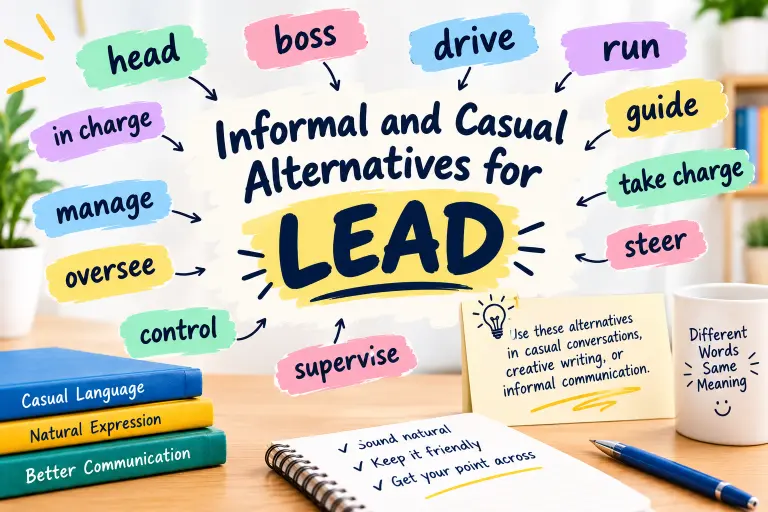
Casual English offers several natural expressions, but these are mostly contextual alternatives, not exact synonyms.
Go First
Meaning: Move ahead of other people.
Example: You go first, and I’ll follow.
When it sounds natural: Everyday conversation and instructions.
When to avoid it: Formal reports or professional descriptions.
Tone: Casual and conversational.
Take Charge
Meaning: Become responsible for controlling a situation.
Example: Someone needs to take charge before the meeting gets completely disorganized.
When it sounds natural: Conversations, workplace discussions, and storytelling.
When to avoid it: Highly formal academic or legal writing.
Tone: Direct and energetic.
Head Up
Meaning: Lead or be responsible for something.
Example: Carlos heads up the customer support team.
When it sounds natural: Workplace conversation and informal professional communication.
When to avoid it: Formal academic writing.
Tone: Casual-professional.
Run
Meaning: Manage or operate something.
Example: My sister runs a small online store.
When it sounds natural: Everyday speech and informal business communication.
When to avoid it: Situations requiring precise descriptions of authority.
Tone: Casual and natural.
Set the Pace
Meaning: Establish the speed, standard, or direction others follow.
Example: The most experienced player set the pace for the rest of the team.
When it sounds natural: Sports, teamwork, business discussions, and figurative writing.
When to avoid it: When someone has formal authority but is not actually setting the pace.
Tone: Conversational and expressive.
Get Things Moving
Meaning: Start an activity or encourage progress.
Example: Let’s get things moving before the deadline gets too close.
When it sounds natural: Meetings, teamwork, messages, and casual conversation.
When to avoid it: Formal documentation where a more precise verb is needed.
Tone: Friendly and informal.
Cause-and-Effect Synonyms to Lead
The word lead often means “cause something to happen.” In that meaning, leadership synonyms such as guide or manage are wrong.
Cause
Meaning: Make something happen.
Example: Heavy rain caused flooding in several areas.
Best Use: Direct cause-and-effect relationships.
Important Difference: Cause is usually stronger and more direct than lead to.
Tone: Neutral and precise.
Result In
Meaning: Produce a particular outcome.
Example: Poor planning can result in unnecessary delays.
Best Use: Reports, essays, research, and professional writing.
Important Difference: It emphasizes the outcome rather than the action that produces it.
Tone: Neutral to formal.
Bring About
Meaning: Cause something to happen.
Example: The new policy brought about significant changes.
Best Use: Formal writing, essays, reports, and historical discussion.
Tone: Formal and measured.
Give Rise To
Meaning: Cause something to develop or occur.
Example: The disagreement gave rise to several new concerns.
Best Use: Academic and formal writing.
Tone: Formal.
Prompt
Meaning: Cause or encourage a particular response or action.
Example: The announcement prompted employees to ask additional questions.
Best Use: Professional writing, journalism, and analytical writing.
Tone: Neutral and precise.
Trigger
Meaning: Cause something to begin suddenly.
Example: The software error triggered a security alert.
Best Use: Technology, medicine, business, journalism, and technical writing.
Tone: Direct and specific.
Generate
Meaning: Produce or create something.
Example: The campaign generated strong interest among customers.
Best Use: Business, marketing, technology, and analytical writing.
Tone: Professional.
Culminate In
Meaning: End or develop into a final result.
Example: Months of negotiations culminated in a new agreement.
Best Use: Formal and academic writing.
Tone: Formal and polished.
True Synonyms vs Contextual Alternatives for Lead
| Type | What It Means | Can It Replace the Original? |
|---|---|---|
| True synonym | Nearly the same meaning in the same context | Often, but still check grammar |
| Near synonym | Similar meaning with a small difference | Sometimes |
| Contextual alternative | Works only for one meaning of lead | Only in specific sentences |
| Broader expression | Covers a wider idea | Sometimes, but meaning may become less precise |
| Narrower expression | Describes one specific form of leading | Only when that specific meaning is intended |
The key point is that lead is polysemous—it has several meanings. Consider these sentences:
- “She leads the department.” → manages, heads, or directs
- “The road leads to the village.” → goes to, runs to, or connects to
- “The evidence leads us to a conclusion.” → points to, suggests, or indicates
- “The mistake led to a delay.” → caused, resulted in, or produced
- “He led the runners.” → was ahead of, set the pace, or was in front of
Replacing lead without first identifying its meaning can produce an inaccurate sentence.
Industry-Specific Usage of Synonyms for Lead
Business Writing
Business writing often benefits from precise alternatives rather than repeatedly using lead.
- Use manage for responsibility over people or operations:
The regional manager manages three sales teams.
- Use oversee for supervision:
The operations director oversees the distribution process.
- Use spearhead when someone actively drives a major initiative:
The director spearheaded the expansion project.
- Use coordinate when several teams or activities must work together:
The project officer coordinated the launch across four departments.
Avoid replacing every instance of lead with a more impressive word. Manage may be clearer than spearhead when the role is routine.
Corporate Communication
Reports and announcements often require exact descriptions of responsibility.
- Lead the initiative → direct the initiative
- Lead the department → head the department
- Lead the project → manage the project
- Lead the discussion → facilitate the discussion
- Lead the transformation → drive the transformation
For internal communication, clarity usually matters more than vocabulary variety.
Academic Writing
Academic writing frequently uses lead in cause-and-effect relationships.
Instead of:
This factor leads to higher costs.
You might write:
This factor results in higher costs.
Or:
This factor contributes to higher costs.
However, these aren’t identical. Results in suggests a clearer outcome, while contributes to indicates that the factor is only one cause among several.
For people guiding research, use supervise, direct, or oversee depending on the exact role.
Customer Service
Customer-facing communication should favor simple, polite language.
Instead of:
This issue led to a delay.
You can write:
This issue caused a delay.
For explaining procedures:
Our specialist will guide you through the next steps.
Guide is often better than direct because it sounds helpful rather than commanding.
Legal Writing
Legal writing requires particular care. A contextual alternative can change the strength or scope of a statement.
For example:
The agreement led to a dispute.
and
The agreement caused a dispute.
are not necessarily identical in legal or factual meaning. Caused may imply a more direct causal relationship.
Similarly, constitutes, results in, creates, and gives rise to can have different implications depending on the sentence.
For legal documents, don’t replace lead merely to make the language sound sophisticated. The most precise wording is usually preferable to the most elaborate wording.
Email Communication
In professional email, choose based on the action you mean:
- Lead a meeting → chair or conduct a meeting
- Lead a project → manage or oversee a project
- Lead someone through a process → guide someone
- Lead to a problem → cause or result in a problem
- Lead an initiative → spearhead or direct an initiative
- Lead to a decision → contribute to or result in a decision
A simple verb is often the strongest choice.
Email Examples Using Synonyms to Lead
Client Communication
Subject: Project Coordination Update
Hi Jordan,
I’ll be coordinating the design and development teams during the next stage of the project. I’ll send you a progress update on Friday and let you know if we need anything from your team.
Best,
Maya
Project Update
Subject: Website Project Update
Hi Team,
Sam will oversee the testing phase this week. Please send any technical issues directly to him so they can be reviewed before Friday’s release.
Thanks,
Alex
Request
Subject: Meeting Discussion
Hi Priya,
Could you chair tomorrow’s meeting? We’ll review the three proposals and agree on the next steps.
Thanks,
Daniel
Customer Service
Subject: Your Account Issue
Hello Mr. Lee,
Our support specialist will guide you through the account recovery process. Please have your account information ready before the call.
Best regards,
Customer Support
Vendor Communication
Subject: Delivery Schedule
Hello Mark,
Our logistics team will manage the delivery schedule from this point forward. We’ll contact you if there are any changes to the agreed dates.
Regards,
Nora
Academic Communication
Subject: Research Project Supervision
Dear Professor Adams,
Thank you for agreeing to supervise my research project. I’ve attached the revised proposal for your review.
Best,
Emma
Short Dialogue Examples
Workplace
Person A: Who is leading the new project?
Person B: David is managing it. He’ll coordinate the teams and handle the schedule.
Classroom
Person A: Who will lead the discussion today?
Person B: Sara will facilitate it. She prepared several questions for the class.
Customer Service
Person A: I’m not sure what to do next.
Person B: Don’t worry. I’ll guide you through the process.
Casual Conversation
Person A: Who’s running the event?
Person B: Mike is heading up the planning team.
Professional Discussion
Person A: What caused the increase in costs?
Person B: Several supply issues resulted in higher transportation expenses.
How to Replace “Lead” in a Sentence
Example 1
Original:
Maria leads the marketing team.
Alternative:
Maria manages the marketing team.
Why it works:
Manage emphasizes responsibility for the team. It is less focused on vision or inspiration.
Example 2
Original:
The manager led the meeting.
Alternative:
The manager chaired the meeting.
Why it works:
Chaired specifically identifies responsibility for a formal meeting.
Example 3
Original:
The mentor led the students through the assignment.
Alternative:
The mentor guided the students through the assignment.
Why it works:
Guided highlights support and instruction.
Example 4
Original:
The error led to a system failure.
Alternative:
The error resulted in a system failure.
Why it works:
Resulted in clearly signals an outcome and works well in technical or formal writing.
Example 5
Original:
The new policy led to several changes.
Alternative:
The new policy brought about several changes.
Why it works:
Brought about emphasizes that the policy produced the changes.
Example 6
Original:
The director led the initiative.
Alternative:
The director spearheaded the initiative.
Why it works:
Spearheaded suggests that the director actively drove the initiative forward.
Example 7
Original:
The road leads to the beach.
Alternative:
The road runs to the beach.
Why it works:
Here lead describes physical direction. A leadership synonym such as manage would be completely wrong.
Example 8
Original:
The evidence led researchers to a different conclusion.
Alternative:
The evidence pointed researchers toward a different conclusion.
Why it works:
Pointed toward preserves the idea of evidence suggesting a direction without claiming that the evidence directly caused the conclusion.
Example 9
Original:
The discussion led to a useful solution.
Alternative:
The discussion resulted in a useful solution.
Why it works:
The alternative focuses on the outcome of the discussion.
Example 10
Original:
The officer led the group through the building.
Alternative:
The officer guided the group through the building.
Why it works:
Guided makes the physical direction clear.
Comparison Table for Lead Alternatives
| Phrase | Tone | Meaning / Scope | Best Use | Example |
|---|---|---|---|---|
| Guide | Neutral | Show direction or provide help | Teaching, mentoring | She guided the team. |
| Direct | Formal | Give instructions or control | Management | He directed the operation. |
| Manage | Neutral-professional | Handle people or work | Business | She manages the department. |
| Oversee | Professional | Supervise activity | Projects | He oversees the process. |
| Supervise | Formal | Monitor workers or tasks | Workplaces | She supervises the staff. |
| Head | Neutral | Be in charge | Departments | He heads the division. |
| Coordinate | Professional | Organize parts to work together | Projects | She coordinated the teams. |
| Facilitate | Formal-neutral | Help a process happen | Meetings | He facilitated the discussion. |
| Spearhead | Strong-professional | Drive an initiative | Business | She spearheaded the campaign. |
| Cause | Neutral | Make something happen | Cause/effect | The error caused a delay. |
| Result in | Formal-neutral | Produce an outcome | Reports | The change resulted in savings. |
| Prompt | Professional | Cause or encourage a response | Analysis | The report prompted action. |
| Precede | Formal | Come before | Sequence | A short introduction preceded the lecture. |
| Steer | Neutral | Guide toward a direction | Strategy | She steered the company forward. |
Which Alternative to Lead Should You Choose?
- For formal writing: Choose direct, oversee, supervise, administer, conduct, or preside over, depending on the meaning.
- For business communication: Manage, oversee, coordinate, head, and direct are usually clear and professional.
- For academic writing: Use guide, supervise, conduct, result in, contribute to, or lead to, depending on whether you mean guidance or cause and effect.
- For legal writing: Prefer the most exact term. Cause, result in, constitute, give rise to, and precede can express different relationships, so don’t substitute them casually.
- For professional email: Guide, manage, oversee, coordinate, and result in are usually safe choices.
- For everyday conversation: Guide, run, head, take charge, and go first sound natural.
- For casual messages: Run, head up, take charge, and get things moving can work well.
The best synonym isn’t necessarily the most sophisticated word. It’s the one that preserves your intended meaning.
Grammar & Usage Guide for Lead
Lead as a Verb Meaning Guide
When lead means guide or direct, it normally takes an object:
The manager leads the team.
Possible alternatives include:
The manager guides the team.
The manager directs the team.
The manager manages the team.
These alternatives differ slightly in meaning.
Lead to + Noun
When lead describes a result, use lead to:
The change led to higher costs.
Do not write:
The change led higher costs.
If you replace it with cause, the structure changes:
The change caused higher costs.
With result, use result in:
The change resulted in higher costs.
Lead Someone To + Destination or Conclusion
Lead can take a person or group followed by to:
The guide led us to the museum.
It can also be figurative:
The evidence led researchers to a new conclusion.
Alternatives may include guided us to, pointed researchers toward, or directed them toward, depending on the meaning.
Lead By + Amount
When lead means being ahead in a competition, by commonly introduces the amount:
Our team leads by three points.
Possible alternatives include:
Our team is ahead by three points.
Here, is ahead is more natural than manages or directs.
Lead the Way
Lead the way means to go first while others follow, either literally or figuratively.
You lead the way, and we’ll follow.
Possible alternatives include:
You go first.
You show us the way.
The alternatives are simpler but may change the tone.
Lead vs. Led
The present tense is lead, pronounced like “leed.”
The past tense is led, pronounced like “led.”
She leads the team today.
She led the team last year.
A common mistake is writing lead as the past tense:
Incorrect: She lead the team yesterday.
Correct: She led the team yesterday.
Lead vs. Leader
Lead is commonly a verb:
They lead the department.
Leader is a noun:
They are the department leader.
Do not treat the two words as interchangeable.
Lead vs. Lead
The word lead also has a completely different pronunciation when it refers to the metal.
As a verb:
She will lead the team.
Pronunciation: “leed”
As a noun referring to the metal:
The pipe contains lead.
Pronunciation: “led”
Context determines the meaning and pronunciation.
Common Mistakes to Avoid
1. Treating Every Alternative as an Exact Synonym
Manage, guide, cause, and precede can all relate to lead, but they do not mean the same thing.
2. Using a Leadership Word for Cause and Effect
Incorrect:
The storm managed to flooding.
Better:
The storm caused flooding.
Manage belongs to a different meaning of lead.
3. Using “Cause” for a Weak Relationship
If something is only one contributing factor, cause may be too strong.
Better: The policy contributed to the increase.
4. Making Simple Writing Too Formal
Replacing lead with orchestrate or preside over can make an ordinary sentence unnecessarily grand.
5. Using Casual Expressions in Formal Documents
Phrases such as head up and get things moving may be fine in conversation but can sound too informal in academic writing.
6. Confusing Lead With Led
Use led for the past tense:
She led the team last year.
7. Forgetting Prepositions
Different alternatives require different structures:
lead to a problem
result in a problem
contribute to a problem
cause a problem
8. Changing the Strength of the Statement
Suggest is weaker than cause. Cause is generally stronger than contribute to. Don’t make the relationship stronger or weaker by accident.
9. Choosing Variety Over Clarity
You don’t need to replace every occurrence of lead. Repeating the correct word is better than inserting an inaccurate synonym.
10. Ignoring the Subject
A person can manage a team, but a road usually doesn’t manage anything. Always check what the subject is doing.
When Not to Use Lead
There are times when another expression is clearer.
When the Meaning Is Specifically Supervision
Use oversee or supervise when the person mainly monitors work.
When You Mean Direct Cause
Use cause when the relationship is direct and clear.
When You Mean a Final Outcome
Use result in when the sentence focuses on what happened afterward.
When You Mean Physical Direction
Use guide, run to, go to, or point toward when describing a route.
When You Mean Formal Meeting Authority
Use chair when someone officially controls a meeting.
When You Mean Assistance Rather Than Authority
Use guide or facilitate when someone helps others rather than commands them.
Still, lead is often the best choice. It is short, familiar, flexible, and capable of expressing leadership, direction, sequence, and causation. Don’t replace it merely for the sake of variety.
Advanced Writer Tips for Synonyms for Lead
Tone Control
Choose verbs according to the impression you want to create.
Guide → supportive
Manage → practical
Direct → authoritative
Spearhead → energetic
Command → powerful
Facilitate → collaborative
The difference can change how readers perceive the person being described.
Professional Email Etiquette
Use straightforward language in emails. Manage, coordinate, oversee, and guide usually sound polished without becoming stiff.
Instead of:
I will spearhead the routine file review.
write:
I will manage the file review.
The second sentence is simpler and more believable.
Politeness
Direct can sometimes sound more commanding than guide.
Compare:
I will direct you through the process.
with:
I will guide you through the process.
The second feels more supportive in customer service or mentoring.
Context Alignment
Ask what lead actually means before selecting a replacement:
- Is someone guiding people?
- Is someone managing work?
- Is something causing an outcome?
- Is something physically ahead?
- Is evidence pointing toward a conclusion?
- Is an event coming before another event?
That one question prevents most synonym errors.
Precision
Choose the narrowest accurate verb.
If someone supervises without doing the work, oversee may be better than manage. If they actively start and drive an initiative, spearhead may be more precise.
Readability
Short words often work best.
The new rule led to delays.
is perfectly clear.
The new rule precipitated an escalation in operational delays.
may sound impressive, but unless the context requires that level of formality, the simpler sentence is easier to understand.
Related Questions About Synonyms for Lead
What is another way to say lead?
Depending on the meaning, you can say guide, direct, manage, head, oversee, supervise, coordinate, steer, or cause. The correct choice depends on whether lead refers to leadership, direction, or cause and effect.
What is a professional Synonyms to Lead?
Manage, oversee, direct, supervise, coordinate, and head are strong professional choices. Spearhead works when someone actively drives a major initiative, while facilitate is better when the person helps a group work together.
What is a formal alternative to lead?
Formal options include direct, administer, supervise, preside over, conduct, govern, orchestrate, and spearhead. However, formal does not automatically mean better. Choose the term that most accurately describes the person’s role.
What can I use instead of lead to?
For cause-and-effect sentences, use cause, result in, bring about, prompt, contribute to, or give rise to. These expressions are more precise when lead to means that one event produces or influences another.
FAQs About Synonyms for Lead
What is the closest synonym for lead?
Guide is one of the closest alternatives when lead means showing someone where to go or helping them make progress. Direct and manage are also close in leadership contexts, but they suggest greater authority or responsibility.
Is “manage” the same as “lead”?
Not exactly. Manage focuses on organizing people, tasks, resources, or processes. Lead can include those duties but may also involve setting direction, motivating people, or establishing a vision. A person can manage effectively without being a strong leader.
Is “spearhead” a synonym for lead?
Spearhead is a contextual synonym. It means to take the main driving role in an important project or initiative. It is stronger than lead in some contexts because it suggests active effort to start and push something forward.
What is a good Synonyms to Lead in academic writing?
The best choice depends on the sentence. Guide and supervise work for people helping researchers or students. Result in, contribute to, cause, and give rise to work for cause-and-effect relationships.
What is a synonym for lead in a business context?
Manage, oversee, direct, coordinate, head, and spearhead are common choices. Use manage for general responsibility, oversee for supervision, and spearhead for actively driving a major initiative.
What is another way to say “lead to”?
Useful synonyms to lead include result in, cause, bring about, give rise to, contribute to, prompt, produce, and culminate in. Each has a different strength, so choose based on whether the relationship is direct, partial, or sequential.
Can “guide” always replace “lead”?
No. Guide usually emphasizes helping or showing direction, while lead can imply authority, command, management, or being ahead in a competition. For example, “She guides the department” does not necessarily communicate the same authority as “She leads the department.”
Key Takeaways
- Lead has several meanings, so no single synonym works in every sentence.
- Use guide, direct, manage, oversee, or head for leadership-related meanings.
- Use cause, result in, prompt, or bring about when lead describes an outcome.
- Use precede, go first, or be ahead of when lead describes position or sequence.
- Keep lead when it is the clearest and most accurate option; synonym variety should never reduce precision.
Conclusion
The best way to choose among synonyms for lead is to identify what lead means in the sentence before searching for a replacement. If someone is responsible for people or work, manage, direct, oversee, supervise, head, and coordinate can be useful. If someone is helping others find a direction, guide is usually more natural. For cause and effect, cause, result in, prompt, bring about, and contribute to offer more precise choices. When lead refers to physical or figurative direction, words such as precede, steer, point toward, or navigate may fit better.
Good writing isn’t about avoiding the same word at all costs. It’s about choosing the word that says exactly what you mean. In many sentences, lead remains the clearest option. In others, a more specific alternative can make the sentence sharper, more professional, and easier to understand.
