
Finding the right synonyms for hard working can make a resume, recommendation letter, performance review, school assignment, or everyday description sound much stronger. While hard-working is positive and widely understood, repeating it can make your writing feel predictable.
Depending on the situation, words such as diligent, dedicated, industrious, conscientious, committed, productive, and persistent can communicate the same general quality while adding a more precise shade of meaning.
However, these alternatives aren’t perfect substitutes. Someone who is diligent pays close attention and works carefully, while a persistent person keeps going despite obstacles. A productive person gets useful results, and a dedicated person shows strong commitment.
This guide explains more than 40 useful alternatives, including formal, neutral, casual, professional, academic, and workplace-friendly choices, so you can describe someone’s work ethic accurately rather than simply choosing the biggest word on the page.
Quick Answer: Synonyms for Hard Working
The best synonyms for hard working include diligent, industrious, hardworking, dedicated, committed, conscientious, productive, motivated, persistent, tireless, diligent, driven, dependable, disciplined, and assiduous. The best choice depends on the quality you want to emphasize, such as effort, persistence, reliability, productivity, or commitment.
Quick List of Synonyms for Hard Working
Closest Synonyms for Hard Working
- Diligent
- Industrious
- Hardworking
- Assiduous
- Laborious
- Tireless
- Dedicated
- Conscientious
- Industrious
- Committed
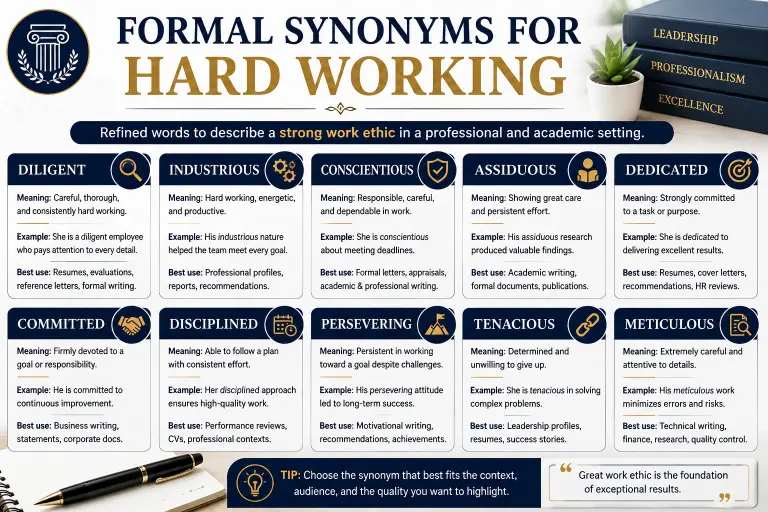
Formal Synonyms for Hard Working
- Diligent
- Industrious
- Assiduous
- Conscientious
- Dedicated
- Meticulous
- Persevering
- Disciplined
- Tenacious
- Committed
Neutral Synonyms for Hard Working
- Productive
- Motivated
- Dependable
- Persistent
- Responsible
- Focused
- Reliable
- Energetic
- Consistent
- Determined
Casual Alternatives for Hard Working
- Driven
- Go-getting
- Hustling
- On the ball
- Puts in the effort
- Gives it their all
Some of these describe how a person works rather than simply saying that the person works hard. That distinction matters when you’re writing a resume, recommendation, or professional message.
Formal Synonyms for Hard Working
Diligent — A Precise Synonym for Hard Working
Meaning: Careful, steady, and hardworking.
Explanation: Diligent is one of the strongest formal alternatives. It suggests that someone consistently puts in effort and pays attention to their responsibilities. It is especially useful because it describes both effort and care.
Example: Maria is a diligent employee who consistently completes her assignments on time.
Best Use: Resumes, recommendation letters, academic writing, performance reviews, and professional descriptions.
Worst Use: Very casual conversations, where it may sound slightly formal.
Tone: Professional, positive, and polished.
Industrious — A Formal Alternative for Hard Working
Meaning: Working hard and productively.
Explanation: Industrious strongly emphasizes a person’s willingness to work and get things done. It is closely related to hardworking but has a more formal feel.
Example: The manager praised the team for being industrious throughout the busy season.
Best Use: Formal writing, professional evaluations, biographies, and recommendations.
Worst Use: Casual text messages or relaxed conversation.
Tone: Formal and complimentary.
Conscientious — A Formal Synonym for Hard Working
Meaning: Careful, responsible, and committed to doing things correctly.
Explanation: Conscientious focuses less on sheer effort and more on responsibility, care, and attention to duties. It is an excellent choice when someone works carefully and can be trusted to do a thorough job.
Example: She is a conscientious employee who checks every report before submitting it.
Best Use: Resumes, references, performance reviews, and professional recommendations.
Worst Use: When you only want to say that someone works long hours.
Tone: Professional and respectful.
Assiduous — A Strong Formal Synonym for Hard Working
Meaning: Showing great care and persistent effort.
Explanation: Assiduous is a highly formal word for someone who works steadily and carefully. It is accurate but less common than diligent, so it may sound sophisticated in ordinary writing.
Example: His assiduous research helped the team identify several useful sources.
Best Use: Formal academic writing, literary descriptions, and polished professional prose.
Worst Use: Casual communication or simple workplace instructions.
Tone: Highly formal and sophisticated.
Dedicated — A Professional Alternative for Hard Working
Meaning: Strongly committed to a person, task, role, or goal.
Explanation: Dedicated emphasizes commitment rather than effort alone. A dedicated employee may work hard because they care deeply about the quality or purpose of their work.
Example: She is a dedicated teacher who spends extra time helping her students.
Best Use: Recommendations, resumes, workplace descriptions, education, and nonprofit writing.
Worst Use: When you specifically need to describe productivity or efficiency.
Tone: Warm, professional, and positive.
Committed — A Formal Alternative for Hard Working
Meaning: Determined to support or achieve a goal.
Explanation: Committed focuses on determination and loyalty to an objective. It doesn’t necessarily mean someone works long hours, so it is a near synonym rather than an exact replacement.
Example: The company is committed to providing reliable service to its customers.
Best Use: Business writing, professional profiles, mission statements, and performance reviews.
Worst Use: When describing only the amount of physical effort someone makes.
Tone: Professional and purposeful.
Disciplined — A Formal Synonym for Hard Working
Meaning: Able to follow a plan and maintain consistent effort.
Explanation: A disciplined person controls distractions and follows through on responsibilities. The word emphasizes self-management more than raw effort.
Example: His disciplined approach helped him complete the training program ahead of schedule.
Best Use: Resumes, sports, education, management, and professional evaluations.
Worst Use: When you need to emphasize enthusiasm or creativity.
Tone: Strong, professional, and controlled.
Tenacious — A Formal Alternative for Hard Working
Meaning: Persistent and unwilling to give up easily.
Explanation: Tenacious describes someone who continues pursuing a goal despite difficulty. It is particularly useful when the person’s work ethic involves overcoming setbacks.
Example: Her tenacious approach helped the team solve a difficult technical problem.
Best Use: Leadership profiles, resumes, recommendations, business writing, and achievement descriptions.
Worst Use: When the person simply follows routine tasks carefully.
Tone: Strong and admiring.
Persevering — A Formal Synonym for Hard Working
Meaning: Continuing to work toward something despite problems or delays.
Explanation: Persevering highlights endurance. It is a good choice when effort continues over a long period or through difficult circumstances.
Example: The persevering student completed the project despite several setbacks.
Best Use: Academic writing, recommendations, personal statements, and professional descriptions.
Worst Use: When persistence isn’t an important part of the person’s behavior.
Tone: Formal and encouraging.
Meticulous — A Precise Alternative for Hard Working
Meaning: Extremely careful and attentive to details.
Explanation: Meticulous does not directly mean hardworking. It describes careful attention to detail. Use it when the person’s work ethic is reflected in accuracy and thoroughness.
Example: Daniel is meticulous when preparing financial reports.
Best Use: Resumes, professional evaluations, technical work, research, and quality control.
Worst Use: When the person works quickly but does not focus on details.
Tone: Professional and precise.
Tireless — A Strong Synonym for Hard Working
Meaning: Showing continuous effort without appearing to become tired.
Explanation: Tireless is a vivid compliment. It suggests exceptional energy and persistence, although it can sometimes sound more enthusiastic than objective.
Example: Her tireless efforts helped organize the community fundraiser.
Best Use: Tributes, recommendations, leadership descriptions, biographies, and inspirational writing.
Worst Use: Formal documents that require restrained, measurable language.
Tone: Strong, admiring, and energetic.
Semi-Formal and Neutral Synonyms for Hard Working
Productive — A Results-Focused Synonym for Hard Working
Meaning: Producing useful or successful results.
Explanation: Productive is not an exact synonym for hard working. Someone can work hard without producing much, while a productive person may achieve excellent results efficiently.
Example: The team remained productive throughout the project.
Best Use: Business writing, workplace communication, performance reviews, and everyday descriptions.
Worst Use: When you only want to describe effort rather than results.
Tone: Neutral and professional.
Motivated — A Neutral Alternative for Hard Working
Meaning: Eager or willing to achieve a goal.
Explanation: Motivated describes the reason or drive behind someone’s effort. It suggests willingness and ambition but does not guarantee sustained hard work.
Example: We are looking for motivated students who want to develop their skills.
Best Use: Job descriptions, interviews, education, resumes, and coaching.
Worst Use: When you need evidence of consistent performance rather than enthusiasm.
Tone: Positive and professional.
Persistent — A Useful Synonym for Hard Working
Meaning: Continuing despite difficulty or opposition.
Explanation: Persistent emphasizes refusal to give up. It is especially useful when someone’s effort continues after mistakes, rejection, or setbacks.
Example: His persistent efforts eventually led to a solution.
Best Use: Work, school, problem-solving, sports, and personal achievements.
Worst Use: When persistence could be confused with refusing to listen or being annoying.
Tone: Neutral and positive.
Determined — A Strong Alternative for Hard Working
Meaning: Having a firm intention to achieve something.
Explanation: Determined focuses on mental commitment to a goal. It often suggests hard work but is broader than the word hardworking.
Example: She is determined to finish the project before Friday.
Best Use: Personal statements, interviews, resumes, school writing, and everyday descriptions.
Worst Use: When the person has not actually shown sustained effort.
Tone: Positive and confident.
Dependable — A Reliability-Focused Alternative
Meaning: Able to be trusted to do what is expected.
Explanation: Dependable describes reliability rather than effort itself. It is useful when a hard-working person is also consistent and trustworthy.
Example: James is a dependable team member who always meets his deadlines.
Best Use: References, resumes, performance reviews, and workplace communication.
Worst Use: When you need to highlight ambition or exceptional effort.
Tone: Professional and trustworthy.
Reliable — A Practical Synonym for Hard Working
Meaning: Consistently performing as expected.
Explanation: Like dependable, reliable focuses on consistency rather than the amount of work someone performs.
Example: She is a reliable employee who handles her responsibilities without constant supervision.
Best Use: Job references, workplace communication, resumes, and recommendations.
Worst Use: When describing someone who is exceptionally ambitious but not necessarily consistent.
Tone: Neutral and professional.
Focused — A Modern Alternative for Hard Working
Meaning: Giving strong attention to a task or goal.
Explanation: Focused suggests that someone avoids distractions and concentrates on what needs to be done. It describes working style rather than effort alone.
Example: He stayed focused throughout the three-hour planning session.
Best Use: Workplace writing, education, coaching, and personal descriptions.
Worst Use: When the person’s main strength is persistence rather than concentration.
Tone: Neutral and contemporary.
Responsible — A Broader Alternative for Hard Working
Meaning: Reliable in completing duties and accepting obligations.
Explanation: Responsible does not mean hardworking by itself, but responsible people often demonstrate a strong work ethic by meeting commitments.
Example: She is a responsible employee who completes her tasks without reminders.
Best Use: School recommendations, workplace reviews, resumes, and everyday descriptions.
Worst Use: When you want to emphasize exceptional effort.
Tone: Neutral and positive.
Energetic — An Effort-Focused Alternative
Meaning: Full of energy and enthusiasm.
Explanation: Energetic can describe someone who works actively and enthusiastically, but it does not necessarily mean they are diligent or careful.
Example: The energetic assistant quickly helped prepare the event space.
Best Use: Customer service, hospitality, teamwork, and casual professional descriptions.
Worst Use: Formal evaluations where accuracy and consistency matter more than energy.
Tone: Positive and lively.
Driven — A Modern Professional Synonym for Hard Working
Meaning: Highly motivated to achieve a goal.
Explanation: Driven suggests ambition, determination, and strong internal motivation. It is popular in professional settings but does not necessarily mean someone is careful or cooperative.
Example: She is a driven professional who sets ambitious goals for herself.
Best Use: Resumes, interviews, professional profiles, business writing, and networking.
Worst Use: When describing a relaxed, supportive work style or a person’s attention to detail.
Tone: Modern, confident, and ambitious.
Informal and Casual Alternatives for Hard Working
Go-Getter — A Casual Alternative for Hard Working
Meaning: A person who is energetic and determined to succeed.
Example: Maya is a real go-getter who never waits around for someone else to solve a problem.
When it sounds natural: Conversations, informal recommendations, team discussions, and casual professional settings.
When to avoid it: Formal academic papers and highly formal reports.
Tone: Casual, upbeat, and complimentary.
Gives It Their All — A Casual Expression for Hard Working
Meaning: Makes a strong effort.
Example: He always gives it his all, even when the job gets difficult.
When it sounds natural: Conversations, sports, personal recommendations, and informal writing.
When to avoid it: Formal resumes or academic research.
Tone: Warm and conversational.
Puts in the Effort — A Natural Casual Alternative
Meaning: Makes a genuine effort to accomplish something.
Example: She may be new to the job, but she definitely puts in the effort.
When it sounds natural: Workplace conversations, feedback, and everyday speech.
When to avoid it: Formal descriptions where a more specific adjective would be stronger.
Tone: Casual and supportive.
Hustling — A Very Informal Alternative
Meaning: Working actively and energetically toward a goal.
Example: The team has been hustling to get everything ready for the event.
When it sounds natural: Informal speech, social media, creative industries, and casual workplace conversations.
When to avoid it: Formal resumes, academic writing, and traditional business documents.
Tone: Very casual and energetic.
On the Ball — A Casual Alternative Related to Work Performance
Meaning: Alert, capable, and quick to respond.
Example: Our new assistant is really on the ball.
When it sounds natural: Conversation and informal workplace communication.
When to avoid it: Formal documents or situations where you specifically mean someone works long hours.
Tone: Casual and complimentary.
Hard at Work — A Natural Informal Expression
Meaning: Actively working on something.
Example: The design team is hard at work preparing the new campaign.
When it sounds natural: Everyday speech, workplace updates, and informal writing.
When to avoid it: When you need to describe a lasting personality trait rather than current activity.
Tone: Casual to neutral.
True Synonyms vs Contextual Alternatives for Hard Working
Not every positive word describing an employee or student is a true synonym for hard-working. Some describe effort, while others describe results, reliability, motivation, or attention to detail.
| Type | What It Means | Can It Replace “Hard Working”? |
|---|---|---|
| True synonym | Describes sustained effort and willingness to work | Usually |
| Near synonym | Shares the idea of strong effort but adds another quality | Often, depending on context |
| Contextual alternative | Works when a specific aspect of work ethic is intended | Only in suitable sentences |
| Broader expression | Describes a larger trait such as character or motivation | Sometimes |
| Narrower expression | Focuses on one part of a strong work ethic | Only when that quality is intended |
For example, diligent is close to a true synonym because it suggests consistent, careful effort. Productive is narrower because it focuses on results. Motivated focuses on internal drive. Dependable focuses on reliability. Meticulous emphasizes attention to detail.
This distinction is especially important on resumes and recommendation letters. Choosing the wrong adjective can make a description sound positive while failing to communicate the quality you actually mean.
Business Writing: Synonyms for Hard Working
Business writing usually benefits from alternatives that describe observable workplace qualities.
Instead of writing:
Sarah is a hard-working employee.
You could write:
Sarah is a diligent employee who consistently meets deadlines.
Or:
Sarah is a dependable team member who takes ownership of her responsibilities.
Or:
Sarah is a driven professional who consistently works toward ambitious goals.
Each version communicates something different. Diligent highlights careful effort, dependable emphasizes reliability, and driven highlights ambition.
For performance reviews, avoid vague praise when you can describe the behavior behind it.
Corporate Communication: Synonyms for Hard Working

Corporate communication often requires positive descriptions without sounding exaggerated.
Useful alternatives include:
- Diligent
- Dedicated
- Dependable
- Productive
- Committed
- Consistent
- Disciplined
- Driven
- Conscientious
- Results-oriented
Example:
Alex has demonstrated a consistent and disciplined approach to managing the project.
This is stronger than simply calling Alex “hard working” because it gives the reader a clearer idea of the behavior being praised.
Academic Writing: Synonyms for Hard Working
In academic writing, adjectives such as hard-working can sometimes sound subjective. More precise words are often better.
For example:
The student demonstrated a diligent approach to research.
Or:
The researcher maintained a consistent and methodical approach throughout the study.
For a recommendation letter, however, hard-working, dedicated, diligent, and persistent can all be appropriate because the purpose is often to describe the student’s character and work habits.
Customer Service: Synonyms for Hard Working
Customer service descriptions should focus on useful behaviors rather than simply saying someone works hard.
Good choices include:
- Attentive
- Dedicated
- Reliable
- Responsive
- Diligent
- Patient
- Dependable
- Proactive
- Consistent
For example:
Jamie is a dedicated customer service representative who responds quickly and follows up on unresolved issues.
Here, dedicated works because the sentence gives evidence of what that dedication looks like.
Email Communication: Synonyms for Hard Working
In professional emails, choose words based on the specific quality you want to praise.
- Diligent — careful and consistent
- Dedicated — committed to the role or goal
- Dependable — reliable
- Productive — gets useful results
- Driven — ambitious and motivated
- Conscientious — careful and responsible
- Persistent — keeps going through difficulties
Avoid stacking several adjectives:
She is a diligent, dedicated, hardworking, motivated, driven, tireless employee.
That sounds inflated. One or two precise words supported by a concrete example are usually stronger.
Email Examples Using Synonyms for Hard Working
Client Communication Using Dedicated
Subject: Thank You for Your Support
Hi Lauren,
I wanted to thank you for your dedicated work during the account transition. Your quick responses and careful follow-up helped us keep the process on schedule.
We appreciate the effort you put into making the transition smooth for the client.
Best,
Michael
Project Update Using Diligent
Subject: Project Review Update
Hi Team,
Thank you for your diligent work on the latest review. We’ve now completed the first round of checks, and the remaining items should be finished by Thursday.
Please flag any issues that could affect the timeline.
Best,
Rachel
Recommendation Using Conscientious
Subject: Recommendation for Daniel
Dear Hiring Manager,
I’m pleased to recommend Daniel for the position. He is a conscientious professional who takes responsibility for his work and consistently follows through on assignments.
He would be a strong addition to a team that values reliability and careful work.
Best regards,
Thomas
Internal Workplace Email Using Productive
Subject: Strong Progress This Week
Hi Everyone,
The team has been especially productive this week. We completed the first phase of the project and resolved several issues that had been slowing us down.
Thank you for keeping the work moving and supporting one another.
Best,
Nina
Academic Communication Using Persistent
Subject: Research Project Progress
Dear Professor Carter,
I wanted to share a quick update on my research project. I’ve continued working through the data and have resolved several issues with the original sample.
Thank you for your earlier feedback. It helped me stay persistent when the analysis became more difficult than expected.
Best regards,
Ethan
Short Dialogue Examples Using Synonyms for Hard Working
Workplace
Person A: How would you describe our new assistant?
Person B: She’s very diligent. She checks her work carefully and rarely misses a deadline.
Classroom
Person A: Why did the teacher recommend James?
Person B: She said he was persistent. He kept working even after the first few attempts didn’t work.
Customer Service
Person A: Is Maya good with customers?
Person B: Definitely. She’s dependable and always follows up when there’s a problem.
Casual Conversation
Person A: Your brother is always working.
Person B: Yeah, he’s a real go-getter. He loves having a goal to chase.
Professional Discussion
Person A: What quality stands out most about Priya?
Person B: She’s conscientious. She takes her responsibilities seriously and pays attention to details.
How to Replace “Hard Working” in a Sentence
Example 1: Resume
Original: I am a hard-working employee who meets deadlines.
Alternative: I am a diligent employee who consistently meets deadlines.
Why it works: Diligent sounds professional and emphasizes steady, careful effort.
Example 2: Recommendation Letter
Original: She is a hard-working student.
Alternative: She is a dedicated student who consistently puts effort into her studies.
Why it works: Dedicated emphasizes commitment rather than simply effort.
Example 3: Performance Review
Original: James is a hard-working member of the team.
Alternative: James is a dependable team member who consistently completes his responsibilities.
Why it works: The alternative gives evidence of what makes him valuable.
Example 4: Academic Writing
Original: The hard-working researcher completed the project.
Alternative: The diligent researcher completed the project.
Why it works: Diligent fits formal academic prose better.
Example 5: Leadership Description
Original: She is a hard-working manager.
Alternative: She is a driven manager who consistently works toward ambitious goals.
Why it works: Driven adds ambition and goal orientation.
Example 6: Detail-Oriented Job
Original: He is a hard-working accountant.
Alternative: He is a conscientious accountant who carefully reviews financial records.
Why it works: Conscientious communicates care and responsibility, not just effort.
Example 7: Difficult Project
Original: The hard-working team solved the problem.
Alternative: The tenacious team solved the problem.
Why it works: Tenacious highlights persistence in the face of difficulty.
Example 8: Results-Focused Description
Original: She is a hard-working employee.
Alternative: She is a productive employee who consistently delivers high-quality work.
Why it works: Productive shifts the focus from effort to results.
Example 9: Long-Term Effort
Original: His hard-working attitude helped him succeed.
Alternative: His persevering attitude helped him succeed.
Why it works: Persevering emphasizes continuing despite setbacks.
Example 10: Casual Conversation
Original: My sister is very hard working.
Alternative: My sister gives it her all.
Why it works: The phrase sounds natural and friendly in casual speech but would be too informal for a resume.
Comparison Table: Synonyms for Hard Working
| Phrase | Tone | Meaning / Scope | Best Use | Example |
| Diligent | Formal | Careful and consistent effort | Resume, academic writing | She is diligent and reliable. |
| Industrious | Formal | Works hard and productively | Professional writing | He is an industrious employee. |
| Conscientious | Formal | Careful and responsible | Recommendations | She is conscientious about her work. |
| Dedicated | Professional | Strong commitment | Reviews, references | He is dedicated to his role. |
| Committed | Professional | Firmly devoted to a goal | Business | She is committed to the project. |
| Assiduous | Highly formal | Persistent, careful effort | Formal prose | His assiduous work was impressive. |
| Productive | Neutral | Produces useful results | Workplace | The team was highly productive. |
| Persistent | Neutral | Continues despite difficulty | School, work | Her persistent efforts paid off. |
| Dependable | Neutral | Can be trusted to follow through | Workplace | He is a dependable employee. |
| Disciplined | Professional | Consistent self-control | Resumes | She has a disciplined approach. |
| Driven | Modern | Highly motivated to succeed | Careers | He is a driven professional. |
| Tenacious | Strong | Refuses to give up | Leadership | She is a tenacious problem-solver. |
| Focused | Neutral | Gives strong attention | Work, school | He remains focused on the goal. |
| Go-getter | Casual | Energetic and ambitious | Conversation | She’s a real go-getter. |
| Gives it their all | Casual | Makes a strong effort | Everyday speech | He always gives it his all. |
Which Synonym for Hard Working Should You Choose?
Best Synonym for Hard Working in Formal Writing
Choose diligent when you want a polished word that emphasizes consistent, careful effort. Industrious and conscientious are also strong options.
Best Synonym for Hard Working in Business Communication
Choose dedicated, dependable, productive, committed, or driven, depending on the quality you want to highlight.
Best Synonym for Hard Working in Academic Writing
Choose diligent, conscientious, persistent, or methodical when the context supports those meanings. Avoid overly casual expressions such as go-getter.
Best Synonym for Hard Working in Legal Writing
There is no special legal synonym that universally replaces hard-working. Legal documents generally require factual descriptions rather than subjective praise. If describing someone’s professional conduct, use specific, supportable wording such as diligent or consistent only when appropriate.
Best Synonym for Hard Working in Professional Email
Dedicated and diligent are useful for praise. Productive works well when discussing results, while dependable is better when reliability is the main point.
Best Synonym for Hard Working in Everyday Conversation
Use hard-working, dedicated, driven, or persistent. They’re natural and easy to understand.
Best Synonym for Hard Working in Casual Messages
Try go-getter, gives it their all, puts in the effort, or simply works really hard. These sound more conversational.
Grammar and Usage Guide for Hard Working
Hard Working vs Hardworking
Both hard-working and hardworking are accepted forms in American English. The closed form, hardworking, is very common in modern usage.
For consistent writing, choose one form and use it consistently throughout a document.
Hard Working as an Adjective
The phrase describes a person’s work ethic.
Example: She is a hardworking employee.
Hardworking Before a Noun
The adjective can directly modify a noun.
Example: He is a hardworking student.
Hardworking After a Linking Verb
It can also appear after be or another linking verb.
Example: The new employee is hardworking and reliable.
Hard Work vs Hardworking
These forms have different grammatical roles.
Hard work is a noun:
Her hard work paid off.
Hardworking is an adjective:
She is hardworking.
Do not write:
Her hardworking paid off.
Instead, use:
Her hard work paid off.
Hard Worker vs Hardworking Person
Hard worker is a noun phrase.
James is a hard worker.
Hardworking is an adjective.
James is hardworking.
Both are natural, but the adjective often works better when describing someone in a larger sentence.
Natural Word Combinations
Common combinations include:
- Hardworking employee
- Hardworking student
- Hardworking parent
- Hardworking team
- Dedicated employee
- Diligent worker
- Conscientious student
- Productive team
- Driven professional
- Dependable colleague
Capitalization
There is normally no reason to capitalize hardworking in a sentence.
Correct: She is a hardworking employee.
Use capitalization only when the word begins a sentence or appears in a title according to your chosen title style.
Common Mistakes to Avoid with Synonyms for Hard Working
Treating Every Positive Word as an Exact Synonym
Productive, motivated, and dependable are positive qualities, but they do not mean exactly the same thing as hard-working.
Using the Wrong Tone
Go-getter may sound friendly in conversation but can look informal on a traditional resume.
Changing the Intended Meaning
Calling someone meticulous says they are detail-oriented. It doesn’t necessarily say they work especially hard.
Overusing Formal Vocabulary
Words such as assiduous can sound impressive, but they may feel unnatural in simple workplace communication.
Using Casual Expressions in Formal Writing
Phrases such as hustling and gives it their all should usually stay out of academic papers and formal reports.
Stacking Too Many Synonyms
Writing “She is diligent, dedicated, industrious, hardworking, persistent, and tireless” can sound exaggerated. Pick the one or two qualities you can support.
Using Hardworking Without Evidence
On a resume or recommendation, a stronger approach is to show the behavior.
Instead of:
Hardworking employee.
Try:
Consistently completed high-priority assignments ahead of deadline.
Confusing Effort With Results
Someone can work long hours without being especially productive. Use productive when results are the main point.
Ignoring Context
The best word depends on the audience. A recommendation letter may welcome dedicated, while a casual conversation may sound more natural with works really hard.
When Not to Use “Hard Working”
When You Need More Specific Praise
If you mean careful, use diligent or meticulous. And if you mean reliable, use dependable. If you mean ambitious, use driven.
When Writing a Professional Resume
Hardworking is positive but common. A more specific description can communicate your value more clearly.
When You Can Show the Behavior
Instead of saying someone is hardworking, describe what they actually accomplish.
Weak: She is hardworking.
Stronger: She consistently completes complex assignments ahead of schedule.
When the Person’s Strength Is Different
If someone is excellent because they are creative, analytical, organized, or collaborative, don’t label them merely hardworking. Use the more accurate trait.
When the Context Is Highly Casual
Sometimes a simple phrase such as “She works really hard” sounds more natural than a formal adjective.
When You Want to Avoid Subjective Claims
In formal evaluations, evidence is often more useful than broad praise.
When “Hard Working” Is Actually the Better Choice
The phrase remains perfectly useful when you want a simple, direct description that most readers will understand immediately. It works especially well in everyday conversation, personal recommendations, and situations where no more specific distinction is needed.
Advanced Writer Tips for Synonyms for Hard Working
Tone Control with Hard Working Synonyms
For formal writing, try diligent, industrious, conscientious, or assiduous.
Meanwhile, for professional writing, choose dedicated, committed, dependable, productive, or driven.
For everyday conversation, hardworking, dedicated, persistent, or works really hard usually sound natural.
For casual writing, go-getter or gives it their all can add personality.
Professional Email Etiquette
Praise is stronger when it is specific.
Instead of:
You’re a very hardworking employee.
Try:
Your diligent work on the client report helped us meet the deadline.
The second sentence connects the compliment to an observable result.
Politeness
Positive adjectives should match the relationship and situation. Calling someone tireless may sound warmly appreciative in a thank-you message, while productive may sound more objective in a performance review.
Context Alignment
Think about the quality behind the effort:
- Works carefully → diligent
- Pays attention to details → meticulous
- Keeps going → persistent
- Doesn’t give up → tenacious
- Produces results → productive
- Can be trusted → dependable
- Wants to succeed → driven
- Cares deeply about the role → dedicated
Precision
Don’t choose a synonym simply because it sounds impressive. Choose the word that describes the person’s actual behavior.
Readability
A short, familiar word is often stronger than a complicated one.
Less natural: The employee demonstrated an assiduous commitment to routine administrative tasks.
Clearer: The employee worked diligently on routine administrative tasks.
The second version is easier to understand while remaining professional.
Related Questions About Synonyms for Hard Working
What is another way to say hard working?
Common alternatives include diligent, dedicated, industrious, conscientious, committed, persistent, productive, motivated, disciplined, dependable, and driven. Choose diligent for careful effort, dedicated for commitment, productive for results, and persistent for continued effort.
What is a professional alternative to hard working?
Diligent, dedicated, conscientious, dependable, productive, and committed are strong professional choices. The best option depends on the quality you want to emphasize. For a resume, it is often stronger to combine one adjective with evidence of what you accomplished.
What is a formal alternative to hard working?
Diligent is probably the most broadly useful formal alternative. Industrious, conscientious, assiduous, persevering, and tenacious can also work, but each adds a slightly different meaning.
What can I use instead of hard working on a resume?
Try a specific quality such as diligent, results-oriented, dependable, disciplined, motivated, driven, or conscientious. Better yet, support the description with an accomplishment that demonstrates your work ethic.
Is hard working a formal phrase?
Hard-working is acceptable in formal writing, but it is a general expression rather than a highly specialized term. On professional documents, a more specific adjective can make the description more informative.
Can I use diligent instead of hard working?
Yes, in many situations. Diligent is especially useful when you mean someone works steadily and carefully. It does not necessarily suggest long hours, intense ambition, or exceptional energy.
What is the difference between hardworking and diligent?
Both describe strong work habits, but hardworking focuses broadly on effort, while diligent emphasizes steady, careful, responsible effort. A diligent person is usually associated with consistency and attention to duties.
FAQs About Synonyms for Hard Working
What is the strongest synonym for hard working?
There is no single strongest synonym because each word highlights a different quality. Diligent is excellent for careful effort, dedicated for commitment, tenacious for persistence, productive for results, and driven for ambition.
Is diligent better than hardworking?
Not always. Diligent is more specific and often sounds more polished in professional or academic writing, while hardworking is broader and more natural in everyday language. Choose based on the meaning and audience rather than assuming one is universally better.
What word describes someone who works hard and never gives up?
Persistent, persevering, and tenacious are strong choices. Tenacious is especially powerful when someone continues pursuing a difficult goal despite obstacles or repeated setbacks.
What word describes someone who works hard and gets results?
Productive is the most direct choice. Results-oriented is another useful professional expression. Both focus more on outcomes than on the amount of effort someone puts in.
What word describes a hardworking and careful person?
Diligent or conscientious usually works well. Meticulous is even more specific if the person pays exceptional attention to small details and accuracy.
What is a casual way to say someone is hard working?
You can say they work really hard, give it their all, put in the effort, or are a real go-getter. These expressions sound natural in conversation but are generally less suitable for formal academic writing.
Should I use “hardworking” on a resume?
You can, but it is usually more effective to show the quality through specific achievements. Words such as diligent, disciplined, dependable, or results-oriented can also be more informative when they accurately describe your strengths.
Key Takeaways
- Diligent is one of the best formal alternatives when you mean careful, consistent effort.
- Choose dedicated for commitment, persistent for continued effort, and productive for strong results.
- Use driven when ambition matters and dependable when reliability is the main quality.
- Casual phrases such as go-getter and gives it their all work better in conversation than formal documents.
- The strongest writing often replaces vague praise with a specific adjective plus evidence of what the person actually accomplished.
Conclusion:
The best synonym for hard working depends on exactly what you want to say about someone’s work ethic. If you mean careful and consistent effort, diligent is a strong choice. If commitment matters most, choose dedicated or committed.
For persistence, persistent, persevering, or tenacious can be more accurate. If results are the focus, productive is better, while dependable highlights reliability and driven emphasizes ambition. Casual expressions such as go-getter and gives it their all add personality but aren’t ideal for formal writing.
Most importantly, don’t replace hard-working simply to sound sophisticated. A precise, familiar word supported by a real example will usually make a stronger impression than a complicated synonym.
Consider your audience, purpose, tone, and the specific behavior you want to describe. The right word doesn’t just say that someone works hard—it tells the reader how, why, and in what way that effort matters.
