
The word red can describe a basic color, a particular shade, a person’s complexion, or something associated with heat, danger, passion, or intensity. That is why people searching for synonyms for red may actually need very different words.
Crimson can suggest a deep, rich red, while scarlet is usually brighter. Ruddy can describe a reddish complexion, and burgundy points toward a dark red with purple or brown tones.
Choosing the right alternative depends on what you are describing. A designer may need a precise color name, a writer may want a vivid description, and an academic or professional writer may need a neutral term.
This guide covers more than 31 alternatives, explains their differences, and shows how to use them naturally without treating every shade or related expression as a perfect synonym.
Quick Answer: What Are the Best Synonyms for Red?
Common synonyms for red include crimson, scarlet, ruby, crimson-red, vermilion, carmine, cherry, burgundy, maroon, wine-red, rose, coral, brick-red, rust, terracotta, garnet, cardinal, ruby-red, blood-red, and fiery red. However, most are shade-specific rather than exact synonyms, so the best choice depends on the color, context, and tone you want.
Quick List of Synonyms for Red
Closest Color Synonyms for Red
- Crimson
- Scarlet
- Vermilion
- Carmine
- Ruby
- Ruby-red
- Cherry-red
- Cardinal
- Garnet
- Blood-red
Formal and Descriptive Synonyms for Red
- Crimson
- Vermilion
- Carmine
- Scarlet
- Ruby
- Cardinal
- Ruddy
- Rosy
- Reddish
- Deep red
Neutral Red Color Synonyms for Red
- Cherry
- Burgundy
- Maroon
- Wine-red
- Brick-red
- Rust
- Terracotta
- Coral
- Rose
- Berry-red
Creative and Casual Synonyms for Red
- Fiery red
- Flame-red
- Fire-engine red
- Tomato red
- Blood-red
- Apple red
- Candy-apple red
- Hot red
- Bright red
- Deep red
Contextual Synonyms for Red
- Reddish
- Ruddy
- Flushed
- Rosy
- Blushing
- Auburn
- Rouge
Not all of these words mean exactly the same thing. Some identify a specific shade, while others describe an appearance, object, pigment, or effect associated with red.
Formal Synonyms for Red
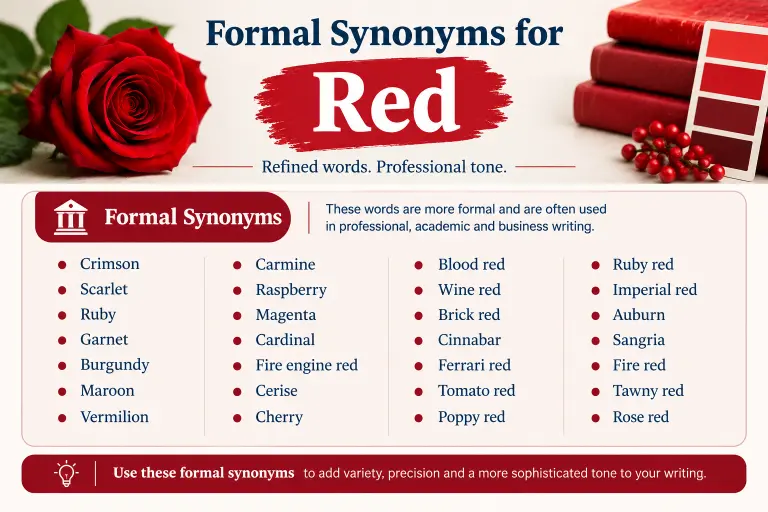
1. Crimson
Meaning: A deep, rich red, often with a slight blue or purple undertone.
Explanation: Crimson is one of the closest and most widely useful descriptive alternatives to red. It usually suggests a strong, deep shade rather than an ordinary bright red.
Example: The artist used a crimson background to create a dramatic effect.
Best Use: Literature, fashion, art, design, branding, and descriptive writing.
Worst Use: When you need to identify a precise standard color without knowing its exact specification.
Tone: Rich, elegant, vivid, and somewhat literary.
2. Scarlet
Meaning: A bright, intense red.
Explanation: Scarlet describes a vivid red that is generally brighter and warmer than crimson. It can also carry literary or symbolic associations.
Example: She wore a scarlet dress to the formal event.
Best Use: Fashion, creative writing, visual descriptions, and literature.
Worst Use: When the actual shade is dark or muted.
Tone: Bold and vivid.
3. Vermilion
Meaning: A bright red to orange-red color.
Explanation: Vermilion is a specific color term historically associated with a vivid red-orange pigment. It is more precise and specialized than ordinary red.
Example: The painter added vermilion to the mixture to create a warmer shade.
Best Use: Art, painting, design, historical writing, and color descriptions.
Worst Use: Casual conversation where simply saying red would be clearer.
Tone: Formal, artistic, and precise.
4. Carmine
Meaning: A rich red or crimson pigment and color.
Explanation: Carmine generally refers to a strong, deep red. It is also associated with a traditional pigment, making it useful in artistic and technical contexts.
Example: The illustration featured carmine lettering against a pale background.
Best Use: Art, printing, design, cosmetics, and formal color descriptions.
Worst Use: Simple everyday communication when the exact shade does not matter.
Tone: Formal and sophisticated.
5. Cardinal
Meaning: A vivid, strong red.
Explanation: Cardinal is a recognized color name commonly used for a bright, strong red. It can be useful when a specific visual identity is intended.
Example: The team selected cardinal as one of its official colors.
Best Use: Design, sports branding, uniforms, and visual identity.
Worst Use: When the audience may not recognize the color term.
Tone: Precise and descriptive.
6. Ruby
Meaning: A rich red resembling the color of a ruby gemstone.
Explanation: Ruby is technically a gemstone name used descriptively for a deep, brilliant red. It often suggests richness and brightness.
Example: The necklace featured a ruby-red stone.
Best Use: Jewelry, fashion, creative writing, product descriptions, and design.
Worst Use: Technical contexts where an exact color value is required.
Tone: Elegant and vivid.
7. Garnet
Meaning: A dark red resembling the color of some garnet gemstones.
Explanation: Garnet is a narrower color description than red. It generally suggests a dark, rich red, although garnets occur in several colors.
Example: The curtains were a deep garnet shade.
Best Use: Interior design, fashion, jewelry, and descriptive writing.
Worst Use: As a universal replacement for bright red.
Tone: Rich and sophisticated.
8. Ruddy
Meaning: Having a healthy-looking reddish color, especially in the face or skin.
Explanation: Ruddy is not a direct synonym for the color red in every context. It commonly describes a person’s complexion or a reddish appearance.
Example: His face became ruddy after spending the afternoon outdoors.
Best Use: Describing complexion, faces, skin, or weathered appearances.
Worst Use: Describing a red traffic sign or a red object.
Tone: Descriptive and somewhat literary.
9. Reddish
Meaning: Somewhat red or containing red.
Explanation: Reddish is a broader, less exact term. It means something has a red appearance but may also contain brown, orange, pink, or another color.
Example: The wall had a reddish-brown finish.
Best Use: Scientific descriptions, observation, everyday writing, and approximate color descriptions.
Worst Use: When you need to communicate a strong, pure red.
Tone: Neutral and precise.
10. Rouge
Meaning: A red or pink cosmetic color; also a French-derived color term.
Explanation: Rouge is commonly associated with red cosmetic coloring, particularly makeup applied to the cheeks. It can also appear in artistic or fashion-related descriptions.
Example: The designer chose a soft rouge shade for the packaging.
Best Use: Fashion, cosmetics, beauty writing, and creative descriptions.
Worst Use: General technical writing where red or a specific color code is clearer.
Tone: Stylish and somewhat formal.
Semi-Formal and Neutral Synonyms for Red
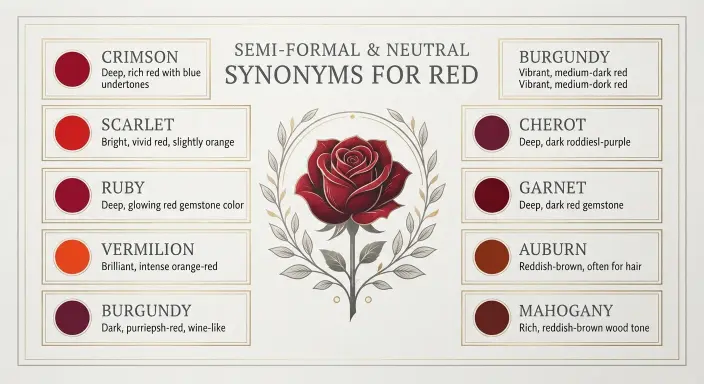
11. Burgundy
Meaning: A dark red with purple or wine-like qualities.
Explanation: Burgundy is a specific dark shade rather than a perfect synonym for every type of red.
Example: He chose a burgundy jacket for the winter event.
Best Use: Fashion, interior design, branding, and product descriptions.
Worst Use: Bright-red objects.
Tone: Sophisticated and neutral.
12. Maroon
Meaning: A dark reddish-brown color.
Explanation: Maroon is commonly used for a dark red that has brown or muted qualities. It is narrower than red.
Example: The school uses maroon and white in its uniforms.
Best Use: Clothing, branding, sports, school colors, and design.
Worst Use: Describing vivid scarlet or bright red.
Tone: Neutral and descriptive.
13. Cherry Red
Meaning: A bright or medium red resembling the color of a ripe cherry.
Explanation: This phrase gives a visual comparison. It usually suggests a lively, attractive red.
Example: She painted the door cherry red.
Best Use: Cars, fashion, interiors, food packaging, and creative descriptions.
Worst Use: Scientific or technical color measurement.
Tone: Vivid and accessible.
14. Wine-Red
Meaning: A dark red resembling the color of red wine.
Explanation: Wine-red is a descriptive compound rather than a universal synonym. It normally suggests a deep, muted red.
Example: The room was decorated with wine-red curtains.
Best Use: Interior design, fashion, literature, and product descriptions.
Worst Use: Bright-red objects.
Tone: Elegant and descriptive.
15. Brick-Red
Meaning: A muted red with brown or orange undertones.
Explanation: The term comes from the typical color of fired clay bricks. It is useful when a natural, earthy red is intended.
Example: The building had a brick-red exterior.
Best Use: Architecture, design, clothing, and nature writing.
Worst Use: Describing a brilliant red.
Tone: Neutral and earthy.
16. Rust
Meaning: A reddish-brown or orange-brown color resembling oxidized iron.
Explanation: Rust can describe a material and, by extension, its characteristic color. It is more orange-brown than pure red.
Example: The designer used rust-colored fabric for the cushions.
Best Use: Fashion, interiors, autumn descriptions, and earthy color palettes.
Worst Use: A pure red color.
Tone: Earthy and descriptive.
17. Terracotta
Meaning: An earthy reddish-orange color associated with fired clay.
Explanation: Terracotta describes both a type of fired clay and its characteristic warm color. It is therefore a contextual color alternative rather than an exact synonym.
Example: The website uses terracotta accents against a cream background.
Best Use: Interior design, architecture, fashion, art, and branding.
Worst Use: When a bright primary red is intended.
Tone: Warm and sophisticated.
18. Coral
Meaning: A pinkish-orange or reddish color.
Explanation: Coral covers a range of warm colors and can be much lighter or more orange than ordinary red.
Example: She selected a coral blouse for the summer event.
Best Use: Fashion, beauty, interiors, and visual design.
Worst Use: Precise descriptions of dark or pure red.
Tone: Fresh and approachable.
19. Rose
Meaning: A pinkish-red color associated with roses.
Explanation: Rose usually describes a softer, lighter red with pink qualities. It should not automatically replace red.
Example: The invitation featured a delicate rose border.
Best Use: Fashion, flowers, design, cosmetics, and creative writing.
Worst Use: Strong, saturated red.
Tone: Soft and elegant.
20. Berry Red
Meaning: A red inspired by the color of berries.
Explanation: This is a broad descriptive phrase rather than a standardized color. It can refer to rich reds with pink, purple, or dark undertones.
Example: The lipstick comes in a deep berry-red shade.
Best Use: Cosmetics, fashion, food, and product descriptions.
Worst Use: Technical color specifications.
Tone: Modern and descriptive.
21. Deep Red
Meaning: A dark or intense version of red.
Explanation: Deep red is useful when you want to stay close to the original color while specifying its intensity.
Example: The walls were painted a deep red.
Best Use: Interior design, fashion, art, and everyday descriptions.
Worst Use: When the color is pale or bright.
Tone: Neutral and clear.
22. Bright Red
Meaning: A vivid, highly noticeable red.
Explanation: This phrase preserves the core meaning of red while adding information about brightness.
Example: The warning label uses bright red lettering.
Best Use: Signs, safety information, design, clothing, and everyday descriptions.
Worst Use: Dark red objects.
Tone: Direct and neutral.
23. Dark Red
Meaning: A red with low brightness or greater depth.
Explanation: Dark red is a straightforward descriptive alternative when the exact shade is not important.
Example: The website uses dark red for its headings.
Best Use: Design, websites, clothing, and general writing.
Worst Use: When a specific standardized shade is required.
Tone: Simple and neutral.
24. Fire-Engine Red
Meaning: A very bright, vivid red associated with fire engines.
Explanation: This phrase is highly visual and usually refers to a strong, saturated red.
Example: He bought a fire-engine-red sports car.
Best Use: Creative descriptions, fashion, cars, design, and advertising.
Worst Use: Formal scientific or technical writing.
Tone: Vivid and conversational.
25. Tomato Red
Meaning: A warm red with orange undertones.
Explanation: The term compares the color to a ripe tomato. It is a useful descriptive label but not a universal definition.
Example: The kitchen walls were painted tomato red.
Best Use: Interiors, food writing, design, and creative descriptions.
Worst Use: Technical color specifications.
Tone: Warm and accessible.
Informal and Casual Synonyms for Red
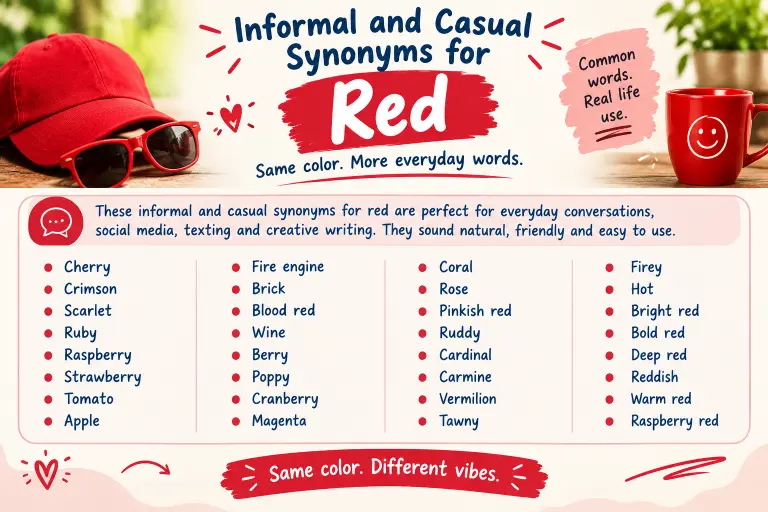
Casual English does not have many true synonyms for red. Instead, speakers often use vivid comparisons or descriptive phrases.
26. Fiery Red
Meaning: A very bright or intense red that suggests fire or heat.
Example: She chose a fiery red scarf.
When it sounds natural: Fashion, creative writing, advertising, and conversation.
When to avoid it: Formal reports or precise technical descriptions.
Tone: Energetic and dramatic.
27. Flame-Red
Meaning: A vivid red associated with flames.
Example: The sports car came in a striking flame-red finish.
When it sounds natural: Product descriptions, fashion, cars, and creative writing.
When to avoid it: Academic or scientific writing unless the visual comparison is relevant.
Tone: Vivid and expressive.
28. Blood-Red
Meaning: A deep red resembling blood.
Example: The sky turned blood-red at sunset.
When it sounds natural: Fiction, poetry, dramatic descriptions, and visual storytelling.
When to avoid it: Sensitive contexts where a blood comparison may be inappropriate or unnecessarily graphic.
Tone: Dramatic and intense.
29. Hot Red
Meaning: A very bright or intense red.
Example: The designer used hot red to make the button stand out.
When it sounds natural: Design, fashion, advertising, and casual descriptions.
When to avoid it: Formal writing where a specific color name would be clearer.
Tone: Casual and energetic.
30. Apple Red
Meaning: A bright red resembling the skin of a ripe red apple.
Example: The kitchen appliance was available in apple red.
When it sounds natural: Product descriptions, fashion, design, and casual speech.
When to avoid it: Technical color documentation.
Tone: Friendly and visual.
31. Candy-Apple Red
Meaning: A glossy, vivid red associated with candy-coated apples.
Example: The classic car had a glossy candy-apple-red finish.
When it sounds natural: Automotive writing, fashion, design, and creative descriptions.
When to avoid it: Academic and highly technical writing.
Tone: Playful and vivid.
32. Rosy
Meaning: Pinkish-red, especially in a person’s cheeks or complexion.
Example: Her cheeks looked rosy after the walk.
When it sounds natural: Everyday conversation, lifestyle writing, and descriptions of faces or skin.
When to avoid it: Describing an object that is simply pure red.
Tone: Warm and gentle.
33. Flushed
Meaning: Redder than usual because of heat, emotion, exercise, embarrassment, or another physical response.
Example: His face was flushed after the long run.
When it sounds natural: Describing people and physical appearance.
When to avoid it: General color descriptions such as a red car or red wall.
Tone: Natural and descriptive.
34. Blushing
Meaning: Becoming or appearing pink or red, usually because of emotion or embarrassment.
Example: Her cheeks were blushing pink after the compliment.
When it sounds natural: Personal descriptions, fiction, and informal writing.
When to avoid it: Technical color descriptions.
Tone: Casual and expressive.
35. Auburn
Meaning: A reddish-brown color, especially associated with hair.
Example: She has beautiful auburn hair.
When it sounds natural: Describing hair, especially in creative or personal writing.
When to avoid it: Describing a bright red object.
Tone: Descriptive and elegant.
True Synonyms vs. Contextual Synonyms for Red
The word red is unusually broad. Many alternatives are actually specific shades rather than true synonyms. Others describe a red appearance rather than the color itself.
| Type | What It Means | Can It Replace “Red”? |
|---|---|---|
| True or very close synonym | A term that can describe red with little change in general meaning | Sometimes |
| Near synonym | A similar red shade with a different intensity or undertone | Only in suitable contexts |
| Contextual alternative | A word connected with red in a specific situation | Only in that context |
| Broader expression | A term that can cover red plus related colors or appearances | Sometimes |
| Narrower expression | A particular type or shade of red | Only when that shade is intended |
| Formal equivalent | A specialized or precise color term | Yes, when the shade matches |
| Casual equivalent | A vivid everyday description | Only in informal contexts |
For example, crimson, scarlet, vermilion, and carmine are all red-family color terms, but they identify different shades. Ruddy describes a reddish complexion, while flushed describes a temporary physical appearance. Auburn is usually associated with reddish-brown hair. These distinctions prevent inaccurate substitutions.
Industry-Specific Usage of Red Synonyms
Business Writing: Red Color Synonyms
Business writing often needs simple and recognizable color terms.
For a general document, use:
- Red
- Bright red
- Dark red
- Deep red
- Crimson
- Burgundy
- Maroon
Example:
“Use dark red for warnings and black for general instructions.”
For branding or product descriptions, more descriptive terms such as crimson, scarlet, or ruby may be useful.
Corporate Communication and Color Descriptions
Corporate communication should prioritize clarity over decorative vocabulary.
For example:
“The warning icon appears in red.”
is clearer than:
“The warning icon appears in a fiery scarlet hue.”
However, brand guidelines may require a specific color name. In those cases, terms such as cardinal, crimson, or burgundy can be appropriate if they match the organization’s defined color.
Academic Writing and Red Synonyms
Academic writing generally favors objective descriptions.
Useful terms include:
- Red
- Reddish
- Dark red
- Bright red
- Red-orange
- Red-brown
- Crimson, when the specific shade matters
Example:
“The sample developed a reddish-brown surface after exposure.”
This is more precise than using an expressive phrase such as fiery red.
Customer Service and Red Color Descriptions
Customer service messages should use recognizable language.
Instead of:
“Select the vermilion option.”
you might write:
“Select the red option.”
If several shades are available, a more precise description can help:
“Please select the dark red option shown in the product image.”
Clarity matters more than vocabulary variety in support communication.
Legal Writing and Red Color Terms
Legal and regulatory documents may need exact descriptions of objects, markings, labels, or evidence. A color word should not be changed simply to make the writing more varied.
For example:
“The package had a red warning label.”
should not automatically become:
“The package had a crimson warning label.”
unless crimson accurately describes the relevant color.
Where a contract, regulation, specification, or legal record depends on an exact color, the governing document or technical color specification should control. General synonyms are not substitutes for an established technical definition.
Email Communication
For professional emails, simple color terms usually work best:
- Red
- Dark red
- Bright red
- Crimson
- Burgundy
- Maroon
Example:
“I’ve marked the urgent items in red so they’re easy to find.”
That sentence is clearer than using a decorative synonym.
Email Examples Using Red Synonyms
Email 1 — Design Feedback
Subject: Color Adjustment for the Brochure
Hi Mia,
The layout looks good overall. Could you change the headline from bright red to a deeper crimson? I think the darker shade will work better with the background.
Thanks,
Daniel
Email 2 — Client Product Description
Subject: Updated Product Color Options
Hi James,
I’ve updated the product page to include the new burgundy option. The description now distinguishes it from the standard red version.
Please let me know if you’d like any other changes.
Best,
Olivia
Email 3 — Internal Workplace Message
Subject: Red Markings in the Spreadsheet
Hi Team,
I’ve highlighted the items that need immediate attention in red. The remaining cells are unchanged.
Please review the marked items before tomorrow’s meeting.
Thanks,
Chris
Email 4 — Vendor Request
Subject: Confirming the Color Sample
Hello Sarah,
Thanks for sending the samples. The darker red is closer to what we’re looking for, but we’d like to compare it with a slightly warmer scarlet before making the final selection.
Could you send that sample with the next shipment?
Best regards,
Alex
Email 5 — Academic Communication
Subject: Clarification About the Figure
Dear Professor Adams,
I’ve updated Figure 3 so the red section is easier to distinguish from the surrounding areas. I used a darker red rather than a bright shade to improve readability.
Please let me know if you would prefer the original version.
Best,
Nora
Email 6 — Customer Service
Subject: Color Confirmation for Your Order
Hello,
Thank you for contacting us. The item you selected is the burgundy version, which is a dark red shade. The standard red option is listed separately on the product page.
Please let us know if you’d like to change your selection.
Regards,
Customer Support
Short Dialogues Using Red Synonyms
Workplace
Person A: Which color should I use for the urgent items?
Person B: Use red. It’s easier for everyone to recognize quickly.
Classroom
Person A: Is crimson the same as red?
Person B: It’s a type of red, but it’s usually darker and richer.
Customer Service
Person A: Is burgundy basically red?
Person B: It’s in the red family, but it’s much darker and usually has a purple or brown quality.
Casual Conversation
Person A: What color was the car?
Person B: A really bright cherry red.
Professional Discussion
Person A: Should we call the shade scarlet?
Person B: Only if it matches that shade. Otherwise, “bright red” is safer and clearer.
How to Replace “Red” in a Sentence
Example 1
Original: She wore a red dress.
Alternative: She wore a scarlet dress.
Why it works: Scarlet adds information by suggesting a vivid, bright red.
Example 2
Original: The wall was red.
Alternative: The wall was deep crimson.
Why it works: Crimson creates a darker, richer visual impression.
Example 3
Original: He has red cheeks.
Alternative: He has rosy cheeks.
Why it works: Rosy naturally describes a soft pinkish-red complexion.
Example 4
Original: His face was red after exercising.
Alternative: His face was flushed after exercising.
Why it works: Flushed explains that the redness was caused by a physical response.
Example 5
Original: She has red hair.
Alternative: She has auburn hair.
Why it works: Auburn gives a more specific reddish-brown description. It should only be used if that shade is accurate.
Example 6
Original: The car was red.
Alternative: The car was cherry red.
Why it works: Cherry red creates a more vivid visual description without sounding overly technical.
Example 7
Original: The curtains were red.
Alternative: The curtains were burgundy.
Why it works: Burgundy specifies a dark red shade and is especially natural in interior-design contexts.
Example 8
Original: The building had a red exterior.
Alternative: The building had a brick-red exterior.
Why it works: Brick-red communicates a muted, earthy red rather than an unspecified color.
Example 9
Original: The artist used red paint.
Alternative: The artist used vermilion paint.
Why it works: Vermilion is a more specific color and pigment term, making it appropriate for art-related writing.
Example 10
Original: The warning sign was red.
Alternative: The warning sign was bright red.
Why it works: Bright red keeps the meaning clear while adding information about visibility and intensity.
Comparison Table for Red Synonyms
| Phrase | Tone | Meaning / Scope | Best Use | Example |
|---|---|---|---|---|
| Red | Neutral | Basic color | General writing | The door is red. |
| Crimson | Rich/formal | Deep red | Art, fashion, writing | A crimson dress |
| Scarlet | Vivid | Bright intense red | Fashion, literature | Scarlet fabric |
| Vermilion | Formal | Bright red-orange | Art and pigments | Vermilion paint |
| Carmine | Formal | Rich red | Art and design | Carmine lettering |
| Ruby | Elegant | Rich gemstone-like red | Jewelry, fashion | Ruby-red shoes |
| Burgundy | Sophisticated | Dark red | Fashion, interiors | Burgundy curtains |
| Maroon | Neutral | Dark red-brown | Clothing, branding | Maroon uniforms |
| Cherry red | Vivid | Bright cherry-like red | Cars, design | Cherry-red car |
| Brick-red | Earthy | Muted red-brown | Architecture, interiors | Brick-red walls |
| Rust | Earthy | Reddish-brown | Fashion, design | Rust-colored fabric |
| Terracotta | Warm | Reddish-orange | Interiors, architecture | Terracotta accents |
| Coral | Soft | Pinkish-orange red | Fashion, beauty | Coral blouse |
| Rose | Soft | Pinkish red | Beauty, flowers | Rose lipstick |
| Ruddy | Literary | Reddish complexion | People, skin | Ruddy cheeks |
| Reddish | Neutral | Somewhat red | Observation | Reddish-brown surface |
| Flushed | Descriptive | Temporarily red | People | A flushed face |
| Rosy | Gentle | Pinkish-red appearance | Complexion | Rosy cheeks |
| Fire-engine red | Casual | Very bright red | Cars, design | Fire-engine-red car |
| Blood-red | Dramatic | Deep blood-like red | Fiction, poetry | Blood-red sky |
Which Red Synonyms Should You Choose?
1. For Formal Writing
Choose crimson, scarlet, vermilion, carmine, or cardinal when the specific shade is accurate and the context benefits from precision.
2. For Business Communication
Use red, bright red, dark red, burgundy, or maroon. Keep color descriptions recognizable unless branding requires a specific shade.
3. For Academic Writing
Prefer red, reddish, red-orange, red-brown, dark red, or another objectively descriptive term. Use specialized names only when they accurately identify the color.
4. For Legal Writing
Use the exact color description supported by the relevant document, specification, photograph, or evidence. Do not substitute an attractive color synonym merely for stylistic variety.
5. For Professional Email
Use red, dark red, bright red, crimson, or burgundy when the distinction matters. If the exact shade is unimportant, red is usually the clearest option.
6. For Everyday Conversation
Red, bright red, dark red, cherry red, burgundy, and maroon are easy to understand.
7. For Casual Messages
Vivid expressions such as fiery red, hot red, candy-apple red, and blood-red can add personality, provided the comparison fits the situation.
Grammar and Usage Guide for Red
Red as an Adjective
Red is most commonly an adjective describing a noun.
“She bought a red car.”
Other forms work the same way:
“She bought a crimson car.”
“She bought a burgundy car.”
Red as a Noun
Red can also function as a noun when referring to the color itself.
“Red is used for the warning label.”
The plural reds can refer to different shades or items of the color.
“The designer compared several reds.”
Reddish as an Adjective
Use reddish when something is partly or somewhat red.
“The leaves had a reddish tint.”
Do not use reddish when you mean a strong, definite red.
Compound Color Adjectives
Many color descriptions use compounds:
- cherry-red
- brick-red
- wine-red
- blue-red
- red-brown
- red-orange
When a compound color appears before a noun, hyphenation is often appropriate:
“a cherry-red dress”
After a linking verb, style conventions can differ:
“The dress is cherry red.”
Dark Red vs. Dark-Red
Before a noun, style can favor a hyphenated compound:
“a dark-red wall”
After a linking verb:
“The wall is dark red.”
House style may vary, so consistency matters.
Redder and Reddest
The ordinary comparative and superlative forms are:
- red
- redder
- reddest
Example:
“This shade is redder than the previous one.”
Natural Collocations
Common combinations include:
- bright red
- dark red
- deep red
- vivid red
- pale red
- red color
- red shade
- red dress
- red paint
- red light
- red flag
- red hair
- red cheeks
- red wine
Common Mistakes to Avoid With Red Synonyms
1. Treating Every Shade as Exact Red
Burgundy, maroon, and coral are not identical to standard red. They identify narrower color ranges.
2. Calling Crimson and Scarlet Identical
Both belong to the red family, but crimson usually suggests a deeper red, while scarlet tends to be brighter.
3. Using Ruddy for Objects
Ruddy is strongly associated with complexion or reddish appearance. “A ruddy traffic sign” would usually sound unnatural.
4. Using Flushed as a Basic Color Name
Flushed describes a temporary reddish appearance, especially on skin.
5. Using Auburn for Every Red Shade
Auburn normally refers to reddish-brown hair or a similar reddish-brown color.
6. Choosing a Dramatic Term in Technical Writing
Expressions such as fiery red and blood-red may sound vivid but are not suitable when precise color identification is required.
7. Using Specialized Color Names Without Checking the Shade
Terms such as vermilion and carmine have more specific color meanings. Do not use them simply because they sound sophisticated.
8. Ignoring Undertones
A red can lean toward orange, purple, pink, or brown. Choosing coral, burgundy, or brick-red communicates that difference.
9. Overusing Color Synonyms
If a report repeatedly discusses a red object, changing red to crimson, scarlet, and carmine without a real color difference can confuse readers.
When Not to Use “Red”
The original word red is sometimes the better choice.
- When the exact shade does not matter: “The button is red” is clear.
- When the audience needs simple language: Avoid obscure color names when clarity is the priority.
- When describing technical information: Use an established color specification rather than a creative synonym.
- When the shade is uncertain: Red is safer than incorrectly calling something crimson or scarlet.
- When writing for accessibility: Common color names are generally easier for readers to understand.
- When repetition does not harm readability: You do not need a new synonym every time the color appears.
- When a legal or technical description must remain exact: Do not alter terminology simply for style.
The original word is often preferable because red is short, familiar, and widely understood.
Advanced Writer Tips for Using Red Synonyms
Tone Control
Use the color word to influence the mood of your description.
- Red — plain and direct
- Crimson — rich and dramatic
- Scarlet — bright and bold
- Ruby — elegant
- Burgundy — sophisticated
- Rose — soft
- Blood-red — intense and dramatic
Professional Email Etiquette
Don’t replace red just to make a business email sound more sophisticated. If the reader needs to identify a color quickly, plain language works best.
“I’ve marked the urgent items in red.”
is better than:
“I’ve marked the urgent items in crimson.”
unless the exact shade matters.
Politeness
Color vocabulary rarely changes politeness by itself. However, clear descriptions reduce confusion.
Instead of saying:
“Please select the darker option.”
say:
“Please select the dark red option.”
if that is what the reader needs to identify.
Context Alignment
Think about the object before choosing the synonym:
- Skin → ruddy, flushed, rosy
- Hair → auburn, reddish
- Clothing → crimson, scarlet, burgundy, maroon
- Paint → vermilion, carmine, crimson
- Architecture → brick-red, terracotta
- Jewelry → ruby, garnet
- Dramatic fiction → blood-red, fiery red
Precision
If the exact color matters, descriptive adjectives are often more reliable than poetic comparisons.
Compare:
“The sample is reddish-brown.”
with:
“The sample is fiery red.”
The first provides a more objective description. The second creates a visual impression.
Readability
Use familiar terms before specialized ones. If your audience may not know vermilion, write:
“a bright red-orange shade called vermilion”
This gives readers both clarity and precision.
Related Questions About Red Synonyms
1. What is another way to say red?
Depending on the shade and context, you can use crimson, scarlet, ruby, vermilion, carmine, burgundy, maroon, cherry red, or reddish.
2. What is the professional synonyms to red?
For professional writing, red, dark red, bright red, reddish, crimson, or burgundy can work. The best choice depends on whether you need a general or specific color description.
3. What is the formal synonyms to red?
Crimson, scarlet, vermilion, carmine, cardinal, and ruby can provide more specialized or formal color descriptions, although they represent different shades.
4. What can I use instead of red?
Use a shade-specific term such as crimson, scarlet, burgundy, maroon, coral, brick-red, or ruby if you know the intended shade.
5. Is red a formal word?
Yes. Red is a standard, neutral English word. It is appropriate in academic, professional, technical, and everyday writing.
6. Can I use crimson instead of red?
Yes, if the color is actually a deep crimson shade. Crimson is narrower than red, so it should not be used for every red object.
7. What is the difference between red and reddish?
Red identifies the color itself, while reddish means somewhat or partly red. A reddish object may also contain noticeable brown, orange, pink, or another color.
FAQs About Synonyms for Red
1. What is the closest synonyms for red?
There is no single perfect replacement for every use of red. Crimson, scarlet, and carmine are close color-family terms, but each refers to a particular shade or range of shades.
2. What is the darker synonyms for red?
Crimson, burgundy, maroon, garnet, and wine-red can describe darker forms of red. Their undertones differ, so choose according to the actual color.
3. What is the bright synonyms for red?
Scarlet, vermilion, cardinal, cherry red, and fire-engine red can describe bright reds. Vermilion usually leans toward orange, while scarlet is a vivid red.
4. What is the soft synonyms for red?
Rose, coral, and rosy can describe softer red-related colors. These terms often contain noticeable pink or orange qualities, so they are not exact substitutes for pure red.
5. What is the synonyms for red when describing skin?
For skin or complexion, ruddy, flushed, rosy, or blushing may work depending on the cause and appearance. These terms describe an appearance rather than simply naming a color.
6. What is the creative synonyms for red?
Creative writing can use expressions such as blood-red, fiery red, flame-red, ruby-red, cherry red, or candy-apple red. These create stronger visual impressions than the plain word red.
7. Is burgundy a synonym for red?
Burgundy is a narrower color term within the red family, not a perfect synonym. It usually describes a dark red with purple or wine-like qualities.
Key Takeaways
- Red is the broad, neutral term, while most alternatives describe particular shades or appearances.
- Crimson, scarlet, vermilion, and carmine are useful when you need a more specific red.
- Burgundy, maroon, brick-red, coral, and rose describe different red-related shades rather than pure red.
- Use ruddy, rosy, flushed, or blushing for reddish appearances of skin or faces.
- Choose simple red when clarity matters more than stylistic variety, and use creative alternatives only when they add useful meaning.
Conclusion
The best synonym for red depends on the exact color and the situation in which you are using it. For a deep, rich shade, crimson works well; scarlet suggests a brighter red; vermilion adds an orange quality; and carmine offers a rich pigment-based description.
Terms such as burgundy, maroon, brick-red, and coral are useful when the red has particular undertones. For people and appearance, words such as ruddy, rosy, and flushed can be much more natural than simply saying red.
Creative writing also gives you room for expressions such as fiery red, ruby-red, or blood-red. Still, you should not replace red simply to avoid repetition. The plain word is often the clearest choice. Use a more specific alternative when it communicates a shade, appearance, mood, or visual quality that the original word does not express.
