
The right synonyms for anger can help you describe emotions with much greater precision. “Anger” is a broad word, but it can refer to anything from mild irritation and annoyance to intense rage, fury, or outrage.
The best alternative depends on the strength of the emotion and what caused it.Writers may look for alternatives to avoid repetition, create a stronger emotional effect, or choose language that fits a particular setting.
A novel may need “fury,” an academic paper may use “indignation,” and a professional email may be better with “frustration” or “concern.” This guide explains more than 35 alternatives and shows how their meanings, tones, and uses differ.
Quick Answer: Synonyms for Anger
Common synonyms for anger include irritation, annoyance, frustration, resentment, displeasure, indignation, exasperation, hostility, fury, rage, wrath, outrage, vexation, bitterness, and indignation. These words are not always interchangeable: some describe mild irritation, while others suggest intense anger, moral offense, hostility, or long-term resentment.
Quick List: Fast Reader Guide to Synonyms for Anger
Closest Synonyms for Anger
- Irritation
- Annoyance
- Frustration
- Resentment
- Displeasure
- Indignation
- Exasperation
- Vexation
- Fury
- Rage
- Wrath
- Outrage
- Hostility
- Bitterness
- Agitation
Formal Synonyms for Anger
- Indignation
- Displeasure
- Resentment
- Exasperation
- Hostility
- Wrath
- Outrage
- Acrimony
- Animosity
- Antagonism
Neutral Synonyms for Anger
- Irritation
- Annoyance
- Frustration
- Discontent
- Agitation
- Upset
- Resentment
- Impatience
- Tension
- Displeasure
Informal and Casual Synonyms for Anger
- Being mad
- Being ticked off
- Being annoyed
- Being steamed
- Being worked up
- Losing your temper
- Blowing up
- Seeing red
Some expressions describe anger itself, while others describe a reaction to anger. For example, “losing your temper” refers to losing emotional control, not simply feeling angry.
Formal Synonyms for Anger
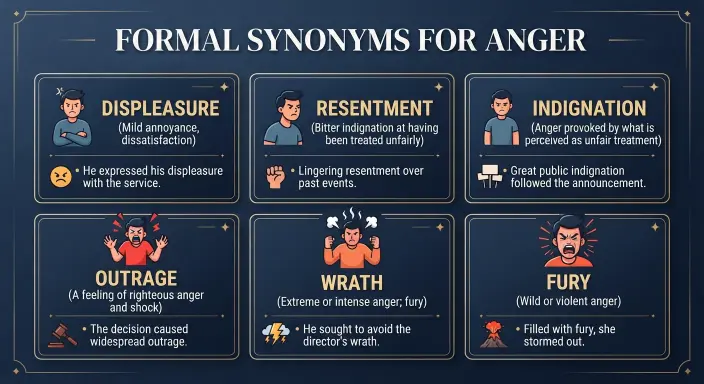
Formal vocabulary can make writing more precise, especially in academic, professional, literary, or official contexts. However, formal does not automatically mean stronger. The exact meaning still matters.
1. Indignation
Meaning: Anger caused by something considered unfair, unjust, or morally wrong.
Explanation: “Indignation” is narrower than general anger. It usually contains a sense that the person has been wronged or has witnessed wrongdoing.
Example: The community expressed indignation over the unfair treatment of local workers.
Best Use: Academic writing, journalism, formal commentary, speeches, and serious discussions.
Worst Use: Describing mild irritation over a small inconvenience.
Tone: Formal, serious, and morally charged.
2. Displeasure
Meaning: A feeling of unhappiness, dissatisfaction, or annoyance.
Explanation: “Displeasure” is often milder than anger and can sound controlled or restrained.
Example: The manager expressed his displeasure with the repeated delays.
Best Use: Business writing, formal correspondence, professional criticism, and official communication.
Worst Use: Describing uncontrollable rage.
Tone: Formal, restrained, and diplomatic.
3. Resentment
Meaning: A lasting feeling of anger or bitterness caused by perceived unfair treatment.
Explanation: Resentment often develops over time rather than appearing suddenly.
Example: Years of unequal treatment created resentment among the employees.
Best Use: Essays, workplace analysis, literature, psychology-related writing, and social discussions.
Worst Use: A sudden moment of anger.
Tone: Serious and reflective.
4. Exasperation
Meaning: Strong annoyance caused by repeated problems, delays, or difficulties.
Explanation: Exasperation often appears when someone has become tired of dealing with the same frustrating situation.
Example: After receiving the same error message for the fifth time, she sighed in exasperation.
Best Use: Formal narratives, essays, workplace writing, and descriptive prose.
Worst Use: Extreme violence or uncontrollable fury.
Tone: Formal to neutral.
5. Hostility
Meaning: Openly unfriendly, aggressive, or antagonistic feeling or behavior.
Explanation: Hostility is related to anger but describes an attitude toward another person or group. It often involves behavior as well as emotion.
Example: The discussion became difficult because of growing hostility between the two groups.
Best Use: Reports, academic writing, workplace communication, and conflict analysis.
Worst Use: Describing a brief moment of annoyance.
Tone: Formal and serious.
6. Wrath
Meaning: Extremely strong anger.
Explanation: “Wrath” is a powerful and somewhat literary word. It can describe severe anger, especially in dramatic or historical writing.
Example: The king’s wrath was feared throughout the kingdom.
Best Use: Literature, historical writing, religious texts, dramatic prose, and elevated language.
Worst Use: Routine workplace emails.
Tone: Powerful, dramatic, and literary.
7. Outrage
Meaning: Extreme anger caused by something considered shocking, offensive, or unjust.
Explanation: “Outrage” often combines anger with a strong sense of moral offense.
Example: The decision sparked public outrage.
Best Use: Journalism, public discussion, formal commentary, and serious writing.
Worst Use: Minor inconveniences.
Tone: Strong, serious, and public.
8. Acrimony
Meaning: Bitter hostility or anger, especially during a disagreement.
Explanation: Acrimony describes a harsh and bitter quality in conflict, speech, or relationships.
Example: The negotiations ended in acrimony after both sides rejected the proposal.
Best Use: Formal reports, political or business analysis, legal contexts, and serious prose.
Worst Use: Simple everyday irritation.
Tone: Formal, severe, and negative.
9. Animosity
Meaning: Strong dislike or hostility toward another person or group.
Explanation: Animosity is usually directed at someone or something and may continue over time.
Example: Long-standing animosity between the two teams affected their negotiations.
Best Use: Formal writing, history, journalism, and conflict analysis.
Worst Use: A temporary feeling of annoyance.
Tone: Formal and serious.
10. Antagonism
Meaning: Active opposition or hostility.
Explanation: “Antagonism” focuses more on conflict or opposition than on the internal feeling of anger.
Example: Political antagonism made cooperation difficult.
Best Use: Academic, political, business, and analytical writing.
Worst Use: Describing mild personal irritation.
Tone: Formal and analytical.
11. Aggravation
Meaning: Annoyance or frustration caused by a problem or repeated difficulty.
Explanation: In American English, “aggravation” can refer to an irritating situation or the emotional response to it.
Example: The repeated technical problems caused considerable aggravation.
Best Use: Professional writing, everyday formal communication, and descriptive prose.
Worst Use: Describing deep moral anger.
Tone: Neutral to formal.
12. Vexation
Meaning: Irritation or annoyance.
Explanation: “Vexation” is a somewhat old-fashioned or literary alternative. It usually suggests troubled irritation rather than explosive anger.
Example: To her great vexation, the package arrived several days late.
Best Use: Literary writing, formal prose, and historical-style writing.
Worst Use: Modern casual conversation.
Tone: Formal, literary, and slightly old-fashioned.
Semi-Formal and Neutral Synonyms for Anger
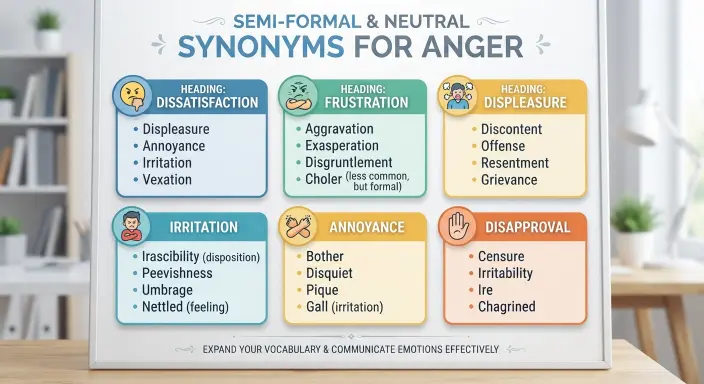
These alternatives are useful when you want natural language without sounding either too dramatic or too casual.
1. Irritation
Meaning: Mild anger or annoyance.
Explanation: Irritation is usually less intense than anger.
Example: His constant interruptions caused some irritation during the meeting.
Best Use: Work, school, everyday writing, and professional communication.
Worst Use: Describing extreme fury.
Tone: Neutral and controlled.
2. Annoyance
Meaning: A feeling of being bothered or irritated.
Explanation: Annoyance is generally mild. It works well when the situation does not justify stronger language.
Example: She tried not to show her annoyance at the repeated questions.
Best Use: Everyday writing, emails, and conversation.
Worst Use: Describing intense emotional conflict.
Tone: Neutral and mild.
3. Frustration
Meaning: Anger or disappointment caused by being unable to achieve something or solve a problem.
Explanation: Frustration often involves an obstacle, delay, failure, or lack of progress.
Example: The team expressed frustration with the slow approval process.
Best Use: Workplace, school, customer service, and everyday communication.
Worst Use: When there is no obstacle or disappointment involved.
Tone: Neutral and professional.
4. Discontent
Meaning: A feeling of dissatisfaction or unhappiness.
Explanation: Discontent is broader and often less emotionally intense than anger.
Example: Growing discontent among employees led management to review the policy.
Best Use: Reports, essays, workplace communication, and social analysis.
Worst Use: A sudden emotional outburst.
Tone: Neutral to formal.
5. Upset
Meaning: Emotionally disturbed, unhappy, or angry.
Explanation: “Upset” is broad and can refer to sadness, disappointment, or anger, so it is less precise.
Example: She was upset about the unexpected cancellation.
Best Use: Everyday conversation and informal professional communication.
Worst Use: Academic writing where the exact emotion matters.
Tone: Neutral and conversational.
6. Agitation
Meaning: A state of emotional disturbance, restlessness, or strong annoyance.
Explanation: Agitation can involve anger but may also include nervousness or physical restlessness.
Example: The customer showed visible agitation while waiting for assistance.
Best Use: Reports, professional communication, and descriptive writing.
Worst Use: When you need to identify simple irritation.
Tone: Neutral to formal.
7. Impatience
Meaning: Annoyance caused by having to wait or deal with delays.
Explanation: Impatience is a specific form of frustration and may lead to anger.
Example: His impatience became obvious when the meeting ran over time.
Best Use: Workplace writing, everyday descriptions, and professional communication.
Worst Use: Deep resentment or moral outrage.
Tone: Neutral.
8. Bitterness
Meaning: Persistent anger, resentment, or disappointment.
Explanation: Bitterness often develops after painful experiences and can last for a long time.
Example: Years after the dispute, she still spoke with bitterness about what happened.
Best Use: Personal essays, literature, biographies, and emotional descriptions.
Worst Use: A brief annoyance.
Tone: Strong, emotional, and serious.
9. Discontentment
Meaning: A state of dissatisfaction or unhappiness.
Explanation: This word is related to “discontent” but is generally less common in everyday usage.
Example: His discontentment with the workplace gradually increased.
Best Use: Formal or descriptive writing.
Worst Use: Short conversational sentences where “dissatisfaction” or “discontent” is clearer.
Tone: Formal.
10. Tension
Meaning: A strained emotional or interpersonal state.
Explanation: Tension does not necessarily mean anger. It can indicate unresolved conflict, discomfort, stress, or hostility.
Example: Tension grew between the two departments after the disagreement.
Best Use: Workplace reports, narratives, journalism, and conflict descriptions.
Worst Use: As a direct replacement for anger in every sentence.
Tone: Neutral and analytical.
11. Dissatisfaction
Meaning: A feeling that something is not acceptable or satisfactory.
Explanation: Dissatisfaction can produce anger, but it is usually more restrained.
Example: Customers expressed dissatisfaction with the new service process.
Best Use: Business, customer service, surveys, reports, and formal communication.
Worst Use: Describing emotional rage.
Tone: Professional and controlled.
12. Resentfulness
Meaning: A tendency or state of feeling resentment.
Explanation: This describes a lingering negative feeling rather than a sudden angry reaction.
Example: His resentfulness became clear whenever the subject was mentioned.
Best Use: Character descriptions and analytical writing.
Worst Use: A simple workplace complaint.
Tone: Serious and descriptive.
Informal and Casual Synonyms for Anger
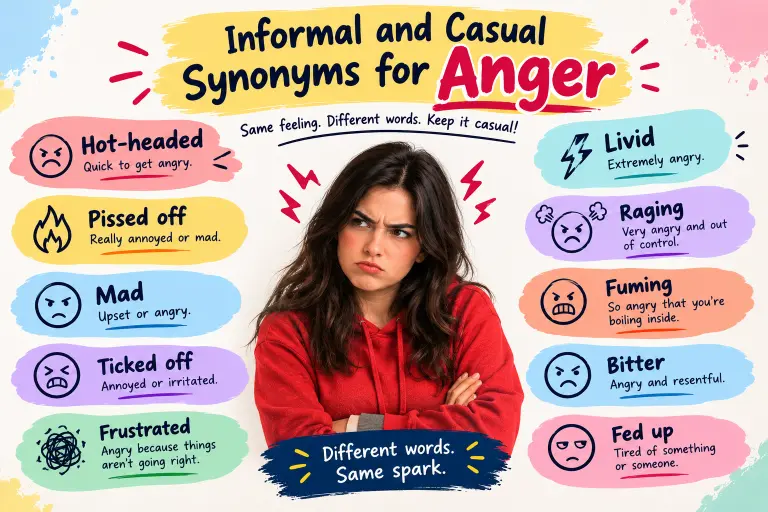
Casual expressions can make conversations and dialogue sound natural. Some describe the emotional state, while others describe visible reactions.
1. Mad
Meaning: Angry.
Example: I’m still mad about what happened.
When it sounds natural: Everyday American English, texting, conversations, and casual dialogue.
When to avoid it: Formal reports and academic writing.
Tone: Very common and conversational.
2. Ticked Off
Meaning: Annoyed or angry.
Example: He was really ticked off when his order arrived damaged.
When it sounds natural: Informal American conversation.
When to avoid it: Professional emails, academic papers, and formal documents.
Tone: Casual and mildly strong.
3. Steamed
Meaning: Very annoyed or angry.
Example: Dad was steamed when he found out about the broken window.
When it sounds natural: Informal storytelling and conversation.
When to avoid it: Formal writing.
Tone: Casual and expressive.
4. Worked Up
Meaning: Emotionally upset, excited, or angry.
Example: Don’t get so worked up over a small mistake.
When it sounds natural: Everyday speech.
When to avoid it: Situations where you need to identify anger specifically because “worked up” can describe other emotions.
Tone: Casual.
5. Losing Your Temper
Meaning: Becoming unable to control an angry reaction.
Example: He apologized after losing his temper during the argument.
When it sounds natural: Conversation and narrative writing.
When to avoid it: When you simply mean someone felt angry.
Tone: Conversational.
6. Blowing Up
Meaning: Suddenly becoming very angry.
Example: She blew up when she discovered that the appointment had been canceled.
When it sounds natural: Casual conversation and dialogue.
When to avoid it: Professional and academic writing.
Tone: Strong and informal.
7. Seeing Red
Meaning: Feeling extremely angry.
Example: I was seeing red after they blamed me for the mistake.
When it sounds natural: Casual speech, stories, and creative writing.
When to avoid it: Formal or technical contexts.
Tone: Idiomatic and dramatic.
True Synonyms vs Contextual Synonyms for Anger
The most important distinction is that anger exists on a spectrum. Some alternatives indicate mild irritation, some describe intense anger, and others explain why the anger exists.
| Type | What It Means | Can It Replace “Anger”? |
|---|---|---|
| True or close synonym | General feeling of strong displeasure or hostility | Usually |
| Near synonym | Similar negative emotion with a different intensity | Sometimes |
| Contextual alternative | Describes a particular cause or form of anger | Only in the right context |
| Broader expression | Describes general emotional upset or dissatisfaction | Sometimes |
| Narrower expression | Describes a specific kind of anger | Only when that meaning fits |
| Formal equivalent | More elevated or restrained wording | Yes, in suitable contexts |
| Casual equivalent | Informal expression for anger | Yes, in casual settings |
For example, irritation is usually milder than anger. Rage is much stronger. Resentment tends to last longer. Frustration usually involves an obstacle. Indignation adds a sense of unfairness or moral offense.
Business Writing: Professional Synonyms for Anger
Business writing usually benefits from restrained and specific language. Saying that a client was “furious” can sound emotional unless that intensity is genuinely relevant.
Useful choices include:
- Frustration
- Dissatisfaction
- Concern
- Displeasure
- Irritation
- Discontent
- Tension
- Resentment
For example:
The customer expressed frustration with the delayed shipment.
This is usually more professional than:
The customer was extremely angry about the shipment.
If the person’s actual behavior was aggressive, however, describe the behavior accurately rather than softening it unnecessarily.
Corporate Communication and Anger Synonyms
Internal reports and workplace communication should distinguish between an emotion and a conflict.
Instead of:
There was a lot of anger during the meeting.
You could write:
The discussion became tense after the proposed changes were announced.
Or:
Several employees expressed frustration with the new process.
Or:
The announcement generated considerable dissatisfaction among staff.
These alternatives communicate the situation while identifying whether the issue involved tension, frustration, or dissatisfaction.
Academic Writing and Synonyms for Anger
Academic writing benefits from precise emotional vocabulary.
Useful terms include:
- Indignation
- Resentment
- Hostility
- Frustration
- Outrage
- Discontent
- Antagonism
- Acrimony
Example:
The character’s growing resentment reflects years of perceived injustice.
This is more informative than simply saying:
The character feels angry.
In literature, history, and social analysis, identify why the anger exists whenever possible.
Customer Service and Anger Synonyms
Customer service writing should acknowledge a person’s emotional response without escalating the situation.
Useful phrases include:
- Frustration
- Concern
- Dissatisfaction
- Disappointment
- Irritation
For example:
We understand your frustration regarding the delayed delivery.
This recognizes the customer’s experience without labeling the customer as “angry.”
A useful distinction is:
We understand your frustration.
rather than:
We understand that you are angry.
The first often sounds more empathetic and less confrontational.
Legal Writing and Anger Synonyms
Legal and official writing should focus on documented conduct, statements, or reactions rather than relying on emotional labels.
For example:
The individual expressed dissatisfaction with the decision.
is more precise than:
The individual was furious.
Words such as hostility, animosity, aggression, or threatening behavior may describe different things and should not be treated as interchangeable. In legal contexts, the exact facts and applicable jurisdiction determine the significance of specific wording.
Email Communication and Professional Synonyms for Anger
Professional emails often benefit from replacing direct emotional labels with the underlying issue.
Instead of:
I am angry about the delay.
Consider:
I am frustrated by the repeated delays.
Or:
I am concerned about the continued delay.
Or:
I am disappointed that the agreed timeline was not met.
The best option depends on how strong and direct you need to be.
Email Examples Using Synonyms for Anger
Email 1: Client Communication
Subject: Update on the Delayed Shipment
Dear Ms. Patel,
I understand your frustration regarding the delayed shipment. We expected the order to arrive earlier, and I apologize for the inconvenience.
The carrier has now confirmed a new delivery date of Thursday. I will continue to monitor the shipment and let you know if anything changes.
Best,
Daniel
Email 2: Project Update
Subject: Timeline Concerns
Hi Team,
I want to acknowledge the frustration surrounding the recent project delays. Several tasks took longer than expected, which affected the original timeline.
We have adjusted the schedule and identified the remaining dependencies. I’ll share another update after tomorrow’s review.
Best,
Maria
Email 3: Professional Request
Subject: Follow-Up on Outstanding Request
Dear James,
I am writing to follow up on the request I sent last week. I am becoming concerned about the delay because we need the information before Friday’s submission.
Could you please let me know when we can expect the documents?
Thank you,
Alex
Email 4: Customer Service
Subject: Your Service Concern
Dear Mr. Brooks,
Thank you for contacting us. I understand your dissatisfaction with the recent service experience, and I am sorry that we did not meet your expectations.
I have reviewed your case and arranged for the issue to be addressed by our support team.
Kind regards,
Customer Care
Email 5: Academic Communication
Subject: Clarification About the Assignment
Dear Professor Lee,
I wanted to ask about the feedback on my assignment. I was initially frustrated because I did not understand why several sections needed revision, but your comments helped clarify the expectations.
Would it be possible to confirm whether I should resubmit the full paper or only the revised sections?
Best regards,
Hannah
Email 6: Internal Workplace Email
Subject: Concerns About the New Schedule
Hi Robert,
Several team members have expressed frustration with the new schedule because it creates conflicts with existing project deadlines.
Could we review the schedule during tomorrow’s meeting and see if any adjustments are possible?
Thanks,
Nina
Email 7: Vendor Communication
Subject: Repeated Delivery Delays
Dear Mr. Wilson,
We are concerned about the repeated delays with recent deliveries. The latest shipment arrived four days after the agreed date, which affected our production schedule.
Please let us know what steps can be taken to prevent further delays.
Regards,
Kevin
Short Dialogue Examples Using Synonyms for Anger
Workplace
Person A: You seem frustrated with the new system.
Person B: I am. I’ve reported the same problem three times.
Classroom
Person A: Why did Sarah leave the discussion?
Person B: She was upset after her idea was dismissed.
Customer Service
Person A: The customer sounds angry.
Person B: I think she’s mainly frustrated because her issue hasn’t been resolved.
Casual Conversation
Person A: Are you still mad at Tom?
Person B: A little, but I’m trying to move past it.
Professional Discussion
Person A: Why did the meeting become so tense?
Person B: There was growing resentment over how the decision was handled.
How to Replace “Anger” in a Sentence
1. Mild emotional response
Original:
His anger was obvious during the meeting.
Alternative:
His irritation was obvious during the meeting.
Why it works: “Irritation” suggests a milder emotional response.
2. Problem-related emotion
Original:
The team’s anger grew as the project was delayed.
Alternative:
The team’s frustration grew as the project was delayed.
Why it works: “Frustration” connects the emotion directly to an obstacle.
3. Long-term feeling
Original:
Her anger remained for years.
Alternative:
Her resentment remained for years.
Why it works: “Resentment” naturally suggests a lasting feeling caused by perceived unfairness or injury.
4. Moral offense
Original:
The decision caused widespread anger.
Alternative:
The decision caused widespread outrage.
Why it works: “Outrage” emphasizes strong anger over something viewed as offensive or unjust.
5. Formal workplace language
Original:
The manager showed anger about the delay.
Alternative:
The manager expressed displeasure about the delay.
Why it works: “Displeasure” sounds more restrained and professional.
6. Strong emotional intensity
Original:
He felt extreme anger after hearing the news.
Alternative:
He felt intense fury after hearing the news.
Why it works: “Fury” is considerably stronger than ordinary anger.
7. Hostile relationship
Original:
Their anger toward each other lasted for years.
Alternative:
Their animosity toward each other lasted for years.
Why it works: “Animosity” emphasizes long-standing hostility between people.
8. Repeated problems
Original:
She showed anger after the same mistake happened again.
Alternative:
She showed exasperation after the same mistake happened again.
Why it works: “Exasperation” captures anger caused by repeated frustration.
9. Literary description
Original:
The king’s anger frightened everyone.
Alternative:
The king’s wrath frightened everyone.
Why it works: “Wrath” creates a more dramatic and literary effect.
10. Casual conversation
Original:
I felt anger when I saw the message.
Alternative:
I was really mad when I saw the message.
Why it works: “Mad” is much more natural in casual American conversation.
Comparison Table: Synonyms for Anger
| Phrase | Tone | Meaning / Scope | Best Use | Example |
|---|---|---|---|---|
| Irritation | Neutral | Mild anger | Everyday/work | His irritation was clear. |
| Annoyance | Neutral | Mild displeasure | Conversation | She showed annoyance. |
| Frustration | Neutral | Anger from obstacles | Work/school | He felt frustration. |
| Displeasure | Formal | Controlled dissatisfaction | Business | She expressed displeasure. |
| Resentment | Serious | Long-term anger | Analysis | Resentment grew over time. |
| Indignation | Formal | Anger over injustice | Academic/public | They expressed indignation. |
| Exasperation | Formal/neutral | Anger from repeated problems | Work/writing | He sighed in exasperation. |
| Outrage | Strong | Anger over serious offense | Public discussion | The decision caused outrage. |
| Hostility | Formal | Antagonistic attitude | Conflict analysis | Hostility increased. |
| Animosity | Formal | Long-term hostility | Formal writing | Animosity remained. |
| Acrimony | Formal | Bitter conflict | Negotiations | Talks ended in acrimony. |
| Fury | Strong | Extreme anger | Literature | She was filled with fury. |
| Rage | Very strong | Intense uncontrolled anger | Narrative | He was consumed by rage. |
| Wrath | Literary | Extreme anger | Dramatic writing | The king’s wrath was feared. |
| Mad | Casual | Angry | Conversation | I’m still mad. |
| Ticked off | Casual | Annoyed/angry | Informal speech | He was ticked off. |
| Seeing red | Idiomatic | Extremely angry | Casual writing | She was seeing red. |
Which Synonyms for Anger Should You Choose?
- For formal writing: Choose indignation, displeasure, resentment, exasperation, hostility, or animosity according to the meaning.
- For business communication: Frustration, dissatisfaction, concern, displeasure, and irritation are usually more controlled.
- For academic writing: Use indignation, resentment, hostility, antagonism, or outrage when the context supports the specific meaning.
- For legal writing: Describe observable conduct or documented statements. Avoid emotional labels unless they accurately reflect the relevant facts.
- For professional email: Frustration, concern, disappointment, and dissatisfaction often communicate problems without unnecessarily escalating the tone.
- For everyday conversation: Annoyance, irritation, frustration, upset, and mad are natural choices.
- For casual messages: Mad, ticked off, steamed, worked up, and blowing up can sound natural, depending on the intensity.
Grammar and Usage Guide for Anger
Anger as a Noun
“Anger” is primarily an uncountable noun when referring to the emotion generally.
His anger was difficult to hide.
She struggled to control her anger.
You normally do not say:
He has an anger.
Instead, say:
He has anger issues.
or:
He feels anger.
“Angry” as an Adjective
The adjective form is angry.
She is angry about the decision.
They became angry after hearing the news.
Use angry with or angry at when identifying the target, and angry about when identifying the subject or situation.
I’m angry with him.
She was angry at the decision.
They were angry about the delay.
In ordinary American English, several prepositions can be natural depending on the intended relationship.
“Anger” as a Verb
“Anger” can also function as a verb meaning “to make someone angry.”
The decision angered the employees.
This is different from:
The employees felt anger.
The first describes the cause; the second describes the emotion.
Common Collocations
Natural combinations include:
- Feel anger
- Express anger
- Show anger
- Control anger
- Manage anger
- Suppress anger
- Hide anger
- Release anger
- Contain anger
- Deep anger
- Intense anger
- Growing anger
- Public anger
- Sudden anger
- Uncontrolled anger
Capitalization
“Anger” is normally lowercase unless it begins a sentence or appears in a title where title-style capitalization is used.
Anger can affect communication.
The character’s anger becomes increasingly obvious.
Common Mistakes to Avoid
1. Treating All Alternatives as Equal
“Annoyance,” “frustration,” “resentment,” and “rage” represent different levels or types of negative emotion.
2. Using “Rage” for Mild Irritation
Rage is extremely strong. Saying someone felt “rage” over a minor inconvenience can sound exaggerated.
3. Confusing Frustration With Anger
Frustration often comes from an obstacle or inability to reach a goal. It can lead to anger but is not identical to it.
4. Using “Outrage” Without a Serious Cause
Outrage generally implies strong offense or moral shock. It is too strong for ordinary inconveniences.
5. Using Casual Idioms in Formal Writing
“Seeing red,” “blowing up,” and “ticked off” are unsuitable for many academic or official documents.
6. Confusing Hostility With Anger
Hostility describes an antagonistic attitude or behavior toward someone. A person can feel angry without being hostile.
7. Replacing Anger With “Upset” Automatically
“Upset” can mean angry, sad, disappointed, or emotionally disturbed. It is less precise.
8. Overusing Dramatic Words
Words such as fury, rage, and wrath can lose their effect if used for ordinary irritation.
9. Ignoring the Cause
If anger comes from unfair treatment, indignation or resentment may communicate more than the general word “anger.”
10. Using Emotional Labels Instead of Behavior
In professional writing, describing what someone actually said or did can be clearer than simply calling them angry.
When Not to Use the Original Word “Anger”
When You Mean Mild Irritation
Use annoyance or irritation if the emotion is relatively minor.
When an Obstacle Is the Cause
Use frustration if someone is angry because a goal has been blocked or progress has been delayed.
When the Feeling Has Lasted a Long Time
Use resentment or bitterness when anger has developed into a persistent feeling.
When the Issue Involves Injustice
Use indignation when the emotional response is connected to perceived unfairness or wrongdoing.
When You Need Professional Restraint
Use displeasure, concern, dissatisfaction, or frustration in many workplace situations.
When the Emotion Is Extremely Strong
Use fury, rage, or wrath only when the intensity genuinely warrants it.
When You Need Casual Language
Use mad, ticked off, steamed, or worked up in appropriate informal settings.
When “Anger” Is Actually Better
The original word is often the best choice when you want a broad, clear description without suggesting a particular cause, intensity, or style.
His anger was obvious.
This sentence is simple and flexible. A synonym should improve precision, not merely make the sentence sound more complicated.
Advanced Writer Tips for Synonyms for Anger
Tone Control
Use irritation or annoyance to soften the emotional intensity. Use frustration for a problem-focused tone. Choose outrage, fury, or rage when the situation genuinely calls for stronger language.
Professional Email Etiquette
Professional emails usually sound more constructive when you describe the problem rather than simply announcing anger.
Instead of:
I am angry that nobody responded.
Try:
I am concerned that I have not yet received a response.
Or:
I am frustrated because the deadline is approaching.
Politeness
Small changes can reduce confrontation:
You made me angry.
is more direct than:
I was frustrated by the delay.
The second sentence focuses on the situation rather than directly blaming the other person.
Context Alignment
Think about three things before selecting a word:
- How intense is the emotion?
- What caused it?
- Who is reading the sentence?
Those answers can quickly narrow your choices.
Precision
Use resentment for lasting anger, indignation for anger over perceived injustice, frustration for blocked goals, and hostility for antagonistic behavior or attitudes.
Readability
Do not choose a rare synonym simply because it sounds sophisticated.
She was annoyed by the delay.
is often better than:
She experienced vexation due to the delay.
Clear language usually communicates emotion more effectively.
Related Questions About Synonyms for Anger
1. What is another way to say “anger”?
You can use irritation, annoyance, frustration, resentment, displeasure, indignation, exasperation, outrage, hostility, fury, rage, or wrath, depending on the exact emotion.
2. What is the professional synonyms for anger?
Frustration, dissatisfaction, concern, displeasure, and discontent are useful professional alternatives. They often sound more measured than “anger.”
3. What is the formal word for anger?
Indignation, displeasure, resentment, hostility, acrimony, animosity, and wrath can work in formal contexts, although each has a different meaning or intensity.
4. What can I use instead of anger in an essay?
Choose a word based on the cause. Use frustration for obstacles, resentment for lasting perceived unfairness, indignation for moral offense, and hostility for antagonistic attitudes.
5. Is “anger” a formal word?
Yes. “Anger” is a standard neutral English word and works in formal, professional, academic, and everyday contexts. You do not need a synonym simply because the writing is formal.
6. Can “frustration” replace anger?
Sometimes. Frustration commonly describes anger caused by obstacles, delays, or blocked goals, so it should not replace anger when those conditions are absent.
7. What is the difference between anger and rage?
Anger is a broad term for strong displeasure. Rage describes a much more intense and often less controlled form of anger.
FAQs About Synonyms for Anger
1. What is the strongest synonyms for anger?
Rage and fury are among the strongest common alternatives. Wrath can also express extreme anger, but it has a more literary or elevated tone.
2. What is the mild synonyms for anger?
Annoyance and irritation are common mild alternatives. They describe being bothered without necessarily suggesting intense emotional distress.
3. What is the synonyms for anger caused by injustice?
Indignation is particularly suitable when anger comes from something perceived as unfair, unjust, or morally wrong.
4. What word describes long-term anger?
Resentment is one of the best choices for anger that continues over time because of a perceived wrong or unfair experience.
5. What is a professional word for being angry?
In professional communication, frustrated, concerned, dissatisfied, or displeased can be more appropriate than directly saying “angry,” depending on the situation.
6. Is frustration the same as anger?
No. Frustration usually results from obstacles, delays, or blocked goals. It can produce anger, but a person can also feel frustrated without becoming angry.
7. What is a casual way to say angry?
Common casual expressions include mad, ticked off, steamed, worked up, and blowing up. Their intensity varies, so they should match the situation.
Key Takeaways
- Irritation and annoyance describe relatively mild forms of anger.
- Frustration works best when an obstacle, delay, or blocked goal causes the emotion.
- Resentment suggests anger that lasts, while indignation often involves perceived injustice.
- Outrage, fury, rage, and wrath are stronger and should be used when the intensity fits.
- In professional writing, describe the specific problem or behavior instead of relying on a broad emotional label.
Conclusion
The right synonym for anger depends on more than finding another word for the same emotion. Irritation and annoyance are useful for mild reactions, while frustration points to blocked goals or difficult situations.
Resentment suggests a lasting emotional response, and indignation adds a sense of unfairness or moral offense. For stronger emotions, outrage, fury, rage, and wrath create progressively more intense or dramatic effects.
In professional and academic writing, precise words such as displeasure, dissatisfaction, hostility, and exasperation can communicate the situation without unnecessary emotional force. Casual expressions such as mad, ticked off, and seeing red are better suited to conversation and informal writing.
Before replacing “anger,” consider the intensity, cause, audience, and tone. The best synonym is the one that communicates the exact emotion you mean—not simply the most sophisticated-sounding word.
