
The word value can mean several different things. It may describe the worth or price of something, the benefit it provides, the importance it has, or the principles someone considers important. Because of these different meanings, finding the right synonyms for value requires more than simply choosing another word from a dictionary.
A good alternative depends on your sentence and audience. In business writing, worth, benefit, utility, and significance may work well.
In academic writing, importance, merit, and relevance can be more precise. While in everyday conversation, worth, usefulness, and benefit are often natural choices. This guide explains the differences so you can select the word that fits your exact meaning.
Quick Answer
Common synonyms for value include worth, importance, significance, benefit, usefulness, utility, merit, advantage, quality, price, cost, estimate, assessment, and appreciation. Some are true or near synonyms, while others apply only to specific meanings, such as financial worth, practical benefit, moral principles, or personal importance.
Quick List: Synonyms for Value
Here is a fast reference list of useful alternatives:
Closest Synonyms for Value
- Worth
- Importance
- Significance
- Benefit
- Usefulness
- Utility
- Merit
- Advantage
- Quality
- Price
Formal synonyms for value
- Significance
- Importance
- Utility
- Merit
- Worth
- Relevance
- Magnitude
- Benefit
- Contribution
- Assessment
- Appraisal
- Valuation
Neutral synonyms for value
- Usefulness
- Advantage
- Benefit
- Quality
- Cost
- Price
- Impact
- Meaning
- Contribution
- Priority
Casual synonyms for value
- Worth
- Use
- Benefit
- Upside
- Payoff
- Plus
- Importance
- Good
- Perk
Contextual synonyms for value
- Principle
- Standard
- Belief
- Conviction
- Appraisal
- Estimate
- Valuation
- Return
- Equity
- Potential
The important distinction is that value has multiple meanings. Worth usually concerns monetary or practical worth, importance concerns significance, benefit concerns a positive result, and principle concerns a belief or moral standard.
Formal Synonyms for Value
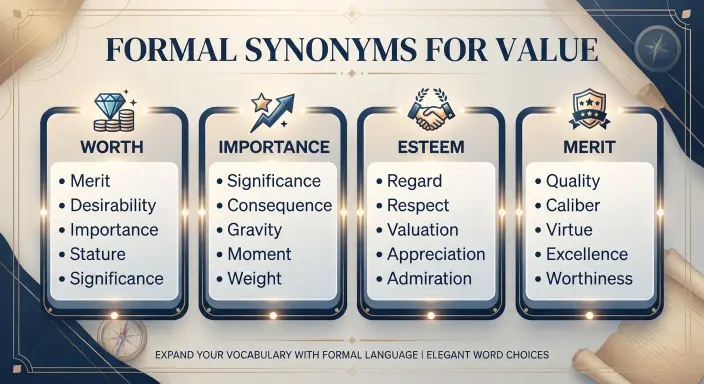
Formal alternatives are especially useful in reports, essays, research, business documents, and professional communication.
Significance
Meaning: The importance or meaning of something.
Explanation: Significance is one of the strongest alternatives when value means importance. It does not normally mean price.
Example: The findings have significant value for future research.
A clearer alternative is:
The findings have considerable significance for future research.
Best Use: Academic writing, research, reports, and professional analysis.
Worst Use: Financial situations where you mean monetary worth.
Tone: Formal and analytical.
Utility
Meaning: Usefulness or practical benefit.
Explanation: Utility describes how useful something is for a particular purpose. It is more precise than value when usefulness is the main idea.
Example: The study evaluates the utility of the new software in classroom settings.
Best Use: Academic, technical, business, and analytical writing.
Worst Use: Describing someone’s moral values.
Tone: Formal and technical.
Merit
Meaning: A quality that makes something worthy of approval, attention, or consideration.
Explanation: Merit focuses on the qualities or strengths that make something worthwhile.
Example: The proposal has considerable merit despite its higher cost.
Best Use: Academic evaluation, proposals, reviews, and formal discussions.
Worst Use: Directly describing a market price.
Tone: Formal and evaluative.
Importance
Meaning: The degree to which something matters.
Explanation: Importance is a close synonym when value refers to significance or relevance.
Example: The report emphasizes the importance of clear communication.
Best Use: Essays, reports, presentations, and professional writing.
Worst Use: Financial valuation.
Tone: Neutral to formal.
Relevance
Meaning: The degree to which something is connected to or useful for a particular subject or purpose.
Explanation: Relevance overlaps with value when something is valuable because it directly applies to a situation.
Example: The researcher questioned the relevance of the older data.
Best Use: Academic writing, research, business analysis, and professional communication.
Worst Use: Replacing value when you mean monetary worth.
Tone: Formal and precise.
Valuation
Meaning: An estimate or determination of the financial worth of something.
Explanation: Valuation is much narrower than value. It refers to the process or result of determining monetary worth.
Example: The company completed a new valuation before seeking investors.
Best Use: Finance, accounting, investment, real estate, and business.
Worst Use: General statements about importance or usefulness.
Tone: Technical and professional.
Appraisal
Meaning: A formal assessment of the quality, worth, or condition of something.
Explanation: Appraisal can refer to an evaluation or an estimate of monetary worth.
Example: The property received an independent appraisal before the sale.
Best Use: Real estate, finance, performance evaluation, and formal assessment.
Worst Use: Casual statements about the usefulness of an everyday object.
Tone: Formal and professional.
Assessment
Meaning: A careful judgment or evaluation.
Explanation: Assessment works when value means an evaluation of quality, effectiveness, or importance.
Example: The assessment considered both the cost and long-term benefits of the program.
Best Use: Education, business, research, and professional reports.
Worst Use: As a direct replacement for value in a simple price statement.
Tone: Formal and analytical.
Contribution
Meaning: Something that adds to a result, goal, or overall outcome.
Explanation: Contribution is useful when something has value because it helps produce a larger result.
Example: The volunteer’s contribution was essential to the success of the event.
Best Use: Teamwork, business, research, organizations, and academic writing.
Worst Use: Describing the selling price of an object.
Tone: Professional and positive.
Benefit
Meaning: An advantage or positive result.
Explanation: Benefit is one of the most useful contextual alternatives for value. Something may have value because it provides a benefit.
Example: The training provides significant benefits for new employees.
Best Use: Business, healthcare, education, marketing, and everyday writing.
Worst Use: When you specifically mean price or monetary worth.
Tone: Neutral and professional.
Magnitude
Meaning: The size, extent, or degree of something.
Explanation: Magnitude can replace value in technical contexts where the word refers to a numerical size or degree. It is not a general synonym.
Example: Researchers measured the magnitude of the observed change.
Best Use: Mathematics, science, statistics, and technical writing.
Worst Use: Describing the usefulness of a product.
Tone: Technical and formal.
Semi-Formal and Neutral Synonyms for Value
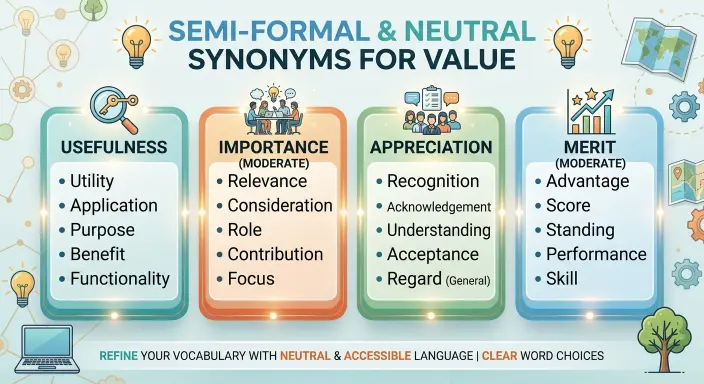
These choices are flexible enough for websites, schoolwork, workplace communication, emails, and everyday writing.
Worth
Meaning: The amount something is worth, financially or in practical terms.
Explanation: Worth is probably the closest everyday alternative to value, especially when discussing money or usefulness.
Example: The laptop is worth about $800.
Best Use: Money, products, time, effort, and practical importance.
Worst Use: Describing moral principles.
Tone: Neutral and natural.
Usefulness
Meaning: The quality of being useful.
Explanation: Usefulness focuses specifically on practical value.
Example: The usefulness of the guide depends on how current its information is.
Best Use: Reviews, websites, education, products, and instructions.
Worst Use: Financial valuation.
Tone: Neutral and clear.
Advantage
Meaning: A condition or feature that provides a benefit.
Explanation: Something can have value because it gives you an advantage. The two words are related but not identical.
Example: One major advantage of the system is its simplicity.
Best Use: Comparisons, business writing, product descriptions, and decision-making.
Worst Use: Describing the total price of an item.
Tone: Neutral and practical.
Quality
Meaning: A characteristic or level of excellence.
Explanation: Quality can sometimes represent value when people judge something based on how good it is. However, quality and value are not identical.
Example: The product offers good quality at a reasonable price.
Best Use: Products, services, writing, performance, and reviews.
Worst Use: Replacing value when discussing personal principles.
Tone: Neutral.
Price
Meaning: The amount of money required to buy something.
Explanation: Price is narrower than value. A product can have a high price but low perceived value, or a low price and high value.
Example: The price of the service increased this year.
Best Use: Shopping, business, finance, and sales.
Worst Use: Replacing value when discussing usefulness or importance.
Tone: Neutral.
Cost
Meaning: The amount required to obtain, produce, or use something.
Explanation: Cost often concerns what must be given up, especially money. It is not the same as value.
Example: The long-term cost of the system is lower than expected.
Best Use: Business, budgeting, purchasing, and financial writing.
Worst Use: Describing how beneficial something is.
Tone: Neutral and practical.
Impact
Meaning: The effect something has on a person, group, or situation.
Explanation: Impact can substitute for value when value means the effect or difference something makes.
Example: The program had a positive impact on student participation.
Best Use: Business, education, social programs, reports, and analysis.
Worst Use: Financial contexts unless the impact is specifically about financial results.
Tone: Neutral and professional.
Priority
Meaning: Something regarded as more important than other things.
Explanation: Priority works when value refers to relative importance or attention.
Example: Customer safety remains our highest priority.
Best Use: Business, planning, management, and everyday communication.
Worst Use: Describing the price of an object.
Tone: Neutral and professional.
Meaning
Meaning: The idea, significance, or message associated with something.
Explanation: Meaning overlaps with value when discussing emotional or symbolic importance.
Example: The gift has special meaning for her.
Best Use: Personal writing, literature, culture, and everyday conversation.
Worst Use: Financial or technical valuation.
Tone: Neutral and personal.
Return
Meaning: The benefit, income, or result received from an investment or effort.
Explanation: Return is a specialized business and financial alternative.
Example: The investment generated a strong return.
Best Use: Finance, business, marketing, and investment.
Worst Use: General statements about personal or moral value.
Tone: Professional and financial.
Potential
Meaning: The possibility of future development, success, or usefulness.
Explanation: Something may have value because it has strong potential, but potential does not mean current value.
Example: The new technology has considerable potential.
Best Use: Business, education, technology, career discussions, and planning.
Worst Use: Describing an established monetary value.
Tone: Neutral and optimistic.
Informal and Casual Synonyms for Value
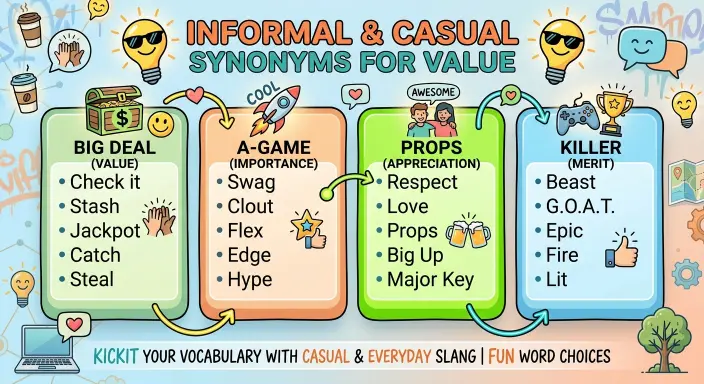
English has fewer true casual synonyms for value, but several conversational expressions work in the right context.
Upside
Meaning: A positive feature or advantage.
Example: The biggest upside is that you can work from home.
When it sounds natural: Casual conversations, workplace discussions, and informal online writing.
When to avoid it: Academic papers and formal legal documents.
Tone: Casual and practical.
Payoff
Meaning: A useful result or benefit gained from an action or investment.
Example: All that practice finally had a payoff.
When it sounds natural: Conversations about effort, money, projects, and personal goals.
When to avoid it: Formal writing where benefit or return is more precise.
Tone: Casual and conversational.
Perk
Meaning: An extra benefit or advantage.
Example: One perk of the job is the flexible schedule.
When it sounds natural: Workplace conversations, job descriptions, and casual writing.
When to avoid it: Academic analysis or formal contracts.
Tone: Casual and friendly.
Plus
Meaning: An additional positive feature.
Example: A big plus is that the store is open late.
When it sounds natural: Casual speech, reviews, and informal messages.
When to avoid it: Formal reports.
Tone: Informal and conversational.
Good
Meaning: A positive quality, result, or benefit.
Example: One good thing about the plan is its low cost.
When it sounds natural: Everyday conversation.
When to avoid it: Formal writing where a more precise noun such as benefit or advantage is available.
Tone: Very common and casual.
True Synonyms vs Contextual Synonyms to Value
The word value is unusually broad, so context determines whether an alternative is accurate.
| Type | What It Means | Can It Replace the Original? |
|---|---|---|
| True synonym | Has essentially the same meaning in a specific context | Usually |
| Near synonym | Shares the central idea but adds a different shade of meaning | Sometimes |
| Contextual alternative | Works only for one particular sense of value | Only in that context |
| Broader expression | Covers a larger idea than value in that sentence | Sometimes |
| Narrower expression | Describes only one specific kind of value | Only when that meaning is intended |
For example, worth is a close alternative when value means monetary or practical worth. Importance works when value means significance. Benefit works when value refers to a positive outcome. Principle, however, applies to the moral or personal meaning of values and should not replace every use of value.
Industry-Specific Uses of Value Alternatives
Business Writing
Business writing often needs to distinguish between value, benefit, return, advantage, utility, contribution, and worth.
For example:
The software provides significant value to small businesses.
can become:
The software provides significant benefits to small businesses.
If the focus is financial:
The software delivers a strong return on investment.
If the focus is practical usefulness:
The software offers substantial utility for small businesses.
Choosing the specific term makes business writing more informative.
Corporate Communication
Corporate reports frequently discuss business value, customer value, shareholder value, contribution, impact, efficiency, and return.
Examples:
- “The initiative created measurable value.”
- “The initiative produced measurable benefits.”
- “The project made a meaningful contribution to company performance.”
- “The investment generated a positive return.”
- “The program had a measurable impact on customer retention.”
Each sentence highlights a different outcome.
Academic Writing
Academic writing benefits from precise alternatives such as significance, relevance, utility, merit, importance, contribution, and impact.
Instead of:
This study has great value.
write:
This study has significant relevance to environmental policy.
Or:
This research makes an important contribution to the field.
The second version tells the reader why the research matters.
Customer Service
Customer service writing should use simple words such as benefit, usefulness, advantage, importance, and worth.
Instead of:
We understand the value of your feedback.
you might write:
We understand the importance of your feedback.
Or:
Your feedback helps us improve the service.
The second version is especially clear because it explains the actual benefit.
Legal Writing
Legal documents require precision. Value may refer to monetary worth, consideration, property value, or another defined concept depending on the document.
Possible related terms include worth, amount, consideration, valuation, assessment, and market value, but these should not be treated as interchangeable automatically.
For legal documents, replacing a defined or technical term merely to avoid repetition can create ambiguity. The exact meaning should take priority over stylistic variation.
Email Communication
Professional emails commonly use:
- Importance for significance
- Benefit for a positive result
- Worth for practical or financial value
- Contribution for someone’s input
- Impact for an effect
- Priority for something requiring attention
For example:
Your feedback is valuable to our team.
could become:
Your feedback is important to our team.
This is simple, professional, and natural.
Email Examples Using Synonyms to Value
Email 1: Client Communication
Subject: The Benefits of the New Service Plan
Hi Sarah,
I wanted to highlight a few benefits of the new service plan. It includes faster response times, a simplified reporting process, and a dedicated support contact.
I believe these changes will make the service easier for your team to manage.
Best,
Michael
Email 2: Project Update
Subject: Project Contribution and Next Steps
Hi Team,
Thank you for the contribution you’ve made to the project so far. The research team completed the initial review, while the design team has already incorporated several of the recommendations.
Your input has helped us move into the next stage with a clearer direction.
Best,
Emma
Email 3: Academic Communication
Subject: Significance of Your Research Topic
Hi Daniel,
Your research topic has strong significance because it connects current environmental concerns with practical community solutions.
As you revise the proposal, make the connection between your research question and existing literature more direct.
Best,
Dr. Carter
Email 4: Internal Workplace Email
Subject: Making This a Higher Priority
Hi everyone,
We need to make the customer response process a higher priority this week. Several outstanding requests are approaching their deadlines, so please review your assigned cases before Friday.
Thanks for helping us keep the workload manageable.
Best,
Laura
Email 5: Vendor Communication
Subject: Assessing the Proposal
Hi Chris,
Thanks for sending the revised proposal. We’re currently assessing its overall merit, particularly the maintenance terms and implementation timeline.
I’ll share our feedback once the review is complete.
Best,
James
Email 6: Customer Service
Subject: Thank You for Your Feedback
Hi Olivia,
Thank you for taking the time to share your feedback. Your comments are important to us and help us identify areas where the service can be improved.
We’ve forwarded your suggestions to the relevant team.
Kind regards,
Customer Care Team
Short Dialogue Examples Using Value Synonyms for Value
Workplace
Person A: Why do you think this training is worth the time?
Person B: It has practical benefits. The team can use the skills immediately.
Classroom
Person A: Why is this article relevant to our assignment?
Person B: It gives us a useful example for the second part of the argument.
Customer Service
Person A: Is the premium plan worth the extra cost?
Person B: If you need priority support, I think the additional benefits make it worthwhile.
Casual Conversation
Person A: What’s the best thing about that restaurant?
Person B: The biggest plus is the food. It’s really good for the price.
Professional Discussion
Person A: What did the company gain from the investment?
Person B: The main return was improved efficiency and lower operating costs.
How to Replace “Value” in a Sentence
1. Meaning: Importance
Original:
This issue has great value for the community.
Alternative:
This issue has great importance for the community.
Why it works: Importance makes it clear that value means significance rather than price.
2. Meaning: Financial worth
Original:
The house has a high value.
Alternative:
The house has a high worth.
Why it works: Worth can work in everyday language, although market value may be more precise in a property context.
3. Meaning: Benefit
Original:
The program offers considerable value to students.
Alternative:
The program offers considerable benefits to students.
Why it works: Benefits emphasizes the positive results students receive.
4. Meaning: Usefulness
Original:
We need to consider the value of this tool.
Alternative:
We need to consider the usefulness of this tool.
Why it works: The alternative focuses specifically on practical use.
5. Meaning: Significance
Original:
The discovery has enormous value for researchers.
Alternative:
The discovery has enormous significance for researchers.
Why it works: Significance is stronger when the point is intellectual or academic importance.
6. Meaning: Advantage
Original:
The product provides value over competing options.
Alternative:
The product provides a clear advantage over competing options.
Why it works: Advantage identifies a competitive benefit.
7. Meaning: Contribution
Original:
Her value to the project was obvious.
Alternative:
Her contribution to the project was obvious.
Why it works: Contribution specifically describes what she added to the project.
8. Meaning: Financial return
Original:
The investment created significant value.
Alternative:
The investment generated a strong return.
Why it works: Return is more specific when the sentence concerns financial results.
9. Meaning: Relevance
Original:
The information has value for our research.
Alternative:
The information has relevance to our research.
Why it works: Relevance emphasizes the connection between the information and the research.
10. Meaning: Moral principle
Original:
Honesty is an important value for her.
Alternative:
Honesty is an important principle for her.
Why it works: Here, value means a personal belief or standard, so principle can be an appropriate contextual alternative.
Comparison Table: Choosing the Right Synonyms
| Phrase | Tone | Meaning / Scope | Best Use | Example |
|---|---|---|---|---|
| Worth | Neutral | Financial or practical worth | Money, products | The car is worth $20,000. |
| Importance | Neutral/Formal | Degree of significance | General, academic | Its importance is clear. |
| Significance | Formal | Importance or meaning | Research, reports | The finding has significance. |
| Benefit | Neutral | Positive result | Business, services | The plan offers several benefits. |
| Utility | Formal | Practical usefulness | Technical, academic | The tool has practical utility. |
| Merit | Formal | Worthy quality | Evaluation | The proposal has merit. |
| Advantage | Neutral | Positive feature | Comparisons | Cost is a major advantage. |
| Usefulness | Neutral | Practical value | Products, education | Its usefulness is obvious. |
| Impact | Neutral/Formal | Effect or influence | Programs, business | The policy had an impact. |
| Contribution | Formal | Added part or support | Research, teamwork | Her contribution was significant. |
| Relevance | Formal | Connection to a purpose | Academic, professional | Its relevance is limited. |
| Price | Neutral | Money charged | Shopping, sales | The price is reasonable. |
| Cost | Neutral | Amount required or sacrificed | Finance, business | The cost is too high. |
| Return | Professional | Financial or practical result | Investment | The return was strong. |
| Priority | Neutral | Relative importance | Planning, management | Safety is the priority. |
| Perk | Casual | Extra benefit | Jobs, everyday speech | Flexible hours are a perk. |
Which Synonyms to Value Should You Choose?
- For formal writing: Choose significance, importance, utility, merit, relevance, or contribution, depending on the intended meaning.
- For business communication: Use benefit, return, advantage, contribution, utility, or impact to explain what creates value rather than relying on the broad word value.
- For academic writing: Significance, relevance, merit, utility, and contribution are often more precise.
- For legal writing: Retain the established technical term when value has a specific legal or financial meaning. Avoid casual substitutions.
- For professional email: Importance, benefit, contribution, impact, and worth are generally natural choices.
- For everyday conversation: Worth, benefit, usefulness, and importance are easy to understand.
- For casual messages: Upside, perk, plus, and payoff can sound natural when the context is informal.
Grammar and Usage Guide for “Value”
Value as a Noun
Value is commonly used as a noun:
The product offers excellent value.
We discussed the value of the proposal.
It can be countable or uncountable depending on meaning.
Value as an Uncountable Noun
When discussing general usefulness, importance, or worth, value is often uncountable:
This experience has great value.
The information is of considerable value.
Value as a Countable Noun
When referring to principles or standards, use values:
Family values are important to him.
The company has clearly stated its core values.
This distinction is important. Value can mean worth or importance. While values often means beliefs or principles.
Value as a Verb
Value can also function as a verb meaning to appreciate, consider important, or estimate worth.
We value your feedback.
The company values honesty.
In these sentences, value should not automatically be replaced with worth. For example, “We worth your feedback” is incorrect.
Common Prepositions
Several structures are common:
the value of education
value for money
valuable to customers
value something at $5,000
add value to a service
“Value for Money”
The phrase value for money means that something provides a satisfactory level of quality or benefit for its price.
This laptop offers good value for money.
It does not simply mean “cheap.”
“Valuable” Is the Adjective
Use valuable when describing something that has high worth, usefulness, or importance.
Her advice was valuable.
This is a valuable resource.
Do not confuse valuable with valued. Valuable means having value, while valued means appreciated or regarded highly.
“Valueless” and “Valueless” vs. “Worthless”
These words are not always identical in tone. Worthless is often stronger and more negative.
The damaged equipment was worthless.
Valueless can sound more technical or literal.
Common Mistakes to Avoid
1. Treating “value” and “price” as identical
Price tells you what something costs. Value describes what something is worth or how beneficial it is. They are related but different.
2. Using “worth” for moral values
You would not normally replace:
Honesty is an important value.
with:
Honesty is an important worth.
Value here refers to a principle.
3. Confusing benefit with value
A benefit is a positive result. Value is broader and can include benefits, importance, quality, worth, or principles.
4. Using “utility” in casual conversation
Although utility is correct, it can sound unnecessarily technical in a simple sentence.
Instead of:
What is the utility of this app?
everyday speech may prefer:
How useful is this app?
5. Using “perks” in formal writing
Perks is a casual word. In a formal report, benefits is usually more appropriate.
6. Confusing “value” with “values”
The value of the car is high.
refers to worth.
Her values are important to her.
refers to principles or beliefs.
7. Using “cost” to mean benefit
Cost usually describes what you give up or pay. It does not communicate the positive usefulness of something.
8. Choosing a vague synonym
If you mean financial return, say return. If you mean practical usefulness, say utility or usefulness. Precision is better than unnecessary variety.
9. Overusing “value” in business writing
Phrases such as “deliver value,” “create value,” and “add value” are common, but repeating them can make business writing sound generic. Explain the actual benefit when possible.
When Not to Use the Original Word “Value”
When you specifically mean price
Use price, cost, market price, or monetary worth when money is the central idea.
When you mean importance
Use importance or significance if the reader might otherwise interpret value as financial worth.
When you mean practical usefulness
Use usefulness or utility when explaining how effectively something serves a purpose.
When you mean a positive result
Use benefit or advantage when the sentence focuses on what someone gains.
When you mean a person’s contribution
Use contribution when discussing what an individual adds to a project, organization, or group.
When you mean financial performance
Use return when discussing investment results.
When “value” is actually the better choice
Keep value when you intentionally want a broad concept covering several dimensions.
For example:
The product provides excellent value.
This can communicate a combination of price, quality, usefulness, and overall benefit without specifying just one.
Advanced Writer Tips for Choosing Value Synonyms
Tone Control
Use simple alternatives for everyday readers and more precise terms for specialized audiences.
Casual:
The biggest plus is the low price.
Professional:
The main advantage is the lower operating cost.
Academic:
The primary significance of the finding lies in its broader application.
Each sentence communicates a related idea at a different level of formality.
Professional Email Etiquette
Instead of repeatedly saying that something is “valuable,” identify what makes it valuable.
Weak:
Your valuable feedback is valuable to us.
Better:
Your feedback helped us identify several areas for improvement.
Specific wording sounds more sincere and less formulaic.
Politeness
The phrase “We value your feedback” is polite, but it can sound generic if overused.
A more personal version is:
Thank you for pointing out the issue. Your feedback helped us understand what needs to be improved.
The second version shows the practical effect of the feedback.
Context Alignment
First determine which meaning of value you need:
- Financial worth → worth, price, valuation
- Importance → importance, significance
- Practical usefulness → utility, usefulness
- Positive result → benefit, advantage
- Quality → merit, quality
- Effect → impact
- Added support → contribution
- Investment result → return
- Moral belief → principle, belief, standard
Precision
Do not choose a synonym merely because it sounds more sophisticated. The best replacement should preserve the intended meaning.
For example:
The article is valuable to students.
could mean it is useful, informative, important, or relevant.
- If you mean usefulness, write:
The article is useful to students.
- If you mean importance:
The article is significant to students.
- If you mean relevance:
The article is relevant to students.
Readability
Simple words often produce stronger writing.
Instead of:
The utility of the resource provides substantial educational value.
write:
The resource is highly useful for students.
The second sentence is easier to understand without losing the core idea.
Related Questions About Synonyms for Value
What is another way to say “value”?
Depending on the context, you can say worth, importance, significance, benefit, usefulness, utility, merit, advantage, quality, or impact.
What is a professional synonyms to “value”?
Benefit, significance, contribution, impact, utility, return, and advantage are useful professional alternatives. The best one depends on what kind of value you mean.
What is a formal synonyms to “value”?
- For importance, use significance or importance.
- For usefulness, use utility.
- For evaluation, use merit or assessment.
- For financial worth, use valuation or worth.
What can I use instead of “valuable”?
Try useful, important, significant, beneficial, worthwhile, meaningful, relevant, or highly regarded, depending on the sentence.
Is “value” a formal word?
Yes. Value is a standard neutral word that works in everyday, professional, academic, financial, and technical contexts. You do not need to replace it simply because your writing is formal.
Can “worth” replace “value”?
Sometimes. Worth is particularly useful when discussing financial or practical value. It cannot replace value when the word means a moral principle.
What is the difference between value and worth?
Value is broader and can refer to importance, usefulness, quality, principles, or monetary worth. Worth usually focuses on how much something is worth financially or practically.
FAQs About Synonyms for Value
1. What is the closest synonyms for value?
Worth is one of the closest everyday synonyms when value means monetary or practical worth. Importance is closer when value means significance. Because value has several meanings, there is no single synonym that works everywhere.
2. What is a strong synonyms for value in business?
Benefit, return, advantage, contribution, impact, and utility are strong business alternatives. Choose the term that identifies the specific result rather than using a broad word unnecessarily.
3. What is a synonyms for high value?
Depending on the context, you can use valuable, worthwhile, important, significant, beneficial, high-quality, or highly useful. For money, highly valuable or high in monetary worth may be appropriate.
4. What is a synonyms for “add value”?
Useful alternatives include improve, enhance, benefit, strengthen, contribute to, increase usefulness, and provide an advantage. The best choice depends on what is actually being improved.
5. What is a synonyms for “value for money”?
Possible alternatives include worth the price, good buy, cost-effective, economical, worthwhile, and good return on investment, depending on the context.
6. What is the difference between value and importance?
Value can mean worth, usefulness, benefit, quality, or importance. Importance specifically describes how much something matters. Therefore, importance is narrower than the broadest meanings of value.
7. What is a synonyms for personal values?
Depending on the context, use principles, beliefs, standards, convictions, ideals, or moral principles. Here, values means the beliefs that guide a person’s choices and behavior.
Key Takeaways
- Worth is one of the closest alternatives when value means financial or practical worth.
- Use importance or significance when value means that something matters.
- Choose benefit, advantage, or usefulness when explaining what someone gains from something.
- In professional and academic writing, utility, merit, relevance, contribution, impact, and return can provide greater precision.
- Remember that value and values can have different meanings: the first often describes worth or importance, while the second commonly refers to principles or beliefs.
Conclusion
The best synonyms for value depend on the meaning you want to communicate. Worth works well for financial or practical worth, while importance and significance are better when something matters.
For positive results, benefit and advantage are useful; utility emphasizes practical usefulness, and contribution describes what someone adds to a larger goal. In financial contexts, valuation, price, cost, and return provide more specific meanings.
For casual communication, expressions such as upside, perk, plus, and payoff can make your writing sound natural. Still, the original word is often the best choice when you need a broad term.
Rather than replacing value simply to avoid repetition, identify what kind of value you mean and select the word that expresses that idea most clearly. Precision, context, audience, and tone should always guide your choice.
