
The right synonyms for reason can make your writing clearer, more precise, and better suited to its context. The word reason can refer to a cause, explanation, motive, justification, purpose, or basis for something.
Because these meanings overlap without being identical, the best replacement depends on what you want to communicate.You may need a formal alternative for an academic essay, a professional term for a business report, a precise word for legal writing, or a natural expression for everyday conversation.
This guide covers more than 38 useful alternatives, explains the differences between them, and shows how to use each one correctly.
Quick Answer: What Are the Best Synonyms for Reason?
The best synonyms for reason include cause, explanation, motive, basis, justification, rationale, purpose, grounds, factor, source, basis, argument, and excuse. They are not all interchangeable. Cause explains why something happened, motive explains why someone acted, purpose describes intended use, and justification gives a reason intended to defend a decision.
Quick List of Synonyms for Reason
Closest Synonyms for Reason
- Cause
- Explanation
- Basis
- Ground
- Motive
- Rationale
- Justification
- Factor
- Source
- Purpose
Formal Synonyms for Reason
- Rationale
- Justification
- Grounds
- Basis
- Motive
- Rationale
- Premise
- Consideration
- Determinant
- Underlying cause
- Supporting argument
Neutral Synonyms for Reason
- Cause
- Explanation
- Factor
- Source
- Purpose
- Point
- Consideration
- Principle
- Argument
- Motivation
Casual Synonyms for Reason
- Why
- Excuse
- Point
- Thinking
- Idea
- Explanation
- Story
- Motive
Contextual Synonyms for Reason
- Root cause
- Driving force
- Incentive
- Intention
- Objective
- Justification
- Grounds
- Evidence
- Premise
- Motivation
The key is not simply finding another word for reason. You should first determine what kind of reason you mean.
Formal Synonyms for Reason
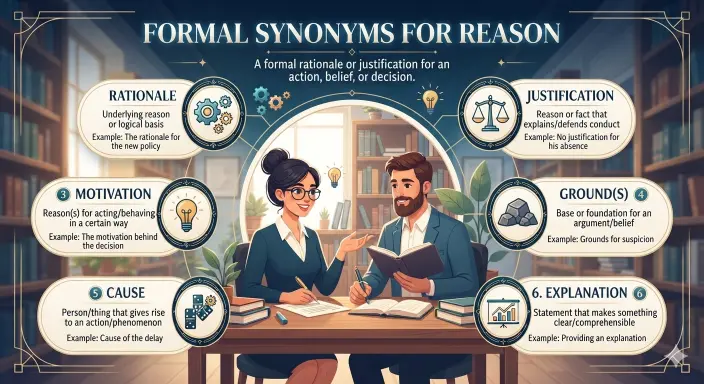
Rationale
Meaning: The underlying explanation or logical basis for a decision, action, or belief.
Explanation: Rationale is one of the strongest formal alternatives to reason when you are explaining why a decision was made. It often suggests a considered or logical basis.
Example: The manager explained the rationale behind the revised schedule.
Best Use: Business reports, academic writing, policies, proposals, professional communication.
Worst Use: Casual conversation, where it may sound unnecessarily formal.
Tone: Formal and analytical.
Justification
Meaning: A reason or explanation offered to show that an action or decision is reasonable or acceptable.
Explanation: Justification is narrower than reason. It often implies that someone needs to defend or support a choice.
Example: The committee requested a written justification for the additional expense.
Best Use: Formal reports, academic writing, workplace decisions, official documents.
Worst Use: Simple situations where no defense or explanation is needed.
Tone: Formal and evaluative.
Grounds
Meaning: The facts, circumstances, or reasons supporting an action or decision.
Explanation: Grounds is commonly used in formal English, particularly with decisions, objections, requests, and legal matters.
Example: The employee had sufficient grounds to request a review.
Best Use: Formal correspondence, legal writing, official decisions.
Worst Use: Casual conversation.
Tone: Formal and authoritative.
Basis
Meaning: The underlying support or foundation for an idea, decision, or action.
Explanation: Basis works well when the reason serves as the foundation for something.
Example: The report provides a strong basis for further discussion.
Best Use: Academic, business, scientific, and professional writing.
Worst Use: Situations where you simply want to explain why something happened.
Tone: Formal and neutral.
Motive
Meaning: A reason that causes someone to act.
Explanation: Motive usually refers to a person’s underlying reason for an action, especially when the intention matters.
Example: Investigators examined the suspect’s possible motive.
Best Use: Criminal investigations, psychology, literature, formal discussion of behavior.
Worst Use: Describing the cause of an event that has no human intention.
Tone: Formal and analytical.
Premise
Meaning: An idea or statement used as the basis for reasoning or an argument.
Explanation: Premise is not a general synonym for reason. It is appropriate when a reason functions as an assumption or starting point in an argument.
Example: The conclusion depends on the premise that demand will remain stable.
Best Use: Academic writing, philosophy, logic, debate.
Worst Use: Ordinary explanations of why something happened.
Tone: Formal and academic.
Consideration
Meaning: A factor that someone thinks about before making a decision.
Explanation: A consideration is something taken into account. It may be one reason among several rather than the single cause.
Example: Cost was an important consideration when choosing the supplier.
Best Use: Business writing, decision-making, professional communication.
Worst Use: When you need to identify a direct cause.
Tone: Formal and neutral.
Determinant
Meaning: A factor that strongly influences or determines an outcome.
Explanation: Determinant is more technical than reason. It suggests a factor that has a significant influence on a result.
Example: Income is an important determinant of housing affordability.
Best Use: Academic, economic, scientific, and analytical writing.
Worst Use: Simple everyday explanations.
Tone: Technical and formal.
Underlying Cause
Meaning: The deeper cause behind a problem or event.
Explanation: This phrase is useful when the visible reason is not the fundamental explanation.
Example: The investigation identified an underlying cause of the repeated system failures.
Best Use: Business analysis, healthcare, engineering, troubleshooting, research.
Worst Use: When you only need to state a simple reason.
Tone: Formal and analytical.
Supporting Argument
Meaning: A point or reason used to support a position.
Explanation: A supporting argument is a specific reason that strengthens a claim. It is narrower than reason in general.
Example: The author provides several supporting arguments for the proposed reform.
Best Use: Essays, debates, persuasive writing, reports.
Worst Use: Describing a physical or scientific cause.
Tone: Formal and academic.
Justifying Factor
Meaning: A factor that helps explain or defend a decision.
Explanation: This phrase combines the idea of a contributing factor with justification. It should be used only when the factor helps establish that a decision was reasonable.
Example: The unexpected cost increase became a justifying factor for postponing the project.
Best Use: Formal workplace and analytical writing.
Worst Use: Casual conversation.
Tone: Formal.
Incentive
Meaning: Something that encourages a person or organization to act.
Explanation: An incentive can be a reason for behavior, but it specifically involves encouragement or motivation.
Example: The tax reduction created an incentive for companies to invest.
Best Use: Business, economics, policy, workplace writing.
Worst Use: Events that have no intentional actor.
Tone: Formal and professional.
Semi-Formal and Neutral Synonyms for Reason
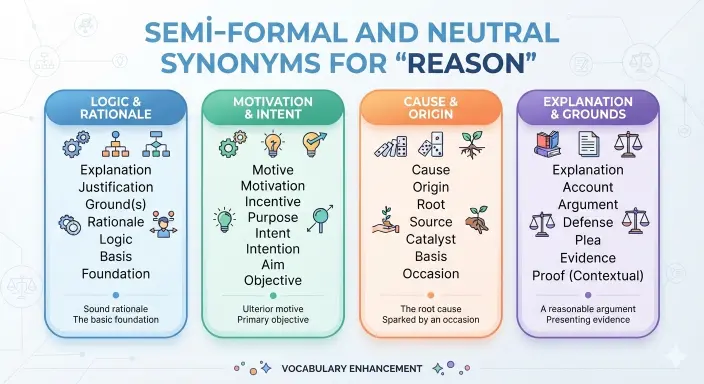
Cause
Meaning: Something that makes an event happen.
Explanation: Cause is one of the closest alternatives when reason refers to why something happened.
Example: Heavy rainfall was the main cause of the flooding.
Best Use: Everyday, academic, scientific, and professional writing.
Worst Use: A person’s motivation, where motive would be more accurate.
Tone: Neutral.
Explanation
Meaning: Information that makes something understandable.
Explanation: An explanation tells someone why something happened or what something means. It may contain one reason or several.
Example: She gave an explanation for the delay.
Best Use: Conversation, emails, school, customer service.
Worst Use: When you need to identify a specific cause rather than provide an account.
Tone: Neutral and clear.
Factor
Meaning: Something that contributes to a result.
Explanation: Factor is useful when several things influence an outcome. It does not necessarily mean the main or direct reason.
Example: Weather was one factor affecting attendance.
Best Use: Reports, research, business, everyday explanations.
Worst Use: When one clear cause is known and cause is more direct.
Tone: Neutral and professional.
Source
Meaning: The origin of something.
Explanation: Source can replace reason when you mean the origin of a problem, feeling, statement, or effect.
Example: The team identified the source of the error.
Best Use: Troubleshooting, research, reporting.
Worst Use: A person’s motivation.
Tone: Neutral.
Purpose
Meaning: The intended reason for doing or creating something.
Explanation: Purpose describes what someone intends to achieve. It is not the same as a cause.
Example: The purpose of the meeting is to discuss the new schedule.
Best Use: Work, education, instructions, websites, formal writing.
Worst Use: Explaining an accidental event.
Tone: Neutral to formal.
Motivation
Meaning: The reason or desire that encourages someone to act.
Explanation: Motivation is closely related to motive, but it often focuses on the force or desire that drives behavior.
Example: Her motivation for learning Spanish was to communicate with her relatives.
Best Use: Education, psychology, workplace writing, personal discussions.
Worst Use: Non-human causes.
Tone: Neutral and professional.
Consideration
Meaning: Something taken into account before making a choice.
Explanation: A consideration is one element in a decision rather than necessarily the complete reason.
Example: Safety was a major consideration in the design.
Best Use: Business, planning, decision-making.
Worst Use: A direct explanation of a past event.
Tone: Neutral and professional.
Point
Meaning: A particular idea, argument, or reason.
Explanation: Point works when reason means an argument or idea supporting what someone is saying.
Example: That’s a good point, but we should consider the cost.
Best Use: Conversation, meetings, essays, discussions.
Worst Use: Scientific explanations of physical causes.
Tone: Neutral and conversational.
Argument
Meaning: A reason or set of reasons used to support a claim or position.
Explanation: In this sense, argument does not mean a fight. It refers to reasoning presented in support of an idea.
Example: The strongest argument for the proposal is its lower cost.
Best Use: Academic writing, debates, persuasive communication.
Worst Use: Explaining why a physical event occurred.
Tone: Neutral to formal.
Principle
Meaning: A fundamental belief, rule, or idea that guides behavior or decisions.
Explanation: A principle can provide a reason for action, but it is more specific than reason.
Example: Environmental responsibility was the principle behind the company’s decision.
Best Use: Ethics, business, education, policy.
Worst Use: Simple cause-and-effect statements.
Tone: Neutral to formal.
Driving Force
Meaning: The main influence that causes or encourages something to happen.
Explanation: Driving force is stronger and more vivid than reason. It suggests a major influence rather than a minor factor.
Example: Customer demand was the driving force behind the product redesign.
Best Use: Business writing, journalism, presentations, explanatory writing.
Worst Use: When the influence is minor.
Tone: Neutral and vivid.
Informal and Casual Alternatives for Reason
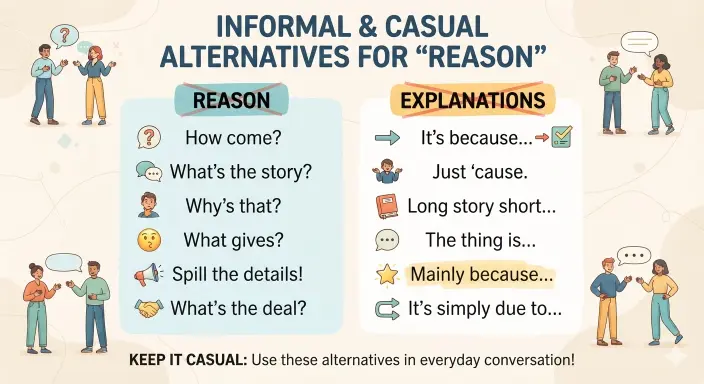
Why
Meaning: The explanation or cause behind something.
Example: Do you know why she left early?
When it sounds natural: Everyday conversation and simple writing.
When to avoid it: Formal writing where a noun such as reason or cause is required.
Tone: Casual and natural.
Excuse
Meaning: A reason given to explain or defend an action, sometimes one that seems weak or unconvincing.
Example: He gave an excuse for missing the meeting.
When it sounds natural: Informal conversation.
When to avoid it: When you do not want to suggest that the explanation may be dishonest or inadequate.
Tone: Casual and sometimes negative.
Thinking
Meaning: The ideas or reasoning behind someone’s choice.
Example: I understand your thinking, but I still disagree with the decision.
When it sounds natural: Conversations and informal professional discussions.
When to avoid it: Formal reports and academic writing.
Tone: Conversational.
Point
Meaning: A reason or argument supporting an idea.
Example: That’s exactly my point.
When it sounds natural: Conversation, meetings, informal messages.
When to avoid it: When describing an objective cause.
Tone: Casual to neutral.
Idea
Meaning: A thought or belief that explains an action or decision.
Example: I get the idea behind the change.
When it sounds natural: Informal discussion.
When to avoid it: Technical writing where more precise wording is available.
Tone: Casual.
Story
Meaning: An account offered as an explanation, sometimes implying that the explanation may be questionable.
Example: He told us a whole story about why he was late.
When it sounds natural: Informal conversation.
When to avoid it: Professional or academic writing.
Tone: Casual and potentially skeptical.
True Synonyms vs Contextual Synonyms for Reason
The word reason has several meanings, so its alternatives should be selected carefully.
| Type | What It Means | Can It Replace the Original? |
|---|---|---|
| True synonym | A word with nearly the same core meaning in the same context | Usually |
| Near synonym | A word that overlaps but adds a different shade of meaning | Often |
| Contextual alternative | A word that works in a particular situation but has a different core meaning | Sometimes |
| Broader expression | A term covering several types of explanations or influences | Only when the wider meaning fits |
| Narrower expression | A specific kind of reason, such as a motive or cause | Only in the appropriate context |
Consider these examples:
The reason for the delay was heavy traffic.
Here, cause is a strong replacement:
The cause of the delay was heavy traffic.
But:
The motive for the delay was heavy traffic.
does not work because motive normally concerns an intentional action.
Likewise:
What was the reason for your decision?
can become:
What was the rationale for your decision?
This sounds more formal and emphasizes the logical thinking behind the decision.
Business Writing: Synonyms for Reason
Business communication often benefits from choosing a word that identifies the exact relationship.
- Use rationale for the thinking behind a decision:
Please explain the rationale for the proposed change.
- Use factor for one influence among several:
Cost was a major factor in the decision.
- Use cause for a direct source of a problem:
We identified the cause of the production delay.
- Use purpose for an intended objective:
The purpose of this meeting is to review the budget.
Using these words precisely can make reports much clearer.
Corporate Communication: Choosing the Right Expression
Corporate announcements often need to explain decisions without sounding defensive.
Instead of:
Here is the reason for the change.
you could write:
Here is the rationale for the change.
For a more neutral tone:
Several factors influenced the decision.
For a policy document:
The purpose of this policy is to establish consistent procedures.
Each version gives readers a different kind of information.
Academic Writing: Synonyms for Reason
Academic writing often requires careful distinctions between cause, explanation, rationale, basis, motive, and argument.
For example:
The reason for the decline was unclear.
can become:
The cause of the decline was unclear.
if you are discussing causation.
But if you are discussing an author’s argument:
The author provides several reasons for supporting the proposal.
could become:
The author provides several arguments in support of the proposal.
For formal essays, rationale is especially useful when explaining the logic behind a method or decision.
The study explains the rationale for selecting this approach.
Customer Service: Clear and Polite Synonyms for Reason
Customer service writing should favor clarity over complicated vocabulary.
Instead of:
Please provide the reason for your complaint.
a more natural version may be:
Could you please explain the reason for your complaint?
Or:
Could you tell us what caused the problem?
For a service investigation:
We are reviewing the cause of the issue.
The choice depends on whether you need an explanation, a cause, or additional information from the customer.
Legal Writing: Reason, Grounds, Cause, and Justification
Legal writing requires particular care because terms that appear similar can carry different meanings in legal contexts.
Grounds is often useful for describing the basis for a legal action or formal request:
The parties discussed the grounds for the appeal.
Justification may refer to a reason intended to support or defend an action:
The report examines the justification for the decision.
Cause is appropriate when discussing causation:
The evidence addressed the cause of the damage.
Casual expressions such as excuse, story, or thinking generally should not replace precise formal terminology in legal documents. The exact wording should always match the legal context and applicable rules.
Email Communication: Professional Synonyms for Reason
For emails, the best alternative depends on your purpose.
- Reason — general and natural.
- Rationale — formal explanation behind a decision.
- Cause — direct source of an event or problem.
- Basis — foundation for a decision or claim.
- Purpose — intended objective.
- Factor — one influence among several.
- Explanation — information that makes something clear.
- Grounds — formal basis for an action or request.
For example:
Could you please explain the reason for the delay?
is natural and polite.
A more formal version is:
Could you please explain the cause of the delay?
Use cause only if the delay resulted from a specific cause.
Email Examples Using Synonyms for Reason
Client Communication
Subject: Rationale for the Proposed Timeline
Hi Sarah,
I wanted to provide some context for the revised project timeline. The main rationale for the change is the additional testing required before launch.
We believe the extra testing will help us identify issues before the final release.
Best,
Daniel
Internal Workplace Email
Subject: Factors Affecting the Schedule
Hi Team,
Several factors affected this week’s schedule, including the delayed delivery of materials and the additional review time requested by the quality team.
I’ve attached the updated schedule for reference.
Thanks,
Maria
Vendor Communication
Subject: Basis for Our Request
Hello James,
We are requesting the revised quotation because the scope of the project has changed. The updated specifications provide the basis for the new estimate.
Please let me know if you need any additional information.
Regards,
Kevin
Customer Service
Subject: Update on Your Order
Hello Ms. Carter,
Thank you for contacting us. We have identified the cause of the shipping delay and are working with the carrier to resolve it.
Your order is now expected to arrive later this week.
Sincerely,
Customer Support
Academic Communication
Subject: Rationale for Research Method
Dear Professor Adams,
I selected this research method because it allows me to compare responses across the two groups. I will also explain the rationale for this choice in the methodology section.
Thank you for your guidance.
Best,
Nadia
Meeting Request
Subject: Purpose of Friday’s Meeting
Hi Alex,
The purpose of Friday’s meeting is to review the final design and agree on the remaining changes before production begins.
I’ve included the latest version of the design for you to review beforehand.
Best,
Ryan
Short Dialogue Examples Using Synonyms for Reason
Workplace
Person A: Why did the deadline change?
Person B: Several factors affected the schedule, including the supplier delay.
Classroom
Person A: What’s the difference between a reason and a motive?
Person B: A motive usually explains why a person acts, while a reason can explain almost any cause or explanation.
Customer Service
Person A: Why hasn’t my order arrived?
Person B: We’re investigating the cause of the delay and will update you shortly.
Casual Conversation
Person A: What’s your reason for leaving so early?
Person B: Honestly, I’m just tired.
Professional Discussion
Person A: What’s the rationale behind the new policy?
Person B: The main goal is to reduce unnecessary approval steps.
How to Replace “Reason” in a Sentence
Example 1
Original: The reason for the delay was heavy traffic.
Alternative: The cause of the delay was heavy traffic.
Why it works: Cause is more precise because heavy traffic directly produced the delay.
Example 2
Original: We need to understand the reason for the decision.
Alternative: We need to understand the rationale for the decision.
Why it works: Rationale emphasizes the logic or thinking behind a decision.
Example 3
Original: Cost was one reason for choosing the supplier.
Alternative: Cost was one factor in choosing the supplier.
Why it works: Factor shows that cost was one influence among several.
Example 4
Original: What was the reason for his actions?
Alternative: What was his motive for acting?
Why it works: Motive is specifically suited to a person’s underlying reason for an action.
Example 5
Original: The reason for the meeting is to discuss the budget.
Alternative: The purpose of the meeting is to discuss the budget.
Why it works: Purpose focuses on the intended objective of the meeting.
Example 6
Original: She gave a reason for missing class.
Alternative: She gave an explanation for missing class.
Why it works: Explanation emphasizes the account she provided rather than simply the underlying cause.
Example 7
Original: We need a reason for approving the request.
Alternative: We need a justification for approving the request.
Why it works: Justification suggests that the decision needs support or defense.
Example 8
Original: The reason for the appeal was unclear.
Alternative: The grounds for the appeal were unclear.
Why it works: Grounds is a formal expression for the basis supporting an appeal or similar action.
Example 9
Original: I understand your reason for disagreeing.
Alternative: I understand your thinking.
Why it works: Thinking is more conversational and focuses on the ideas behind the person’s position.
Example 10
Original: Let’s discuss the reason for the problem.
Alternative: Let’s look at the cause of the problem.
Why it works: Cause is more direct when discussing why a problem occurred.
Comparison Table: Synonyms for Reason
| Phrase | Tone | Meaning / Scope | Best Use | Example |
|---|---|---|---|---|
| Reason | Neutral | General explanation or cause | Almost any context | What’s the reason? |
| Cause | Neutral/formal | Something producing an outcome | Events and problems | Find the cause. |
| Explanation | Neutral | Information that makes something clear | Communication | Give an explanation. |
| Rationale | Formal | Logic behind a decision | Business, academics | Explain the rationale. |
| Justification | Formal | Reason supporting or defending an action | Decisions, arguments | Provide justification. |
| Grounds | Formal | Basis for an action or claim | Official/legal contexts | Legal grounds exist. |
| Basis | Formal/neutral | Foundation for an idea or action | Reports, decisions | Basis for the decision |
| Motive | Formal/neutral | Personal reason for acting | Behavior, crime, literature | Determine the motive. |
| Factor | Neutral | One contributing influence | Analysis, business | A major factor |
| Purpose | Neutral/formal | Intended objective | Meetings, actions | Purpose of the project |
| Motivation | Neutral | Force encouraging action | Behavior, education | Motivation for change |
| Premise | Formal | Starting assumption in reasoning | Logic, academic writing | The argument’s premise |
| Argument | Neutral/formal | Reason supporting a claim | Essays, debates | Strong argument |
| Incentive | Formal/neutral | Something encouraging action | Business, economics | Financial incentive |
| Excuse | Casual | Explanation, often questionable | Informal conversation | That’s a weak excuse. |
| Look into | Casual | Investigate the reason | Conversation, emails | I’ll look into it. |
Which Synonyms for Reason Should You Choose?
1. For Formal Writing
Choose rationale, justification, basis, grounds, or underlying cause, depending on meaning.
Best general choice: rationale for the logic behind a decision.
2. For Business Communication
Use rationale for decisions, factor for contributing influences, cause for problems, and purpose for objectives.
3. For Academic Writing
Choose cause for causation, rationale for methodological decisions, argument for supporting claims, and premise for foundational assumptions.
4. For Legal Writing
Grounds, basis, cause, and justification may be appropriate, but the exact term should match the legal concept being discussed.
5. For Professional Email
Use reason or explanation for general communication. Choose rationale when explaining a formal decision and cause when discussing a problem.
6. For Everyday Conversation
Reason, why, explanation, and point are usually the most natural.
7. For Casual Messages
Try why, thinking, point, excuse, or story, depending on the meaning and tone you want.
Grammar and Usage Guide for “Reason”
Reason + For
One of the most common structures is:
the reason for something
Examples:
What is the reason for the delay?
We need to understand the reason for the change.
Reason + Why
In standard English, the reason why is grammatical and common:
I understand the reason why she left.
You can also simply say:
I understand why she left.
The second version is usually shorter and more natural.
Reason + To
Use reason to + verb when talking about a basis for doing something:
There is no reason to worry.
We have several reasons to reconsider the plan.
Reason + That
You may also see:
The reason that he left was unclear.
This is grammatical, although the reason he left is often more concise.
Reason vs Cause
Use reason broadly for explanations, motivations, and causes.
Use cause when something directly produces an effect.
The reason she left was personal.
Heavy rain caused the delay.
Reason vs Excuse
An excuse is a particular kind of explanation, often one that may be viewed as weak, defensive, or unconvincing.
He gave a reason for being late.
is neutral.
He gave an excuse for being late.
may suggest doubt about the explanation.
Reason vs Rationale
Reason is general and works almost everywhere.
Rationale is more formal and usually describes the logic behind a decision, policy, method, or proposal.
Singular and Plural Forms
The singular is reason.
There is one main reason.
The plural is reasons.
There are several reasons.
Both forms are common, but choose the number that matches the actual situation.
Common Mistakes to Avoid
1. Treating Cause and Reason as Identical
They overlap, but cause is more closely connected to producing an event, while reason can also refer to motivation or explanation.
2. Using Motive for Non-Human Causes
A machine failure does not normally have a motive. A person can have a motive.
3. Using Rationale in Casual Conversation
Rationale is correct but can sound unnecessarily formal in ordinary conversation.
4. Confusing Purpose With Cause
A purpose describes intended achievement. A cause explains why something happened.
5. Using Justification When No Defense Is Needed
Justification can imply that an action needs to be defended or supported.
6. Treating Every Factor as the Main Reason
A factor may be only one influence among many. It does not necessarily mean the primary cause.
7. Using Excuse as a Neutral Synonym
Excuse can imply that the explanation is weak, doubtful, or defensive.
8. Using Grounds in Ordinary Conversation
Grounds is useful in formal contexts but may sound stiff when a simple reason would be clearer.
9. Choosing a Fancy Word Instead of a Precise One
Replacing reason with rationale does not automatically improve writing. Precision should come first.
10. Ignoring the Sentence Structure
Some alternatives require different grammatical patterns. For example:
the reason for the delay
but:
the cause of the delay
and:
the purpose of the meeting
Learning the natural combinations is just as important as learning the synonyms.
When Not to Use “Reason”
You may want to replace reason when:
- You mean a direct cause — use cause.
- You mean the logic behind a decision — use rationale.
- You mean a personal motive — use motive.
- You mean the intended objective — use purpose.
- You mean one contributing influence — use factor.
- You need to defend an action — use justification.
- You are describing formal grounds for an action — use grounds.
- You want a more conversational style — use why or thinking.
However, reason is often the best choice because it is broad, familiar, and natural. Do not replace it simply to make a sentence sound more sophisticated.
Advanced Writer Tips for Choosing Synonyms for Reason
Tone Control
- For formal writing, consider rationale, basis, grounds, justification, or underlying cause.
- For neutral writing, reason, cause, explanation, factor, and purpose work well.
- For casual writing, why, point, thinking, and excuse may sound more natural.
Professional Email Etiquette
Avoid unnecessarily complicated wording.
Instead of:
Please provide the rationale pertaining to your absence.
write:
Could you please explain the reason for your absence?
Clear language usually sounds more professional than inflated vocabulary.
Politeness
Small wording choices can change the tone.
Why didn’t you respond?
can sound direct.
Could you explain the reason for the delay?
is more measured and professional.
Context Alignment
Ask yourself what kind of “reason” you mean:
- Cause?
- Motivation?
- Explanation?
- Purpose?
- Justification?
- Contributing factor?
- Logical basis?
Once you identify the category, choosing the right alternative becomes much easier.
Precision
Avoid vague statements such as:
There were many reasons.
If possible, identify the relationship:
Several factors contributed to the delay.
That tells readers more about how the situation developed.
Readability
Do not use rationale every time you could use reason. Familiar words are often easier to understand.
A strong writer changes vocabulary when the meaning changes—not simply when the same word appears twice.
Related Questions About Synonyms for Reason
What is another way to say reason?
Depending on context, you can use cause, explanation, basis, motive, rationale, purpose, factor, justification, or grounds.
What is a professional synonyms for reason?
Rationale, basis, factor, cause, explanation, and justification are useful professional alternatives. The correct choice depends on the intended meaning.
What is a formal synonyms for reason?
Rationale, justification, grounds, basis, motive, and underlying cause are formal alternatives in appropriate contexts.
What can I use instead of reason in an essay?
Use cause for causation, rationale for the logic behind a decision, argument for a supporting point, motive for human behavior, and factor for a contributing influence.
Is reason a formal word?
Reason is a standard neutral word. It is suitable for formal, professional, academic, and everyday English.
Can I use cause instead of reason?
Sometimes. Use cause when you mean something that produces an event or outcome. It is not always appropriate for a person’s motivation or a justification.
What is the difference between reason and rationale?
Reason is broad and can describe a cause, explanation, motive, or justification. Rationale specifically emphasizes the logical basis behind a decision, method, or position.
FAQs About Synonyms for Reason
What is the closest synonyms for reason?
Cause and explanation are among the closest alternatives, but the best choice depends on the meaning. Cause focuses on what produces an event, while explanation focuses on making something understandable.
What is the best formal synonyms for reason?
Rationale is often the best formal alternative when discussing the logic behind a decision. Basis, justification, and grounds are also useful in specific contexts.
What is the best synonyms for reason in academic writing?
There is no single best choice. Cause, rationale, factor, argument, motive, and basis are useful for different academic purposes.
Is “rationale” a synonym for “reason”?
Yes, in some contexts. Rationale means the underlying reasoning or logical basis for something. It cannot replace every use of reason, especially when discussing physical causes or simple explanations.
Is “motive” the same as “reason”?
Not exactly. A motive is specifically a reason that drives a person to act. Reason has a much broader meaning.
Is “cause” stronger than “reason”?
Not necessarily. Cause is more specific. It identifies something that produces an effect, whereas reason can refer to a cause, explanation, motivation, purpose, or justification.
What is a casual way to say reason?
In everyday speech, why, point, thinking, excuse, and explanation can work depending on the sentence. Why is especially natural when asking about the explanation for something.
Key Takeaways
- Reason is a broad word that can describe a cause, explanation, motive, purpose, or justification.
- Use cause for something that produces an event and motive for a person’s reason for acting.
- Choose rationale when explaining the logic behind a decision, policy, or method.
- Use factor for one influence among several and purpose for an intended objective.
- Always match the alternative to the meaning, audience, and tone rather than replacing reason simply for variety.
Conclusion
The best synonym for reason depends on exactly what you mean. If you are explaining why something happened, cause may be the clearest choice. If you are describing the logic behind a decision, rationale works better.
For a person’s motivation, choose motive; for an intended objective, use purpose; and for one contributing influence, factor is often more accurate. Explanation, basis, justification, grounds, argument, and motivation each add their own shade of meaning.
Tone matters, too. Reason remains a versatile neutral choice, while rationale, grounds, and justification sound more formal. Casual expressions such as why, thinking, and point fit everyday communication.
The strongest writing does not simply replace words—it chooses language that reflects the exact relationship between an event, action, decision, or idea and the explanation behind it.
