
The word “is” is one of the most common verbs in English, but finding synonyms for is is not as simple as replacing it with another word. “Is” is a form of the verb be, and its meaning changes according to the sentence. It can show identity, description, location, condition, existence, or a temporary state. Because of that, the best alternative depends on what the sentence actually means.
Writers often look for alternatives to “is” to avoid repetition, make academic writing more precise, strengthen professional communication, or create a more natural style. Some alternatives, such as equals, represents, remains, exists, occurs, stands, lies, and appears, work in particular contexts rather than as direct replacements. This guide explains more than 36 useful alternatives, shows how they differ, and gives practical examples for school, business, academic, professional, and everyday writing.
Quick Answer: What Are the Best Synonyms for “Is”?
The best synonyms for “is” depend on its meaning. Useful alternatives include equals, represents, means, remains, exists, occurs, stands, lies, appears, seems, becomes, constitutes, comprises, contains, describes, indicates, signifies, denotes, occurs as, takes place, functions as, serves as, belongs to, consists of, and amounts to. Many are contextual rather than exact synonyms.
Quick List of Synonyms for “Is”
Here are useful alternatives grouped by meaning rather than treating every word as an exact replacement.
Closest Contextual Alternatives for “Is”
- remains
- exists
- occurs
- appears
- seems
- stands
- lies
- equals
- represents
- means
- indicates
- signifies
- denotes
- constitutes
- comprises
- contains
- consists of
- describes
- defines
- identifies
- belongs to
- includes
- involves
- results in
- amounts to
- functions as
- serves as
- acts as
- takes place
- happens
- occurs as
- becomes
- proves to be
- turns out to be
- can be found
- can be described as
- can be considered
- can be regarded as
- is located at
- is situated at
The important distinction is that “is” itself has several grammatical uses, while most of these alternatives have narrower meanings.
Formal Synonyms for “Is”
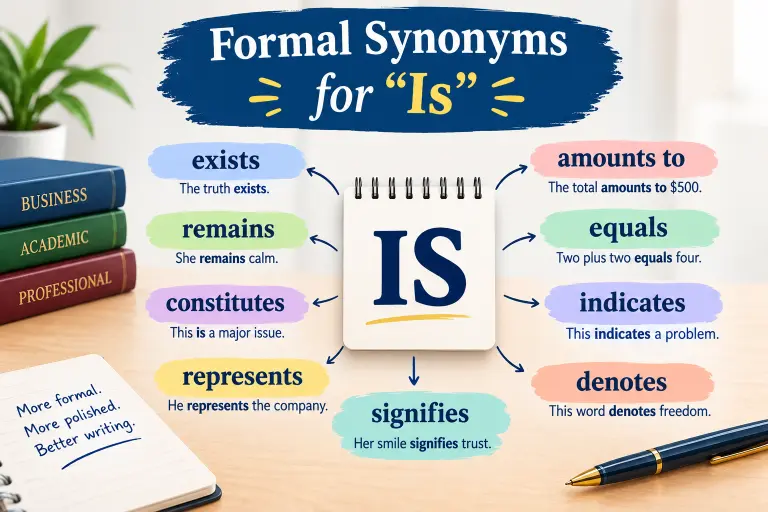
Formal writing often benefits from replacing a repeated form of “is” with a more precise verb. The goal should not be to make every sentence sound complicated. Instead, choose a stronger word when it communicates the intended relationship more clearly.
“Constitutes” as a Synonym for “Is”
Meaning: Forms or makes up something.
Explanation: “Constitutes” is useful when something forms part or the whole of a larger thing. It is not a universal replacement for “is.”
Example: “Reliable data constitutes the foundation of the study.”
Best Use: Academic writing, reports, research, and formal analysis.
Worst Use: Casual conversation or simple descriptions.
Tone: Formal and analytical.
“Represents” as a Synonym for “Is”
Meaning: Stands for, symbolizes, or describes something.
Explanation: “Represents” works when one thing expresses or stands for another. It should not replace “is” when you simply mean identity.
Example: “The blue line represents the annual growth rate.”
Best Use: Reports, presentations, academic writing, and data analysis.
Worst Use: “She represents my sister” when you simply mean “She is my sister.”
Tone: Professional and precise.
“Denotes” as a Synonym for “Is”
Meaning: Means or refers to something.
Explanation: “Denotes” focuses on the meaning of a word, symbol, sign, or expression.
Example: “The symbol ‘+’ denotes addition.”
Best Use: Academic, technical, linguistic, and mathematical writing.
Worst Use: Personal or conversational descriptions.
Tone: Formal and technical.
“Signifies” as a Synonym for “Is”
Meaning: Indicates or expresses a particular meaning.
Explanation: “Signifies” is useful when something carries a meaning or signals an idea.
Example: “The white flag signifies surrender.”
Best Use: Academic analysis, literature, history, and formal explanations.
Worst Use: Simple statements where “is” would be clearer.
Tone: Formal and interpretive.
“Comprises” as a Synonym for “Is”
Meaning: Consists of or includes particular parts.
Explanation: “Comprises” describes what something contains as its components. It does not generally mean “is.”
Example: “The committee comprises twelve members.”
Best Use: Reports, organizational descriptions, academic writing, and professional documents.
Worst Use: Describing a single person’s identity or condition.
Tone: Formal and professional.
“Consists of” as a Synonym for “Is”
Meaning: Is made up of particular parts.
Explanation: This phrase gives specific information about composition.
Example: “The course consists of six units.”
Best Use: Academic writing, instructions, product descriptions, and reports.
Worst Use: Simple identity statements such as “He consists of a teacher.”
Tone: Neutral to formal.
“Amounts to” as a Synonym for “Is”
Meaning: Has a particular total, value, or overall effect.
Explanation: “Amounts to” is useful for totals, quantities, or conclusions rather than basic identity.
Example: “The total cost amounts to $2,500.”
Best Use: Financial, business, and numerical contexts.
Worst Use: Personal descriptions.
Tone: Formal and practical.
“Equates to” as a Synonym for “Is”
Meaning: Has the same value, meaning, or effect as something else.
Explanation: “Equates to” establishes an equivalence. It is narrower than “is.”
Example: “One hour of training equates to approximately four hours of practice.”
Best Use: Business, mathematics, comparisons, and analytical writing.
Worst Use: Ordinary descriptions where no equivalence exists.
Tone: Formal and analytical.
“Indicates” as a Synonym for “Is”
Meaning: Shows or suggests something.
Explanation: “Indicates” is appropriate when evidence points toward a conclusion.
Example: “The survey indicates strong customer satisfaction.”
Best Use: Research, reports, statistics, and professional writing.
Worst Use: When you need to state something as an established identity rather than evidence.
Tone: Professional and evidence-based.
“Demonstrates” as a Synonym for “Is”
Meaning: Shows something clearly through evidence or action.
Explanation: “Demonstrates” is stronger than “is” because it implies evidence.
Example: “The experiment demonstrates the effect of temperature on pressure.”
Best Use: Academic and scientific writing.
Worst Use: Simple descriptions without evidence.
Tone: Formal and confident.
“Defines” as a Synonym for “Is”
Meaning: States the essential meaning or characteristics of something.
Explanation: “Defines” is useful when a characteristic establishes what something means or is.
Example: “Clarity defines effective technical writing.”
Best Use: Essays, educational writing, definitions, and analysis.
Worst Use: Statements where no defining relationship exists.
Tone: Formal and authoritative.
“Characterizes” as a Synonym for “Is”
Meaning: Describes a distinctive quality.
Explanation: This verb focuses on a feature that identifies or distinguishes something.
Example: “Rapid innovation characterizes the modern technology sector.”
Best Use: Academic analysis and professional reports.
Worst Use: Basic everyday sentences.
Tone: Formal and analytical.
“Functions as” as a Synonym for “Is”
Meaning: Performs the role or purpose of something.
Explanation: “Functions as” emphasizes a role rather than identity.
Example: “The introduction functions as a roadmap for the essay.”
Best Use: Academic, technical, and professional writing.
Worst Use: When the object is not actually performing that function.
Tone: Professional and precise.
“Serves as” as a Synonym for “Is”
Meaning: Performs a particular role.
Explanation: “Serves as” is similar to “functions as” but often sounds more natural.
Example: “The final paragraph serves as a brief summary.”
Best Use: Essays, reports, websites, and professional documents.
Worst Use: Casual writing if a simple “is” sounds more natural.
Tone: Neutral to formal.
Semi-Formal and Neutral Synonyms for “Is”
Not every useful alternative needs to sound formal. In everyday and professional writing, natural phrasing usually matters more than impressive vocabulary.
“Remains” as a Synonym for “Is”
Meaning: Continues to be in the same state.
Explanation: “Remains” adds the idea of continuation.
Example: “The policy remains effective until December.”
Best Use: Work, announcements, reports, and everyday writing.
Worst Use: A new or temporary state.
Tone: Neutral and professional.
“Appears” as a Synonym for “Is”
Meaning: Seems to be based on available evidence or observation.
Explanation: “Appears” introduces some uncertainty.
Example: “The package appears to be damaged.”
Best Use: Emails, reports, observations, and cautious statements.
Worst Use: When you are completely certain and need a direct statement.
Tone: Neutral and cautious.
“Seems” as a Synonym for “Is”
Meaning: Gives the impression of being something.
Explanation: “Seems” is less certain than “is.”
Example: “The new approach seems more effective.”
Best Use: Everyday conversation, opinions, and informal professional communication.
Worst Use: Legal or highly precise claims when certainty matters.
Tone: Conversational and cautious.
“Stands” as a Synonym for “Is”
Meaning: Remains in a particular position, condition, or state.
Explanation: It often appears in phrases such as “the situation stands” or “the record stands.”
Example: “The current balance stands at $1,200.”
Best Use: Business, finance, reports, and updates.
Worst Use: Basic descriptions.
Tone: Professional.
“Lies” as a Synonym for “Is”
Meaning: Exists or is located in a particular place or area.
Explanation: “Lies” often describes location, especially an abstract or geographical one.
Example: “The main challenge lies in the lack of funding.”
Best Use: Academic, analytical, and formal writing.
Worst Use: Casual statements where “is” is clearer.
Tone: Formal and polished.
“Exists” as a Synonym for “Is”
Meaning: Has real existence or presence.
Explanation: “Exists” focuses specifically on existence rather than description.
Example: “A significant gap exists between the two systems.”
Best Use: Research, academic writing, philosophy, reports, and formal explanations.
Worst Use: “My brother exists a doctor,” which incorrectly treats it as an identity verb.
Tone: Neutral to formal.
“Occurs” as a Synonym for “Is”
Meaning: Happens or takes place.
Explanation: “Occurs” should be used for events or processes, not ordinary identity statements.
Example: “The meeting occurs every Friday.”
Best Use: Academic, scientific, business, and technical writing.
Worst Use: Describing a person’s identity or a physical object.
Tone: Formal and precise.
“Happens” as a Contextual Alternative to “Is”
Meaning: Takes place.
Explanation: “Happens” can replace “is” in expressions involving events.
Example: “The conference is on Monday.” → “The conference happens on Monday.”
The second sentence is less natural in many contexts, so “occurs” or “takes place” may be better.
Best Use: Informal conversation.
Worst Use: Formal event schedules.
Tone: Casual.
“Takes place” as a Contextual Alternative to “Is”
Meaning: Happens at a particular time or location.
Explanation: This is a phrase rather than a direct synonym.
Example: “The ceremony takes place at noon.”
Best Use: Events, announcements, schedules, and formal descriptions.
Worst Use: Personal identity or simple descriptions.
Tone: Neutral and polished.
“Becomes” as a Contextual Alternative to “Is”
Meaning: Changes into a particular state.
Explanation: “Becomes” introduces a change, so it cannot normally replace “is” without changing meaning.
Example: “The water becomes cloudy after mixing.”
Best Use: Processes, development, and change.
Worst Use: Permanent descriptions.
Tone: Neutral.
“Turns out to be” as a Contextual Alternative to “Is”
Meaning: Eventually proves or appears to be something.
Explanation: This phrase suggests that the information became clear later.
Example: “The simple repair turns out to be more complicated than expected.”
Best Use: Narratives, conversation, explanatory writing.
Worst Use: Formal reports where a direct statement is preferable.
Tone: Conversational.
“Proves to be” as a Contextual Alternative to “Is”
Meaning: Is shown through experience or evidence to be something.
Explanation: It suggests that evidence or events confirmed a description.
Example: “The strategy proves to be effective.”
Best Use: Analysis, reviews, reports, and essays.
Worst Use: Before there is evidence to support the claim.
Tone: Confident and analytical.
“Acts as” as a Synonym for “Is” in Role-Based Sentences
Meaning: Performs a role or behaves as something.
Explanation: “Acts as” focuses on function, not identity.
Example: “The opening sentence acts as a clear introduction.”
Best Use: Essays, instructions, technical explanations.
Worst Use: Literal identity statements.
Tone: Neutral and professional.
“Includes” as a Contextual Alternative to “Is”
Meaning: Contains something as part of a larger group.
Explanation: “Includes” changes the relationship from identity to membership or content.
Example: “The package is three books.” → “The package includes three books.”
The second sentence means the books are contents of the package, not that the package and books are identical.
Best Use: Product descriptions, websites, lists, and business writing.
Worst Use: Identity statements.
Tone: Neutral.
Informal and Casual Alternatives for “Is”
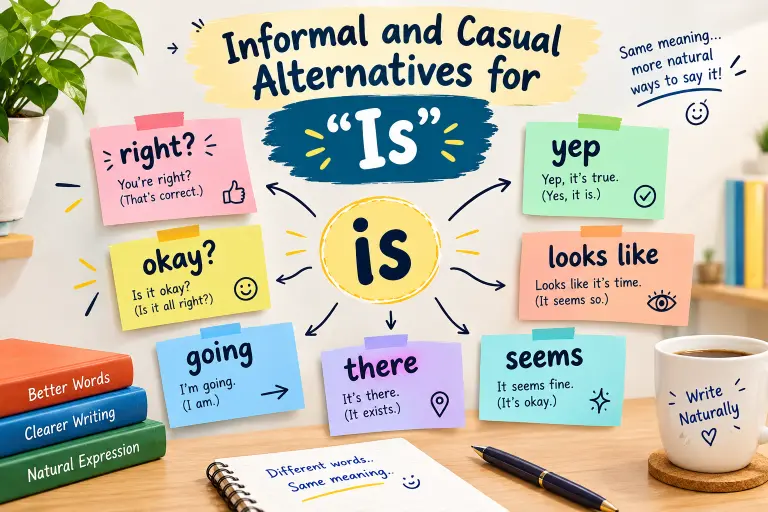
English has relatively few true casual synonyms for “is.” Instead, speakers often change the sentence structure.
“Seems” for Casual Statements
Meaning: Gives an impression.
Example: “He is tired.” → “He seems tired.”
When it sounds natural: Conversations, texts, and casual observations.
When to avoid it: When certainty matters.
Tone: Casual and tentative.
“Looks” as a Casual Alternative to “Is”
Meaning: Appears based on visual evidence.
Example: “The cake is delicious.” → “The cake looks delicious.”
When it sounds natural: Casual conversation.
When to avoid it: If you are claiming taste based on actual experience rather than appearance.
Tone: Informal and conversational.
“Sounds” as a Casual Alternative to “Is”
Meaning: Appears to be true based on what was heard.
Example: “That is a good idea.” → “That sounds like a good idea.”
When it sounds natural: Conversation, texts, and friendly emails.
When to avoid it: Formal academic claims.
Tone: Friendly and conversational.
“Feels” as a Casual Alternative to “Is”
Meaning: Gives a particular emotional or physical impression.
Example: “The room is cold.” → “The room feels cold.”
When it sounds natural: Everyday conversation.
When to avoid it: Technical measurements when exact temperature matters.
Tone: Personal and conversational.
“Goes” in Informal Expressions
Meaning: Works or proceeds in a particular way.
Example: “The story is like this.” → “The story goes like this.”
When it sounds natural: Storytelling and conversation.
When to avoid it: Formal reports.
Tone: Informal.
True Synonyms vs. Contextual Alternatives for “Is”
The word “is” deserves special treatment because it is a grammatical form of be, not a single concept with one replacement.
| Type | What It Means | Can It Replace “Is”? |
|---|---|---|
| True synonym | Nearly the same meaning and grammatical role | Rarely |
| Near synonym | Similar meaning but different emphasis | Sometimes |
| Contextual alternative | Works in a particular sentence | Yes, in suitable contexts |
| Broader expression | Covers a wider idea | Sometimes |
| Narrower expression | Gives a more specific meaning | Only when that meaning is intended |
For example, “remains” can replace “is” when continuation matters. “exists” works when existence matters. “represents” works when something stands for another idea. “seems” introduces uncertainty. None of these is a universal replacement.
Industry-Specific Synonyms for “Is”
Different fields favor different alternatives because precision matters more than simply avoiding repetition.
Business Writing and Synonyms for “Is”
Business writing often benefits from verbs that communicate measurable relationships.
Use:
- represents
- indicates
- amounts to
- stands at
- comprises
- includes
- constitutes
- remains
Example:
Weak: “The current revenue is $2 million.”
More precise: “The current revenue stands at $2 million.”
Another option is:
“The report indicates a steady increase in revenue.”
The second version focuses on what the report shows rather than merely describing the revenue.
Corporate Communication and Synonyms for “Is”
Internal reports and announcements often use remains, stands, includes, consists of, represents, and continues to be.
Example:
“The current policy remains in effect through the end of the quarter.”
This is more informative than simply saying:
“The current policy is in effect.”
The word “remains” tells the reader that the condition continues.
Academic Writing and Synonyms for “Is”
Academic writing should favor precision over unnecessary variation.
Useful choices include:
- indicates
- demonstrates
- suggests
- represents
- constitutes
- signifies
- denotes
- characterizes
- consists of
- comprises
- exists
- occurs
Example:
“The evidence suggests that the method is effective.”
Notice that “suggests” is not equivalent to “is.” It deliberately makes the claim less absolute.
Customer Service and Synonyms for “Is”
Customer service writing usually benefits from simple, direct language.
Useful alternatives include:
- remains
- appears
- seems
- includes
- contains
- shows
- stands at
Example:
“Your order appears to be delayed.”
This is safer than stating:
“Your order is delayed.”
The first sentence leaves room for further investigation.
Legal Writing and Synonyms for “Is”
Legal writing requires special care. A seemingly simple substitution can change the legal meaning of a sentence. Terms such as constitutes, means, includes, consists of, represents, and remains may carry specific interpretive effects depending on the document.
For example:
“This conduct constitutes a breach of the agreement.”
This is stronger and more specific than:
“This conduct is a breach of the agreement.”
Do not substitute casual expressions such as “seems,” “looks,” or “feels” in legal language when the original sentence expresses a defined legal fact. Legal wording should be reviewed according to the applicable law and document.
Email Communication and Synonyms for “Is”
Professional emails rarely need fancy substitutes. The best choice is usually the most precise natural verb.
Client update:
“The revised schedule remains unchanged.”
Project update:
“The final report is now ready.”
Request:
“The attached document contains the requested information.”
Follow-up:
“The current balance stands at $850.”
Cautious statement:
“The file appears to be incomplete.”
Email Examples Using Synonyms for “Is”
Client Communication
Subject: Updated Project Schedule
Hello Maria,
The revised schedule remains unchanged following today’s review. The design phase will finish on October 14, and development will begin the following week.
Please let me know if you would like a copy of the updated timeline.
Best,
Daniel
Project Update
Subject: Project Report
Hi Team,
The latest report indicates steady progress across the three main work areas. Two tasks are still pending, but they are expected to be completed this week.
I’ll share another update after Friday’s review.
Best,
Nina
Academic Communication
Subject: Question About the Assignment
Dear Professor Lee,
I’m reviewing the research requirements, and one section appears to require additional sources. Could you please confirm whether two peer-reviewed articles will be sufficient?
Thank you,
James
Customer Service
Subject: Your Order Status
Hello,
Your order appears to have been delayed during transit. We have contacted the carrier and will update you as soon as we receive more information.
Thank you for your patience.
Customer Support
Vendor Communication
Subject: Invoice Confirmation
Hello Mark,
The outstanding balance stands at $1,450 according to our records. Please review the attached statement and let us know if your records show a different amount.
Regards,
Taylor
Internal Workplace Email
Subject: Meeting Room Update
Hi everyone,
The conference room remains unavailable this afternoon because of maintenance. Today’s meeting will therefore take place in Room 204.
Thanks,
Alex
Short Dialogue Examples Using Synonyms for “Is”
Workplace
Person A: Is the report ready?
Person B: It appears to be. I’m checking the final figures now.
Classroom
Person A: What does this symbol mean?
Person B: It denotes the beginning of a new section.
Customer Service
Person A: Is my order delayed?
Person B: It appears to be delayed, but we’re confirming that with the carrier.
Casual Conversation
Person A: Is that your new car?
Person B: Yep. It looks great, right?
Professional Discussion
Person A: What is the main issue?
Person B: The problem lies in the current approval process.
How to Replace “Is” in a Sentence
The safest way to replace “is” is to identify its exact function first.
Example 1: Identity
Original:
“Maria is the project manager.”
Alternative:
“Maria serves as the project manager.”
Why it works:
The alternative emphasizes Maria’s role rather than simply stating her identity.
Example 2: Location
Original:
“The office is in Chicago.”
Alternative:
“The office is located in Chicago.”
Why it works:
The new phrase specifically emphasizes location. It is slightly more formal.
Example 3: Continuation
Original:
“The policy is effective.”
Alternative:
“The policy remains effective.”
Why it works:
“Remains” adds the idea that the policy continues to be effective.
Example 4: Evidence
Original:
“The data is evidence of improvement.”
Alternative:
“The data indicates improvement.”
Why it works:
The alternative creates a clearer relationship between evidence and conclusion.
Example 5: Meaning
Original:
“The symbol is a warning.”
Alternative:
“The symbol signifies a warning.”
Why it works:
“Signifies” explains the meaning carried by the symbol.
Example 6: Composition
Original:
“The committee is twelve members.”
Alternative:
“The committee comprises twelve members.”
Why it works:
“Comprises” correctly expresses the committee’s composition.
Example 7: Existence
Original:
“There is a problem with the system.”
Alternative:
“A problem exists within the system.”
Why it works:
“Exists” focuses on the presence of the problem and creates a more formal tone.
Example 8: Function
Original:
“The introduction is a guide to the essay.”
Alternative:
“The introduction serves as a guide to the essay.”
Why it works:
“Serves as” emphasizes the function performed by the introduction.
Comparison Table of Synonyms for “Is”
| Phrase | Tone | Meaning / Scope | Best Use | Example |
|---|---|---|---|---|
| Is | Neutral | Basic identity or state | All-purpose writing | The report is complete. |
| Remains | Neutral/formal | Continues to be | Updates | The policy remains active. |
| Exists | Formal | Has existence | Academic writing | A gap exists. |
| Represents | Formal | Stands for | Reports | The figure represents growth. |
| Indicates | Professional | Shows or suggests | Research | The data indicates improvement. |
| Signifies | Formal | Carries meaning | Analysis | The symbol signifies change. |
| Denotes | Technical | Means or refers to | Technical writing | The mark denotes emphasis. |
| Comprises | Formal | Is made up of | Reports | The team comprises eight members. |
| Consists of | Neutral/formal | Is made up of | Descriptions | The course consists of five units. |
| Functions as | Formal | Performs a role | Academic writing | The section functions as a summary. |
| Serves as | Neutral/formal | Performs a role | Professional writing | The document serves as evidence. |
| Appears | Neutral | Seems to be | Cautious claims | The file appears incomplete. |
| Seems | Casual/neutral | Gives an impression | Conversation | It seems useful. |
| Occurs | Formal | Happens | Events/processes | The error occurs frequently. |
| Equals | Technical | Has the same value | Math/comparison | Two plus two equals four. |
Which Synonym for “Is” Should You Choose?
- For formal writing: Choose constitutes, represents, denotes, signifies, comprises, consists of, or indicates when the meaning fits.
- For business communication: Use remains, stands at, indicates, includes, comprises, or represents.
- For academic writing: Prefer indicates, demonstrates, constitutes, signifies, denotes, exists, and characterizes where they accurately express the relationship.
- For legal writing: Use precise terms such as constitutes, means, includes, consists of, or remains only when they preserve the intended legal meaning.
- For professional emails: Favor simple alternatives such as remains, appears, contains, includes, and stands at.
- For everyday conversation: Usually keep is. If you need variety, use seems, looks, sounds, feels, or appears when their added meaning is intended.
- For casual messages: Natural sentence structure is usually better than forcing a synonym. “It’s great” often sounds much better than an unusual substitute.
Grammar and Usage Guide for “Is”
“Is” Is a Form of the Verb “Be”
“Is” is the third-person singular present-tense form of be.
Examples:
- He is ready.
- She is a teacher.
- The book is on the desk.
- It is raining.
The correct alternative depends on the grammatical role of “is.”
“Is” With Adjectives
“Is” often links a subject to an adjective.
Example:
“The room is quiet.”
A direct synonym may not exist. You can restructure the sentence:
- “The room remains quiet.”
- “The room seems quiet.”
- “The room feels quiet.”
Each version adds a different meaning.
“Is” With Nouns
“Is” can connect a subject with a noun that identifies it.
Example:
“James is a doctor.”
You could write:
“James works as a doctor.”
However, “works as” describes his occupation rather than simply identifying him.
“Is” and Location
For location, phrases such as is located, is situated, lies, and stands can work.
Example:
“The museum is downtown.”
More formal:
“The museum is located downtown.”
“Is” and Prepositions
Do not automatically change the preposition when replacing “is.”
- Correct:
- “The office is in Boston.”
- Correct:
- “The office is near the station.”
- Correct:
- “The problem lies in the process.”
The correct preposition depends on the alternative verb.
“Is” and Subject-Verb Agreement
“Is” is used with singular subjects.
Correct:
“The report is ready.”
For plural subjects, use are.
Correct:
“The reports are ready.”
Do not replace “is” with a singular verb when the subject is plural.
Capitalization
“Is” is normally lowercase unless it begins a sentence or appears in a title where title-style capitalization applies.
Example:
“The answer is correct.”
Do not capitalize “is” simply because it is a verb.
Common Mistakes When Replacing “Is”
1. Treating Every Alternative as an Exact Synonym
“Is,” “seems,” “appears,” and “remains” do not mean exactly the same thing. Choose according to meaning.
2. Changing the Level of Certainty
“Is true” expresses a direct claim. “Seems true” introduces uncertainty.
3. Using Formal Words Just to Sound Intelligent
“Denotes” does not improve a sentence if “means” is clearer.
4. Using Casual Alternatives in Formal Writing
“Looks like” may sound natural in conversation but can be too informal for a research paper.
5. Confusing Identity With Function
“He is the manager” and “He serves as the manager” are close, but the second emphasizes his role.
6. Using “Comprises” Incorrectly
“Comprises” describes what a whole contains.
Correct: “The team comprises ten employees.”
Avoid treating it as a general substitute for every use of “is.”
7. Changing Certainty Without Intending To
“Is” and “appears to be” make different claims. This distinction matters in reports and professional communication.
8. Forcing Variety
There is nothing wrong with using “is” several times. Replacing every occurrence can make writing less natural.
When Not to Use “Is”
You may want an alternative to “is” when:
- The same verb appears repeatedly in a paragraph.
- A stronger verb can communicate the relationship more precisely.
- You need to show continuation with remains.
- You need to express evidence with indicates.
- You need to describe composition with comprises.
- You need to describe a role with serves as.
- You need to identify a location more specifically with is located or is situated.
However, “is” is often the better choice when the sentence is simple and direct. For example, “The answer is correct” is usually clearer than “The answer remains correct” unless continuation is relevant.
The goal is not to eliminate “is.” The goal is to use the word that communicates the intended meaning most accurately.
Advanced Writer Tips for Using Alternatives to “Is”
Tone Control With Synonyms for “Is”
Use is for plain, direct writing. Use remains when continuity matters, appears when certainty is limited, and constitutes when describing a formal relationship.
Compare:
- “The plan is effective.”
- “The plan appears effective.”
- “The plan remains effective.”
- “The plan demonstrates effectiveness.”
These sentences are related, but they do not make the same claim.
Professional Email Etiquette and “Is”
Professional emails rarely need complicated synonyms. A simple replacement can improve precision:
“The invoice stands at $900.”
“The document contains the requested information.”
“The issue appears to be resolved.”
Each sentence gives the reader a clearer idea of the relationship.
Politeness and “Is”
Changing “is” can also change how certain a statement sounds.
“The request is incomplete” is direct.
“The request appears to be incomplete” sounds less accusatory because it leaves room for correction.
That distinction can be useful in customer service and workplace communication.
Context Alignment
Ask what “is” actually means before replacing it:
- Identity?
- Location?
- Condition?
- Existence?
- Function?
- Meaning?
- Composition?
- Evidence?
- Continuation?
- Event?
Once you identify the meaning, the best alternative becomes much easier to choose.
Precision
Choose the narrowest accurate verb.
- If a symbol means something, use denotes or signifies.
- If data shows something, use indicates.
- If something continues, use remains.
- If something is made up of parts, use comprises or consists of.
Readability
Do not replace a short word with a longer phrase unless the new wording adds value.
“The room is quiet” is clearer than:
“The room constitutes a state of quietness.”
The second sentence is technically more elaborate but much worse English.
Related Questions About Synonyms for “Is”
What Is Another Way to Say “Is”?
Another way to say “is” depends on the sentence. Common alternatives include remains, exists, appears, seems, represents, indicates, signifies, denotes, constitutes, comprises, consists of, serves as, and functions as. These words are contextual alternatives, not universal replacements.
What Is a Professional Alternative to “Is”?
Professional alternatives include remains, indicates, represents, comprises, constitutes, stands at, and serves as. The best choice depends on the relationship being described. For example, “remains” shows continuation, while “indicates” shows that evidence points toward a conclusion.
What Is a Formal Alternative to “Is”?
Formal alternatives include constitutes, signifies, denotes, represents, comprises, consists of, characterizes, and indicates. They should be used only when their specific meanings fit the sentence. Formal vocabulary does not automatically make writing better.
Can “Seems” Replace “Is”?
Sometimes, but the meaning changes. “Is” presents something directly, while “seems” indicates an impression or lower level of certainty. “The plan is effective” and “The plan seems effective” should not be treated as identical claims.
Can “Remains” Replace “Is”?
Yes, when the sentence describes a condition that continues. “The office is closed” simply states its condition. “The office remains closed” emphasizes that it continues to be closed.
What Is the Difference Between “Is” and “Exists”?
“Is” can express identity, description, location, condition, or other relationships. “Exists” specifically focuses on existence or presence. Therefore, “A problem exists” works, but “She exists a teacher” does not.
Should I Avoid Using “Is” in Academic Writing?
No. Academic writing does not require eliminating common verbs. Replace “is” when another verb gives more precise information, but keep “is” when it is the clearest and most accurate choice.
FAQs About Synonyms for “Is”
What are the most useful synonyms for “is”?
The most useful alternatives include remains, exists, appears, seems, represents, indicates, signifies, denotes, constitutes, comprises, consists of, serves as, functions as, and stands at. Their usefulness depends on context because they express different relationships rather than functioning as universal substitutes.
Is “is” a formal word?
Yes. “Is” is a standard, neutral English verb and is appropriate in formal, academic, business, and everyday writing. There is no need to replace it simply because a sentence appears in a formal document.
What is a stronger alternative to “is”?
There is no single stronger alternative. Indicates may be stronger for evidence, constitutes for formal relationships, remains for continuing states, and represents for symbolic relationships. The strongest choice is the one that expresses the intended meaning accurately.
Can “is” and “seems” be used interchangeably?
No. “Is” generally makes a direct statement, while “seems” signals an impression or uncertainty. For example, “The solution is correct” is more certain than “The solution seems correct.”
Can “is” and “remains” mean the same thing?
They can overlap, but “remains” adds the idea of continuation. “The door is open” describes its current condition. “The door remains open” suggests that it was already open and continues to be so.
What is the best alternative to “is” in academic writing?
There is no universal best option. Indicates, demonstrates, constitutes, represents, signifies, denotes, exists, and characterizes can be useful when their specific meanings fit. In many academic sentences, however, “is” remains the clearest option.
How can I avoid repeating “is” without making my writing awkward?
First, identify whether another verb can add useful meaning. You can use remains for continuity, indicates for evidence, represents for symbolism, or comprises for composition. You can also restructure the sentence instead of forcing a synonym into every occurrence.
Key Takeaways
- “Is” has no single universal synonym because it performs several grammatical and semantic functions.
- Use remains, exists, appears, or seems only when their added meanings are intended.
- Formal alternatives such as constitutes, denotes, signifies, and comprises are useful in specific contexts, not everywhere.
- In professional writing, precision and clarity matter more than avoiding repetition.
- Sometimes the best synonym for “is” is simply “is” because direct wording is clearer.
Conclusion:
Finding synonyms for “is” requires more than replacing one word with another. Because “is” can express identity, location, condition, existence, meaning, composition, and other relationships, each sentence needs to be considered on its own. Remains is useful for continuing states, exists emphasizes presence, represents expresses symbolism, indicates connects evidence with a conclusion, and comprises describes composition. Other choices, such as serves as, functions as, occurs, appears, and seems, have equally specific roles.
For formal and academic writing, choose precise verbs when they genuinely clarify the idea. For emails and everyday communication, keep the language natural. Most importantly, don’t replace “is” simply for the sake of variety. A short, familiar verb is often the strongest choice. Good writing isn’t about avoiding common words; it’s about selecting the word that expresses your meaning clearly, accurately, and naturally.
