
If you’re looking for synonyms for consistent, the best choice depends on what you mean by the word. Consistent can describe something that stays the same, happens regularly, produces reliable results, agrees with something else, or remains logically sound. Because those meanings are slightly different, replacing it with any random synonym can change your sentence.
This guide gives you more than 39 useful alternatives, including formal, professional, neutral, casual, academic, and contextual choices. You’ll also see realistic examples, differences in meaning, grammar tips, email examples, sentence transformations, and a practical guide for choosing the right word.
Quick Answer: Synonyms for Consistent
Common synonyms for consistent include steady, constant, regular, uniform, stable, reliable, dependable, persistent, continual, continuous, sustained, predictable, unchanging, constant, coherent, compatible, congruent, and invariable. The best alternative depends on whether you mean regular behavior, stable results, logical agreement, or something that remains unchanged.
Quick List of Synonyms for Consistent
Here are useful alternatives at a glance:
Closest Synonyms for Consistent
- Steady
- Constant
- Regular
- Uniform
- Stable
- Reliable
- Dependable
- Unchanging
- Sustained
- Persistent
- Predictable
- Invariable
- Continuous
- Continual
- Even
- Recurrent
- Repeated
- Enduring
Formal Synonyms for Consistent
- Coherent
- Congruent
- Compatible
- Conforming
- Uniform
- Invariable
- Sustained
- Persistent
- Systematic
- Regularized
Neutral and Professional Alternatives
- Steady
- Stable
- Reliable
- Dependable
- Predictable
- Regular
- Continuous
- Sustained
- Repeated
- Routine
- Balanced
- Constant
Contextual Alternatives
- In keeping with
- In line with
- Aligned
- Compatible with
- In agreement with
- Unwavering
- Even
- Recurrent
- Ongoing
- Habitual
Not all of these are interchangeable. For example, reliable focuses on trustworthiness, while uniform emphasizes sameness. Coherent usually refers to ideas that make sense together, and aligned often describes goals, policies, or positions that agree.
Formal Synonyms for Consistent
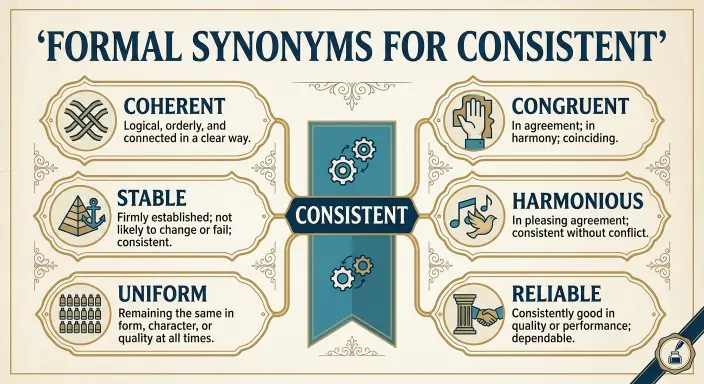
Formal writing often benefits from a more precise word than consistent. Choose the alternative according to the exact meaning you want.
1. Consistent → Coherent
Meaning: Logical, clear, and connected.
Explanation: Coherent is a near synonym rather than a universal replacement. It works especially well for arguments, explanations, theories, and written ideas that fit together logically.
Example: The report presents a coherent explanation of the findings.
Best Use: Academic writing, reports, analysis, and professional explanations.
Worst Use: Describing a person’s regular attendance or repeated behavior.
Tone: Formal and analytical.
2. Consistent → Congruent
Meaning: In agreement or harmony with something else.
Explanation: Congruent is useful when two ideas, results, behaviors, or statements correspond. It does not usually mean simply “happening regularly.”
Example: The results were congruent with the original hypothesis.
Best Use: Academic, scientific, technical, and analytical writing.
Worst Use: Casual conversation where matching or in agreement would sound more natural.
Tone: Formal and precise.
3. Consistent → Compatible
Meaning: Able to exist, work, or agree together without conflict.
Explanation: Compatible is a contextual alternative. It emphasizes agreement or suitability rather than repetition or stability.
Example: The proposed changes are compatible with the company’s existing policies.
Best Use: Business, technology, policy, and technical communication.
Worst Use: Describing a person who exercises regularly.
Tone: Professional and neutral.
4. Consistent → Conforming
Meaning: Following an established rule, standard, or expectation.
Explanation: Conforming highlights compliance. A process can be consistent because it conforms to a standard, but the two words aren’t always interchangeable.
Example: All samples were processed using a conforming procedure.
Best Use: Standards, regulations, manufacturing, quality control, and formal documentation.
Worst Use: Friendly conversation or descriptions of personal habits.
Tone: Formal and procedural.
5. Consistent → Invariable
Meaning: Not changing or varying.
Explanation: Invariable is one of the stronger alternatives when you specifically mean that something remains unchanged.
Example: The machine must maintain an invariable temperature during testing.
Best Use: Technical, scientific, and formal descriptions.
Worst Use: Situations where some normal variation is expected.
Tone: Very formal and precise.
6. Consistent → Sustained
Meaning: Continued at a particular level or maintained over time.
Explanation: Sustained focuses on duration and continued effort. It is especially useful for performance, growth, attention, pressure, or activity.
Example: The company achieved sustained growth throughout the year.
Best Use: Business reports, performance reviews, academic writing, and formal analysis.
Worst Use: A simple statement about whether two facts agree.
Tone: Professional and polished.
7. Consistent → Persistent
Meaning: Continuing for a long time or refusing to stop.
Explanation: Persistent emphasizes continuation. It can describe effort, problems, behavior, or conditions, and may sometimes carry a negative tone.
Example: Persistent effort eventually improved the team’s performance.
Best Use: Formal writing about effort, trends, problems, or behavior.
Worst Use: When you simply mean “accurate” or “reliable.”
Tone: Formal to neutral.
8. Consistent → Systematic
Meaning: Done according to an organized method or system.
Explanation: Systematic is not a direct synonym, but it can replace consistent when consistency comes from following a planned method.
Example: The researchers used a systematic approach to evaluate the responses.
Best Use: Academic, scientific, business, and technical writing.
Worst Use: Describing something that merely happens often.
Tone: Formal and methodical.
9. Consistent → Predictable
Meaning: Likely to behave or occur in an expected way.
Explanation: Predictable focuses on expectation rather than sameness. It can be positive in systems and negative when describing boring behavior.
Example: The software delivers predictable results under normal conditions.
Best Use: Technical writing, business communication, and performance descriptions.
Worst Use: When you want to praise someone for being dependable in a personal relationship.
Tone: Neutral and analytical.
10. Consistent → Unwavering
Meaning: Firm and not changing.
Explanation: Unwavering is particularly useful for attitudes, support, commitment, confidence, or determination.
Example: She showed unwavering support for the project.
Best Use: Formal writing, speeches, biographies, and professional praise.
Worst Use: Technical descriptions of numerical measurements.
Tone: Strong, formal, and expressive.
11. Consistent → Enduring
Meaning: Continuing over a long period.
Explanation: Enduring emphasizes lasting quality rather than regular repetition.
Example: The organization has built an enduring relationship with its community.
Best Use: Formal writing about relationships, values, influence, or achievements.
Worst Use: Describing a weekly schedule.
Tone: Formal and positive.
12. Consistent → In Keeping With
Meaning: Agreeing with or matching something.
Explanation: This phrase is useful when consistent with means “in agreement with.” It cannot replace every meaning of consistent.
Example: The decision is in keeping with the company’s stated values.
Best Use: Reports, policies, formal emails, and professional explanations.
Worst Use: Describing repeated performance.
Tone: Formal and natural.
Semi-Formal and Neutral Synonyms for Consistent
These alternatives are generally easier to use in everyday professional writing.
13. Steady
Meaning: Remaining stable without sudden changes.
Explanation: Steady is one of the most versatile alternatives. It can describe progress, effort, performance, movement, or conditions.
Example: The team has made steady progress on the project.
Best Use: Work, school, reports, and everyday conversation.
Worst Use: Formal logical arguments where coherent is more accurate.
Tone: Neutral and positive.
14. Stable
Meaning: Not likely to change suddenly.
Explanation: Stable emphasizes security and lack of major variation.
Example: The company has maintained stable revenue over the past year.
Best Use: Business, finance, technology, science, and everyday writing.
Worst Use: When you mean someone performs a task regularly rather than remaining unchanged.
Tone: Neutral and professional.
15. Reliable
Meaning: Dependable and likely to work or perform as expected.
Explanation: Reliable shifts attention from sameness to trustworthiness.
Example: We need a reliable supplier for the new project.
Best Use: Business, customer service, technology, and personal communication.
Worst Use: A statement where you specifically mean that two pieces of information agree.
Tone: Neutral and professional.
16. Dependable
Meaning: Someone or something that can be trusted to do what is expected.
Explanation: Dependable is close to reliable but often sounds more personal.
Example: Maria is one of our most dependable team members.
Best Use: Workplace feedback, recommendations, and everyday conversation.
Worst Use: Highly technical descriptions where stable or reliable may be more precise.
Tone: Warm, positive, and professional.
17. Regular
Meaning: Happening repeatedly according to a pattern or schedule.
Explanation: Regular works when consistency involves frequency.
Example: Regular practice helped him improve his writing.
Best Use: Schedules, habits, routines, exercise, study, and everyday communication.
Worst Use: Describing logical agreement between two statements.
Tone: Neutral.
18. Uniform
Meaning: The same or very similar throughout.
Explanation: Uniform emphasizes sameness across multiple items, people, measurements, or processes.
Example: The samples were uniform in size.
Best Use: Manufacturing, science, design, data, and formal descriptions.
Worst Use: Describing a person’s dependable behavior.
Tone: Neutral to formal.
19. Constant
Meaning: Continuing without much change or interruption.
Explanation: Constant is stronger than regular because it can suggest something is continuously present.
Example: The patient requires constant monitoring.
Best Use: Situations involving uninterrupted attention, presence, or change-free conditions.
Worst Use: Scheduled events that happen only occasionally.
Tone: Neutral to formal.
20. Predictable
Meaning: Easy to anticipate.
Explanation: This is useful when consistent behavior makes an outcome expected.
Example: The team’s performance has become more predictable.
Best Use: Business, sports, technology, planning, and analysis.
Worst Use: If you mean “high quality.” Something can be predictably poor.
Tone: Neutral.
21. Sustained
Meaning: Maintained continuously or over a period.
Explanation: Sustained is especially effective with nouns such as effort, growth, attention, improvement, pressure, and performance.
Example: The campaign generated sustained interest among students.
Best Use: Reports, school writing, business communication, and professional evaluations.
Worst Use: Simple casual statements where steady is easier.
Tone: Professional.
22. Continuous
Meaning: Happening without interruption.
Explanation: Continuous is narrower than consistent. Something continuous does not stop, while something consistent may simply occur repeatedly or remain stable.
Example: Continuous monitoring is required during the experiment.
Best Use: Science, technology, schedules, processes, and technical writing.
Worst Use: Weekly meetings, because they are regular rather than continuous.
Tone: Neutral and technical.
23. Continual
Meaning: Happening repeatedly, often with short breaks.
Explanation: Continual is often confused with continuous. A continual problem keeps happening; a continuous process does not stop.
Example: The team faced continual delays during construction.
Best Use: Repeated events or problems.
Worst Use: A process that literally runs without interruption.
Tone: Neutral to formal.
24. Repeated
Meaning: Happening more than once.
Explanation: Repeated focuses on recurrence, not necessarily reliability or stability.
Example: Repeated testing confirmed the original result.
Best Use: Research, reports, instructions, and everyday writing.
Worst Use: Praising someone as dependable.
Tone: Neutral.
25. Routine
Meaning: Done regularly as part of a normal pattern.
Explanation: Routine describes established activities rather than qualities such as accuracy or stability.
Example: Regular backups are now part of the team’s routine process.
Best Use: Workflows, habits, procedures, and everyday communication.
Worst Use: Describing changing financial results.
Tone: Neutral and practical.
Informal and Casual Alternatives for Consistent
English does not have many slang words that directly mean consistent. Most casual alternatives are ordinary words and phrases.
26. Steady
Meaning: Dependable or regular.
Example: He’s been pretty steady with his workouts lately.
When it sounds natural: Conversation, texts, social posts, and friendly workplace talk.
When to avoid it: Highly technical writing if greater precision is needed.
Tone: Casual and friendly.
27. Keeps It Up
Meaning: Continues doing something well or regularly.
Example: If she keeps it up, she’ll finish the project early.
When it sounds natural: Conversations and informal messages.
When to avoid it: Formal reports and academic writing.
Tone: Casual and encouraging.
28. On a Regular Basis
Meaning: Happening regularly.
Example: We check the equipment on a regular basis.
When it sounds natural: Everyday workplace communication.
When to avoid it: Concise writing, because simply saying regularly is often cleaner.
Tone: Neutral to mildly formal.
29. Stays the Same
Meaning: Does not change.
Example: The price has stayed the same all month.
When it sounds natural: Everyday conversation.
When to avoid it: Academic writing where remained stable or remained unchanged may be more polished.
Tone: Casual and clear.
30. Keeps Going
Meaning: Continues without giving up or stopping.
Example: Her motivation keeps going even during difficult weeks.
When it sounds natural: Informal conversation.
When to avoid it: Technical descriptions where continues or persists is more exact.
Tone: Casual and encouraging.
31. Same Old Pattern
Meaning: A familiar pattern that keeps occurring.
Example: It’s the same old pattern: sales rise in December and fall in January.
When it sounds natural: Casual conversation.
When to avoid it: Formal reports and professional evaluations.
Tone: Informal, sometimes slightly negative.
More Contextual Alternatives for Consistent
Some of the most useful replacements aren’t dictionary-perfect synonyms. They become appropriate because of the specific sentence.
32. Aligned
Meaning: In agreement with a goal, position, plan, or standard.
Example: The new strategy is aligned with our long-term goals.
Best Use: Business, strategy, education, and professional writing.
Caution: Don’t use aligned simply to mean “regular.”
33. In Line With
Meaning: In agreement with or consistent with something.
Example: The proposal is in line with our current budget.
Best Use: Emails, reports, business communication, and everyday professional writing.
Caution: It describes agreement, not repeated behavior.
34. In Agreement With
Meaning: Having the same view or result as something else.
Example: The findings are in agreement with earlier research.
Best Use: Academic and analytical writing.
Caution: It does not mean “happening regularly.”
35. Compatible With
Meaning: Able to work or exist together without conflict.
Example: The software is compatible with the existing system.
Best Use: Technology, business, engineering, and technical communication.
Caution: Compatibility is about working together, not consistency over time.
36. Matching
Meaning: Similar or corresponding to something else.
Example: The records contain matching information.
Best Use: Everyday communication, data comparison, and customer service.
Caution: Matching usually describes similarity between things.
37. Unchanging
Meaning: Remaining the same.
Example: The company’s core values have remained unchanging for decades.
Best Use: Formal and descriptive writing.
Caution: It is stronger than consistent if normal variation is possible.
38. Even
Meaning: Smooth, balanced, or regular.
Example: The machine maintains an even flow of water.
Best Use: Descriptions of pace, distribution, performance, or physical movement.
Caution: Even has many unrelated meanings, so context matters.
39. Habitual
Meaning: Done regularly because it has become a habit.
Example: His habitual lateness became a concern for the manager.
Best Use: Behavior, routines, and formal descriptions of habits.
Caution: It can suggest an automatic or ingrained behavior and may sound negative.
40. Recurrent
Meaning: Happening repeatedly.
Example: The report identified recurrent technical problems.
Best Use: Medical, technical, academic, and formal writing.
Caution: It refers to repeated occurrence, not dependable performance.
41. Ongoing
Meaning: Continuing at the present time.
Example: The team is conducting an ongoing review of the policy.
Best Use: Projects, investigations, discussions, and work updates.
Caution: Something can be ongoing without being consistent.
42. Unvarying
Meaning: Not changing or varying.
Example: The experiment requires an unvarying temperature.
Best Use: Scientific, technical, and formal descriptions.
Caution: It can sound stiff in everyday writing.
43. Persistent
Meaning: Continuing despite difficulty or attempts to stop it.
Example: Persistent effort helped the student improve.
Best Use: Effort, problems, behavior, and formal writing.
Caution: A persistent problem is not necessarily a desirable consistent result.
44. Invariable
Meaning: Always the same; not subject to change.
Example: The procedure follows an invariable sequence.
Best Use: Technical and highly precise writing.
Caution: It can sound unnecessarily formal in ordinary communication.
45. Dependable
Meaning: Trustworthy and reliable.
Example: We need a dependable person to manage the schedule.
Best Use: People, services, suppliers, systems, and workplace communication.
Caution: It emphasizes trust rather than sameness.
True Synonyms vs. Contextual Alternatives for Consistent
The word consistent has several meanings, so the distinction between exact synonyms and contextual alternatives matters.
| Type | What It Means | Can It Replace “Consistent”? |
|---|---|---|
| True synonym | Has essentially the same meaning in the same context | Often |
| Near synonym | Shares much of the meaning but adds a different nuance | Sometimes |
| Contextual alternative | Works in a particular sentence but has a different core meaning | Only in that context |
| Broader expression | Covers a wider idea than consistent | Sometimes |
| Narrower expression | Describes one specific form of consistency | Only when that meaning is intended |
For example, steady can replace consistent in “steady performance,” but continuous would be wrong if the performance has natural breaks. Likewise, reliable works for “consistent service” when you mean dependable service, but not necessarily when you mean identical service every time.
Industry-Specific Synonyms for Consistent
Business Writing and Consistent Alternatives
Business writing often benefits from precise words such as reliable, steady, stable, sustained, regular, predictable, and aligned.
Instead of:
The company has consistent growth.
You could write:
The company has achieved steady growth.
If you mean that growth has continued for a long period:
The company has achieved sustained growth.
If you mean the results can be trusted:
The company has delivered reliable results.
The best choice depends on what the original sentence actually claims.
Corporate Communication and Consistent Alternatives
Corporate documents often use consistent to describe policies, procedures, messaging, or performance.
Useful alternatives include:
- Uniform
- Standardized
- Aligned
- Systematic
- Reliable
- Stable
- In line with
- Conforming
Example:
“The department uses a consistent approval process.”
More precise:
“The department uses a standardized approval process.”
Here, standardized tells the reader that the process follows an established standard.
Academic Writing and Consistent Alternatives
Academic writing often needs more precision than simply replacing consistent with a synonym.
Useful choices include:
- Coherent
- Congruent
- Compatible
- Repeated
- Stable
- Sustained
- Uniform
- In agreement with
- In line with
Example:
The findings are consistent with previous research.
Possible alternatives:
The findings are in agreement with previous research.
Or:
The findings are congruent with previous research.
The first alternative is more natural for many academic contexts. Congruent is more formal and should be used only when its precise meaning fits.
Customer Service and Consistent Alternatives
Customer service language usually favors clear words such as:
- Reliable
- Regular
- Steady
- Dependable
- Predictable
- Uniform
Example:
We aim to provide consistent service.
A natural alternative is:
We aim to provide reliable service.
This shifts the emphasis from uniformity to dependability.
Legal Writing and Consistent Alternatives
Legal writing requires special care because seemingly similar words can carry different meanings in a specific document or legal context.
Useful general expressions include consistent with, in accordance with, conforming to, compatible with, and in conformity with. However, they are not automatically interchangeable. A legal document may distinguish between complying with a rule, agreeing with a provision, and maintaining the same position over time.
For example:
The policy is consistent with the applicable requirements.
This should not automatically become:
The policy is compatible with the applicable requirements.
Compatible with can suggest that two things can coexist, while consistent with can indicate that there is no contradiction. In legal work, preserve the intended meaning rather than choosing a synonym simply because it sounds formal.
Email Communication and Consistent Alternatives
For professional emails, steady, reliable, regular, aligned, in line with, and consistent are usually safer than highly formal words such as invariable or unvarying.
Compare:
We need consistent communication throughout the project.
With:
We need regular communication throughout the project.
The second version is clearer if you mean frequent updates.
Email Examples Using Alternatives to Consistent
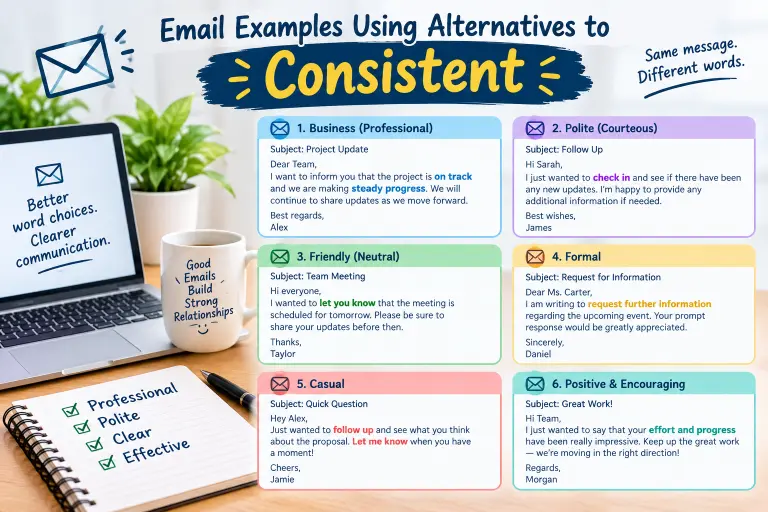
Client Communication: Reliable
Subject: Service Schedule for September
Hi Daniel,
I wanted to confirm that our support team will remain available throughout September. You can expect reliable response times during our normal support hours.
If your team has any urgent requests, please send them directly to me.
Best,
Alex
Project Update: Steady
Subject: Project Progress Update
Hi Maya,
The development work is moving forward at a steady pace. We’ve completed the database changes and are now testing the reporting features.
I’ll send another update after the next testing phase.
Best,
Jordan
Internal Request: Regular
Subject: Weekly Project Updates
Hi Team,
Please send your project updates every Friday afternoon. Regular updates will help us identify delays early and keep the schedule accurate.
Thanks,
Chris
Academic Communication: Coherent
Subject: Revised Research Draft
Professor Lee,
I’ve revised the discussion section to make the argument more coherent. I also clarified the connection between the findings and the research question.
Thank you for your feedback.
Best,
Nina
Vendor Communication: Dependable
Subject: Delivery Schedule
Hello Marcus,
We’re reviewing our supplier arrangements for the next quarter. Your company has provided dependable deliveries so far, and we’d like to discuss continuing that arrangement.
Please let me know which dates work for a short call.
Regards,
Sam
Customer Service: In Line With
Subject: Your Refund Request
Hello Taylor,
We’ve reviewed your request, and the refund has been approved. The decision is in line with our current refund policy.
You should receive confirmation once the transaction has been processed.
Best,
Customer Support
Short Dialogue Examples Using Consistent Synonyms
Workplace
Person A: Has the team’s performance improved?
Person B: Yes. It’s been much steadier over the last few months.
Classroom
Person A: Why did the teacher use the word “coherent” instead of “consistent”?
Person B: Because she was talking about whether the argument made logical sense.
Customer Service
Person A: We need someone reliable to handle these requests.
Person B: I can take care of them every afternoon.
Casual Conversation
Person A: How’s your running going?
Person B: Pretty good. I’ve been steady with it this month.
Professional Discussion
Person A: Are the new results consistent with the earlier data?
Person B: Yes. They’re broadly in agreement with the previous findings.
How to Replace “Consistent” in a Sentence
Example 1: Regular Behavior
Original: She is consistent with her study schedule.
Alternative: She is regular with her study schedule.
Why it works: Regular emphasizes frequency. A more natural sentence would also be “She studies regularly.”
Example 2: Stable Performance
Original: The employee delivers consistent performance.
Alternative: The employee delivers steady performance.
Why it works: Steady emphasizes stable performance over time.
Example 3: Dependability
Original: We need consistent service from the provider.
Alternative: We need reliable service from the provider.
Why it works: Reliable emphasizes trust and dependable delivery.
Example 4: Logical Agreement
Original: The conclusion is consistent with the evidence.
Alternative: The conclusion is in agreement with the evidence.
Why it works: The phrase clearly shows that two things do not conflict.
Example 5: No Change
Original: The temperature remained consistent.
Alternative: The temperature remained stable.
Why it works: Stable is more precise if the temperature remained within a controlled range.
Example 6: Continuous Activity
Original: The system requires consistent monitoring.
Alternative: The system requires continuous monitoring.
Why it works: Continuous means monitoring does not stop. This is a stronger and narrower claim.
Example 7: Long-Term Effort
Original: Consistent effort helped her succeed.
Alternative: Sustained effort helped her succeed.
Why it works: Sustained highlights continued effort over time.
Example 8: Matching Policies
Original: The proposal is consistent with our policy.
Alternative: The proposal is aligned with our policy.
Why it works: Aligned with clearly communicates agreement with a policy or position.
Example 9: Repeated Problems
Original: The company experienced consistent delays.
Alternative: The company experienced recurrent delays.
Why it works: Recurrent emphasizes that the delays happened repeatedly. It doesn’t suggest the delays were predictable in every instance.
Example 10: Same Results
Original: The machine produces consistent results.
Alternative: The machine produces uniform results.
Why it works: Uniform emphasizes similarity among the results.
Comparison Table: Synonyms for Consistent
| Phrase | Tone | Meaning / Scope | Best Use | Example |
|---|---|---|---|---|
| Consistent | Neutral | Stable, regular, or agreeing | General writing | Her results are consistent. |
| Steady | Neutral | Stable over time | Performance | Sales showed steady growth. |
| Reliable | Professional | Dependable | Services and people | We need reliable support. |
| Dependable | Neutral | Trustworthy | People and services | He is dependable. |
| Stable | Professional | Not changing suddenly | Conditions and results | Prices remained stable. |
| Regular | Neutral | Happening repeatedly | Habits and schedules | We have regular meetings. |
| Uniform | Formal | Essentially the same | Data and products | The samples were uniform. |
| Sustained | Formal | Maintained over time | Effort and growth | Sustained improvement followed. |
| Continuous | Technical | Without interruption | Processes | Continuous monitoring is required. |
| Continual | Neutral | Repeated frequently | Events and problems | Continual delays caused concern. |
| Coherent | Formal | Logically connected | Arguments and writing | Her explanation was coherent. |
| Congruent | Formal | In agreement | Research and analysis | The findings were congruent. |
| Predictable | Neutral | Easy to anticipate | Outcomes and behavior | The results are predictable. |
| Persistent | Formal | Continuing despite obstacles | Effort or problems | Persistent effort paid off. |
| Aligned | Professional | In agreement with a goal | Strategy and policy | The plan is aligned with our goals. |
| In line with | Professional | In agreement with | Policies and decisions | The decision is in line with policy. |
Which Synonym for Consistent Should You Choose?
For Formal Writing
Choose coherent, congruent, sustained, uniform, or invariable when their specific meanings fit.
Avoid choosing a complicated word simply to make the writing sound sophisticated.
For Business Communication
Reliable, steady, stable, predictable, and aligned are strong choices.
For example, use reliable for a service and steady for performance.
For Academic Writing
Use coherent for arguments, congruent or in agreement with for findings, and repeated for recurring tests or observations.
Precision matters more than formality.
For Legal Writing
Use the original consistent with when it accurately expresses the intended relationship. Alternatives such as in accordance with or in conformity with may carry different implications.
For Professional Email
Choose straightforward words such as regular, reliable, steady, stable, and in line with.
A clear email is usually better than an unusually formal one.
For Everyday Conversation
Steady, regular, reliable, and keeps going are natural choices.
For Casual Messages
Use simple expressions such as stays the same, keeps going, or keeps it up when appropriate.
Grammar and Usage Guide for Consistent
Consistent + With
The most important grammatical pattern is:
consistent with + noun or noun phrase
Examples:
- The result is consistent with the evidence.
- Her actions are consistent with her values.
- The decision is consistent with company policy.
Do not normally write:
The result is consistent to the evidence.
Use consistent with, not consistent to, in this meaning.
Consistent + In
Use consistent in + noun when describing someone’s regularity in a particular quality or behavior.
Examples:
- She is consistent in her approach.
- He has been consistent in his efforts.
- The company is consistent in its treatment of customers.
Consistently as an Adverb
The adverb form is consistently.
Example:
She consistently meets her deadlines.
This means she does so regularly or reliably.
Consistency as a Noun
The noun form is consistency.
Example:
Consistency is important in professional communication.
Consistent vs. Consistently
These forms are not interchangeable.
Adjective:
His performance is consistent.
Adverb:
He performs consistently.
Consistent With vs. Consistent in
Compare:
The findings are consistent with earlier research.
Here, with introduces the thing that agrees with the findings.
The researcher was consistent in applying the method.
Here, in introduces the area in which the behavior remained regular.
Singular and Plural Agreement
Consistent does not change between singular and plural subjects.
- The result is consistent.
- The results are consistent.
- The methods are consistent.
Only the verb changes.
Common Mistakes to Avoid With Consistent Synonyms
1. Treating Every Alternative as an Exact Synonym
Reliable and consistent overlap, but they are not identical. Reliability emphasizes dependability; consistency can emphasize sameness or regularity.
2. Confusing Continuous With Continual
Continuous means without interruption.
Continual means repeated, often with breaks.
The machine runs continuously.
The machine requires continual maintenance.
3. Using Uniform When You Mean Reliable
A uniform process may produce the same pattern, but that doesn’t automatically make it dependable.
4. Using Coherent for Regular Behavior
Coherent concerns logical connection. It is appropriate for an argument, not usually for someone’s exercise routine.
5. Making Professional Writing Too Formal
Words such as invariable and unvarying may be technically appropriate but unnecessarily stiff in an ordinary email.
6. Using Casual Expressions in Formal Documents
Phrases such as keeps it up or same old pattern belong in informal contexts, not academic papers or formal reports.
7. Changing the Intended Meaning
Replacing “consistent results” with “continuous results” changes the meaning. Results can be consistent without being produced continuously.
8. Ignoring the Preposition
The common construction is:
consistent with the evidence
not:
consistent to the evidence
9. Using Predictable as Automatic Praise
Predictable can be positive when discussing stable systems, but it can also mean boring or unimaginative when describing people.
10. Replacing a Clear Word With a Fancy One
If consistent already communicates the intended meaning, there is no need to replace it. Good writing values precision and clarity over unnecessary variation.
When Not to Use the Word Consistent
There are several situations where another word may be more precise.
Use “Regular” Instead of “Consistent” for Schedules
We hold consistent meetings.
This is less natural if you mean meetings happen every Monday.
Better:
We hold regular meetings.
Use “Reliable” for Trustworthiness
The supplier provides consistent deliveries.
If the point is that deliveries arrive when promised, use:
The supplier provides reliable deliveries.
Use “Stable” for Lack of Change
The patient’s condition remained consistent.
If you mean there was little or no change, stable may communicate the idea more clearly.
Use “Continuous” for No Interruption
The system needs consistent monitoring.
If monitoring must happen without stopping:
The system needs continuous monitoring.
Use “Coherent” for Logical Writing
The essay is consistent.
If you mean the ideas connect logically:
The essay is coherent.
Use “Aligned” for Goals and Strategies
The project is consistent with our goals.
A natural professional alternative is:
The project is aligned with our goals.
When Consistent Is Actually Better
Keep consistent when it covers the meaning you need without ambiguity.
For example:
The data is consistent with the original hypothesis.
Here, consistent with is concise, natural, and precise. There is no need to replace it just for variety.
Advanced Tips for Choosing Synonyms for Consistent
Tone Control
For a conversational tone, choose steady, regular, reliable, or stays the same.
Use for professional writing, consider stable, dependable, sustained, aligned, or in line with.
For academic writing, coherent, congruent, uniform, and in agreement with may be useful when their meanings fit.
Professional Email Etiquette
Don’t replace consistent with a longer phrase simply to sound professional.
Compare:
Please provide consistent updates.
with:
Please provide regular updates.
The second is better if you mean updates should arrive on a schedule.
Politeness
Word choice can soften or sharpen a message.
Your attendance has been inconsistent.
is direct.
We’ve noticed some variation in your attendance.
is softer but less direct.
The right choice depends on the purpose of the message.
Context Alignment
Ask what kind of consistency you mean:
- Same → uniform
- Stable → steady / stable
- Dependable → reliable / dependable
- Regular → regular / recurrent
- Uninterrupted → continuous
- Repeated → continual / repeated
- Logical agreement → coherent / in agreement with
- Goal or policy agreement → aligned / in line with
- Unchanging → invariable / unchanging
Precision
Before selecting a synonym, identify the exact relationship.
For example, “consistent with” can mean “does not contradict.” In that sentence, aligned with may work. But if consistent means “performed reliably every week,” aligned would be the wrong choice.
Readability
Shorter words are often stronger.
Instead of:
The company has demonstrated sustained and consistent performance over an extended period.
consider:
The company has maintained steady performance.
The second sentence communicates the main idea with less clutter.
Related Questions About Synonyms for Consistent
What Is Another Way to Say Consistent?
Another way to say consistent is steady, reliable, stable, regular, uniform, dependable, sustained, predictable, or coherent, depending on the meaning. Use steady for stable performance, reliable for dependability, regular for repeated schedules, and coherent for logically connected ideas.
What Is a Professional Alternative to Consistent?
Reliable, steady, stable, sustained, aligned, and in line with are strong professional alternatives. The best choice depends on context. For example, “reliable service” focuses on dependability, while “steady growth” describes performance that remains stable over time.
What Is a Formal Alternative or Synonyms to Consistent?
Formal alternatives include coherent, congruent, uniform, sustained, invariable, conforming, and unwavering. However, they are not interchangeable in every sentence. Coherent is best for ideas, while uniform emphasizes sameness and unwavering emphasizes firm commitment.
Is Consistent a Formal Word?
No. Consistent is a standard neutral English word and works well in casual, professional, academic, and formal writing. It is often preferable to a more complicated synonym because it is familiar and flexible.
Can Reliable Replace Consistent?
Sometimes. Reliable can replace consistent when you mean dependable or trustworthy performance. It cannot replace every meaning of consistent. For example, “consistent with the evidence” generally should not become “reliable with the evidence.”
What Is the Difference Between Consistent and Steady?
Consistent is broader. It can mean regular, stable, uniform, or logically compatible. Steady usually emphasizes stability or a lack of sudden changes. “Consistent attendance” and “steady growth” illustrate two different uses.
What Is the Difference Between Consistent and Continuous?
Consistent does not necessarily mean uninterrupted. Continuous specifically describes something that continues without stopping. A company can provide consistent service during business hours without providing continuous service around the clock.
FAQs About Synonyms for Consistent
What Is the Best Synonym for Consistent?
There is no single best synonym because consistent has several meanings. Steady is excellent for stable performance, reliable for dependable service, regular for repeated events, uniform for sameness, and coherent for logically connected ideas.
What Is a Strong Word for Consistent?
Steady, reliable, dependable, sustained, and unwavering are strong alternatives. Unwavering is particularly strong for commitment or support, while sustained works well for effort, growth, or performance maintained over time.
What Is a Formal Word for Consistent?
Depending on context, formal choices include congruent, coherent, uniform, invariable, sustained, conforming, and unwavering. These should be selected for meaning rather than formality alone.
What Is a Synonym for Consistent in Academic Writing?
Synonyms for Consistent in academic alternatives include coherent, congruent, compatible, repeated, stable, uniform, and in agreement with. For example, “The results are consistent with previous research” can become “The results are in agreement with previous research.”
What Is a Synonym for Consistent in Business?
Useful business alternatives include reliable, steady, stable, dependable, predictable, sustained, and aligned. Choose reliable for service quality, steady for performance, and aligned for strategies or objectives.
Can “Regular” Mean the Same as “Consistent”?
Sometimes. Regular emphasizes repeated timing or frequency, while consistent has a broader meaning. “Regular meetings” means meetings occur according to a recurring schedule; “consistent communication” could mean communication is regular, clear, or dependable.
Can “Stable” Replace “Consistent”?
Yes, in some contexts. Stable works when consistency means remaining relatively unchanged. It is especially useful for prices, conditions, systems, performance, and situations. It is not a good replacement when consistency means logical agreement.
Key Takeaways
- Synonyms for Consistent can mean stable, regular, dependable, uniform, or in agreement, so context determines the best synonym.
- Use steady for stable performance, reliable for dependability, and regular for recurring schedules.
- Use uniform when you mean things are essentially the same and continuous only when something happens without interruption.
- For academic or analytical writing, coherent, congruent, and in agreement with can provide greater precision.
- Don’t replace consistent just for variety; the clearest word is often the strongest choice.
Conclusion
The best synonyms for consistent depend on the exact idea you want to express. If you mean stable performance, steady or stable usually works well. If you mean something can be trusted, choose reliable or dependable. For recurring schedules or habits, regular is more precise. If several things are essentially the same, uniform may be better. In academic writing, coherent, congruent, or in agreement with can clarify logical relationships, while aligned and in line with work naturally for goals, policies, and strategies.
The key is not to chase a synonym simply because it sounds more sophisticated. Words such as continuous, persistent, predictable, and compatible carry their own meanings and can change the sentence if used carelessly. Start with the idea behind consistent, then select the word that expresses that idea most accurately. Clear, precise wording will almost always make your writing stronger.
