
Finding the right synonyms for together can make your writing more precise, natural, and varied. The word together is extremely flexible: it can describe people being in the same place, things being combined, people working toward the same goal, or events happening at the same time. Because of that, no single replacement works in every sentence.
The best alternative depends on what you mean. In a business report, jointly, collectively, or in collaboration may sound better. In everyday conversation, side by side, alongside each other, or as a group may feel more natural. This guide explains 39+ useful alternatives, shows their differences, and provides practical examples for writing, emails, school, business, and conversation.
Quick Answer: Synonyms for Together
Common synonyms for together include jointly, collectively, jointly, in unison, in concert, in collaboration, cooperatively, simultaneously, concurrently, alongside one another, side by side, as a group, as one, united, combined, connected, mutually, in partnership, in tandem, and all at once. The best choice depends on whether together means shared action, physical proximity, unity, combination, or timing.
Quick List of Synonyms for Together
Closest Synonyms for Together
- Jointly
- Collectively
- Cooperatively
- In unison
- In concert
- In collaboration
- In partnership
- In tandem
- As a group
- As one
- United
- Combined
- Alongside one another
- Side by side
- With one another
Formal Synonyms for Together
- Conjointly
- Collaboratively
- Coordinately
- Collectively
- Mutually
- In conjunction
- In cooperation
- In association
- In concert
- In partnership
Neutral Synonyms for Together
- At the same time
- Simultaneously
- Concurrently
- As a team
- With each other
- Alongside each other
- As a unit
- In tandem
- Combined
Casual and Contextual Alternatives
- Side by side
- All at once
- All together
- Shoulder to shoulder
- One with another
- Working together
- Joined
- Linked
- Connected
- Grouped
- Paired
Not all of these are exact replacements. Some describe cooperation, some describe physical closeness, some indicate unity, and others describe simultaneous action.
Formal Synonyms for Together
1. Jointly
Meaning: Done or shared by two or more people or organizations.
Explanation: Jointly is one of the closest formal alternatives when people share responsibility or perform an action together. It often emphasizes shared involvement.
Example: The two companies jointly developed the new software.
Best Use: Contracts, reports, business writing, official announcements, and professional communication.
Worst Use: Casual conversation, where together may sound simpler.
Tone: Formal and professional.
2. Collectively
Meaning: As a group rather than as individuals.
Explanation: Collectively emphasizes the group as a whole. It doesn’t necessarily mean the people were physically together.
Example: The researchers collectively reviewed the findings.
Best Use: Academic, corporate, organizational, and analytical writing.
Worst Use: Describing two people sitting next to each other.
Tone: Formal and analytical.
3. Conjointly
Meaning: Together or jointly.
Explanation: This is a formal and relatively uncommon word. It can replace together when describing shared action, but it may sound unnecessarily technical in ordinary writing.
Example: The departments conjointly prepared the annual report.
Best Use: Highly formal or specialized writing.
Worst Use: Everyday emails and casual speech.
Tone: Very formal.
4. Collaboratively
Meaning: By working with others toward a shared result.
Explanation: Collaboratively adds the idea of active cooperation. It is not a universal synonym because simply being together does not necessarily involve collaboration.
Example: The designers worked collaboratively on the campaign.
Best Use: Business, education, creative projects, and workplace writing.
Worst Use: Physical-location contexts such as “The students sat together.”
Tone: Professional and positive.
5. Cooperatively
Meaning: By working together willingly and helpfully.
Explanation: This word focuses on cooperation. It suggests that participants are helping one another.
Example: The departments worked cooperatively to resolve the issue.
Best Use: Workplace reports, education, organizational communication, and conflict resolution.
Worst Use: Situations involving simple physical proximity.
Tone: Formal to neutral.
6. In conjunction
Meaning: In combination or working with something else.
Explanation: In conjunction with is useful when two things operate or happen together. It is more formal than ordinary together.
Example: The treatment is used in conjunction with regular exercise.
Best Use: Academic, medical, technical, and professional writing.
Worst Use: Friendly conversation.
Tone: Formal.
7. In concert
Meaning: Acting together or in agreement.
Explanation: In concert often describes coordinated actions by people, organizations, or systems.
Example: Several agencies acted in concert to address the problem.
Best Use: Formal reports, journalism, and professional writing.
Worst Use: Simple sentences about physical location.
Tone: Formal and polished.
8. In partnership
Meaning: Working together as partners.
Explanation: This phrase specifically suggests an established relationship or shared effort.
Example: The university worked in partnership with local businesses.
Best Use: Business proposals, nonprofit communication, education, and corporate writing.
Worst Use: Describing people merely standing together.
Tone: Professional and cooperative.
9. Collaboratively Working Together
Meaning: Working jointly toward a common goal.
Explanation: This phrase is understandable but often redundant because collaboratively already communicates the idea of working together. Use one strong expression rather than stacking both unnecessarily.
Example: The teams worked collaboratively to complete the project.
Best Use: Workplace and academic writing.
Worst Use: Where concise wording is preferred.
Tone: Professional.
10. Mutually
Meaning: Shared by or affecting two or more parties.
Explanation: Mutually can sometimes replace together, but it changes the emphasis. It focuses on a relationship between parties rather than simply shared physical presence.
Example: The organizations mutually agreed to extend the deadline.
Best Use: Agreements, relationships, negotiations, and formal correspondence.
Worst Use: “They sat mutually in the room.”
Tone: Formal.
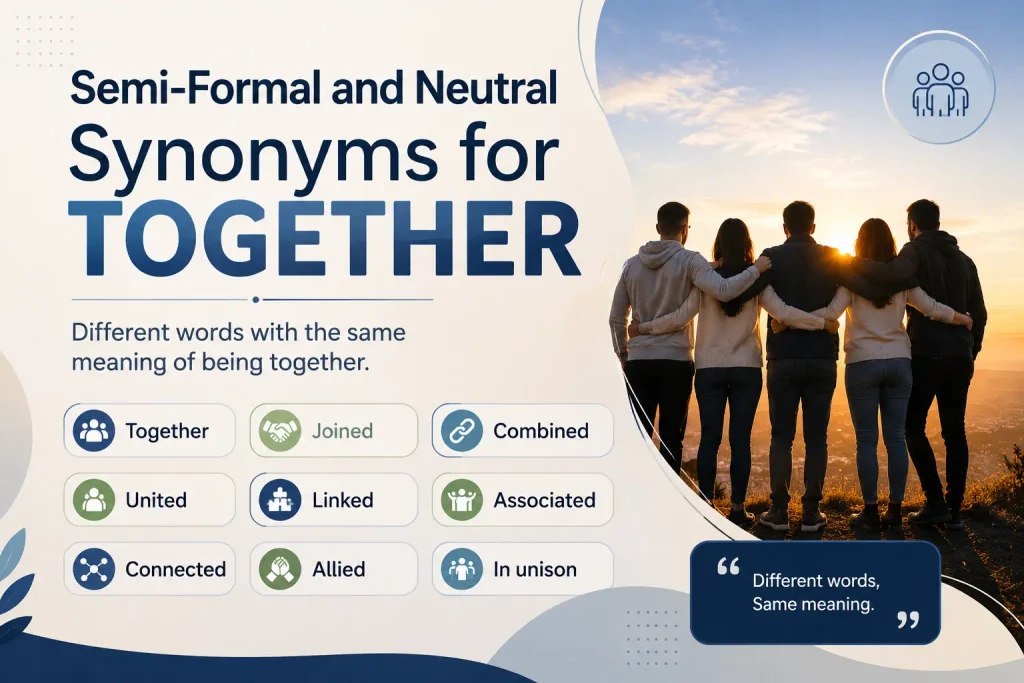
Semi-Formal and Neutral Synonyms for Together
11. Side by Side
Meaning: Next to one another.
Explanation: This is mainly a physical expression. It can also suggest people working closely or sharing an experience.
Example: The two teams worked side by side during the event.
Best Use: Everyday writing, stories, websites, and descriptive writing.
Worst Use: A contract where precise legal language is needed.
Tone: Neutral and natural.
12. Alongside One Another
Meaning: Next to or in cooperation with each other.
Explanation: This phrase can describe physical proximity or cooperation, making it more flexible than side by side.
Example: The two researchers worked alongside one another for several months.
Best Use: Professional, academic, and descriptive writing.
Worst Use: Very short casual messages, where it may sound slightly formal.
Tone: Neutral to semi-formal.
13. With Each Other
Meaning: In relation to one another.
Explanation: This is a natural alternative when together describes interaction.
Example: The students shared their ideas with each other.
Best Use: Everyday communication, school writing, and general prose.
Worst Use: Formal reports that require a more specific term.
Tone: Neutral.
14. With One Another
Meaning: With each member of a group interacting with another.
Explanation: Similar to with each other, but sometimes slightly more formal or literary.
Example: The participants exchanged information with one another.
Best Use: Professional and academic writing.
Worst Use: Very casual conversation if simpler wording is preferable.
Tone: Neutral to formal.
15. As a Group
Meaning: Acting or existing as a group.
Explanation: This expression focuses on collective participation rather than physical closeness.
Example: We attended the conference as a group.
Best Use: Work, school, travel, and everyday writing.
Worst Use: When you specifically need to emphasize cooperation.
Tone: Neutral.
16. As a Team
Meaning: Working collectively toward a shared goal.
Explanation: As a team is narrower than together. It implies teamwork.
Example: We solved the problem as a team.
Best Use: Sports, workplaces, school projects, and leadership writing.
Worst Use: People who are merely in the same location.
Tone: Neutral and encouraging.
17. In Tandem
Meaning: Working or operating together.
Explanation: In tandem suggests coordinated action, often by two people, systems, or processes.
Example: The two programs operate in tandem.
Best Use: Business, technology, professional writing, and technical explanations.
Worst Use: Simple family or social situations.
Tone: Semi-formal.
18. As One
Meaning: With unity or in complete agreement.
Explanation: This phrase adds a strong sense of unity. It is more expressive than the basic word together.
Example: The audience rose as one when the speaker finished.
Best Use: Speeches, journalism, storytelling, and inspirational writing.
Worst Use: Precise technical instructions.
Tone: Expressive and neutral.
19. United
Meaning: Joined by a common purpose, belief, or interest.
Explanation: United is usually an adjective rather than a direct adverbial replacement for together.
Example: The community remained united during the difficult period.
Best Use: Social, political, organizational, and motivational writing.
Worst Use: A sentence that only means people were physically close.
Tone: Strong and positive.
20. Combined
Meaning: Joined or brought into one.
Explanation: Combined focuses on things being merged or used together.
Example: The combined efforts of the volunteers made the event possible.
Best Use: Business, science, mathematics, reports, and general writing.
Worst Use: Describing people simply spending time together.
Tone: Neutral to formal.
21. Connected
Meaning: Linked or related to one another.
Explanation: Connected emphasizes a relationship or link rather than simultaneous presence.
Example: The two systems are connected through a secure network.
Best Use: Technology, relationships, ideas, and technical writing.
Worst Use: As a direct substitute whenever together means “at the same time.”
Tone: Neutral.
22. Linked
Meaning: Joined or associated.
Explanation: Linked is useful for physical, conceptual, digital, or organizational relationships.
Example: The two issues are closely linked.
Best Use: Reports, websites, academic writing, technology, and analytical content.
Worst Use: Casual situations where no relationship exists.
Tone: Neutral.
Informal and Casual Synonyms for Together
23. Side by Side
Meaning: Next to someone or something.
Example: We walked side by side along the beach.
When it sounds natural: Conversation, social media, stories, and personal writing.
When to avoid it: Formal documents when physical proximity isn’t the intended meaning.
Tone: Friendly and descriptive.
24. All Together
Meaning: Everyone or everything as one group.
Example: Let’s sing the song all together.
When it sounds natural: Conversation, classrooms, family settings, and group activities.
When to avoid it: Academic or technical writing if collectively or another precise term is better.
Tone: Casual and friendly.
25. Shoulder to Shoulder
Meaning: Very close together, often while facing a challenge.
Example: The volunteers stood shoulder to shoulder during the cleanup.
When it sounds natural: Speeches, stories, and expressive writing.
When to avoid it: Neutral technical descriptions.
Tone: Figurative and expressive.
26. Hanging Out Together
Meaning: Spending relaxed, informal time with other people.
Example: We spent the afternoon hanging out together.
When it sounds natural: Friends, texting, social media, and casual conversation.
When to avoid it: Business emails, academic papers, and formal reports.
Tone: Very casual.
27. All at Once
Meaning: Happening at the same time.
Example: The lights went out all at once.
When it sounds natural: Everyday conversation and storytelling.
When to avoid it: When together means cooperation rather than simultaneous timing.
Tone: Casual to neutral.
True Synonyms vs. Contextual Alternatives for Together
Not every replacement listed above means exactly the same thing. This distinction matters because together has several grammatical and semantic uses.
| Type | What It Means | Can It Replace the Original? |
|---|---|---|
| True synonym | Very similar meaning in a particular context | Usually |
| Near synonym | Similar but carries an extra shade of meaning | Sometimes |
| Contextual alternative | Works only in a specific situation | Yes, only in that context |
| Broader expression | Covers a wider idea than the original | Sometimes |
| Narrower expression | Describes only one specific sense | Only in suitable contexts |
For example, jointly works well in “They jointly own the property,” but it doesn’t replace together in “They sat together on the bench.” In the second sentence, side by side is more accurate.
Likewise, simultaneously can replace together when the meaning is “at the same time,” but it cannot replace it when the meaning is “with one another.”
Business Writing: Synonyms for Together

Business writing benefits from precise alternatives. Instead of repeatedly writing “work together,” consider the exact relationship:
- Collaborate — work jointly on a task.
- Partner — work with another organization or person in a partnership.
- Coordinate — organize activities so they work effectively together.
- Jointly — share responsibility or action.
- In conjunction with — operate alongside another process or activity.
- Collectively — describe a group acting as a whole.
- In tandem — describe coordinated processes or teams.
Example:
The marketing and sales teams collaborated on the new product launch.
This is more precise than:
The marketing and sales teams worked together on the new product launch.
The original is perfectly correct, but collaborated tells the reader more about the nature of the relationship.
Corporate Communication: Synonyms for Together
Corporate communication often needs language that is clear without becoming stiff.
Suitable Corporate Alternatives
Jointly:
“The companies jointly announced the agreement.”
Collectively:
“Employees are collectively responsible for maintaining a safe workplace.”
- In partnership:
- “We developed the program in partnership with local organizations.”
- In collaboration:
- “The communications team worked in collaboration with the legal department.”
- In tandem:
- “The two systems operate in tandem to improve reporting.”
For internal announcements, avoid replacing every instance of together with a formal phrase. Plain English is often stronger.
Academic Writing: Synonyms for Together
Academic writing benefits from precision. Depending on the sentence, useful alternatives include:
- Collectively
- Jointly
- In conjunction
- Simultaneously
- Concurrently
- In combination
- In association
- Alongside
- Collaboratively
Example:
The variables were analyzed in conjunction with demographic data.
Here, in conjunction with clearly expresses a relationship between two sets of information.
For a group project, however:
The students collaborated on the research project.
is more precise than simply saying:
The students worked together on the research project.
Customer Service: Synonyms for Together
Customer service language should remain clear and friendly.
Useful options include:
- Together — warm and direct.
- With you — personal and reassuring.
- Alongside you — supportive.
- As a team — emphasizes shared effort.
- In partnership with you — professional and collaborative.
- Collectively — appropriate for group responsibility, but often too formal for direct customer interaction.
Example:
We’ll work with you to find the best solution.
This is usually more natural than:
We will work collaboratively in conjunction with you to identify an appropriate solution.
The second sentence is grammatically possible but unnecessarily complicated.
Legal Writing: Synonyms for Together
Legal writing requires extra care because seemingly similar words can carry different meanings.
Terms such as jointly, collectively, in conjunction with, jointly and severally, and in association with can have specific legal or contractual implications depending on the document and jurisdiction.
For example:
The parties jointly agreed to the amendment.
does not necessarily communicate exactly the same thing as:
The parties agreed to the amendment together.
Similarly, jointly can describe shared responsibility, while collectively can describe a group acting as a whole.
For legal documents, choose terminology based on the intended legal relationship rather than simply searching for a more sophisticated synonym. If legal rights or obligations are involved, the wording should be reviewed by a qualified legal professional familiar with the applicable jurisdiction.
Email Communication: Synonyms for Together
Professional emails usually benefit from simple, specific wording.
- Use jointly for shared responsibility:
We jointly prepared the proposal.
- Use collaboratively for teamwork:
Our teams worked collaboratively on the update.
- Use in partnership for organizations:
We developed this initiative in partnership with the local council.
- Use alongside for parallel work:
We worked alongside the design team during testing.
- Use in conjunction with for related processes:
The new procedure should be used in conjunction with the existing checklist.
Email Examples Using Synonyms for Together
Client Email — “In Partnership”
Subject: Next Steps for the Marketing Project
Hi Jordan,
Thank you for the productive discussion today. We’re looking forward to continuing this project in partnership with your team.
We’ll send the revised campaign schedule by Thursday and include the changes we discussed.
Best,
Alex
Project Update — “Collaboratively”
Subject: Website Project Update
Hi Team,
The design and development teams have been working collaboratively on the new landing pages. The first draft is now ready for review.
Please add your comments by Friday afternoon so we can keep the next stage on schedule.
Thanks,
Maya
Internal Request — “Jointly”
Subject: Budget Review
Hi Sam,
Could you review the revised figures with me? I’d like us to jointly confirm the numbers before they are included in the final report.
Please let me know if you’re available tomorrow morning.
Best,
Chris
Academic Email — “Alongside”
Subject: Research Project Discussion
Dear Professor Lee,
I’ve completed the first section of the assignment and am now reviewing the findings alongside the background research.
I would appreciate your feedback on whether the sources support the main argument clearly.
Best regards,
Nina
Vendor Email — “In Conjunction With”
Subject: Updated Delivery Schedule
Hello Mark,
Please find the revised delivery schedule attached. The updated dates should be used in conjunction with the latest purchase order.
Please let me know if any information needs clarification.
Regards,
Daniel
Short Dialogue Examples Using Synonyms for Together
Workplace
Person A: Can marketing and sales handle this project together?
Person B: Yes. They can collaborate on the launch plan.
Classroom
Person A: Should we complete the assignment together?
Person B: Sure. Let’s work as a team and divide the research.
Customer Service
Person A: I’m not sure which option is best.
Person B: That’s okay. We’ll work with you to find the right one.
Casual Conversation
Person A: Are you two going to the concert together?
Person B: Yes. We’re going to travel there side by side.
Professional Discussion
Person A: How did the two departments solve the problem?
Person B: They worked in tandem and compared their findings.
How to Replace “Together” in a Sentence
Example 1
Original:
The two companies worked together on the project.
Alternative:
The two companies collaborated on the project.
Why it works:
Collaborated clearly communicates purposeful teamwork.
Example 2
Original:
The students sat together.
Alternative:
The students sat side by side.
Why it works:
Side by side makes the physical meaning clearer.
Example 3
Original:
The departments jointly created the policy.
Alternative:
The departments collectively created the policy.
Why it works:
Collectively emphasizes the departments acting as a group. It slightly changes the focus from shared responsibility to group action.
Example 4
Original:
The systems work together.
Alternative:
The systems operate in tandem.
Why it works:
In tandem suggests coordinated operation and sounds appropriate in technical writing.
Example 5
Original:
The researchers examined both factors together.
Alternative:
The researchers examined both factors in conjunction.
Why it works:
The alternative is more formal and suitable for academic or technical writing.
Example 6
Original:
We completed the task together.
Alternative:
We completed the task as a team.
Why it works:
As a team emphasizes cooperation and shared effort.
Example 7
Original:
The lights turned on together.
Alternative:
The lights turned on simultaneously.
Why it works:
Here together means “at the same time,” so simultaneously is more precise.
Example 8
Original:
The children walked together.
Alternative:
The children walked alongside one another.
Why it works:
The alternative suggests physical proximity while retaining a natural tone.
Example 9
Original:
The organizations worked together to support the program.
Alternative:
The organizations worked in partnership to support the program.
Why it works:
In partnership highlights a cooperative relationship between organizations.
Example 10
Original:
The community stood together during the crisis.
Alternative:
The community remained united during the crisis.
Why it works:
United adds the idea of shared purpose and solidarity rather than simply physical presence.
Comparison Table: Synonyms for Together
| Phrase | Tone | Meaning / Scope | Best Use | Example |
|---|---|---|---|---|
| Together | Neutral | General shared action or presence | Almost any context | We worked together. |
| Jointly | Formal | Shared responsibility/action | Business, official writing | They jointly approved it. |
| Collectively | Formal | As a group | Reports, academic writing | They acted collectively. |
| Collaboratively | Professional | Active cooperation | Work, education | They worked collaboratively. |
| Cooperatively | Formal/neutral | Willing cooperation | Workplace, education | They responded cooperatively. |
| In conjunction | Formal | In combination | Academic, technical | Used in conjunction with data. |
| In tandem | Semi-formal | Coordinated action | Business, technology | The systems operate in tandem. |
| Side by side | Neutral | Physical closeness | Everyday writing | They walked side by side. |
| As a team | Neutral | Shared teamwork | Work, sports, school | We succeeded as a team. |
| As one | Expressive | Unity | Speeches, stories | They moved as one. |
| Simultaneously | Formal | At the same time | Academic, technical | Both events occurred simultaneously. |
| United | Neutral/formal | Shared purpose | Community, organizations | They remained united. |
| Combined | Neutral | Joined into one | General, technical | Their combined efforts helped. |
| With one another | Neutral/formal | Interaction between people | Academic, professional | They communicated with one another. |
| All at once | Casual/neutral | At the same time | Conversation | Everyone spoke all at once. |
Which Synonym for Together Should You Choose?
- For formal writing: Choose jointly, collectively, in conjunction, or conjointly, depending on meaning.
- For business communication: Collaboratively, jointly, in partnership, and in tandem are useful.
- For academic writing: Prefer collectively, collaboratively, simultaneously, concurrently, or in conjunction when they accurately describe the relationship.
- For legal writing: Use the legally intended term rather than choosing a synonym simply because it sounds formal. Jointly and collectively may have different implications.
- For professional email: Keep the wording simple. Together, collaboratively, alongside, jointly, and in partnership are usually effective.
- For everyday conversation: Together, with each other, side by side, and as a group sound natural.
- For casual messages: Stick with together, all together, hanging out together, or side by side, depending on the meaning.
Grammar and Usage Guide for Together
Together as an Adverb
Together is most commonly an adverb.
We worked together.
They arrived together.
The pieces fit together.
It can describe action, movement, arrangement, or relationships.
Together for Physical Proximity
Use together when people or objects occupy the same place or are close to one another.
The children stayed together.
For greater precision:
The children stayed side by side.
Together for Cooperation
When the meaning is teamwork, alternatives such as collaboratively, jointly, and as a team can be more precise.
We worked together on the proposal.
We collaborated on the proposal.
Together for Simultaneous Action
Sometimes together means “at the same time.”
They shouted together.
This can become:
They shouted simultaneously.
However, simultaneously sounds more formal and specifically emphasizes timing.
“Together With”
The phrase together with means “along with” or “in addition to.”
The report, together with its supporting documents, was submitted.
Don’t automatically replace this with with each other. The grammatical meaning is different.
“Together” vs. “Altogether”
These words are not interchangeable.
Together usually means jointly, in one place, or at the same time.
We went together.
Altogether can mean completely or in total.
The repairs cost $500 altogether.
Confusing these two words is a common mistake.
Capitalization
Together does not normally require capitalization unless it begins a sentence or appears in a proper title.
We worked together.
Not:
We worked Together.
Common Mistakes to Avoid With Synonyms for Together
1. Treating Every Alternative as an Exact Synonym
Simultaneously, jointly, and side by side each express different meanings. Choose according to context.
2. Using “Collectively” for Physical Proximity
“Collectively” means as a group. It doesn’t necessarily mean people are physically in the same place.
3. Using “Simultaneously” for Cooperation
If two teams cooperate, they don’t necessarily act at exactly the same time. Collaboratively may be better.
4. Making Simple Writing Too Formal
“The children walked in conjunction with one another” is technically understandable but unnatural. “The children walked together” is much better.
5. Using Casual Phrases in Formal Documents
“Hanging out together” belongs in casual conversation, not a research paper or corporate policy.
6. Ignoring Grammatical Form
Some alternatives are adverbs, some adjectives, and some phrases.
They worked jointly.
But:
They were united.
These aren’t structurally interchangeable.
7. Changing the Meaning
Replacing together with united can introduce the idea of shared purpose. That’s not always intended.
8. Using “Altogether” Instead of “Together”
We went together.
is different from:
There were ten people altogether.
9. Choosing Complexity Over Clarity
A synonym isn’t automatically better because it sounds more sophisticated. If together communicates the meaning clearly, keep it.
When Not to Use “Together”
There are situations where another expression gives readers more useful information.
When You Mean Teamwork
Instead of:
The departments worked together.
Consider:
The departments collaborated.
When You Mean Shared Responsibility
Use:
The organizations jointly approved the agreement.
rather than relying on the less specific together.
When You Mean Physical Proximity
Use:
They stood side by side.
if that is the exact image you want to create.
When You Mean Simultaneous Timing
Use:
The alarms sounded simultaneously.
This is clearer in technical or formal writing.
When You Mean a Shared Purpose
Use:
The community remained united.
if unity, rather than simple presence, is the intended meaning.
When “Together” Is Actually Better
Don’t replace together just for variety. It is short, familiar, flexible, and natural in almost every form of English.
Let’s work together.
is usually better than:
Let’s work collaboratively.
The second version is more formal but not necessarily better.
Advanced Writer Tips for Using Synonyms for Together
Tone Control
- For a conversational tone, choose together, with each other, side by side, or as a group.
- For professional writing, consider jointly, collaboratively, collectively, or in partnership.
- For highly formal writing, in conjunction may fit, but don’t use formal vocabulary merely to sound impressive.
Professional Email Etiquette
Clarity matters more than complexity. A sentence such as:
We’ll work with you to resolve the issue.
usually sounds better than:
We will collaborate in conjunction with your team to facilitate a resolution.
Keep professional communication direct and human.
Politeness
The word together can create a sense of shared effort:
Let’s solve this together.
This often sounds warmer than:
You need to solve this.
Similarly:
We’ll work with you to find a solution.
puts the emphasis on partnership.
Context Alignment
Ask what together means in your sentence:
- Same place?
- Same time?
- Shared responsibility?
- Cooperation?
- Unity?
- Combination?
- Interaction?
Once you identify the meaning, the best replacement becomes much easier to find.
Precision
- If you mean shared responsibility, use jointly.
- If you mean group action, use collectively.
- If you mean teamwork, use collaboratively.
- If you mean simultaneous timing, use simultaneously.
- If you mean physical proximity, use side by side or alongside one another.
Readability
Don’t sacrifice natural language for synonym variety. Replacing every occurrence of together can make an article sound forced. Good editing means choosing the clearest word, not the rarest one.
Related Questions About Synonyms for Together
What is another way to say together?
Depending on the meaning, you can say jointly, collectively, collaboratively, side by side, in tandem, as a team, in partnership, in unison, or with one another. The best choice depends on whether you mean cooperation, physical closeness, unity, combination, or simultaneous action.
What is a professional alternative to together?
Collaboratively, jointly, collectively, in partnership, and in tandem are strong professional alternatives. However, together itself is completely acceptable in professional writing when it communicates the meaning clearly.
What is a formal synonym for together?
Common formal options include jointly, collectively, collaboratively, conjointly, in conjunction, in concert, and in partnership. They aren’t interchangeable in every sentence, so select one based on the specific relationship being described.
What can I use instead of together in an essay?
For academic writing, consider collectively, jointly, collaboratively, simultaneously, concurrently, in conjunction, or alongside. Avoid changing together automatically; use an alternative only when it makes the academic sentence more precise.
Is together a formal word?
Yes. Together is a neutral, standard English word that works in formal, professional, academic, and casual contexts. It isn’t inherently informal. In many cases, it is actually preferable because it is simple and clear.
Can “jointly” replace “together”?
Sometimes. Jointly is especially useful when two or more parties share responsibility, ownership, or action. It does not normally replace together when the meaning is physical proximity or simply spending time with someone.
What is the difference between together and collectively?
Together has several meanings, including shared presence, cooperation, and simultaneous action. Collectively specifically emphasizes a group acting or being considered as a whole. Therefore, collectively is narrower in meaning.
FAQs About Synonyms for Together
What is the closest synonym for together?
The closest synonym depends on context. Jointly is close when people share an action or responsibility, while side by side is closer for physical proximity. Collectively works when a group is considered as a whole, and simultaneously works when together means “at the same time.”
Is “jointly” more formal than “together”?
Yes. Jointly generally has a more formal or professional tone than together. It is particularly useful for shared responsibility, ownership, decisions, or actions. For ordinary conversation, however, together usually sounds more natural.
Can I use “collaboratively” instead of “together”?
You can when together means actively working with someone toward a shared goal. For example, “The teams worked collaboratively” is natural. But collaboratively does not describe every kind of togetherness, such as people simply sitting next to each other.
What is a good synonym for together in academic writing?
Collectively, collaboratively, jointly, simultaneously, concurrently, and in conjunction can work well in academic writing. The correct option depends on the sentence. Academic writing should favor precision rather than unnecessarily complicated vocabulary.
What is a casual way to say together?
In casual conversation, together itself is often the best option. Depending on the situation, you can also use all together, side by side, hanging out together, or with each other. These expressions have different meanings and levels of informality.
Is “in tandem” the same as together?
Not exactly. In tandem means working or operating together in a coordinated way. It is therefore narrower than together. Saying two systems work “in tandem” suggests coordination, not merely that they exist at the same time or in the same place.
What is the difference between “together” and “in unison”?
Together is broad and can describe many kinds of shared action or presence. In unison specifically means doing or saying something at the same time, often in synchronization. For example, “The audience clapped in unison” emphasizes synchronized timing.
Key Takeaways
- Together is a flexible word, so the best synonym depends on the intended meaning.
- Use jointly for shared responsibility and collectively for group action.
- Choose collaboratively or as a team when the sentence is about cooperation.
- Use side by side for physical proximity and simultaneously for actions happening at the same time.
- Don’t replace together simply to sound more formal; clear, natural wording is usually the stronger choice.
Conclusion
The best synonyms for together depend on what you want the sentence to communicate. Together can mean sharing a place, cooperating on a task, acting at the same time, combining things, or remaining united. That range is why alternatives such as jointly, collectively, collaboratively, in tandem, side by side, in partnership, simultaneously, and as a team each work in different situations.
For professional and academic writing, choose words that add precision rather than unnecessary complexity. Jointly highlights shared responsibility, collectively emphasizes group action, and collaboratively focuses on active cooperation. In everyday writing, simpler choices such as together, with each other, alongside one another, and side by side usually feel more natural.
The strongest replacement is not always the most formal one. Before changing together, identify its exact meaning, consider your audience, and choose the alternative that preserves that meaning while improving clarity and tone.
