
If you’re looking for synonyms for consequences, the best choice depends on what you mean by the word. In general, consequences are the results or effects that follow an action, decision, event, or situation. Useful alternatives include results, effects, outcomes, repercussions, ramifications, aftermath, impact, implications, fallout, and upshot. Some are neutral, while others suggest serious, harmful, or delayed results.
The word consequences appears frequently in essays, business reports, workplace emails, news articles, legal discussions, and everyday conversation. However, replacing it with another word can subtly change the meaning or tone. For example, results is broad and neutral, while repercussions usually suggests negative effects. This guide explains more than 36 useful alternatives, including formal, neutral, casual, academic, business, legal, and professional choices.
Quick Answer: Synonyms for Consequences
Common synonyms for consequences include results, effects, outcomes, repercussions, ramifications, aftermath, impact, implications, fallout, upshot, repercussions, end results, and effects. The most accurate replacement depends on context: outcomes works well for neutral situations, repercussions suggests negative results, and ramifications emphasizes complex or far-reaching effects.
Quick List: 36+ Synonyms for Consequences
Here are useful alternatives, grouped by meaning and tone:
Closest Synonyms for Consequences
- Results
- Effects
- Outcomes
- Repercussions
- Ramifications
- Aftermath
- Impact
- Implications
- Fallout
- Upshot
Formal Synonyms for Consequences
- Repercussions
- Ramifications
- Implications
- Sequelae
- Resulting effects
- Subsequent effects
- Long-term effects
- Downstream effects
- Ultimate effects
- End results
Neutral Alternatives for Consequences
- Results
- Effects
- Outcomes
- Reactions
- Developments
- Aftereffects
- End results
- Impacts
- Changes
- Consequent effects
Contextual Alternatives for Consequences
- Fallout
- Aftermath
- Outcome
- Impact
- Implications
- Chain reaction
- Knock-on effects
- Side effects
- Repercussions
- Penalties — only when consequences mean punishments or sanctions
- Costs — when consequences involve losses or burdens
- Trade-offs — when consequences involve both benefits and disadvantages
Not all 42 expressions are interchangeable. The sections below explain exactly where each one fits.
Formal Synonyms for Consequences
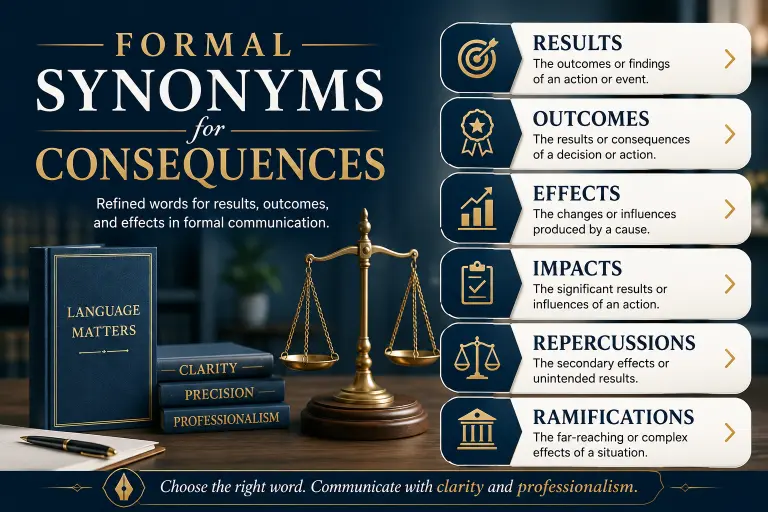
Formal writing often benefits from precise alternatives rather than simply repeating consequences. However, formal does not always mean complicated. In many cases, effects, outcomes, implications, ramifications, and resulting effects are clearer than more specialized vocabulary.
Repercussions as a Formal Synonym for Consequences
Meaning: Negative effects that happen because of an action or decision.
Explanation: Repercussions is a close synonym, but it usually carries a negative meaning. It is stronger than the neutral word results.
Example: The policy change could have serious repercussions for small businesses.
Best Use: Reports, journalism, professional writing, and discussions of harmful decisions.
Worst Use: Avoid it when the results are clearly positive or neutral.
Tone: Formal, serious, and usually negative.
Ramifications as a Formal Synonym for Consequences
Meaning: The different effects or results that develop from a situation.
Explanation: Ramifications emphasizes complexity and the fact that one decision may create several connected effects.
Example: The committee considered the long-term ramifications of the proposal.
Best Use: Business reports, policy discussions, academic writing, and strategic analysis.
Worst Use: It may sound excessive for a simple cause-and-effect relationship.
Tone: Formal and analytical.
Implications as a Formal Alternative for Consequences
Meaning: Possible effects, meanings, or results suggested by an action or fact.
Explanation: Implications is related to consequences but is not always an exact synonym. It often focuses on what something may mean or lead to rather than an actual result that has already happened.
Example: The findings have important implications for future research.
Best Use: Academic, scientific, business, and analytical writing.
Worst Use: Don’t use it if you are describing a definite result that has already occurred.
Tone: Formal, analytical, and measured.
Resulting Effects as a Formal Alternative for Consequences
Meaning: Effects produced by a particular action or event.
Explanation: This phrase is more explicit than consequences. It clearly shows a cause-and-effect relationship.
Example: The report examined the resulting effects of the regulatory change.
Best Use: Reports, technical writing, research, and professional analysis.
Worst Use: It can sound wordy in casual conversation.
Tone: Formal and precise.
Subsequent Effects as a Formal Alternative for Consequences
Meaning: Effects that occur after an event or action.
Explanation: This phrase emphasizes timing. It is useful when the effects happen later.
Example: Researchers documented the subsequent effects of the intervention.
Best Use: Academic and technical writing.
Worst Use: Avoid it when timing is irrelevant.
Tone: Formal and technical.
Downstream Effects as a Formal Alternative for Consequences
Meaning: Later effects caused by an earlier action or event.
Explanation: Downstream effects highlights a chain of cause and effect. It is common in business, economics, technology, public policy, and systems analysis.
Example: The team evaluated the downstream effects of the software change.
Best Use: Professional and analytical contexts.
Worst Use: It may be unnecessarily technical in everyday writing.
Tone: Professional and analytical.
Long-Term Effects as a Formal Alternative for Consequences
Meaning: Results that continue or become apparent over an extended period.
Explanation: This is narrower than consequences because it specifically refers to effects that persist or emerge over time.
Example: The study examined the long-term effects of the new treatment.
Best Use: Research, policy, education, health-related writing, and planning.
Worst Use: Don’t use it for immediate results.
Tone: Formal and neutral.
Ultimate Effects as a Formal Alternative for Consequences
Meaning: Final or eventual results.
Explanation: Ultimate effects focuses on the end result after earlier stages have occurred.
Example: The organization must consider the ultimate effects of the decision.
Best Use: Strategic planning and formal analysis.
Worst Use: It is unnecessary if you simply mean immediate results.
Tone: Formal and analytical.
End Results as a Formal Alternative for Consequences
Meaning: The final results of an action or process.
Explanation: End results emphasizes what happens after a process is completed.
Example: The evaluation focused on the end results of the training program.
Best Use: Reports, education, business, and general formal writing.
Worst Use: Avoid it when discussing several effects that occur along the way.
Tone: Neutral to formal.
Sequelae as a Specialized Synonym for Consequences
Meaning: Conditions or effects that follow an earlier event, especially in medical contexts.
Explanation: Sequelae is a specialized term rather than a general replacement for consequences. It is often used for lasting effects following an injury or disease.
Example: The patient experienced neurological sequelae after the injury.
Best Use: Medical and scientific writing.
Worst Use: It would sound inappropriate and confusing in ordinary conversation.
Tone: Highly specialized and technical.
Aftereffects as a Formal-Technical Alternative for Consequences
Meaning: Effects that remain or appear after an event.
Explanation: Aftereffects focuses on what continues after the main event has ended.
Example: The researchers studied the psychological aftereffects of the disaster.
Best Use: Research, journalism, medicine, and serious discussions.
Worst Use: Don’t use it for consequences that happen before an event is over.
Tone: Neutral to formal.
Semi-Formal and Neutral Synonyms for Consequences
For most everyday writing, neutral alternatives are the safest. They communicate the idea without making the sentence unnecessarily dramatic.
Results as a Neutral Synonym for Consequences
Meaning: What happens because of an action or situation.
Explanation: Results is one of the broadest and most useful alternatives. It can describe positive, negative, or neutral outcomes.
Example: The results of the decision were unexpected.
Best Use: Essays, emails, reports, conversations, and websites.
Worst Use: It may be too broad when you specifically mean harmful effects.
Tone: Neutral and versatile.
Effects as a Neutral Synonym for Consequences
Meaning: Changes caused by something.
Explanation: Effects is often interchangeable with consequences, especially when discussing cause and effect.
Example: The new rule had several effects on employees.
Best Use: Academic writing, business communication, science, and everyday English.
Worst Use: It may not convey the sense of punishment or negative fallout that consequences sometimes carries.
Tone: Neutral and clear.
Outcomes as a Neutral Synonym for Consequences
Meaning: The final results of an action, process, or event.
Explanation: Outcomes is particularly useful when discussing goals, decisions, projects, or processes.
Example: We need to consider the possible outcomes before making a decision.
Best Use: Business, education, healthcare, planning, and professional communication.
Worst Use: It can sound slightly technical in very casual conversation.
Tone: Neutral and professional.
Impact as a Contextual Alternative for Consequences
Meaning: The effect or influence something has.
Explanation: Impact focuses on the strength or importance of an effect rather than simply identifying what happened afterward.
Example: The price increase had a significant impact on customers.
Best Use: Business, journalism, reports, presentations, and everyday writing.
Worst Use: Don’t automatically replace every use of consequences with impact. An impact can be positive, negative, or neutral.
Tone: Neutral and professional.
Aftermath as a Contextual Synonym for Consequences
Meaning: The situation that follows a major or often damaging event.
Explanation: Aftermath usually describes the period or conditions following an event rather than individual consequences.
Example: The town struggled in the aftermath of the storm.
Best Use: News, history, storytelling, and serious discussions.
Worst Use: It sounds too dramatic for minor events.
Tone: Serious and often negative.
Fallout as a Contextual Synonym for Consequences
Meaning: Unwanted effects that follow an event or decision.
Explanation: Fallout strongly suggests negative consequences and is common in journalism and everyday speech.
Example: The company faced public fallout after the announcement.
Best Use: News, business discussions, politics, and informal professional speech.
Worst Use: Avoid it in highly formal academic writing unless the style permits it.
Tone: Strong, negative, and conversational.
Upshot as a Neutral Alternative for Consequences
Meaning: The final result or main outcome of a situation.
Explanation: Upshot generally focuses on the overall conclusion rather than every individual consequence.
Example: The upshot of the meeting was that the project would continue.
Best Use: Articles, commentary, conversation, and general writing.
Worst Use: It may sound too conversational for highly technical reports.
Tone: Informal to semi-formal.
Impacts as a Neutral Alternative for Consequences
Meaning: Significant effects or influences.
Explanation: The plural impacts works when several areas are affected.
Example: The proposal could have economic and environmental impacts.
Best Use: Reports, planning documents, business writing, and academic discussion.
Worst Use: Don’t use impacts merely to sound sophisticated when effects is clearer.
Tone: Professional and neutral.
Developments as a Contextual Alternative for Consequences
Meaning: New situations or changes that occur as events unfold.
Explanation: Developments does not mean consequences exactly. It is useful when the focus is on what happens next.
Example: We will monitor further developments after the announcement.
Best Use: News, business updates, and ongoing situations.
Worst Use: It is too vague when you need to identify a specific result.
Tone: Neutral and professional.
Reactions as a Contextual Alternative for Consequences
Meaning: Responses caused by an event or action.
Explanation: Reactions focuses on how people, groups, systems, or markets respond.
Example: The announcement generated strong reactions from customers.
Best Use: Public relations, communication, journalism, and social situations.
Worst Use: Don’t use it when the consequence is an automatic physical or financial effect rather than a response.
Tone: Neutral.
Chain Reaction as a Contextual Alternative for Consequences
Meaning: A sequence in which one event causes another.
Explanation: This is narrower than consequences. It emphasizes connected events rather than simply the final result.
Example: One small error triggered a chain reaction of delays.
Best Use: Business, technology, storytelling, and everyday explanations.
Worst Use: It is inaccurate when there is only one consequence.
Tone: Neutral and vivid.
Knock-On Effects as a Contextual Alternative for Consequences
Meaning: Secondary effects caused by an initial event.
Explanation: This expression is especially common in British English, though it is understood by many American English speakers. It emphasizes indirect results.
Example: The factory closure had knock-on effects throughout the local economy.
Best Use: Economics, business, news, and policy discussions.
Worst Use: Avoid it if you need very formal American academic wording.
Tone: Informal to semi-formal.
Informal and Casual Synonyms for Consequences
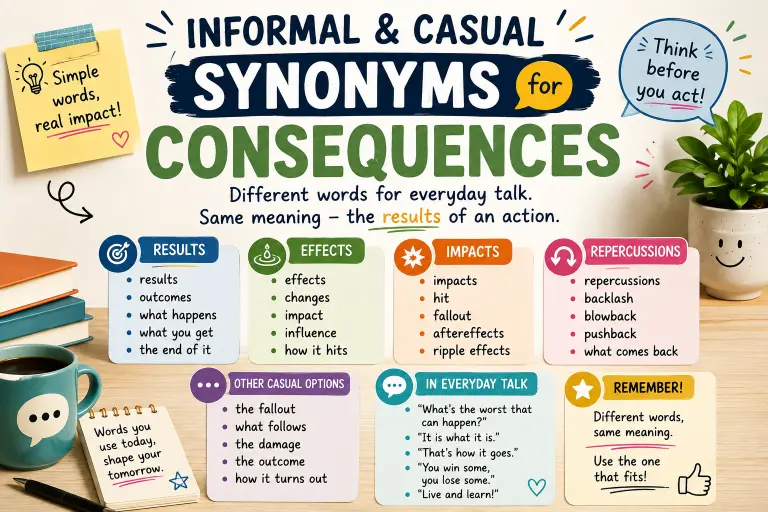
English has several casual expressions that can replace consequences in conversation, but many are contextual rather than exact synonyms.
Fallout as a Casual Alternative for Consequences
Meaning: Negative results that follow an event.
Example: There’s been a lot of fallout from the argument.
When it sounds natural: Casual conversation, news discussion, and workplace talk.
When to avoid it: Formal academic or legal documents.
Tone: Casual, strong, and negative.
The Result as a Casual Alternative for Consequences
Meaning: What happened because of something.
Example: The result was a complete mess.
When it sounds natural: Everyday conversation.
When to avoid it: It is not wrong in formal writing, but more precise wording may be preferable.
Tone: Simple and neutral.
What Happened Next as a Casual Alternative for Consequences
Meaning: Events that followed an earlier action.
Example: Nobody expected what happened next.
When it sounds natural: Conversation and storytelling.
When to avoid it: Academic, legal, and technical writing.
Tone: Conversational.
What Came of It as a Casual Alternative for Consequences
Meaning: The final result of something.
Example: I wonder what came of that meeting.
When it sounds natural: Friendly conversation.
When to avoid it: Formal reports and professional documents.
Tone: Casual and conversational.
The Fallout as a Casual Alternative for Consequences
Meaning: The negative situation created by an event.
Example: We’re still dealing with the fallout from the mistake.
When it sounds natural: Conversations about conflicts, mistakes, scandals, or problems.
When to avoid it: Positive or neutral consequences.
Tone: Casual and negative.
The Price of It as a Contextual Alternative for Consequences
Meaning: The cost or sacrifice resulting from an action.
Example: They got what they wanted, but the price of it was high.
When it sounds natural: Personal conversation and persuasive writing.
When to avoid it: Situations where there is no actual cost, sacrifice, or burden.
Tone: Conversational and expressive.
True Synonyms vs. Contextual Alternatives for Consequences
Not every word listed above has the same meaning. This distinction is essential if you want your writing to sound precise.
| Type | What It Means | Can It Replace “Consequences”? |
|---|---|---|
| True synonym | A word with nearly the same core meaning | Usually |
| Near synonym | Similar meaning with a small difference | Often, depending on context |
| Contextual alternative | Works in a particular situation | Sometimes |
| Broader expression | Covers a larger or less specific idea | Sometimes |
| Narrower expression | Describes one specific kind of consequence | Only when that meaning is intended |
For example, results is broad and neutral. Repercussions usually means negative results. Ramifications suggests multiple or complex effects. Aftermath describes the situation following a major event. Penalties specifically refers to punishments or costs imposed because of an action.
That means replacing every occurrence of consequences with the same synonym can actually reduce accuracy.
Industry-Specific Synonyms for Consequences
Different fields favor different alternatives because the intended meaning changes with the subject.
Business Writing: Synonyms for Consequences
Business writing generally favors results, outcomes, effects, impacts, implications, and ramifications.
Example:
The management team reviewed the potential implications of the proposed restructuring.
Here, implications sounds more analytical than consequences. For a performance report, results or outcomes may be better:
The report compares the outcomes of three pricing strategies.
For a complex strategic decision:
Leaders must consider the long-term ramifications of the acquisition.
Corporate Communication: Synonyms for Consequences
Corporate communication should usually avoid unnecessarily dramatic language. Effects, impacts, outcomes, implications, and results are often appropriate.
For example:
The system upgrade may affect response times during the transition.
This is usually better than:
The system upgrade may have serious repercussions.
The second version suggests a negative result and may create unnecessary alarm.
In internal announcements, choose words that match the certainty of the situation. If an effect is only possible, say potential effects or possible outcomes rather than presenting it as an established consequence.
Academic Writing: Synonyms for Consequences
Academic writing often uses effects, outcomes, implications, ramifications, long-term effects, and resulting effects.
Examples:
- The study examines the effects of sleep deprivation.
- The findings have important implications for education policy.
- Researchers analyzed the long-term effects of the intervention.
- The authors discuss the potential ramifications of the proposed model.
In academic work, effects is often preferable to consequences because it can remain neutral. Consequences may suggest that an outcome is negative.
Customer Service: Synonyms for Consequences
Customer service language should be clear and calm. Effects, results, impact, and outcomes are usually better than repercussions or fallout.
Instead of:
Your delay will have consequences for your order.
Try:
The delay may affect your delivery date.
Or:
As a result of the delay, your order may arrive later than expected.
These versions explain the actual effect rather than using a vague warning.
Legal Writing: Synonyms for Consequences
Legal contexts require special care because words that seem interchangeable can carry different meanings.
Depending on context, legal writers may discuss effects, results, penalties, sanctions, liabilities, remedies, obligations, or legal implications. These are not general synonyms for consequences.
For example, penalty means a punishment or financial charge imposed for certain conduct. Liability concerns legal responsibility. Sanction can refer to a legal or regulatory penalty, depending on context. Remedy refers to a legal means of addressing a wrong.
Therefore, don’t replace legal consequences with penalties unless the consequences specifically involve punishment.
For legal documents, use the terminology required by the relevant law, contract, or legal context rather than choosing a synonym simply because it sounds formal.
Email Communication: Synonyms for Consequences
Professional emails benefit from direct wording. Consider these choices:
- Results — for completed actions
- Effects — for measurable changes
- Outcomes — for projects or decisions
- Implications — for possible future meaning or impact
- Impact — for significance
- Ramifications — for complex effects
- Aftereffects — for continuing effects
Instead of:
We need to discuss the consequences of the missed deadline.
You could write:
We need to discuss the effects of the missed deadline on the project schedule.
That’s clearer because the reader immediately understands what kind of consequence you mean.
Email Examples Using Synonyms for Consequences
Client Email: Using “Impact”
Subject: Project Schedule Update
Hi Jordan,
The supplier delay will have an impact on the current delivery schedule. We now expect the materials to arrive on Tuesday rather than Friday.
I’ll send you another update once the shipment is confirmed.
Best,
Alex
Internal Workplace Email: Using “Implications”
Subject: Proposed Schedule Change
Hi Team,
Before we approve the new schedule, I’d like us to review its implications for staffing and customer coverage.
Please send me any concerns by Thursday afternoon.
Thanks,
Maya
Academic Email: Using “Effects”
Subject: Question About Research Assignment
Dear Professor Lee,
I’m reviewing the effects of remote learning on student participation for my assignment. Would it be acceptable to focus on classroom engagement rather than academic performance?
Thank you,
Daniel
Vendor Email: Using “Results”
Subject: Results of the Equipment Test
Hello Priya,
We completed the equipment test this morning. The results were positive, although we identified one issue with the temperature sensor.
Could you let us know if your team can review it this week?
Regards,
Chris
Customer Service Email: Using “Outcome”
Subject: Your Service Request
Hello Maria,
Thank you for contacting us. We’ve reviewed your request and approved the replacement.
The expected outcome is that your new unit will ship within two business days.
Best,
Customer Support
Project Email: Using “Ramifications”
Subject: Project Scope Discussion
Hi Everyone,
The requested feature would require changes to the current database structure. Before we commit to it, I’d like to discuss the broader ramifications for the launch schedule.
Let’s review the options during tomorrow’s meeting.
Best,
Sam
Short Dialogue Examples Using Synonyms for Consequences
Workplace
Person A: What happens if we miss the deadline?
Alex: The main consequence is that the client won’t receive the report on time.
Person A: So the biggest impact is on delivery.
Alex: Exactly.
Classroom
Person A: What were the effects of the new rule?
Jordan: Students had less time for group activities.
Person A: So it changed how the class worked.
Jordan: Right.
Customer Service
Person A: Will changing my delivery address affect the order?
Alex: It may affect the delivery date.
Person A: That’s fine. I just need to know before I change it.
Casual Conversation
Person A: Did you tell him what happened?
Alex Yeah, and there was a lot of fallout afterward.
Person A: I figured there would be.
Professional Discussion
Person A: Have we considered the implications?
Person B: Yes. The biggest concern is the additional cost.
Person A: Then we should include that in the final report.
How to Replace “Consequences” in a Sentence
The best replacement depends on what the original sentence is trying to emphasize.
Example 1
Original: The decision had serious consequences.
Alternative: The decision had serious repercussions.
Why it works: Repercussions preserves the negative meaning and sounds slightly more formal.
Example 2
Original: We need to consider the consequences of the change.
Alternative: We need to consider the effects of the change.
Why it works: Effects is neutral and works well in professional and academic writing.
Example 3
Original: The consequences of the experiment were unexpected.
Alternative: The results of the experiment were unexpected.
Why it works: Results is particularly natural when discussing research or testing.
Example 4
Original: The decision could have serious consequences.
Alternative: The decision could have serious ramifications.
Why it works: Ramifications suggests that several connected effects may develop.
Example 5
Original: We are still dealing with the consequences of the accident.
Alternative: We are still dealing with the aftermath of the accident.
Why it works: Aftermath focuses on the situation that remains after a major event.
Example 6
Original: The policy had unexpected consequences for employees.
Alternative: The policy had unexpected effects on employees.
Why it works: Effects is neutral and directly describes what changed.
Example 7
Original: What are the consequences of this decision?
Alternative: What are the possible outcomes of this decision?
Why it works: Outcomes is especially natural when discussing possible future results.
Example 8
Original: The company faced consequences after the announcement.
Alternative: The company faced significant fallout after the announcement.
Why it works: Fallout emphasizes negative public or organizational reactions.
Example 9
Original: The consequences of the research are still unclear.
Alternative: The implications of the research are still unclear.
Why it works: Implications works well when discussing what findings may mean or lead to.
Example 10
Original: The mistake had consequences for the entire project.
Alternative: The mistake had knock-on effects throughout the project.
Why it works: This version emphasizes secondary effects spreading from the original mistake.
Comparison Table: Synonyms for Consequences
| Phrase | Tone | Meaning / Scope | Best Use | Example |
|---|---|---|---|---|
| Results | Neutral | What happens because of something | General writing | The results were unexpected. |
| Effects | Neutral | Changes caused by something | Academic/business | The effects were significant. |
| Outcomes | Professional | Final results | Projects/decisions | We reviewed the outcomes. |
| Repercussions | Formal | Usually negative effects | Serious issues | The decision had repercussions. |
| Ramifications | Formal | Complex connected effects | Strategy/policy | Consider the ramifications. |
| Implications | Formal | Possible meaning or effects | Academic/business | The findings have implications. |
| Impact | Neutral | Strength or influence of an effect | Business/general | The impact was substantial. |
| Aftermath | Serious | Situation following a major event | News/history | The aftermath was difficult. |
| Fallout | Casual | Negative effects or reactions | News/conversation | The fallout was widespread. |
| Upshot | Semi-formal | Main or final result | General discussion | The upshot was positive. |
| Aftereffects | Neutral | Effects remaining afterward | Research/health | The aftereffects lasted months. |
| Downstream effects | Technical | Later indirect effects | Systems/business | The change created downstream effects. |
| Chain reaction | Vivid | Connected sequence of effects | General/technical | The error caused a chain reaction. |
| Penalties | Specific | Punishments or charges | Legal/rules | Late payments may result in penalties. |
| Costs | Specific | Losses or burdens | Finance/business | The decision created additional costs. |
| Trade-offs | Specific | Gains and losses considered together | Planning | Every option has trade-offs. |
Which Synonym for Consequences Should You Choose?
For Formal Writing
Choose ramifications, repercussions, implications, resulting effects, or subsequent effects. Match the word to the exact meaning rather than choosing the longest-sounding option.
For Business Communication
Use results, outcomes, effects, impact, or implications. These words are professional without sounding dramatic.
For Academic Writing
Effects, outcomes, implications, and long-term effects are especially useful. Use ramifications when you genuinely mean complex or far-reaching effects.
For Legal Writing
Use the precise legal term required by the situation. Consequences, penalties, sanctions, liabilities, obligations, and remedies have different meanings and should not be treated as interchangeable.
For Professional Emails
Prefer effects, impact, results, outcomes, or direct phrases such as this may affect the schedule. Clear language is usually better than an elaborate synonym.
For Everyday Conversation
Results, effects, outcome, fallout, and what happened next can sound natural. Fallout is particularly useful when the consequences are negative.
For Casual Messages
Use simple expressions such as results, effects, what happened, what came of it, or the fallout. Choose based on the situation and relationship.
Grammar and Usage Guide for Synonyms for Consequences
The noun consequence is countable.
- One consequence
- Two consequences
- Several consequences
- The consequences of the decision
The singular form refers to one result:
One consequence of the delay was higher shipping costs.
The plural is common when discussing multiple effects:
The decision had several consequences.
“Consequence of” Is the Standard Pattern
Use consequence of + noun or gerund:
The consequences of the mistake were costly.
The consequences of ignoring the warning were serious.
You can also use:
The consequences of failing to prepare can be significant.
“Result of” Works in Similar Structures
The result of the experiment was unexpected.
The results of the survey were encouraging.
Be careful with singular and plural forms. Result refers to one outcome, while results may refer to several findings or the overall findings of a test.
“Effect on” Is a Common Combination
Use:
The effect on customers was immediate.
Not:
The effect of customers was immediate.
But use effect of when identifying the cause:
The effect of the policy was significant.
“Impact on” Is Also Common
The decision had a major impact on employees.
“Consequences for” Is Natural
Use consequences for when identifying who or what is affected:
The changes could have consequences for small businesses.
“As a Consequence” Means “As a Result”
The road was closed. As a consequence, traffic increased.
In many contexts, as a result sounds more natural and less formal:
The road was closed. As a result, traffic increased.
Capitalization
Words such as consequences, results, effects, and outcomes are normally lowercase unless they begin a sentence or appear in a proper title.
The consequences were significant.
Not:
The Consequences were significant.
Common Mistakes to Avoid With Synonyms for Consequences
1. Treating Every Alternative as an Exact Synonym
Fallout, ramifications, effects, and penalties do not mean exactly the same thing. Check the intended meaning first.
2. Using “Repercussions” for Positive Results
Repercussions normally suggests undesirable effects.
Incorrect:
The celebration had wonderful repercussions.
Better:
The celebration had wonderful results.
3. Using “Aftermath” for Minor Events
Aftermath usually suits significant or disruptive events.
A delayed lunch doesn’t normally have an aftermath.
4. Using “Penalties” as a General Replacement
Penalties are specific consequences involving punishment, charges, or sanctions.
Late payment may result in penalties.
Don’t use penalties for every ordinary result.
5. Using “Implications” When You Mean Proven Results
Implications can describe possible meaning or effects.
If something has already happened and is measurable, effects or results may be more accurate.
6. Making Professional Writing Too Dramatic
Words such as fallout and repercussions can sound alarming. In a client email, impact or effect may be calmer and more appropriate.
7. Choosing “Ramifications” Just to Sound Intelligent
Longer or more formal words aren’t automatically better. If you mean simple results, results is often the strongest choice.
8. Ignoring Positive and Negative Meaning
Consequences can be neutral, but it often implies something negative. Outcomes and results are safer when the direction of the effect is unknown.
9. Confusing “Impact” With “Outcome”
An outcome is what happens. An impact is the significance or effect that something has.
The outcome was approval.
The approval had a major impact on the project.
When Not to Use “Consequences”
The word consequences is perfectly correct in many situations, but another expression may be more precise.
When You Mean Neutral Results
Use results or outcomes.
The outcomes of the trial were encouraging.
When You Mean Scientific Effects
Use effects.
The study measured the effects of temperature on plant growth.
When You Mean Complex Future Effects
Use ramifications.
The company considered the ramifications of the merger.
When You Mean Negative Reactions
Use fallout.
The announcement created significant fallout.
When You Mean the Situation After a Major Event
Use aftermath.
The community struggled in the aftermath of the flood.
When You Mean Possible Meaning or Significance
Use implications.
The findings have important implications for future research.
When You Mean Punishment
Use penalties or another precise legal or regulatory term.
Employees may face penalties for violating the policy.
When “Consequences” Is Actually Better
Keep consequences when you want a broad, familiar word that can cover several results without specifying whether they are immediate, indirect, positive, negative, or long-term.
Advanced Writer Tips for Using Synonyms for Consequences
Tone Control With Consequences
For a neutral tone, use results, effects, or outcomes.
While for a serious tone, use repercussions or ramifications.
For a conversational tone, use fallout or what came of it.
The word you choose can change how strongly the reader reacts to the sentence.
Professional Email Etiquette
Don’t make ordinary problems sound like disasters.
Instead of:
This will have serious repercussions for the project.
Consider:
This may affect the project schedule.
The second sentence is more direct and gives the reader useful information.
Politeness and Consequences
If you need to warn someone, focus on the specific effect rather than making a vague threat.
Less helpful:
There will be consequences if the form is late.
More helpful:
If the form is submitted after Friday, processing may take an additional three business days.
The second version tells the reader exactly what to expect.
Context Alignment
Ask three questions before choosing a synonym:
- Is the result positive, negative, or neutral?
- Has it already happened, or is it only possible?
- Is the effect direct, indirect, immediate, or long-term?
Your answers will usually reveal the best word.
Precision
Use effects for measurable changes, outcomes for final results, implications for possible meaning or future significance, repercussions for negative effects, and ramifications for complex connected effects.
Readability
Don’t replace a simple word with a complicated one just to vary your vocabulary.
The change had several effects.
is often clearer than:
The change generated numerous subsequent ramifications.
Good writing is not about using the most sophisticated synonym. It’s about using the most accurate one.
Related Questions About Synonyms for Consequences
What Is Another Way to Say Consequences?
Another way to say consequences is results, effects, outcomes, repercussions, ramifications, implications, aftermath, impact, or fallout. The best choice depends on the sentence. Results is neutral, while repercussions and fallout usually suggest negative effects.
What Is a Professional Alternative to Consequences?
Outcomes, effects, results, impact, and implications are strong professional alternatives. For example, “We should consider the implications of this decision” sounds polished without being overly dramatic.
What Is a Formal Alternative to Consequences?
Repercussions, ramifications, implications, subsequent effects, and resulting effects can work in formal writing. However, the correct choice depends on the intended meaning. Repercussions usually implies negative effects, while implications can refer to possible future significance.
What Can I Use Instead of Consequences in an Essay?
For an essay, consider effects, results, outcomes, implications, long-term effects, or ramifications. Effects is often the safest neutral choice, while implications works especially well when discussing what research findings may mean for future work or policy.
Is Consequences a Formal Word?
Yes. Consequences is standard in both formal and everyday English. It isn’t necessary to replace it simply because you’re writing professionally. Choose another word only when it provides greater precision, variety, or a better match for the intended tone.
Can I Use Results Instead of Consequences?
Often, yes. Results is one of the closest neutral alternatives. However, results can describe positive, negative, or neutral outcomes, while consequences often carries a stronger suggestion of negative or significant effects.
What Is the Difference Between Consequences and Ramifications?
Consequences is a broad term for results that follow an action or event. Ramifications usually suggests several connected, complex, or far-reaching effects. Therefore, ramifications is more specific and analytical than the general word consequences.
FAQs About Synonyms for Consequences
What Is the Best Synonym for Consequences?
The best general synonym is results because it is neutral, clear, and widely applicable. However, effects may be better for cause-and-effect writing, outcomes for final results, and repercussions for negative consequences. Choose according to meaning rather than simply replacing the word mechanically.
What Is a Strong Synonym for Negative Consequences?
Repercussions and fallout are strong choices for negative consequences. Repercussions sounds more formal, while fallout is more conversational. Adverse effects is another precise option when discussing harmful changes, especially in professional or technical writing.
What Is the Difference Between Effects and Consequences?
Effects are changes caused by something, while consequences are results that follow an action or event. The two can overlap, but effects is usually more neutral. Consequences can carry a stronger sense of significance, responsibility, or negative results.
Is Ramifications a Positive or Negative Word?
Ramifications is generally neutral in terms of direction, but it is often used for complicated or potentially serious effects. It does not inherently mean something bad. Still, phrases such as “serious ramifications” usually signal that the effects are unfavorable.
Is Fallout a Formal Synonym for Consequences?
Fallout can mean negative consequences, but it is less formal than repercussions or ramifications. It works well in journalism, conversation, and some business writing. For highly formal academic or legal writing, a more precise term is usually preferable.
What Is a Good Synonym for Consequences in Academic Writing?
Effects, outcomes, implications, long-term effects, and ramifications are useful academic alternatives. Effects is especially suitable for research involving cause and effect, while implications is useful when explaining what findings may mean for future research, practice, or policy.
Can Consequences Mean Punishment?
Yes, in some contexts consequences can refer to punishment, especially in everyday language. However, penalties, sanctions, or disciplinary action may be more precise when punishment is specifically intended. These words should not be used as general replacements for every meaning of consequences.
Key Takeaways
- Results, effects, and outcomes are the safest neutral alternatives to consequences.
- Use repercussions for negative effects and ramifications for complex or far-reaching effects.
- Implications is best when discussing possible meaning, significance, or future effects.
- Aftermath describes the situation following a major event, while fallout emphasizes negative results or reactions.
- Always choose a synonym based on meaning, tone, audience, and context, not simply vocabulary variety.
Conclusion
There is no single replacement that works perfectly for every use of consequences. The word itself is broad, which is why context matters so much. For everyday and professional writing, results, effects, and outcomes are reliable choices. If you want to emphasize negative results, repercussions or fallout may be stronger. For complex or far-reaching effects, ramifications is more precise, while implications works well when discussing possible meaning or future significance.
Specialized contexts require extra care. In academic writing, effects and implications are often useful. In business communication, outcomes and impact can sound direct and professional. But in legal writing, terms such as penalties, sanctions, and liabilities should only be used when their specific meanings apply.
The strongest synonym isn’t necessarily the most sophisticated word. It is the one that tells your reader exactly what kind of result you mean.
