
Energy can describe physical strength, mental alertness, enthusiasm, electrical power, or the lively quality of a person, place, or activity. That makes synonyms for energy highly dependent on context.
A word that works for a scientific report may sound strange in a casual conversation, while an expression that describes someone’s enthusiasm may not work for electricity or physics.
The best alternative depends on what you actually mean by energy. Words such as vitality, vigor, stamina, liveliness, enthusiasm, drive, power, force, dynamism, and momentum overlap with energy, but they are not interchangeable in every sentence. This guide explains their differences so you can choose a word that sounds natural and precise.
Quick Answer
The best synonyms for energy include vitality, vigor, stamina, liveliness, enthusiasm, dynamism, drive, power, force, strength, activity, intensity, momentum, spirit, and pep. The right choice depends on context: vitality suits life and health, drive suits motivation, power suits physical or electrical force, and enthusiasm suits excitement.
Quick List: Synonyms for Energy
Here are useful alternatives grouped by meaning and tone:
Closest synonyms for energy
- Vitality
- Vigor
- Strength
- Power
- Force
- Stamina
- Activity
- Liveliness
Formal synonyms for energy
- Dynamism
- Intensity
- Capacity
- Exertion
- Potency
- Resilience
- Vigorousness
- Activation
Neutral and semi-formal synonyms for energy
- Enthusiasm
- Drive
- Momentum
- Motivation
- Spirit
- Alertness
- Pep
- Activity level
- Physical strength
- Mental stamina
Casual synonyms for energy
- Pep
- Get-up-and-go
- Spark
- Zest
- Fire
- Zip
- Bounce
- Pizazz
Contextual synonyms for energy
- Electricity
- Force
- Power
- Fuel
- Momentum
- Effort
- Initiative
- Excitement
Remember that some of these are contextual alternatives rather than exact synonyms. For example, momentum suggests continuing progress, while energy is much broader.
Formal Synonyms for Energy
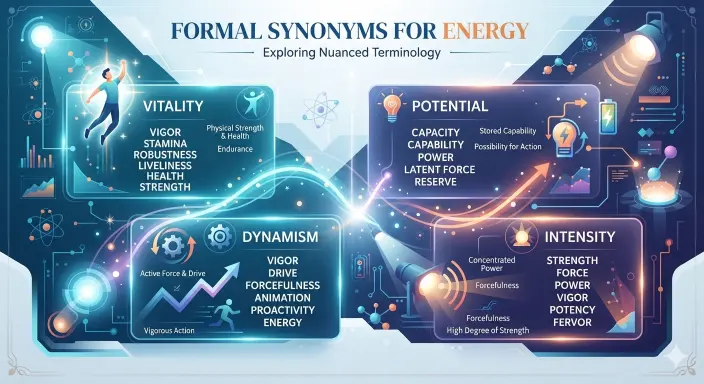
Formal vocabulary is useful in academic papers, reports, professional communication, technical writing, and serious descriptions. However, formality should not replace precision.
Vitality
Meaning: The quality of being strong, active, and full of life.
Explanation: Vitality is one of the closest alternatives when energy means physical or mental liveliness. It often describes people, organizations, communities, or creative work rather than electricity.
Example: The organization has demonstrated renewed vitality following the leadership change.
Best Use: Health, organizations, communities, creative work, and personal well-being.
Worst Use: Technical discussions about electrical energy.
Tone: Formal, positive, and polished.
Vigor
Meaning: Physical or mental strength and energetic activity.
Explanation: Vigor strongly suggests force, enthusiasm, and robust activity. It is especially useful in formal descriptions of how someone works or performs.
Example: The researchers approached the project with considerable vigor.
Best Use: Academic, professional, literary, and formal writing.
Worst Use: Talking about electricity or energy consumption.
Tone: Formal and energetic.
Dynamism
Meaning: Energy and force that produce activity, change, or progress.
Explanation: Dynamism is useful when energy means an ability to create movement or change. It often describes leaders, companies, economies, teams, or organizations.
Example: Her dynamism helped the team adapt to changing market conditions.
Best Use: Business writing, leadership discussions, and organizational descriptions.
Worst Use: Describing someone’s basic physical stamina.
Tone: Professional and sophisticated.
Intensity
Meaning: The degree of strength, force, or concentration.
Explanation: Intensity overlaps with energy when you are describing how powerful, concentrated, or forceful something feels. It does not always mean energy itself.
Example: The intensity of the training session increased throughout the week.
Best Use: Exercise, emotions, activity, performance, science, and technical contexts.
Worst Use: As a general replacement for energy in every sentence.
Tone: Neutral to formal.
Exertion
Meaning: The use of physical or mental effort.
Explanation: Exertion focuses on effort being used rather than the amount of energy someone naturally possesses.
Example: Prolonged physical exertion can lead to fatigue.
Best Use: Exercise, health-related writing, sports, and formal descriptions of effort.
Worst Use: Describing someone’s enthusiasm or cheerful personality.
Tone: Formal and technical.
Stamina
Meaning: The ability to continue an activity for a long time without becoming exhausted.
Explanation: Stamina is a narrower alternative. It refers to endurance rather than energy in general.
Example: The athlete has the stamina required to compete for several hours.
Best Use: Sports, exercise, work, and demanding activities.
Worst Use: Electrical or scientific contexts where energy has a technical meaning.
Tone: Neutral and professional.
Resilience
Meaning: The ability to recover and continue after difficulty.
Explanation: Resilience is related to energy only when the idea involves continuing after stress, pressure, or setbacks. It is not a direct synonym.
Example: The team showed remarkable resilience after the initial setback.
Best Use: Leadership, education, psychology, business, and organizational writing.
Worst Use: Simple descriptions of physical energy.
Tone: Formal and positive.
Potency
Meaning: The power or strength of something to produce an effect.
Explanation: Potency can replace energy in certain technical or scientific contexts, but its meaning is more specific. It often concerns effectiveness or strength.
Example: Researchers evaluated the potency of the new compound.
Best Use: Scientific, medical, chemical, and technical writing.
Worst Use: Describing an energetic person.
Tone: Technical and formal.
Capacity
Meaning: The ability or potential to perform, contain, or produce something.
Explanation: Capacity can refer to the amount of energy something can store or the ability of a person or system to sustain activity. It is a contextual alternative, not a general synonym.
Example: The battery has enough capacity to power the device throughout the day.
Best Use: Engineering, business, technology, and technical writing.
Worst Use: Replacing energy when discussing enthusiasm.
Tone: Neutral to formal.
Activation
Meaning: The process of causing something to become active or operational.
Explanation: Activation is related to energy in scientific, technical, and biological contexts. It refers to becoming active rather than simply possessing energy.
Example: Muscle activation increased during the second phase of the exercise.
Best Use: Science, technology, biology, fitness, and technical writing.
Worst Use: Everyday descriptions of someone’s enthusiasm.
Tone: Technical and formal.
Force
Meaning: Strength or influence that produces movement or change.
Explanation: Force overlaps with energy in physical and metaphorical contexts, but physics gives the term a specific meaning. In ordinary writing, it can describe powerful influence or effort.
Example: The new policy became a force for organizational change.
Best Use: Physics, leadership, influence, and formal descriptions of power.
Worst Use: Using it as a blanket substitute for every meaning of energy.
Tone: Strong and formal.
Semi-Formal and Neutral Synonyms for Energy
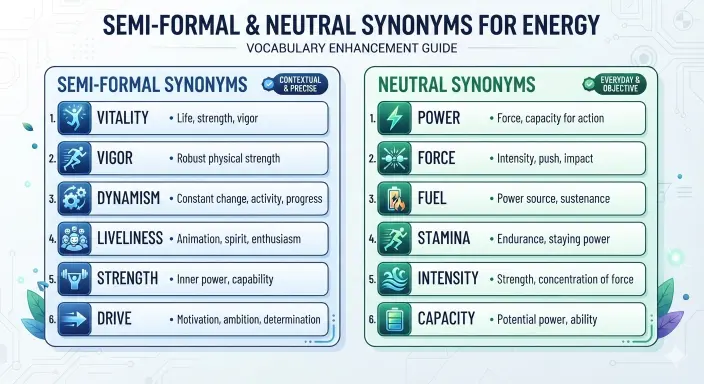
These words work well in everyday writing, professional communication, school assignments, websites, and conversations.
Enthusiasm
Meaning: Strong excitement or interest.
Explanation: Enthusiasm is a good choice when energy refers to someone’s excitement about an activity.
Example: She spoke about the project with genuine enthusiasm.
Best Use: Work, school, presentations, hobbies, and social situations.
Worst Use: Physical energy or electricity.
Tone: Positive and friendly.
Drive
Meaning: Strong motivation to achieve something.
Explanation: Drive describes internal motivation rather than physical energy.
Example: His drive helped him complete the project ahead of schedule.
Best Use: Careers, sports, leadership, education, and personal goals.
Worst Use: Describing how much electricity a device consumes.
Tone: Confident and professional.
Motivation
Meaning: The reason or desire that encourages someone to act.
Explanation: Motivation is related to energy because motivation can cause action, but the two words are not identical.
Example: The recognition gave the employees extra motivation.
Best Use: Education, work, personal development, and coaching.
Worst Use: Describing physical exhaustion.
Tone: Neutral and professional.
Momentum
Meaning: A force or progress that makes an activity continue.
Explanation: Momentum works when energy has created forward movement. It emphasizes continuing progress rather than energy itself.
Example: The campaign gained momentum after the announcement.
Best Use: Business, projects, sports, campaigns, and social movements.
Worst Use: Simple descriptions such as “I have no energy.”
Tone: Neutral and dynamic.
Liveliness
Meaning: A quality of being active, cheerful, or energetic.
Explanation: Liveliness is useful for people, conversations, events, places, and writing.
Example: The liveliness of the discussion kept everyone engaged.
Best Use: Social settings, writing, classrooms, and descriptions.
Worst Use: Technical or scientific contexts.
Tone: Friendly and descriptive.
Alertness
Meaning: The state of being awake, aware, and attentive.
Explanation: Alertness is narrower than energy. It describes mental readiness rather than general physical strength.
Example: A short break helped improve the driver’s alertness.
Best Use: Work, safety, education, and health-related contexts.
Worst Use: Describing enthusiasm or excitement.
Tone: Neutral and practical.
Spirit
Meaning: Enthusiasm, attitude, or emotional energy.
Explanation: Spirit can describe the emotional energy of an individual or group.
Example: The team maintained its spirit despite the difficult conditions.
Best Use: Teams, communities, celebrations, sports, and encouraging writing.
Worst Use: Scientific or technical writing about energy.
Tone: Warm and positive.
Zest
Meaning: Strong enjoyment, excitement, or enthusiasm.
Explanation: Zest describes a lively approach to life or an activity.
Example: She brings zest and creativity to every lesson.
Best Use: Personal descriptions, lifestyle writing, creative content, and informal professional writing.
Worst Use: Technical reports.
Tone: Positive and expressive.
Activity
Meaning: The state or amount of being active.
Explanation: Activity can sometimes replace energy when the focus is on how much movement or action is occurring.
Example: The sensor detected increased activity in the system.
Best Use: Science, technology, business, fitness, and general writing.
Worst Use: Describing enthusiasm unless the context makes the meaning clear.
Tone: Neutral.
Strength
Meaning: The quality or degree of physical or mental power.
Explanation: Strength is close to energy in some contexts but emphasizes power or ability rather than liveliness.
Example: She regained her strength after several days of rest.
Best Use: Physical ability, recovery, performance, and metaphorical writing.
Worst Use: Electrical energy unless the technical context supports it.
Tone: Neutral and strong.
Pep
Meaning: Lively enthusiasm or energy.
Explanation: Pep is a friendly word for someone who seems active, cheerful, and energetic.
Example: The coach brought plenty of pep to the morning practice.
Best Use: Casual workplace or everyday conversation.
Worst Use: Formal academic or legal writing.
Tone: Informal and upbeat.
Informal and Casual Synonyms for Energy
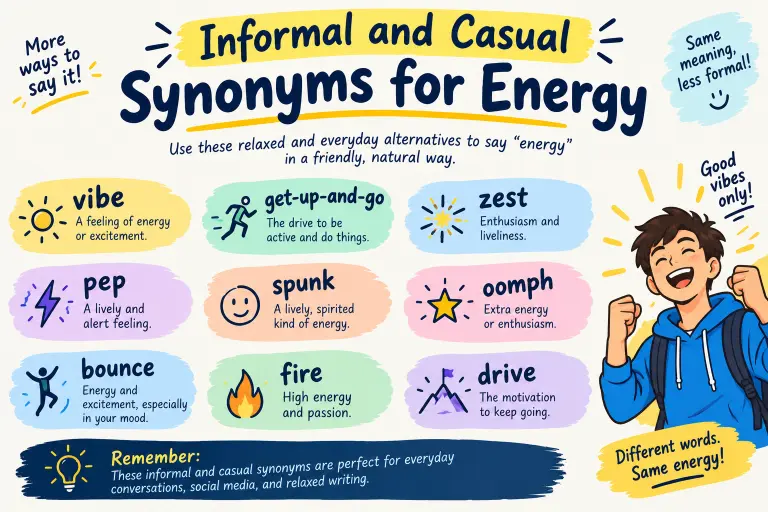
Casual alternatives are often more vivid than the original word. They work especially well in conversation, social media, personal writing, and relaxed messages.
Get-Up-and-Go
Meaning: Enthusiasm, determination, and willingness to act.
Example: She has plenty of get-up-and-go, even on busy mornings.
When it sounds natural: Casual conversation and friendly writing.
When to avoid it: Formal reports, academic papers, and professional documents.
Tone: Very casual and cheerful.
Spark
Meaning: A small but noticeable source of excitement, creativity, or energy.
Example: The new design added a spark to the presentation.
When it sounds natural: Creative, social, and conversational contexts.
When to avoid it: Technical writing unless spark has its literal meaning.
Tone: Casual and vivid.
Fire
Meaning: Strong passion, determination, or enthusiasm.
Example: She has the fire needed to lead the team.
When it sounds natural: Sports, motivation, entertainment, and casual conversation.
When to avoid it: Formal documents where literal precision matters.
Tone: Energetic and expressive.
Zip
Meaning: Lively energy or speed.
Example: A quick walk gave me some extra zip.
When it sounds natural: Casual speech and lifestyle writing.
When to avoid it: Formal or academic writing.
Tone: Playful and informal.
Bounce
Meaning: Lively energy or enthusiasm.
Example: The kids came back with plenty of bounce after lunch.
When it sounds natural: Informal descriptions of people, especially children.
When to avoid it: Professional and technical writing.
Tone: Casual and cheerful.
Pizazz
Meaning: An exciting, lively, or distinctive quality.
Example: The opening scene gives the show plenty of pizazz.
When it sounds natural: Entertainment, fashion, creative writing, and casual reviews.
When to avoid it: Academic, legal, or scientific writing.
Tone: Very informal and expressive.
True Synonyms vs Contextual Synonyms for Energy
Not every word in a synonym list can replace energy in every sentence. The distinction matters because energy has several meanings.
| Type | What It Means | Can It Replace the Original? |
|---|---|---|
| True synonym | Has essentially the same meaning in a particular context | Usually |
| Near synonym | Shares much of the meaning but adds a slight difference | Sometimes |
| Contextual alternative | Works only in a specific situation | Only in that context |
| Broader expression | Covers a larger or less precise idea | Sometimes |
| Narrower expression | Describes only one aspect of energy | Only when that aspect is intended |
For example, vigor can replace energy in “He worked with great energy,” but motivation changes the focus to the reason or desire behind the action. Likewise, stamina focuses on endurance, while enthusiasm focuses on excitement.
Industry-Specific Uses of Energy Synonyms for Energy
Business Writing
Business writing often uses drive, momentum, dynamism, initiative, enthusiasm, and capacity.
Instead of:
The company needs more energy.
You might write:
The company needs renewed momentum.
The second sentence is more precise if the problem is slow progress rather than a lack of enthusiasm.
For employees, drive and initiative can describe motivation, while dynamism can describe an energetic leadership style.
Corporate Communication
Reports and internal announcements benefit from precise language.
- Dynamism — organizational energy and adaptability
- Momentum — continuing progress
- Initiative — willingness to take action
- Enthusiasm — positive engagement
- Capacity — ability to handle additional work
- Resilience — ability to recover from challenges
Example:
The project has gained momentum following the successful pilot.
This is more specific than simply saying:
The project has gained energy.
Academic Writing
Academic writing usually benefits from precision. Depending on the subject, useful alternatives include vigor, intensity, activity, exertion, capacity, force, and potency.
For example:
The study examines the intensity of physical activity among participants.
Here, intensity is more precise than energy because the sentence concerns the level of physical activity.
In science, never replace a technical term with a casual synonym simply for variety. Technical terminology often carries a defined meaning.
Customer Service
Customer-facing communication should usually favor clear words such as energy, enthusiasm, effort, support, and attention.
Instead of:
Thank you for bringing such great energy to our event.
A customer service message might say:
Thank you for your enthusiasm and participation.
This is clearer if the customer actively participated rather than simply creating a lively atmosphere.
Legal Writing
Legal writing requires special care because technical words can have specific meanings. Energy, force, capacity, power, effort, and activity may describe different concepts depending on the document.
Do not substitute casual terms such as pep, fire, or get-up-and-go for a legally significant term.
If a contract, regulation, or legal document uses energy in a defined or technical sense, preserve that wording unless a qualified legal professional determines that another term has the same intended meaning.
Email Communication
For professional emails, the safest alternatives are usually enthusiasm, drive, momentum, effort, vitality, and energy itself.
For example:
Your enthusiasm for the project was clear during the meeting.
sounds more natural than:
Your vitality for the project was clear during the meeting.
The first describes interest and excitement; the second sounds unnatural in this context.
Email Examples Using Synonyms for Energy
Email 1: Client Communication
Subject: Thank You for Your Enthusiasm
Hi Jordan,
Thank you for the enthusiasm you brought to yesterday’s planning session. Your feedback helped us identify several practical improvements, and the discussion gave the project a strong sense of direction.
We’ll include your suggestions in the revised proposal and send it over by Friday.
Best,
Maya
Email 2: Project Update
Subject: Strong Momentum on the Website Project
Hi Team,
The website project has gained strong momentum this week. We’ve completed the homepage design, approved the content structure, and started development on the main product pages.
Thanks for keeping things moving and responding quickly to feedback.
Best,
Daniel
Email 3: Internal Workplace Message
Subject: Great Drive During This Week’s Sprint
Hi everyone,
I wanted to thank you for the drive you’ve shown during this week’s sprint. We had a demanding schedule, but everyone stayed focused and helped resolve issues quickly.
Let’s carry that same focus into next week’s testing phase.
Thanks,
Rachel
Email 4: Academic Communication
Subject: Feedback on Your Research Presentation
Hi Alex,
Your presentation showed impressive vigor and careful preparation. I especially appreciated the way you connected the research findings to your main argument.
For the final version, consider shortening the introduction so you have more time for your analysis.
Best,
Professor Lee
Email 5: Customer Service
Subject: Thank You for Your Enthusiasm
Hi Sam,
Thank you for your enthusiasm during our community event. We’re glad you enjoyed the activities and took the time to share your feedback.
Your comments have been passed to the event team for consideration.
Kind regards,
Customer Support
Email 6: Vendor Communication
Subject: Maintaining Project Momentum
Hi Chris,
Thanks for the quick turnaround on the latest shipment details. Your prompt response has helped us maintain momentum and keep the installation schedule on track.
I’ll confirm the final delivery window once our team completes the site review.
Best,
Nina
Short Dialogue Examples Using Energy Synonyms
Workplace
Person A: How is the new team handling the workload?
Person B: They have a lot of drive. Everyone seems motivated to finish the launch on time.
Classroom
Person A: Your class was unusually lively today.
Person B: Yes, the students had plenty of enthusiasm for the topic.
Customer Service
Person A: The staff made the event feel so welcoming.
Person B: I agree. Their enthusiasm really changed the atmosphere.
Casual Conversation
Person A: You seem tired today.
Person B: I am. I need some rest before I get my usual pep back.
Professional Discussion
Person A: Do you think the campaign is moving forward?
Person B: Definitely. We’ve built enough momentum to keep the next phase on schedule.
How to Replace “Energy” in a Sentence
1. General physical energy
Original:
I don’t have enough energy to exercise today.
Alternative:
I don’t have enough stamina for a long workout today.
Why it works: Stamina makes the meaning more specific by emphasizing endurance.
2. Enthusiasm
Original:
She brings a lot of energy to the classroom.
Alternative:
She brings a lot of enthusiasm to the classroom.
Why it works: The alternative focuses on excitement and engagement rather than physical strength.
3. Motivation
Original:
His energy helped him finish the project.
Alternative:
His drive helped him finish the project.
Why it works: Drive emphasizes determination and motivation.
4. Continuing progress
Original:
The project has a lot of energy right now.
Alternative:
The project has gained momentum.
Why it works: Momentum clearly communicates growing progress.
5. Organizational vitality
Original:
The company needs new energy.
Alternative:
The company needs renewed dynamism.
Why it works: Dynamism suits an organization that needs more activity, movement, and adaptability.
6. Physical strength
Original:
She regained her energy after resting.
Alternative:
She regained her strength after resting.
Why it works: Strength is appropriate when the focus is physical capability.
7. Excitement
Original:
The crowd’s energy was incredible.
Alternative:
The crowd’s spirit was incredible.
Why it works: Spirit can describe the shared enthusiasm and emotional atmosphere of a group.
8. Mental awareness
Original:
A short break restored my energy.
Alternative:
A short break restored my alertness.
Why it works: Alertness works when the main issue is mental focus rather than general energy.
9. Creative liveliness
Original:
The presentation needs more energy.
Alternative:
The presentation needs more spark.
Why it works: Spark is casual and metaphorical, so it works better in creative or conversational writing.
10. Physical endurance
Original:
The runner still had plenty of energy.
Alternative:
The runner still had plenty of stamina.
Why it works: The sentence concerns the ability to continue physical activity.
Comparison Table: Choosing the Right Alternative
| Phrase | Tone | Meaning / Scope | Best Use | Example |
|---|---|---|---|---|
| Vitality | Formal | Liveliness and strength | Health, people, organizations | The team showed renewed vitality. |
| Vigor | Formal | Strong physical or mental activity | Work, study, performance | She worked with vigor. |
| Dynamism | Formal | Energetic movement or change | Business, leadership | His dynamism inspired the team. |
| Stamina | Neutral | Ability to endure | Sports, work | She has excellent stamina. |
| Enthusiasm | Neutral | Excitement and interest | School, work, events | He showed enthusiasm. |
| Drive | Neutral | Motivation and determination | Careers, goals | Her drive is impressive. |
| Momentum | Neutral | Continuing progress | Projects, campaigns | The project gained momentum. |
| Liveliness | Neutral | Cheerful, active quality | People, places, discussions | The class had liveliness. |
| Strength | Neutral | Physical or mental power | Fitness, recovery | He regained his strength. |
| Spirit | Neutral | Emotional energy or attitude | Teams, groups | The team kept its spirit. |
| Zest | Casual | Enjoyment and enthusiasm | Lifestyle, creative writing | She approaches life with zest. |
| Pep | Casual | Lively energy | Conversation | He has plenty of pep. |
| Spark | Casual | Small source of excitement | Creative contexts | The idea added a spark. |
| Fire | Casual | Passion and determination | Sports, motivation | She has real fire. |
| Get-up-and-go | Very casual | Enthusiasm and willingness to act | Conversation | He has plenty of get-up-and-go. |
Which Synonyms for Energy Should You Choose?
- For formal writing: Choose vitality, vigor, dynamism, intensity, or capacity, depending on the intended meaning.
- For business communication: Use drive, momentum, dynamism, initiative, or enthusiasm. These usually communicate a specific professional idea better than simply saying energy.
- For academic writing: Choose the technically accurate term. Intensity, exertion, activity, force, capacity, or vigor may work depending on the subject.
- For legal writing: Keep the original technical term if it carries a defined meaning. Do not replace it simply to avoid repetition.
- For professional emails: Enthusiasm, effort, drive, and momentum are generally natural choices.
- For everyday conversation: Energy, pep, stamina, spirit, and enthusiasm are easy to understand.
- For casual messages: Spark, fire, zip, bounce, zest, and get-up-and-go can add personality.
Grammar and Usage Guide for “Energy”
Energy is usually an uncountable noun
When referring to someone’s general physical or mental energy, use energy as an uncountable noun.
Correct:
I don’t have much energy today.
Less natural:
I don’t have many energies today.
However, energies can appear in specialized contexts when referring to different forms or sources of energy.
Use “energy to” before an action
A common structure is:
I don’t have the energy to finish the report.
Another natural structure is:
She had enough energy to keep working.
Use “energy for” with activities or subjects
Examples:
I don’t have much energy for another meeting.
He has plenty of energy for outdoor activities.
“Energy level” is useful for measurable or comparative descriptions
Examples:
My energy level improved after lunch.
The team’s energy level dropped during the final hour.
“Energetic” is the adjective
If you are describing a person, use energetic rather than trying to force energy into the sentence.
Natural:
She is an energetic teacher.
Less natural:
She is a person of much energy.
“Energize” is the verb
When something gives someone more energy, use energize.
The short break energized the team.
The related adjective energized describes the resulting state:
I feel energized after the walk.
Common Mistakes to Avoid
1. Treating every alternative as an exact synonym
Stamina, enthusiasm, and motivation each describe different aspects of energy. Do not treat them as universally interchangeable.
2. Using “momentum” for physical energy
Momentum usually refers to continuing movement or progress. Saying someone has “momentum” when you mean they feel physically energetic can change the meaning.
3. Using “enthusiasm” for electricity
Electricity can be described as energy, but enthusiasm cannot replace it.
4. Choosing an overly formal word
Words such as dynamism and vigor may sound unnatural in an ordinary text message. Simple language is often better.
5. Using casual expressions in formal documents
Pep, zip, fire, and get-up-and-go are expressive, but they usually do not belong in academic or legal writing.
6. Confusing energy with motivation
Motivation is the desire or reason that encourages action. Energy is broader and can be physical, mental, emotional, or technical.
7. Ignoring the subject
A person’s energy, a battery’s energy, a team’s energy, and an economy’s energy can require very different vocabulary.
8. Using “strength” when endurance is meant
If someone can continue an activity for a long time, stamina may be more accurate than strength.
9. Replacing a technical term just for variety
In scientific writing, repeating the correct technical term is better than replacing it with an inaccurate synonym.
When Not to Use “Energy”
There are situations where another word can make a sentence clearer.
1. When you mean motivation
Instead of:
Her energy helped her achieve the goal.
Use:
Her drive helped her achieve the goal.
2. When you mean endurance
Instead of:
He has enough energy to run for an hour.
Use:
He has enough stamina to run for an hour.
3. When you mean excitement
Instead of:
The audience had great energy.
Use:
The audience showed great enthusiasm.
4. When you mean progress
Instead of:
The project has new energy.
Use:
The project has gained momentum.
5. When you mean physical power
Instead of:
He needs more energy to lift the object.
Use:
He needs more strength to lift the object.
6. When the original word is better
Do not change energy merely to avoid repetition. If the sentence means exactly what energy expresses, the original word is often the clearest choice.
For example:
Solar energy can be stored in batteries.
Replacing energy with enthusiasm, vigor, or drive would be incorrect because the sentence has a technical meaning.
Advanced Writer Tips for Choosing Synonyms for Energy
Tone Control
Match the word to the audience. Vigor sounds more formal than pep, while enthusiasm is more neutral.
A professional sentence might say:
The team demonstrated strong enthusiasm for the initiative.
A casual version could say:
The team brought plenty of spark to the project.
Professional Email Etiquette
Avoid trying too hard to sound sophisticated. In an email, enthusiasm, effort, drive, and momentum are usually clearer than uncommon substitutes.
Politeness
Positive words can soften professional feedback.
Instead of:
Your presentation lacked energy.
Try:
The presentation could use a little more liveliness.
Or:
Adding more visual variety could make the presentation more engaging.
The second approach focuses on improvement rather than criticizing the person.
Context Alignment
Ask what kind of energy you mean:
- Physical energy → strength, stamina, vigor
- Mental energy → alertness, focus, stamina
- Emotional energy → spirit, enthusiasm, zest
- Professional motivation → drive, initiative, motivation
- Organizational energy → dynamism, momentum
- Technical energy → power, force, capacity
- Creative energy → spark, inspiration, vitality
Precision
A precise synonym is better than a fancy one.
- If you mean “the ability to keep going,” choose stamina.
- If you mean “strong motivation,” choose drive.
- If you mean “continuing progress,” choose momentum.
- If you mean “excitement,” choose enthusiasm.
Readability
Do not replace a simple word with a complicated one unless the new word adds meaning.
The team has energy.
is perfectly clear.
The team demonstrates considerable organizational dynamism.
may be useful in a formal report, but it is unnecessarily complicated in casual communication.
Related Questions About Synonyms for Energy
1. What is another way to say “energy”?
Depending on the meaning, you can say vitality, vigor, stamina, strength, enthusiasm, drive, momentum, dynamism, spirit, or liveliness.
2. What is a professional synonyms to “energy”?
Enthusiasm, drive, momentum, dynamism, and initiative are strong professional choices. Select one based on whether you mean excitement, motivation, progress, organizational activity, or willingness to act.
3. What is a formal synonyms for “energy”?
Vigor, vitality, dynamism, intensity, and exertion can work in formal contexts. The correct choice depends on the intended meaning.
4. What can I say instead of “positive energy”?
You might use enthusiasm, optimism, positive spirit, encouragement, vitality, or a positive atmosphere, depending on what you mean.
5. Is “energy” a formal word?
Yes. Energy is a standard neutral word that works in casual, professional, academic, and technical writing. You do not need a synonym simply because the writing is formal.
6. Can “enthusiasm” replace “energy”?
Sometimes. It works when energy means excitement, interest, or eagerness. It does not replace energy in technical, physical, or electrical contexts.
7. What is the difference between energy and stamina?
Energy is a broad term for physical or mental capacity, liveliness, or power. Stamina specifically refers to the ability to continue an activity without becoming exhausted.
FAQs About Energy Synonyms
1. What is the closest synonyms for energy?
Vitality and vigor are among the closest alternatives when energy means physical or mental liveliness. However, power may be closer when energy refers to a technical or physical concept.
2. What is strong synonyms for energy?
Vigor, vitality, dynamism, and force are strong choices, but each emphasizes something different. Vigor suggests strength, vitality suggests liveliness, dynamism suggests active change, and force suggests power.
3. What is synonyms for positive energy?
Good choices include enthusiasm, optimism, vitality, spirit, zest, and positive attitude. The best option depends on whether you mean emotion, behavior, personality, or atmosphere.
4. What is synonyms for physical energy?
Strength, stamina, vigor, vitality, and physical power can describe physical energy. Stamina is particularly useful when endurance is the main idea.
5. What is synonyms for mental energy?
Depending on context, use mental stamina, alertness, focus, concentration, vitality, or mental capacity. These are related terms rather than universal replacements.
6. What is synonyms for energy at work?
Drive, enthusiasm, initiative, motivation, momentum, and dynamism are useful workplace alternatives. Choose drive for determination and momentum for ongoing progress.
7. What is casual synonyms for energy?
Casual choices include pep, spark, zip, fire, bounce, zest, pizazz, and get-up-and-go. These are best suited to informal conversation and creative writing.
Key Takeaways
- Vitality, vigor, and strength work well when energy means physical or mental power.
- Enthusiasm, drive, and motivation are better when energy means interest or determination.
- Stamina focuses on endurance, while momentum focuses on continuing progress.
- Dynamism, capacity, force, and power can be useful in professional or technical contexts, but their meanings differ.
- Always choose the alternative that matches the specific type of energy, audience, tone, and context.
Conclusion
The word energy is broad, which is why there is no single replacement that works in every situation. Vitality and vigor are strong choices for physical or mental liveliness, while stamina highlights endurance.
For motivation and enthusiasm, drive and enthusiasm are usually more precise. In professional writing, dynamism can describe organizational activity, while momentum is useful for continuing progress.
Casual words such as pep, spark, zest, fire, and get-up-and-go can make everyday language more colorful, but they are not suitable for every audience. In technical writing, the safest approach is to preserve the exact term when energy has a specialized meaning.
Ultimately, the best synonym is not the most impressive word—it is the word that communicates your intended meaning clearly, naturally, and accurately.
