
If you’re looking for synonyms for utilize, you’re probably trying to make your writing clearer, less repetitive, or better suited to a specific audience. Utilize means to make practical use of something, but it often sounds more formal than the simple word use. Depending on your sentence, alternatives such as use, employ, apply, leverage, operate, implement, harness, exploit, deploy, or put to use may be more natural.
The best replacement depends on context. A business report may benefit from leverage or employ, while an everyday conversation usually sounds better with use. Academic writing may call for apply, whereas technology writing may favor deploy. This guide explains more than 33 alternatives, shows how their meanings differ, and gives practical examples so you can choose the right word instead of simply swapping one term for another.
Quick Answer: Synonyms for Utilize
The closest synonym for utilize is use. Other useful alternatives include employ, apply, leverage, harness, operate, deploy, implement, exploit, exercise, consume, handle, adopt, and put to use. However, these words are not always interchangeable. Choose according to the object, purpose, tone, and context of your sentence.
Quick List of Synonyms for Utilize
Here are useful alternatives to utilize, grouped by how they typically work:
Closest alternatives
- Use
- Employ
- Make use of
- Put to use
- Apply
- Operate
Formal alternatives
- Employ
- Utilize
- Implement
- Deploy
- Leverage
- Exercise
- Exploit
- Administer
Neutral alternatives
- Use
- Apply
- Handle
- Adopt
- Operate
- Practice
- Take advantage of
Contextual alternatives
- Harness
- Consume
- Spend
- Access
- Engage
- Execute
- Implement
- Integrate
Casual alternatives
- Use
- Try
- Work with
- Put to work
- Take advantage of
Not all of these are exact substitutes. For example, consume emphasizes using up a resource, while deploy suggests deliberately putting something into active service.
Formal Synonyms for Utilize
Employ as a Formal Synonym for Utilize
Meaning: To use something for a particular purpose.
Explanation: Employ is one of the closest formal alternatives to utilize. It works well when discussing methods, tools, techniques, resources, or strategies.
Example: The researchers employed a new method to analyze the results.
Best Use: Academic writing, reports, professional communication, and formal prose.
Worst Use: Casual conversation, where use usually sounds simpler and more natural.
Tone: Formal and professional.
Apply as a Formal Alternative to Utilize
Meaning: To use a method, principle, knowledge, or technique in a particular situation.
Explanation: Apply is more specific than utilize. It normally suggests putting an idea, skill, rule, or method into practice.
Example: Students can apply these principles to real-world problems.
Best Use: Academic writing, education, technical instructions, and professional training.
Worst Use: Physical objects when use would be more accurate.
Tone: Formal, precise, and practical.
Leverage as a Professional Alternative to Utilize
Meaning: To use something strategically to achieve an advantage or desired result.
Explanation: Leverage is common in business and technology writing. It suggests getting extra value or advantage from an existing resource.
Example: The company leveraged customer feedback to improve its product.
Best Use: Business strategy, marketing, technology, and management writing.
Worst Use: Simple everyday situations where it can sound unnecessarily corporate.
Tone: Professional and strategic.
Harness as a Formal Alternative to Utilize
Meaning: To control and use something effectively, especially a source of power, ability, or potential.
Explanation: Harness suggests directing something toward a useful purpose. It often describes energy, technology, creativity, data, or natural forces.
Example: The organization harnessed data to improve decision-making.
Best Use: Technology, science, business, sustainability, and analytical writing.
Worst Use: Ordinary objects when use is clearer.
Tone: Formal and purposeful.
Deploy as a Formal Synonym for Utilize
Meaning: To put something into active use, especially where deliberate planning is involved.
Explanation: Deploy is common when discussing software, equipment, personnel, systems, or resources. It implies intentional placement or activation.
Example: The IT team deployed the new security system across the network.
Best Use: Technology, military contexts, project management, and operations.
Worst Use: Simple objects such as pencils, cups, or household items.
Tone: Professional and technical.
Implement as a Formal Alternative to Utilize
Meaning: To put a plan, policy, system, or decision into effect.
Explanation: Implement is not a general synonym for utilize. It specifically refers to carrying out or putting something into operation.
Example: The school implemented a new attendance policy.
Best Use: Policies, plans, procedures, systems, and strategies.
Worst Use: Replacing use when the sentence only means using an object.
Tone: Formal and administrative.
Exploit as a Contextual Alternative to Utilize
Meaning: To make effective use of something, often by taking full advantage of its properties or opportunities.
Explanation: Exploit can be neutral in technical contexts, but it may also have a negative meaning involving unfair advantage or abuse. Context matters greatly.
Example: The software exploits the processor’s available memory efficiently.
Best Use: Technical writing, computing, science, and discussions of opportunities.
Worst Use: Situations involving people where the word could imply manipulation or unfair treatment.
Tone: Technical, formal, or potentially negative.
Exercise as a Formal Alternative to Utilize
Meaning: To use or put into action a right, authority, judgment, or skill.
Explanation: Exercise has a narrower meaning than utilize. It commonly appears with words such as authority, caution, judgment, discretion, and rights.
Example: Managers must exercise caution when reviewing confidential information.
Best Use: Legal, professional, academic, and formal writing.
Worst Use: General physical objects.
Tone: Formal and precise.
Administer as a Formal Alternative to Utilize
Meaning: To manage, provide, or apply something in an organized way.
Explanation: Administer is specialized. It may refer to managing a system or giving a treatment, test, or substance.
Example: The technician administered the test according to the approved procedure.
Best Use: Healthcare, education, government, and organizational settings.
Worst Use: Ordinary situations where use is enough.
Tone: Formal and specialized.
Integrate as a Contextual Alternative to Utilize
Meaning: To combine something with another system or process so that it functions as part of the whole.
Explanation: Integrate does not simply mean use. It emphasizes combining or incorporating something into an existing structure.
Example: The company integrated customer feedback into its product development process.
Best Use: Technology, business, education, and systems writing.
Worst Use: A sentence where nothing is being combined.
Tone: Professional and technical.
Neutral and Semi-Formal Synonyms for Utilize
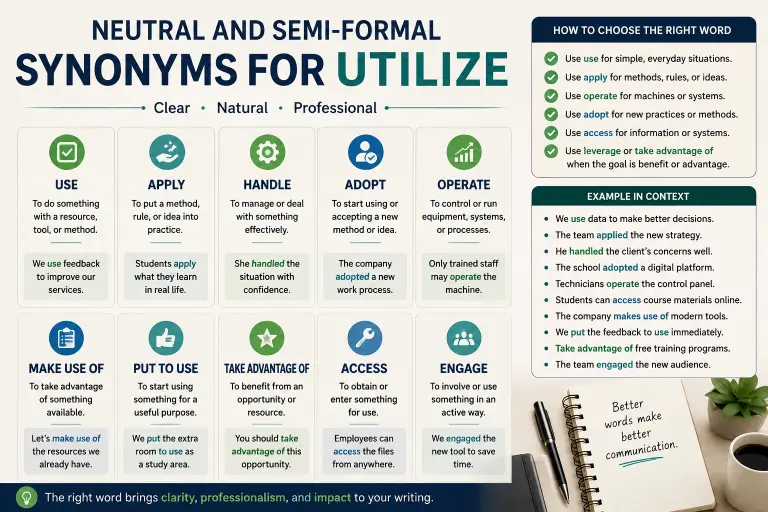
Use as the Best Neutral Synonym for Utilize
Meaning: To do something with an object, resource, method, or idea for a purpose.
Explanation: Use is the simplest and most versatile alternative to utilize. In many sentences, it is actually preferable because it is shorter and clearer.
Example: Please use the updated form when submitting your application.
Best Use: Almost any everyday, academic, or professional context.
Worst Use: Very few situations require avoiding it. Sometimes a more precise verb communicates the intended action better.
Tone: Neutral.
Make Use of as a Direct Alternative to Utilize
Meaning: To use something for a particular purpose.
Explanation: Make use of is close in meaning to utilize, but it can place slightly more emphasis on taking advantage of something available.
Example: We should make use of the resources already available to us.
Best Use: General writing and situations where you want to emphasize available resources.
Worst Use: Very concise instructions, where use is more efficient.
Tone: Neutral to moderately formal.
Put to Use as a Practical Alternative to Utilize
Meaning: To begin using something for a useful purpose.
Explanation: This phrase often emphasizes turning something that is available, unused, or newly created into something functional.
Example: The community put the empty building to use as a public library.
Best Use: Describing resources, spaces, skills, equipment, or ideas that become useful.
Worst Use: Sentences that simply require a basic verb.
Tone: Neutral and practical.
Operate as a Contextual Alternative to Utilize
Meaning: To control, run, or make a machine or system function.
Explanation: Operate is narrower than utilize. It focuses on actively controlling machinery, equipment, or systems.
Example: Only trained staff may operate the equipment.
Best Use: Machinery, software systems, vehicles, and technical equipment.
Worst Use: Ideas, general resources, or abstract concepts.
Tone: Neutral to professional.
Handle as a Contextual Alternative to Utilize
Meaning: To manage, control, or deal with something.
Explanation: Handle can sometimes replace use when the focus is on managing an object, material, task, or situation.
Example: Employees must learn how to handle the equipment safely.
Best Use: Equipment, materials, tasks, customer situations, and responsibilities.
Worst Use: When the intended meaning is simply applying a method or idea.
Tone: Neutral and practical.
Adopt as a Contextual Alternative to Utilize
Meaning: To begin using or accepting a method, system, practice, or approach.
Explanation: Adopt emphasizes choosing something and making it part of your normal practice.
Example: The school adopted a new digital learning platform.
Best Use: Policies, technologies, practices, methods, and approaches.
Worst Use: A one-time use of an object.
Tone: Neutral to formal.
Take Advantage of as a Contextual Alternative to Utilize
Meaning: To make beneficial use of an opportunity, resource, or situation.
Explanation: This phrase emphasizes benefit. It is not always a direct replacement for utilize.
Example: Employees should take advantage of the free training sessions.
Best Use: Opportunities, benefits, resources, and favorable conditions.
Worst Use: Situations where the phrase could suggest exploiting a person.
Tone: Neutral and conversational.
Consume as a Contextual Alternative to Utilize
Meaning: To use up a resource, product, material, or supply.
Explanation: Consume is much narrower than utilize. It indicates that something is depleted or used as part of a process.
Example: The machine consumes less electricity than the older model.
Best Use: Energy, food, fuel, materials, data, and other measurable resources.
Worst Use: Skills, strategies, or equipment that remain available after use.
Tone: Neutral and technical.
Access as a Contextual Alternative to Utilize
Meaning: To obtain or enter something so that it can be used.
Explanation: Access describes reaching or obtaining something, not necessarily using it.
Example: Employees can access the database from their office computers.
Best Use: Websites, files, databases, systems, information, and services.
Worst Use: When you actually mean applying or operating something.
Tone: Neutral and professional.
Engage as a Contextual Alternative to Utilize
Meaning: To involve, activate, or use something for a particular purpose.
Explanation: Engage can sometimes mean use, especially with mechanisms, services, or strategies, but it has several other meanings.
Example: Press the button to engage the safety mechanism.
Best Use: Mechanisms, services, processes, and certain strategies.
Worst Use: Basic sentences where use would be clearer.
Tone: Neutral to formal.
Informal and Casual Synonyms for Utilize
Use as the Casual Alternative to Utilize
In everyday speech, use is almost always the best choice. It is direct, familiar, and natural.
Example: Can I use your charger?
When it sounds natural: Conversations, texts, casual emails, instructions, and everyday writing.
When to avoid it: Rarely. Replace it only when a more specific verb communicates the action more accurately.
Tone: Casual to neutral.
Try as a Contextual Alternative to Utilize
Meaning: To use something experimentally or as an attempt to achieve a result.
Example: Try this tool if the first one doesn’t work.
When it sounds natural: Informal advice and situations involving experimentation.
When to avoid it: When the sentence requires certainty that something will be used.
Tone: Casual and encouraging.
Work With as a Casual Alternative to Utilize
Meaning: To use or interact with something while completing a task.
Example: I usually work with spreadsheets to organize the data.
When it sounds natural: Workplace conversations, technical discussions, and casual explanations.
When to avoid it: When use is more precise or when the object is simply being consumed.
Tone: Conversational.
Put to Work as a Casual Alternative to Utilize
Meaning: To make something actively useful.
Example: Let’s put these old computers to work in the training room.
When it sounds natural: Everyday speech and practical discussions.
When to avoid it: Highly formal documents where a more precise term may be preferable.
Tone: Conversational and energetic.
True Synonyms vs Contextual Alternatives for Utilize
Not every word that can replace utilize in one sentence is a true synonym. Understanding this distinction prevents awkward or inaccurate writing.
| Type | What It Means | Can It Replace the Original? |
|---|---|---|
| True synonym | Nearly the same meaning in the same context | Usually |
| Near synonym | Similar meaning with a slight difference | Sometimes |
| Contextual alternative | Works only in particular situations | Only in suitable contexts |
| Broader expression | Covers a wider meaning | Sometimes, but meaning may become less precise |
| Narrower expression | Describes a specific kind of use | Only when that specific meaning is intended |
For example, use is a true close alternative in most sentences. Leverage is more specialized because it suggests strategic benefit. Consume is narrower because it implies using up a resource. Implement is different because it means putting a plan or system into effect.
Business Writing: Synonyms for Utilize
Business writing often overuses utilize because it sounds formal. In many cases, use, employ, leverage, apply, implement, or adopt will be more precise.
Example:
Instead of: The company will utilize customer feedback.
Better: The company will use customer feedback.
More strategic: The company will leverage customer feedback to improve the product.
The best choice depends on the intended meaning. If feedback is simply being used, choose use. If it is being strategically turned into an advantage, leverage is more specific.
Corporate Communication: Synonyms for Utilize

Corporate communication benefits from clear verbs rather than unnecessarily complicated wording.
- Use for straightforward instructions.
- Employ for methods and approaches.
- Implement for policies and plans.
- Leverage for strategic advantages.
- Deploy for systems, technology, or resources.
- Adopt for new practices or processes.
Example: The department will implement the revised approval process next month.
Here, implement is stronger than utilize because the department isn’t merely using a process; it is putting a new process into operation.
Academic Writing: Synonyms for Utilize
Academic writing often benefits from precision. Useful alternatives include use, apply, employ, analyze, examine, implement, and adopt, depending on the sentence.
Example: Researchers applied the statistical model to the available data.
Here, apply is more precise than utilize because the researchers are using a model in a specific analytical context.
Avoid replacing every occurrence of use with utilize. Academic writing does not become stronger simply because a longer word is chosen.
Customer Service: Synonyms for Utilize
Customer service writing should usually favor plain language.
Instead of:
You may utilize the online portal to update your information.
Prefer:
You can use the online portal to update your information.
A customer usually benefits from the second version because it is shorter and immediately clear.
For more specific situations, alternatives such as access, follow, select, enter, submit, or apply may be even better.
Legal Writing: Synonyms for Utilize
Legal writing requires particular care because apparently similar words can carry different meanings. Use, exercise, employ, apply, administer, and implement may be appropriate depending on the legal context, but they should not be treated as interchangeable automatically.
For example, exercise a right is a conventional phrase. Replacing it with use a right may be understandable, but it can sound less precise in formal legal drafting.
When wording has contractual or legal consequences, the original terminology should be checked against the governing document and applicable legal requirements rather than changed simply for stylistic variety.
Email Communication: Synonyms for Utilize
Professional emails usually sound better when they use direct verbs.
- Use use for simple instructions.
- Use apply for rules or methods.
- Use employ for formal professional language.
- Use implement for plans and policies.
- Use access for systems and information.
- Use leverage for strategic business advantages.
A useful rule is simple: if use says exactly what you mean, there’s usually no need to replace it.
Email Examples Using Synonyms for Utilize
Client Email Using Use
Subject: Updated Project Documents
Hi Jordan,
Please use the attached project brief when reviewing the latest requirements. I’ve included the revised timeline on page three.
If anything is unclear, please let me know.
Best,
Alex
Project Update Using Implement
Subject: Updated Review Process
Hi Team,
We’ll implement the revised review process beginning Monday. The main change is that final approvals will now be completed before the files are sent to production.
Please review the attached guide before the next project meeting.
Thanks,
Morgan
Business Strategy Email Using Leverage
Subject: Customer Feedback for the Next Release
Hi Priya,
We can leverage the feedback from last month’s survey to prioritize the next group of product improvements. I’ve summarized the most common requests in the attached document.
Let’s discuss the priorities during Thursday’s meeting.
Best,
Daniel
Academic Email Using Apply
Subject: Question About the Research Method
Dear Professor Lee,
I’m reviewing the research methods for my assignment and would like to confirm whether I should apply the model discussed in last week’s lecture to the second data set.
Thank you for your guidance.
Best regards,
Sam
Vendor Email Using Deploy
Subject: Software Deployment Schedule
Hello Chris,
Our IT team plans to deploy the updated software on Friday evening. We expect the system to be unavailable for approximately 30 minutes during the installation.
Please confirm that your team is available if any technical issues arise.
Regards,
Taylor
Short Dialogues Using Synonyms for Utilize
Workplace
Person A: How should we use the new reporting tool?
Person B: Start with the monthly dashboard. It automatically pulls the latest figures.
Classroom
Person A: Can I use this formula for the assignment?
Person B: Yes, but make sure you apply it to the correct data set.
Customer Service
Person A: How do I get into my account?
Person B: You can access it through the customer portal using your registered email.
Casual Conversation
Person A: What are you doing with that old desk?
Person B: I’m going to put it to work in the garage.
Professional Discussion
Person A: Should we use the survey results in the presentation?
Person B: Yes. We can leverage them to support the recommendation.
How to Replace “Utilize” in a Sentence
Example 1: Simple Everyday Use
Original: Please utilize this form to submit your request.
Alternative: Please use this form to submit your request.
Why it works: Use is shorter, clearer, and more natural without changing the meaning.
Example 2: Academic Context
Original: Students should utilize the theoretical framework.
Alternative: Students should apply the theoretical framework.
Why it works: Apply specifically suggests putting a theory or framework into practice.
Example 3: Business Strategy
Original: The company utilized its customer data.
Alternative: The company leveraged its customer data.
Why it works: Leverage adds the idea of gaining strategic value from the data.
Example 4: Technology
Original: The team utilized the new software across its offices.
Alternative: The team deployed the new software across its offices.
Why it works: Deploy indicates that the software was installed and put into active service.
Example 5: Policy
Original: The organization utilized a new safety policy.
Alternative: The organization implemented a new safety policy.
Why it works: Implement means putting the policy into effect.
Example 6: Equipment
Original: Only trained employees should utilize the machine.
Alternative: Only trained employees should operate the machine.
Why it works: Operate is more precise when someone is controlling machinery.
Example 7: Energy
Original: The building utilizes a large amount of electricity.
Alternative: The building consumes a large amount of electricity.
Why it works: Consumes emphasizes that the electricity is being used up.
Example 8: Opportunity
Original: Employees should utilize the training program.
Alternative: Employees should take advantage of the training program.
Why it works: The alternative emphasizes benefiting from an available opportunity.
Example 9: Existing Resources
Original: We should utilize the materials already available.
Alternative: We should make use of the materials already available.
Why it works: Make use of retains the meaning while emphasizing the practical value of available resources.
Example 10: Rights
Original: Citizens may utilize their legal rights.
Alternative: Citizens may exercise their legal rights.
Why it works: Exercise is the conventional formal expression for actively using a right or authority.
Comparison Table: Synonyms for Utilize
| Phrase | Tone | Meaning / Scope | Best Use | Example |
| Use | Neutral | General use | Almost any context | Use the available tools. |
| Employ | Formal | Use for a purpose | Academic or professional writing | Researchers employed a new method. |
| Apply | Formal/neutral | Put a method or idea into practice | Education and technical writing | Apply the formula carefully. |
| Leverage | Professional | Use strategically for advantage | Business | Leverage existing data. |
| Harness | Formal | Direct useful power or potential | Science and technology | Harness renewable energy. |
| Deploy | Technical | Put into active service | Technology and operations | Deploy the software. |
| Implement | Formal | Put a plan or policy into effect | Business and government | Implement the new policy. |
| Exploit | Technical/formal | Make effective use of potential | Computing and science | Exploit available capacity. |
| Operate | Neutral | Control or run | Machines and systems | Operate the equipment. |
| Adopt | Neutral/formal | Begin using as a practice | Policies and methods | Adopt a new approach. |
| Consume | Neutral | Use up a resource | Energy and materials | Consume less fuel. |
| Exercise | Formal | Use a right, power, or judgment | Legal/professional | Exercise caution. |
| Access | Neutral | Reach something for use | Digital systems | Access the database. |
| Put to use | Neutral | Make something useful | Resources and objects | Put the space to use. |
Which Synonym for Utilize Should You Choose?
Best Synonym for Utilize in Formal Writing
Choose employ, apply, implement, or exercise, depending on what follows the verb.
For example, employ a method and exercise caution are natural formal combinations.
Best Synonym for Utilize in Business Communication
Choose use for straightforward statements and leverage when you genuinely mean to gain strategic value.
Best Synonym for Utilize in Academic Writing
Choose apply for theories, methods, principles, and models. Choose employ when describing the deliberate use of a method or technique.
Best Synonym for Utilize in Legal Writing
Choose a conventional phrase that precisely matches the legal concept, such as exercise a right or apply a rule. Avoid changing legal wording simply to avoid repetition.
Best Synonym for Utilize in Professional Email
Usually choose use. If you need greater precision, choose access, apply, implement, or deploy based on the actual action.
Best Synonym for Utilize in Everyday Conversation
Choose use. It is natural, familiar, and rarely misunderstood.
Best Synonym for Utilize in Casual Messages
Again, use is usually the strongest choice. Phrases such as try, work with, or put to work may work when they communicate a more specific idea.
Grammar and Usage Guide for Utilize
Utilize as a Transitive Verb
Utilize normally takes a direct object.
Correct: The team utilized the available data.
Less natural: The team utilized.
The reader generally needs to know what was used.
Utilize + Object + for + Purpose
A common structure is:
utilize + something + for + purpose
Example: The laboratory utilizes the equipment for testing materials.
Utilize + Object + to + Verb
Another common structure is:
utilize + something + to + verb
Example: The company utilizes software to track inventory.
Use Versus Utilize
Utilize and use can often appear in the same grammatical position.
Use: We use the system to manage orders.
Utilize: We utilize the system to manage orders.
The grammar is acceptable in both sentences, but use is usually more concise.
Utilize or Utilise?
Utilize is the standard spelling in American English. Utilise is commonly used in British English and some other varieties of English.
Since this article follows American English, utilize is the preferred spelling here.
Common Collocations with Utilize
Some combinations occur naturally, although many can be improved by choosing a more specific verb.
- Utilize resources
- Utilize technology
- Utilize data
- Utilize equipment
- Utilize a method
- Utilize a system
- Utilize available space
- Utilize existing tools
- Utilize information
- Utilize software
However, consider whether a more precise verb would be better:
- Apply a method
- Deploy software
- Operate equipment
- Consume resources
- Access information
- Implement a system
Common Mistakes with Synonyms for Utilize
Treating Every Alternative as an Exact Synonym
Deploy, consume, implement, and access have specific meanings. They cannot replace utilize in every sentence.
Using Leverage Everywhere
Leverage is useful when strategic advantage is involved. Using it for every instance of use can make writing sound like corporate jargon.
Making Simple Writing Too Formal
A sentence such as “Please utilize the restroom” sounds unnecessarily stiff in ordinary communication. “Please use the restroom” is more natural.
Using Implement for General Use
You don’t normally implement a pen. You use it. Implement is appropriate for putting a plan, policy, or system into effect.
Using Consume for Reusable Items
A reusable tool can be used without being consumed. Consume suggests that the resource is depleted.
Using Exploit Without Considering Its Tone
Exploit can imply unfair treatment when people are involved. Always check the context before choosing it.
Confusing Access With Use
Accessing a file means reaching or opening it. It does not necessarily mean doing something with the information inside it.
Choosing a Longer Word Just to Sound Professional
Longer does not automatically mean better. Clear writing usually wins over unnecessarily formal wording.
When Not to Use Utilize
When Use Is Clearer
If your sentence simply means “use,” the shorter word is usually preferable.
Better: Use the blue button to continue.
When the Audience Is General
Public instructions should prioritize clarity. Use is more familiar than utilize.
When a More Precise Verb Exists
If you mean implement, deploy, consume, or operate, use that specific verb.
When the Sentence Sounds Artificial
Read the sentence aloud. If utilize makes an ordinary statement sound stiff, replace it with use.
When You Are Writing Concisely
Instructions, interfaces, signs, and short messages benefit from economical wording.
When You Mean Something More Specific
Do not use utilize as a vague substitute when the actual action matters. For example, access the database tells the reader more than utilize the database.
When Utilize Is Actually the Better Choice
Utilize can be useful when you intentionally want a formal tone or when the idea involves making practical or effective use of a particular resource.
For example:
The study examines how hospitals utilize limited resources.
Here, utilize fits the formal analytical tone, although use would also be grammatically correct.
Advanced Writer Tips for Choosing Synonyms for Utilize
Tone Control with Utilize
For a more conversational tone, use use.
For a professional tone, consider employ.
When aiming for a strategic tone, use leverage when appropriate.
For a technical tone, choose deploy, operate, or implement when their specific meanings fit.
Professional Email Etiquette with Utilize
Professional does not mean complicated. A polished email can be direct:
Please use the attached template.
That sentence is often better than:
Please utilize the attached template.
The first version is shorter without losing professionalism.
Politeness and Utilize
Changing utilize to use usually does not make a request less polite. Politeness comes more from wording, tone, and context.
Please use the attached form.
Could you please use the attached form when submitting your request?
The second sentence is more polite because of the request structure, not because it uses a more formal synonym.
Context Alignment with Utilize
Ask yourself three questions:
- What exactly is being used?
- What is the person doing with it?
- Who will read the sentence?
The answers often reveal the best verb.
Precision When Replacing Utilize
Instead of asking, “What fancy word can replace utilize?” ask, “What exactly is happening?”
When installing software, use deploy.
If a policy is being put into effect, use implement.
If a method is being put into practice, use apply.
When controlling a machine, use operate.
If a resource is being used up, use consume.
If something is being used strategically, consider leverage.
Readability and Utilize
Clear writing often improves when you replace unnecessary formal verbs with familiar ones.
Less direct: The department will utilize the available information.
Clearer: The department will use the available information.
More precise: The department will analyze the available information.
The third sentence may be strongest if analyze describes the actual action.
Related Questions About Synonyms for Utilize
What is another way to say utilize?
The simplest alternative is use. Depending on context, you can also choose employ, apply, leverage, harness, deploy, implement, operate, or make use of. The right choice depends on what is being used and what action is actually taking place.
What is a professional alternative to utilize?
Employ is a strong professional alternative, while apply, implement, leverage, and deploy can be better when they describe a more specific action. In many professional sentences, however, plain use is still the clearest choice.
What is a formal alternative to utilize?
Employ is one of the closest formal alternatives. Other options include apply, exercise, leverage, harness, and deploy, but each carries a slightly different meaning. The best formal word depends on the noun that follows it.
What can I use instead of utilize in an email?
In most emails, simply use use. For greater precision, choose apply for methods, access for systems or information, implement for plans, and deploy for technology. Direct wording usually makes professional emails easier to read.
Is utilize a formal word?
Yes. Utilize is generally more formal than use. It is common in professional, academic, technical, and administrative writing, although it is not always the best choice. If the sentence only means “use,” the shorter word often reads better.
Can I use employ instead of utilize?
Often, yes. Employ is a close synonym when you mean deliberately using a method, tool, resource, or technique. However, it does not work in every sentence, and it can sound more formal than use.
What is the difference between utilize and use?
Use is the broad, everyday verb for making something serve a purpose. Utilize is a more formal alternative and can sometimes emphasize practical or effective use. In ordinary sentences, they often have the same basic meaning, but use is usually simpler.
FAQs About Synonyms for Utilize
Is “use” better than “utilize”?
Usually, yes, when both words express exactly the same idea. Use is shorter, clearer, and more natural in most everyday and professional writing. However, utilize can fit formal or technical prose when a more formal register is appropriate.
Is “employ” a synonym for “utilize”?
Yes, in many contexts. Employ means to use something for a specific purpose and is especially common with methods, techniques, tools, and strategies. It is more formal than use, so it may sound too stiff in casual conversation.
Is “leverage” the same as “utilize”?
Not exactly. Leverage suggests using something strategically to gain an advantage or achieve greater value. It can replace utilize when that strategic meaning is intended, but it should not be used as a universal substitute for use.
Is “implement” a synonym for “utilize”?
Only in specific contexts. Implement means to put a plan, policy, system, or decision into effect. It does not simply mean to use something. Saying that someone “implemented a pen,” for example, would be incorrect.
Is “apply” a good replacement for “utilize”?
Yes, when the object is a method, principle, theory, skill, rule, or technique. Apply emphasizes putting something into practice. It is especially useful in academic, educational, scientific, and professional writing.
Can “deploy” replace “utilize”?
Sometimes. Deploy is appropriate when something such as software, equipment, personnel, or resources is deliberately put into active service. It is more specific than utilize and is especially common in technology and operations.
Should I avoid the word “utilize”?
You do not need to avoid it completely. The word is grammatically correct and useful in suitable contexts. The main issue is unnecessary formality. If use communicates the same idea more clearly, choosing use is usually the stronger writing decision.
Key Takeaways
- Use is the closest and most natural everyday synonym for utilize.
- Employ, apply, leverage, deploy, and implement have more specific or formal meanings.
- Do not treat contextual alternatives such as consume or access as interchangeable with utilize.
- Choose the replacement based on the action, audience, tone, and purpose of the sentence.
- Clear writing is not about choosing the longest word; it is about choosing the most accurate one.
Conclusion:
The best synonym for utilize is often the simplest one: use. It is clear, flexible, and suitable for almost any audience. Still, other alternatives can add useful precision. Choose employ for formal use of a method or tool, apply for putting knowledge or principles into practice, leverage for strategic advantage, deploy for putting technology or resources into service, and implement for putting plans or policies into effect.
Words such as consume, access, operate, harness, and exercise can also work when their narrower meanings match the sentence. The key is not to replace utilize mechanically. First identify what the sentence actually means, then select the verb that communicates that action most naturally. Good word choice makes writing clearer, more precise, and easier to trust.
